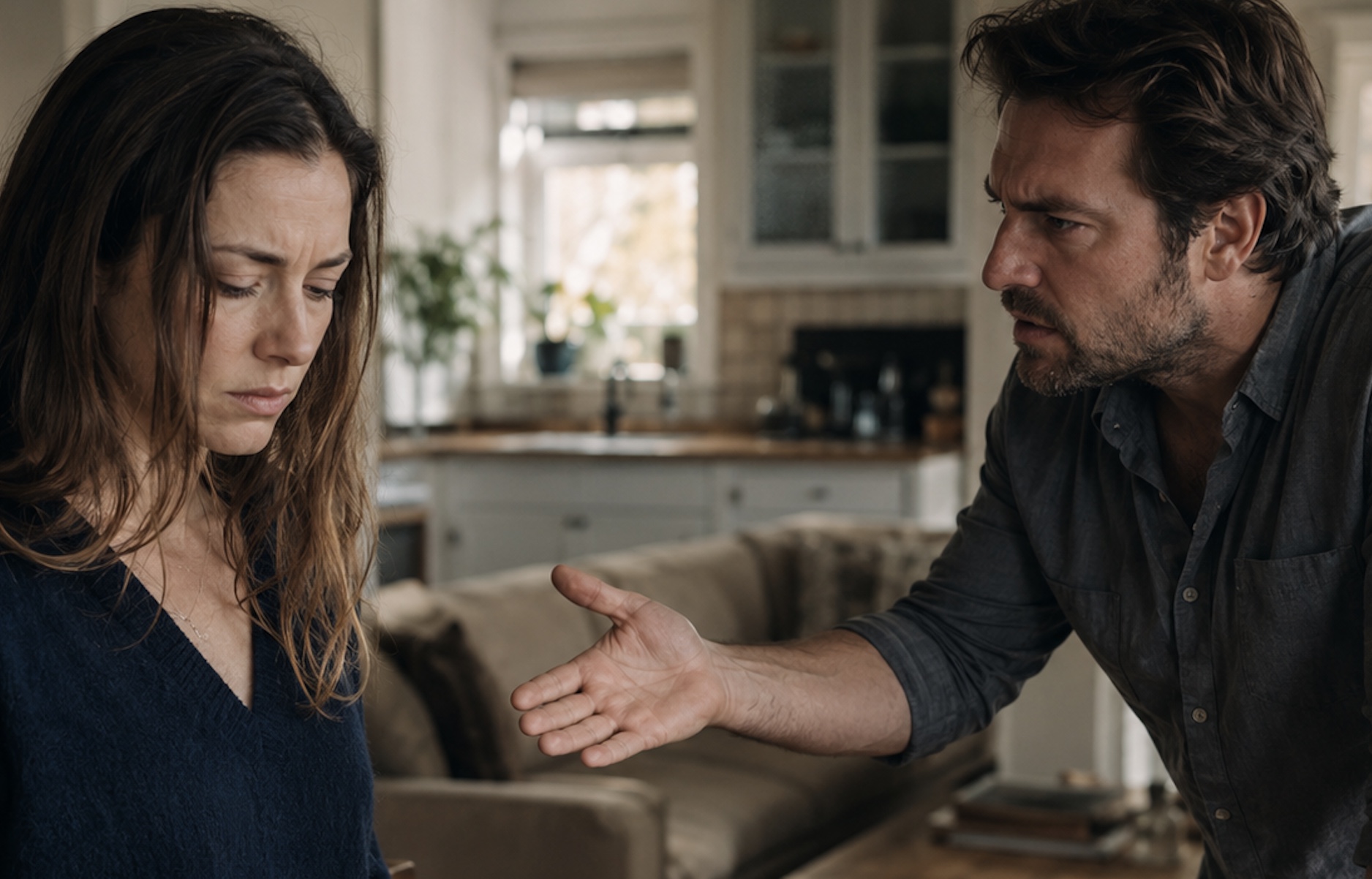
They met in March, during that strange in-between season when winter has already begun to surrender, but spring still has not fully decided to arrive. At the time, Oksana worked in a small architectural bureau and walked the same route every day: past the flower kiosk, past the bakery with fogged-up windows, past the corner coffee shop that always smelled of freshly roasted beans.
Ilya worked nearby, in a design company that occupied the second floor of the same building. They met by chance, the way people meet when they happen to be near each other often enough: first they simply nodded to each other by the elevator, then exchanged a few words about the elevator being broken again, and then, somehow naturally, they ended up going for coffee together.
Oksana did not make anything of it. Just a pleasant man. Just coffee. Just a conversation.
But the conversations continued. At first rarely, then more and more often. Ilya knew how to listen — not the way many people do, looking into your eyes while already thinking about something else, but truly, with genuine interest, without rushing. He noticed that she ordered cappuccino without sugar. He remembered things she had said a week earlier. He asked questions not out of politeness, but out of real curiosity.
Oksana valued that. She valued his quietness, the absence of that demonstrative masculinity that had always tired her. With him, it was easy to be silent — and that, as she had long ago decided for herself, was rare and a sure sign of something important.
Six months later, he moved in with her. They did not discuss it solemnly or make grand plans. It simply turned out one day that his clothes took up half of her wardrobe, his charger stood beside her nightstand, and the coffee machine he had brought one morning had permanently settled on her kitchen counter. And neither of them was bothered by it.
A year later, they got married — quietly, on a weekday, with two witnesses and dinner in a small restaurant. Oksana was thirty-two then. She was not in a hurry and did not celebrate excessively. They simply continued living, and that in itself felt good.
The first years passed evenly. Not perfectly — perfection always alarms with its fragility — but genuinely well. They knew how to agree without either of them being pushed aside. They knew how to give in without resentment. They knew how to give each other space without turning it into drama.
Oksana worked a lot, and so did Ilya. On weekends they sometimes drove out of town, and sometimes simply stayed home and read in separate rooms, knowing the other was nearby — and that was enough. They did not need to fill every silence. That mattered. That was what she loved most about him.
There was one evening — probably in their fourth year together — that Oksana remembered separately from everything else. They had argued about something completely trivial: whether to spend New Year’s holidays with his parents or stay at home. The argument was foolish and quickly grew heated — not because of the question itself, but because both of them were tired.
Ilya raised his voice. Oksana answered more sharply than she had intended. Then they both fell silent, went into different rooms, and the apartment filled with that heavy silence in which every step can be heard.
But an hour later, he came into her room carrying two mugs of tea. He placed one on her desk and said:
“I’m sorry.”
He did not explain. He did not justify himself. Just that word, and a mug of hot tea.
Oksana looked at him, then at the tea, and something inside her loosened a little.
“So am I,” she said.
The next day, they decided to stay home. They welcomed the New Year together, with a bottle of champagne and an old movie they had both seen before, but somehow always enjoyed watching again.
Those were the things she remembered. Not grand events, not holidays, but those small, almost invisible moments from which real closeness is made. A mug of tea placed quietly. A word spoken without explanation. The ability to come back.
Then that ability disappeared from him somehow. Or perhaps he simply stopped using it — she never quite understood.
And then something began to change.
Not suddenly, not because of one single event — it never happens like that. It was a slow, almost imperceptible shift, like the light in a room changing when a cloud covers the sun. Everything seems the same, but it is not. A little colder. A little more distant.
Ilya began speaking in shorter phrases. Where there had once been a conversation, now there was only an answer — precise, correct, sufficient, but with no continuation. He stopped talking about work. He stopped sharing those little stories that, in truth, make up a life together — not big events, but the small details that make you feel you are living beside a person, not merely in the same apartment.
Oksana noticed it, but she did not pull words out of him. She knew how to wait. She knew how to give a person time without filling the silence with anxiety and questions.
In the evenings, he began disappearing into his phone — not demonstratively, but quietly, as if something there held him. She did not ask what. He went to bed earlier. Woke up earlier. It was as though a separate rhythm had appeared inside their shared time — the same hours, the same rooms, but already slightly aside from her.
Sometimes at dinner she caught his gaze — distant, aimed somewhere past her — and understood that he was not really there. In his mind, he had already been somewhere else for a long time.
Oksana watched all of this. Not with suspicion, but with the kind of understanding that comes with age and experience. She had lived long enough to know that when a person withdraws into himself like that — methodically, without scandal, without sharp edges, without any visible reason — it is not fatigue and not a temporary mood. It is a decision already made. Quietly, inside, without announcement. He simply had not yet found the moment to say it aloud.
She did not rush him. She did not stage heavy conversations in raised voices, did not ask questions that usually make people retreat even further. She simply lived beside him, waited, and drew her own conclusions.
Sometimes in the evening, when he was already asleep, she sat in the kitchen with tea and thought about what she felt. She tried to find fear in herself — and could not. She tried to find anger — but there was none of that either. There was only something quiet, something like exhaustion from waiting for the inevitable.
Like before a storm that you hear somewhere in the distance and know will come, though you do not know exactly when.
It would be better if it came already.
There was another moment — about two months before that ordinary evening — when Oksana tried to speak to him directly. Not accusing him, not demanding explanations, she simply asked:
“Is something going on? Are you all right?”
Ilya answered:
“Everything’s fine. I’m just tired from work.”
She looked at him and waited a little, in case he added something else. Then she understood that he would not. His answer closed the door. It was the kind of answer people give not to explain, but to make sure the question is not asked again.
Oksana nodded and went into the kitchen. She put the kettle on. She watched the water begin to heat and thought: when a person says everything is fine in that voice, it is not an answer. It is a signal.
She accepted it.
She did not ask again.
Sometimes it seemed to her that she was too good at keeping distance. That where other women might have made scenes, demanded explanations, cried, and through that perhaps held someone back, she remained silent, observed, and waited. And maybe that silence was exactly what allowed him to leave so slowly and so quietly that he himself did not notice when he had gone completely.
She thought about that. But not with regret — with curiosity. A strange curiosity about herself, the kind that appears when you stop being afraid of what you see.
The storm arrived on a Wednesday.
Ilya came home earlier than usual — almost an hour early. Oksana was in the kitchen, cooking something simple, listening to the radio at low volume. She heard him come in, heard him take off his jacket, heard him stop in the hallway for a few seconds — too long for simply changing shoes.
Then he entered the kitchen.
She turned around. Looked at him — one glance, one second — and understood immediately. Not from his expression, not from any specific detail. Simply from the way he stood. Too straight. Too collected. That is how people stand when they have been preparing for a conversation for a long time and are afraid they will lose the words if they delay even a second longer.
She lowered the heat under the pan and turned fully toward him.
“I filed for divorce,” he said.
There was no introduction. No preface. Just directly, like that. Oksana had once read that the most important words are almost always spoken that way — without preparation, because with preparation they can still be stopped, but without it, they are already out.
Oksana did not answer right away.
She looked at him for a little longer than people usually look during a normal conversation. She looked and tried to fit what she had heard to what she saw in front of her: a little pale, holding her gaze but with effort, hands tucked into his pockets. He had prepared. Rehearsed, probably. Maybe more than once. Maybe several evenings in a row, standing in front of the bathroom mirror and saying it aloud until the intonation became firm enough.
“You’re not twenty anymore,” he added, and something appeared in his voice that sounded like harshness, though not real harshness. More like something learned. Prepared in advance. “It’s time to accept it.”
That phrase was unnecessary.
Oksana felt it immediately — not as an insult, but as a cold, almost professional observation. He was waiting for a reaction. He had counted on it. The phrase about her age was not an argument and not even cruelty. It was a hook he wanted to catch her on. So there would be tears, or shouting, or at least confusion — something that would allow him to feel right. Or at least not the only one responsible for what was happening in that room.
She did not take the bait.
Oksana remained silent for a few more seconds. Then she calmly walked past him — not demonstratively, not with offended dignity, but simply passed him the way one passes a piece of furniture — picked up her phone from the table, looked at the screen, and placed it back.
She did not need the phone. She had taken it only because her hands were looking for something familiar. An anchor.
The room became quiet.
He stood there and waited. Oksana could almost physically feel that waiting — tense, compressed, prepared for anything except silence. Silence is the one thing people prepare for least when they prepare for a difficult conversation.
“Listen,” he began at last, and the rehearsed firmness had already vanished from his voice. It had peeled away like damp plaster. “I understand this is unexpected. But we both see that over the past six months between us…”
“Speak,” she said evenly.
She was not interrupting. She was simply letting him know that she was listening.
So he spoke.
For a long time — the way people speak when no one stops them and they themselves do not know where to place the final period. About how they had become strangers. About how he felt they were in a dead end and he could not see a way out. About how it was better now than in a few more years, when it would only be worse. About how he did not want to hurt her, but could not do otherwise.
The words were correct. Polished. Some of them she herself had thought during those late evenings in the kitchen, sitting with cooling tea and listening to the silence beyond the wall.
Oksana listened without interrupting. She did not ask a single question. Did not ask him to clarify. Did not demand names or reasons, the kind people usually demand in such conversations so they have something specific to be angry at.
She simply listened — attentively, with a closed face, the way one listens to something important that can no longer be changed.
She let him speak to the end.
When he fell silent, she gave a short nod.
Not as agreement. Not as reconciliation. Simply as acknowledgment.
I hear you. I understand. The conversation has happened.
Ilya looked at her and seemed not to know what to do next. The entire script he had built in his head — perhaps for weeks — had clearly assumed a different continuation. Tears, accusations, or a long, heavy conversation after which people come out emptied, but at least with the feeling that everything important has been said.
But she stood by the window and looked somewhere past him — not defiantly, not demonstratively, simply toward the place where the evening sky was already darkening behind the glass.
“Don’t you want to say anything?” he asked.
There was almost confusion in his voice.
“You said everything,” she replied. “I heard you.”
He was silent for a moment. Then he went into the bedroom.
Oksana heard the wardrobe open, heard things being moved around, heard a bag being placed on the floor. The sounds were familiar — the sounds of packing. She had heard them before, when he left on business trips. But now they sounded different. More final.
A few minutes later, he came out with a small dark-blue bag — the same worn one he always used for work trips. Oksana knew that bag well. It was strange to see it now, in this context, in this silence.
“I’ll pick up the rest later,” he said.
“All right,” she answered.
He stood by the door for a few more seconds. Looked at her, as if waiting for something she was supposed to add. A final word that would either stop him or release him completely.
Oksana added nothing.
She simply stood there — straight, calm, like a person who had accepted something inside herself before it was ever announced aloud.
The door closed.
It did not slam. It simply closed — carefully, almost quietly, as if even while leaving he did not want to disturb anything.
Oksana stood still for another minute. She looked at the door. Then, slowly, very slowly, she exhaled.
Not from pain. Pain, if it was there, lay somewhere deep, and she would still have to reach it through several layers. This breath was different. It came from the final understanding that everything had already happened. That the conversation she had been waiting for over months had taken place and ended. That now something else was beginning — still nameless, still without shape, but already beginning right now, in this room, in this silence.
She returned to the kitchen. The pan still held warmth. Oksana turned off the stove, poured herself water, and drank a glass slowly while standing by the sink. Then she went back to the window and looked out at the street.
Below, people were walking — going about their own business, into their own evenings. Someone with grocery bags, someone with a dog, someone simply walking without hurry. Life outside continued with complete indifference to what had just happened in this apartment.
Oksana was not angry at that indifference.
It was honest.
She thought about the fact that she had work she loved. She had friends with whom she could speak honestly, without pretending everything was fine. She had this apartment — which they had rented together, but which had always felt like hers, in the placement of things, in the smell, in the habits.
She had tomorrow morning, which would come no matter what had happened this evening.
She had herself.
Thirty-seven years old. Not twenty — that was true. But also not someone who needed to accept what other people’s words tried to impose on her.
He had miscalculated with that phrase about age. Not because it was cruel; cruel words are often spoken from confusion, and Oksana understood that. He had miscalculated because he had chosen the wrong person for it.
That phrase had been written for someone else. For someone who clings to a relationship out of fear of being alone. For someone who hears age mentioned and feels the ground disappear beneath her feet. For someone who becomes afraid there will never be another chance.
Oksana was not that kind of person.
She had known it for a long time. She simply had not always had the moment to prove it to herself completely.
Now she had.
Oksana walked to the wardrobe and opened the door. His things — several shirts, a sweater, a book he had never finished — still hung and lay in their places. She looked at them without hurry. Then she closed the door.
She could sort it out tomorrow. Or the day after tomorrow.
It was not going anywhere.
The apartment was quiet — quieter than it had been in a long time. At first Oksana did not understand why the silence felt different now. Then she did.
Before, there had always been tension in that silence. Waiting. Unspoken words that occupied space even when no one said anything. But now the silence was simply silence.
Weightless.
Without hidden meaning.
She did not know whether that was good or bad. Probably both at once. That is how life is arranged — rarely is anything only one thing.
She thought about how strangely memory works. Now, standing by the window in the quiet of the emptied apartment, she did not remember the arguments or those final cold months when they had lived side by side, but already apart.
She remembered the corner coffee shop where they had truly talked for the first time. How he had said something funny, and she had laughed, and he had looked at her as though that laughter meant something important to him.
She remembered their trip to the sea — the only one in all those years — when they missed the bus and ended up sitting for two hours at a small station, eating dry cookies from a vending machine and inventing stories about the people who passed by.
It had been good then.
Back then, he knew how to be near her — truly near, not merely present in the same space.
She did not cling to those memories. She simply allowed them to exist, to pass through her like light through glass. That, too, was part of what had happened. Not only tonight, not only his words in the kitchen, but everything together: the good, and the way it had gradually disappeared.
All of it now became the past.
Whole.
Finished.
With its own beginning and its own end.
She picked up her phone and wrote to her friend — briefly, without details:
Call me when you have time.
Not today. Just so there would be someone she could talk to tomorrow, when she herself understood what exactly she wanted to say.
Then she turned off the kitchen light.
She went into the room and stopped by the window. The city glowed below — familiar, uneventful. Yellow windows, moving cars, streetlights along the road. Oksana looked at all of it and thought:
Here it is.
The moment people usually call the end.
But an end is always something else at the same time. A boundary. A new starting point. The place where the next part begins.
She did not know what would happen next. She did not know how soon that quiet inner tension, the one that remains in the body after such conversations, would leave. She did not know when the real pain would come — because it would come, Oksana understood that well. That is how people are made: first calm, and then, when the protective shell begins to peel away, everything else arrives all at once.
But that would be later.
Not now.
Now there was silence.
Clean, like air after rain.
Without his footsteps in the next room. Without the quiet phone conversations he ended whenever she entered. Without that long, exhausting waiting — when will he finally say what had clearly been decided long ago?
He had said it.
She had heard it.
Everything else was already hers.
At work, she did not tell anyone about it — at least not at first. She came in every morning, sat down at her desk, opened her drawings, and continued doing what she had always done. Her colleagues noticed nothing — or pretended not to notice, which was also a kind of respect.
Architecture requires attention. When you are focused on lines, proportions, on the way space works with a person, everything else recedes. Oksana had always loved that quality of her work: it took you in completely, leaving no room for what was unnecessary.
Evenings were harder.
The apartment heard itself differently now — every step, every sound was a little louder than it needed to be. Oksana grew used to it gradually, day by day, the way people get used to a new route.
She rearranged a few things. Bought a new desk lamp — warm-colored, the one she had wanted for a long time but kept postponing. Small changes that meant: this is only my space now.
And there was nothing bad in that.
Several weeks passed.
Lena called the day after that evening, and they talked for almost two hours — not only about what had happened, but about everything that had accumulated. Oksana realized she had not spoken that long and that freely in a very long time. Without background anxiety. Without feeling that she needed to weigh something before saying it.
Ilya wrote a week later — businesslike, about his things. They agreed on a time. He came when she was not home; it was easier for both of them that way.
When she returned, his book had disappeared from the nightstand.
So had the coffee machine.
Oksana placed a small potted plant in its spot. She had wanted one for a long time, but there had been no space.
Now there was.
She did not think about age. Not then, not later.
Thirty-seven is not an ending and not a deadline. It is simply an age at which a person already knows herself well enough not to accept other people’s definitions of her life.
She knew herself.
That was enough.