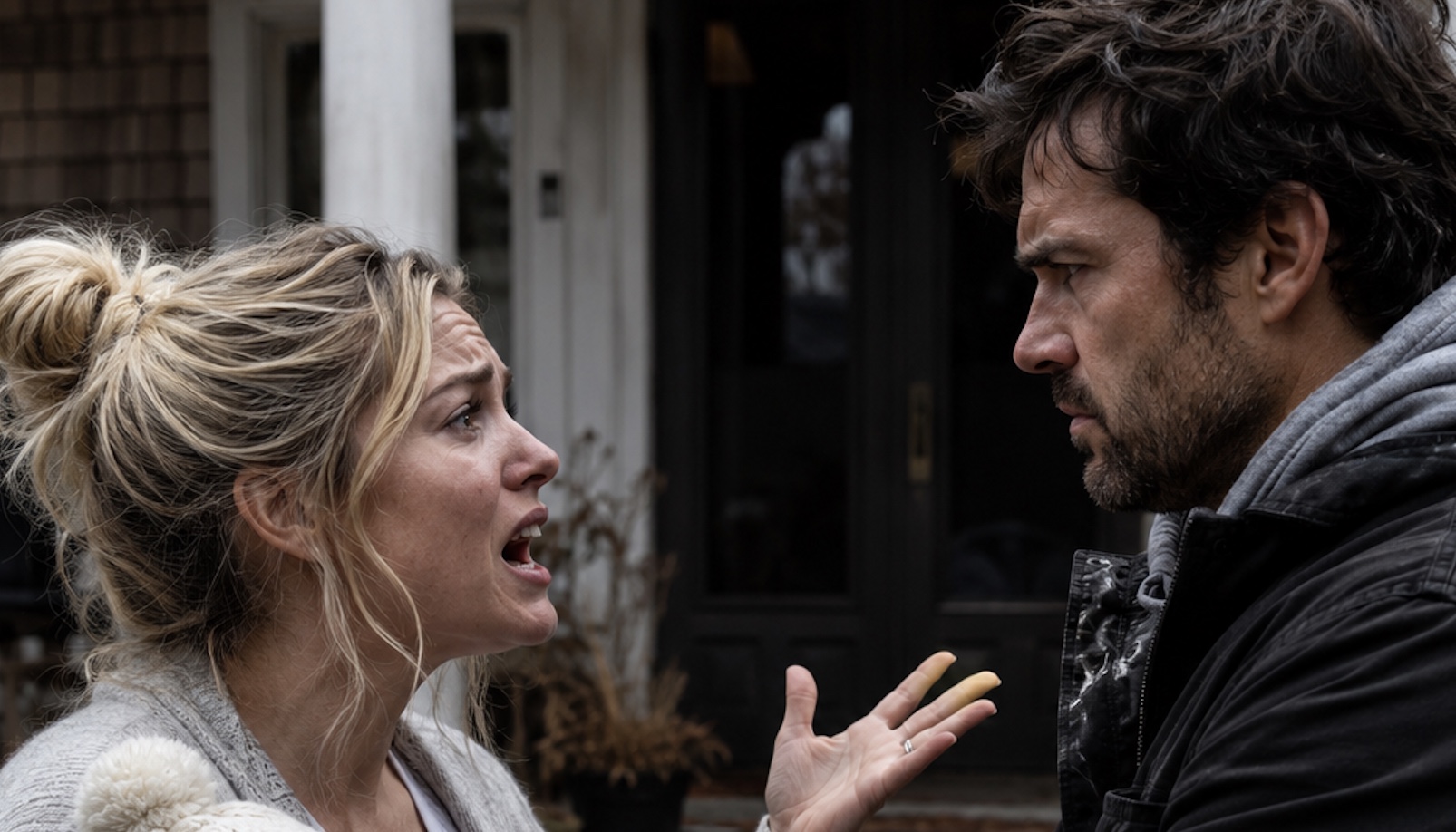
“Everyone, welcome the hero father!” Anton announced, his voice deliberately cheerful and far too loud for the narrow hallway, where the air smelled of baby powder and the new rubber wheels of the stroller. “I come bearing gifts, so come on, let’s celebrate!”
He burst noisily into the apartment, nearly catching his shopping bags on the doorframe. In one hand, a bundle of colorful helium balloons dangled, already slightly deflated and bumping sadly against the ceiling. In the other, he carried a plastic cake box from the nearest supermarket. Anton kicked off his shoes without looking where they landed, sending one of them skidding toward the shoe rack.
He expected his wife to rush out of the room any second now, tearful with happiness, a baby bundle in her arms. He expected the sort of sweet family scene they show in mayonnaise commercials.
But the apartment was quiet.
Not simply quiet — thick, stuffy, padded with exhaustion. From the kitchen came only the dull hum of the refrigerator and the faint clink of a spoon against a cup.
Anton walked into the kitchen, his jacket rustling. Ksenia was sitting at the table. She had not even changed into home clothes. She was still wearing the loose dress she had come home from the maternity hospital in, except now it hung on her like a sack. Her hair, which she had apparently tried to arrange that morning, had collapsed into a messy bun. In front of her stood a mug of tea gone cold, a thin film floating on the surface.
“So why are we just sitting here?” Anton’s smile faltered, but he tried to keep it in place. “Where are the trumpets? Where’s my son? I thought you’d already set the table. It’s a big day, after all. I bought cake — Prague cake, your favorite. And balloons. Look how bright they are.”
He dropped the plastic box onto the empty table.
Ksenia slowly lifted her eyes to him. Her gaze was dry and sharp, as if she were not looking at her husband, but at some irritating salesman who had barged into the house uninvited.
“The baby is sleeping,” she said flatly, without the slightest trace of emotion. “Don’t shout. If you wake him, you’ll be the one rocking him back to sleep. I carried him for two hours because his colic started in the taxi.”
Anton frowned. The festive mood he had forced onto himself all the way up in the elevator began slipping away, revealing irritation underneath. He unzipped his jacket, threw it over the back of a chair, and glanced toward the stove.
It was perfectly clean.
No pots. No pans. Not even the slightest sign of dinner.
“Ksyusha, I don’t understand,” he said, his tone taking on a wounded, self-important edge. “I rushed here from work, through traffic, hungry as a wolf. You’ve probably been home for four hours already. Would it really have been so hard to boil some dumplings? I’m not asking for roast duck with apples, but a little basic respect for your husband would be nice. I earn money. I provide for this family. And I come home to an empty kitchen and a sour face.”
Ksenia took a sip of the cold tea, grimaced, but swallowed it.
“You didn’t rush from work, Anton,” she said, looking out the window, where dusk was already thickening. “Your workday ended at six. It’s ten now. And you didn’t rush. You came when it suited you.”
“Oh, here we go,” Anton rolled his eyes and threw up his hands theatrically, nearly hitting the chandelier with the balloons. “You’re starting again with this nagging. So I was delayed. Things happened. Force majeure. You’re a grown woman, you should understand. Did I come home? I did. Did I bring gifts? I did. What else do you want from me? There are balloons. There’s cake. Let’s drink tea while it’s still fresh.”
He went to the cupboard, took out a plate and a knife, making it very clear with every movement that he intended to ignore her mood. He cut the cake right inside the box, scattering crumbs of chocolate glaze over the table.
“You didn’t even ask how we got home,” Ksenia said quietly.
It was not an accusation. It sounded more like a statement of fact, as if she were reading a news report.
“You promised to be at the maternity hospital at five. I came out with the baby. The nurse was holding the little envelope, smiling, waiting for the happy father with flowers so she could take a photo. But there was no father. We stood there for fifteen minutes. Then half an hour. The nurse got cold, handed me the baby, and went back inside. And I stayed there. Other women were coming out, getting into cars with ribbons, drinking champagne. And I was ordering an economy taxi because there were no child seats available in the comfort class, and I couldn’t wait anymore.”
Anton stopped chewing. A piece of cake seemed to stick in his throat.
He knew he was guilty. But admitting it now, when he was tired and wanted nothing more than a simple human dinner, was not something he felt like doing. The best defense is offense — he had learned that tactic a long time ago.
“Oh, don’t dramatize it,” he snapped, pushing the plate aside. “Poor abandoned orphan. You called a taxi and got home, didn’t you? You didn’t break in half. Modern women drive themselves until the last day of pregnancy. So what, I didn’t meet you with an orchestra. Circumstances happened. What, do you think I did it on purpose? Maybe I had problems more important than your little photos for social media.”
“More important than the birth of your son?” Ksenia finally turned her whole body toward him. Her face was gray with exhaustion, deep shadows under her eyes.
“That’s enough!” Anton slammed his palm on the table. “You gave birth, fine. Women give birth every day. Billions of them. I’m here now, aren’t I? I came! And you’re sitting here acting like some victim of persecution. You could have cleaned up a little while the baby was sleeping, by the way. There’s sand in the hallway, bags lying around. It’s unpleasant, Ksyusha. I want to come home to comfort, not to this tomb.”
He stood up, went to the refrigerator, pulled it open, and stared disappointedly at a shelf holding kefir and a dried-out piece of cheese.
“So, basically, there’s no dinner,” he concluded, slamming the door shut. “Thanks, wife. Very kind of you. I guess I’ll choke down whatever I can find.”
Anton sat back down and bit aggressively into a large piece of cake, washing it down with water straight from the pitcher.
Ksenia watched him, and something in her expression shifted. As if the last thin threads tying them together had snapped right there, to the sound of his chewing.
“Eat, Anton,” she said. “Gather your strength. You’ll need it when you go back.”
“Back where?” he froze with his mouth full.
“To wherever your ‘important circumstances’ were.”
Anton choked. He wiped his lips with the back of his hand and looked at her with open irritation.
“Are you delirious from lack of sleep? Have the hormones gone to your head? I’m not going anywhere. I’m home. And I’m sleeping in my own bed whether you like it or not. And tomorrow morning, you’ll get up and make me a proper breakfast. Because unlike you, I work.”
At that moment, the phone in his jacket pocket began buzzing insistently.
Anton twitched. His eyes darted nervously. He quickly looked at the screen and rejected the call, but Ksenia had already noticed how his face changed — from arrogant and self-satisfied to frightened and eager to please.
“What, do your circumstances need attention again?” she asked.
“It’s work,” Anton muttered.
But the phone rang again, sharp and persistent.
The ringing did not stop. The ringtone — some stupid popular song Anton had set especially for that number — cut through the kitchen silence like a dentist’s drill.
Anton jerked, glanced sideways at Ksenia, who continued staring motionless into the dark window, and finally grabbed the phone. His face instantly transformed. The irritation and arrogance disappeared, replaced by a soft, pleading smile meant for the invisible person on the other end.
“Yes, Polinka? Yes, bunny, I’m already home… Hush, hush, why are you starting again?” Anton’s voice turned syrupy. He even hunched slightly, pressing the phone to his ear with his shoulder. “I transferred the money to your card, just like we agreed. The specialist is good, she’ll fix everything. Don’t cry, do you hear me? Daddy sorted it all out. Tomorrow morning she’ll take you without waiting in line, I arranged it personally… That’s it, wipe your tears, or your nose will swell before the date. Kisses.”
He hung up and placed the phone face down on the table with a heavy exhale.
A thick silence settled over the kitchen.
Ksenia slowly turned her head. Her gaze moved over his face, pausing on his shifty eyes.
“Polina?” she asked.
Her voice was calm, but steel rang inside it.
“Well, yes, Polina,” Anton shrugged and reached for the cake again, trying to look casual. “The child is stressed. Teenage years, you understand. She needs support. She needs her father. I can’t abandon her when she’s upset. Her mother, as you know, is no mother of the year. She’d rather watch her shows, and the girl calls me when something goes wrong.”
Ksenia stared at him without blinking.
In her mind, the picture of the last five hours began assembling itself like a puzzle.
Five hours waiting on the cold steps of the maternity hospital. Five hours of humiliating glances from nurses. Five hours wrapped in her coat, trying to shield the envelope with their son inside from the wind.
“Stressed, you say?” she repeated. “What happened? Did she get a bad grade? Did some boy break up with her?”
Anton winced as though from tooth pain.
“No, it was… well, it was a delicate situation. She was getting ready for a date with that new boy of hers. She went to a salon, got her nails done. Long ones, the kind that are fashionable now. She came out, was calling a taxi, slammed the car door and… well, broke a nail right down to the root. Almost tore it off. Hysterics, tears, blood, panic. She called me, sobbing so hard she could barely speak. So I rushed over.”
Ksenia felt a cold shiver run down her spine.
She had thought he might have been in an accident. She had imagined an emergency at work, something that could cost him his job. She had believed his daughter might truly be in trouble — hospital, police, something terrible.
“Are you serious?” she leaned forward slightly, unable to believe what she was hearing. “You’re not joking?”
“Ksyusha, why are you so heartless?” Anton looked genuinely surprised as he broke off another piece of sponge cake. “For a sixteen-year-old girl, that’s a tragedy. She had a dream date, and then her hand swelled up, her manicure was ruined. She’s a girl! I went, calmed her down, took her to another clinic, arranged for a nail technician to redo it, bought her ice cream while she recovered. I barely managed to soothe her. You should have seen her eyes — red, miserable. I’m her father. I have to protect her.”
Ksenia slowly stood up. The chair scraped unpleasantly across the tile.
She walked up to the table and looked down at her husband. What rose inside her was not ordinary anger. It was something vast, dark, icy, and merciless.
“Protect her?” she repeated quietly. “From a broken nail?”
“Don’t exaggerate!” Anton snapped, sensing that the conversation was moving in the wrong direction. “It’s easy for you to talk. You’re an adult woman, toughened up. But she’s a child! Her psyche is unstable!”
And then Ksenia broke.
She did not scream. No. She spoke in that terrifying low voice that usually makes people’s hands go cold.
“You missed our discharge from the maternity hospital because your daughter from your first marriage broke a nail? She had a teenage trauma? And I stood on the steps alone with our son like an orphan! You made your choice. Go back to them, since their problems matter more than the birth of your child.”
Anton jumped to his feet, knocking over the chair. Red blotches spread across his face.
“What… what are you saying?” he shouted, spitting as he spoke. “How dare you compare the two? You stood there, so what? You didn’t fall apart! It wasn’t even that cold! And over there a person had a real problem — pain, tears! You’re selfish, Ksyusha! You only think about yourself! ‘I gave birth, I’m a heroine, carry me in your arms!’ Who needs your great achievement if you turn into a shrew afterward?”
He began pacing the kitchen, waving his hands like the conductor of a mad orchestra.
“I’m tearing myself apart! I’m trying to be a good father to everyone! And instead of gratitude, you spit in my face! So what, I was late? I came, didn’t I? I bought a cake! I earn money! And you’re jealous of a child! Jealous of a little girl! That’s low, Ksenia. Really low.”
Ksenia stood motionless, arms crossed over her chest, where beneath the fabric of her dress, her milk-swollen breasts ached.
It physically hurt to listen to this nonsense.
Every word struck like a whip. He did not simply fail to understand. He did not want to understand. To him, her labor, her pain, her waiting were something minor — background noise interfering with his performance as a “super dad” for a spoiled teenager.
“The little girl is sixteen, Anton,” she said sharply. “Your son is three days old. Three. Days. Today was the first time he saw the outside world. And his father was blowing on the sore finger of an overgrown princess.”
“Don’t you dare insult my daughter!” Anton shrieked. “She is not some princess, she is my child! And if she has a problem, I will go to her! At night, during the day, whenever! And you, if you’re so smart, could have quietly called a taxi instead of putting on this burnt-out theater performance. ‘An orphan on the steps,’ please. Always making a drama.”
He grabbed his phone again as it pinged with a new message. Instantly he buried himself in the screen, forgetting his wife existed.
“See?” he said, thrusting the phone toward Ksenia. “She writes, ‘Daddy, thank you, you’re the best.’ That is love. That is family. All you have are complaints.”
Ksenia looked at the glowing screen. In the messenger, there was a photo of a hand with long, bright red claws and a pile of heart emojis.
And in that moment, she understood completely: she no longer had a husband.
Maybe she never had one.
There had only been a convenient housemate playing at family as long as family did not require real action from him.
“You’re right, Anton,” she said with sudden calm. “That really is family. Your family. And my son and I are just… tenants here.”
“Well, finally you get it,” Anton snorted, missing the sarcasm completely. “Family is where people understand and support each other, not where someone saws your brain over being late.”
He sat back down, pulled the plate toward himself, and began chewing the cake loudly and demonstratively, showing with his entire body that the conversation was over and he had won.
But he did not notice Ksenia turn and leave the kitchen.
Not to the bedroom to check on the baby.
To the hallway.
Ksenia stood in the half-darkness of the bedroom, leaning over the crib. Her son was sleeping, his little arms thrown out comically, his chest rising and falling evenly beneath a blanket covered in teddy bears. In that silence, broken only by the baby’s soft breathing, Ksenia tried to find even a drop of the warmth she had dreamed of for nine months.
But inside, everything was hollow and echoing, like an abandoned house.
The door creaked.
Anton looked into the room. He was still holding his phone, the dead pale glow of the screen lighting his satisfied face.
He did not approach the crib. He did not even look at his son. He stopped in the doorway, as if afraid to cross an invisible line separating his world of “important matters” from the boring reality of diapers.
“Sleeping?” he asked in a loud whisper. There was no interest in the question, only a desire to make sure he would not be disturbed. “Good. Listen, Polinka sent a photo. Look how the nail technician fixed it. It’s a masterpiece! And they matched the color perfectly. It’s called marsala. I didn’t even know that color existed.”
He stepped toward his wife, shoving the phone into her face. The bright screen stabbed Ksenia’s eyes, which had adjusted to the dark. On the display were long predatory nails wrapped around a coffee cup.
“Are you serious?” Ksenia pushed his hand away. “You came into the room of your three-day-old son to show me a manicure?”
“Oh, don’t start again,” Anton rolled his eyes, instantly switching into defense mode. “I’m sharing good news. We’re family, we’re supposed to share everything. I solved a problem. The child is happy. And you act like I committed a crime. You know, Ksyusha, I’m starting to think you’re simply jealous.”
“Of what?” Ksenia looked at him with genuine disbelief. “A broken nail?”
“Of attention!” Anton blurted out. “You’re furious because I’m not jumping around you like a trained dog. Because I have a daughter I love. You thought you’d give birth and Polina would disappear? Too bad. She’s my blood. And you’re acting like a classic evil stepmother from a fairy tale. Selfish. You want to pull the whole blanket onto yourself.”
He said it with such certainty, such arrogance, that for one second Ksenia felt afraid.
He truly believed what he was saying.
In his distorted reality, she was the monster demanding the impossible, and he was the knight saving the princess from disaster.
“Anton,” Ksenia said quietly, trying not to wake the baby. “Look at him.”
She nodded toward the crib.
“Just go over and look at your son. You haven’t even held him. You haven’t asked how he eats, how he sleeps. You haven’t seen his face.”
Anton jerked his shoulders irritably. He took a step toward the crib, but he was not looking at the baby. He was looking over him, at his phone, where another message had appeared.
“I see him,” he muttered, barely glancing at the bundle. “He’s asleep. Small and wrinkled. What is there to look at? He doesn’t understand anything yet. Just a little vegetable. When he grows up, we’ll talk, play football. Right now all he needs is a breast and a dry diaper. That’s your job. You’re the mother.”
The phone in his hand chimed again. Anton broke into a smile as he read the message.
“Oh, she says the boy forgave her for being late! They have their little romance going on. She’s asking if I can send her money for a café tomorrow to celebrate making up. Of course I can. Nothing is too much for my child.”
Ksenia felt nausea rise in her throat.
It was surreal. She was standing beside a living human being, their shared son, while her husband was mentally across the city in a café with a teenager, discussing manicures and boys.
She and the baby were extra here.
Props in his performance called “I Am the Perfect Father to My Daughter.”
“Do you understand what you’re doing right now?” she asked, her voice hard as stone. “You are standing over your son’s cradle and texting your daughter about café money. You haven’t even asked whether we have diapers. You didn’t buy groceries. You brought a cake and ate it yourself.”
“Why are you so obsessed with this cake?” Anton flared up, forgetting to whisper.
The baby stirred in the crib and whimpered softly.
“I’ll buy diapers! I’ll buy them tomorrow! God, you’ve become unbearable, Ksenia. It’s impossible to talk to you. Complaint after complaint. Polina is going through a hard time. She needs support. And this one…” he carelessly waved toward the crib, “he won’t even remember whether I was here or not. He doesn’t care.”
“He doesn’t care,” Ksenia repeated like an echo. “And me?”
“You need your head checked,” Anton cut her off. “Postpartum depression or whatever you people call it. Hysterical woman. I came to you with all my heart, with balloons and cake, and you’re scraping out my brain with a teaspoon. That’s it, I’m tired. I’m going to shower. And don’t you dare touch me until I come out. I have work tomorrow. I need to earn money for your whims and for this… heir.”
He turned and left the room, slamming the door loudly.
The baby flinched and began to cry — thinly, pitifully, like a kitten. Ksenia automatically picked him up, pressed him to her chest, and started rocking him.
From the hallway came the sound of running water. Then Anton’s voice.
He had not gone to shower.
He was calling someone again.
“Yes, Polinka! Yes, of course, I’ll transfer it now. Yes, this Ksyusha is hysterical again, I have no strength left. Don’t worry, Daddy is with you. Daddy will solve everything.”
Ksenia stood in the middle of the dark room, holding the warm little bundle to herself.
No tears came.
Everything emotional inside her had been burned away, leaving only cold, crystal-clear understanding.
She suddenly realized Anton would not change. This was not a one-time thing. It was not an accident. It was the pattern of his life.
Where things were fun, easy, and love could be bought with money — there, he was a father.
Here, where there were colics, sleepless nights, and responsibility — here, he was only a guest who disliked the service.
She was not a wife.
She was staff assigned to his second child.
And that second child — their son — had been placed from birth into the category of “inconvenient circumstances.”
Ksenia gently laid the now-calmed baby back in the crib. She adjusted his blanket. Then she left the bedroom.
She did not go to the kitchen to finish the dried-out cake.
She went into the hallway, where Anton’s sports bag still stood unpacked, along with his laptop backpack.
She moved quickly and silently.
From the shelf, she took a large blue IKEA bag. She opened the hallway closet. She grabbed his jacket, hat, and scarf.
Then she went to the bathroom, where Anton, having turned on the water for cover, was still cooing into the phone while sitting fully dressed on the edge of the bathtub. He had not even locked the door — that was how certain he was of his own impunity.
Ksenia returned to the bedroom and opened the dresser.
Underwear, socks, T-shirts — everything flew into the blue bag in chaotic handfuls. She did not sort or fold. She simply cleared the space.
Like removing a tumor.
Like taking out trash.
Five minutes later, two overstuffed bags stood by the front door. Ksenia threw her cardigan over her shoulders, slipped her feet into house slippers, and walked to the bathroom door.
The sound of water drowned out his voice, but she still caught fragments:
“…she’s just jealous because you’re my beauty… nothing, she’ll calm down…”
Ksenia flung the door open and turned off the bathroom light.
Anton, sitting in the darkness on the edge of the tub with the phone pressed to his ear, cried out in surprise.
“What the hell are you doing?” he shouted.
“Come out,” Ksenia said.
Calmly. Plainly. Like announcing a stop on the metro.
“The show is over.”
Anton stepped out of the bathroom, squinting in the bright hallway light. He still held the phone to his ear, but ended the call by pressing the button.
His face showed a mixture of confusion and aggression — the same aggression men often use to hide fear when faced with a situation they cannot control.
He saw the swollen blue IKEA bag, his backpack leaning sadly against the wall, and his winter boots lying nearby — one on its side, the other pointed toward the door.
“What is this installation?” he sneered, kicking the bag with his foot. “Did you decide to rearrange the apartment in the middle of the night? Or is this some subtle hint? Ksyusha, I’m tired. I don’t want to play your little charades.”
Ksenia stood leaning her shoulder against the nursery doorframe. Her arms were crossed. Her face was a white mask emptied of emotion.
She looked at him the way one looks at mold on wallpaper — with disgust and the desire to get rid of it as soon as possible.
“It’s not a hint, Anton,” she said quietly, but every word landed in the hallway like a stone. “These are your things. Everything I managed to collect in five minutes. You’ll take the rest later, when I say so. Right now, leave.”
Anton burst out laughing.
The laugh came out barking and unnatural. He walked down the hallway with his hands shoved into the pockets of the sweatpants Ksenia had not yet had time to pack.
“You’re throwing me out? Seriously?” He turned to her, still smiling. “You, with a three-day-old baby in your arms and no money to your name, are throwing out the husband who feeds you? You’ll be howling in an hour. You’ll be begging at my feet for me to come back. Do you even understand what you’re doing? Have your hormones completely melted your brain?”
“I understand,” Ksenia nodded. “I’m making the air in this apartment cleaner. Put your shoes on.”
The smile slid from Anton’s face.
He realized this was not hysteria. In hysteria, people smash dishes, scream, demand attention. This was something else — the icy calm of a person who had made a decision.
And that enraged him.
“Oh, so that’s how we’re speaking now!” he stepped toward her, looming over her. “I came to her with my whole soul, I’m torn between two families, and she tells me to leave. Who needs you besides me? Look at yourself in the mirror! Your stomach is hanging, your eyes are bruised, milk leaking everywhere. Do you think you’re some prize right now? I’m the only one who tolerates you!”
“Your jacket is on top,” Ksenia nodded toward the pile in the bag. “Leave the keys on the cabinet.”
Anton choked on his fury.
Her indifference hit harder than any insult. He understood that his words were not reaching her; they were simply bouncing off.
He rushed to the door, grabbed his boots, and began yanking them on angrily, crushing the backs without even untying the laces.
“Fine! Excellent!” he shouted, hopping on one foot. “I’ll leave! I’ll go to Polina. They value me there! They love me there! And you can sit in your swamp with that screaming piece of meat! Just don’t call me later, do you hear? Don’t ask me for diaper money! I won’t give you a single coin, on principle! Do it yourself! All by yourself!”
He threw on his jacket, struggling to find the sleeves.
Then his gaze fell toward the kitchen.
“And I’m taking the cake!” he suddenly declared, petty and cruel. “I bought it. I spent money on it. You don’t even deserve it. Eat your buckwheat.”
Anton marched into the kitchen, grabbed the box with the remains of the Prague cake, and returned to the hallway clutching it to his chest like a trophy.
It looked pathetic and grotesque: a grown man in an unzipped jacket, with a bag of underwear and a half-eaten cake, at war with his nursing wife.
“Take it,” Ksenia said indifferently. “You need it more. You’re celebrating over there.”
“Yes, celebrating!” he spat. “A celebration of freedom from a shrew!”
He grabbed the bags. The blue IKEA strap dug into his shoulder. The backpack slipped. The cake box got in the way. He looked like a caricature of a refugee.
“The keys,” Ksenia reminded him.
Anton threw the keychain onto the floor with a crash. The metal rang against the tile and bounced toward the baseboard.
“Choke on your keys! The apartment is mine anyway. I’ll come back here with the police, do you understand? I’ll throw you out into the street!” he yelled through the open door into the stairwell.
The upstairs neighbor, carrying out the trash, recoiled in fright.
“Go, Anton. Go to your daughter. Her nail hurts. She needs you more,” Ksenia said, walking toward the door.
“You’ll regret this! You’ll die here alone!” his scream echoed through the building. “You’re nothing without me! Nothing!”
Ksenia looked into his eyes.
For the first time that evening, something alive appeared in her gaze — pity.
But not for herself.
For him.
“I’m not alone,” she said. “There are two of us. But you are completely alone.”
She slammed the door in his face.
The click of the lock sounded like a gunshot.
Then the second turn — the final one.
Behind the door, Anton continued shouting, kicking the metal panel. There was the crack of plastic — apparently, the cake had not survived transportation. Then the elevator chimed, the doors slid open, and the noise faded.
Ksenia rested her forehead against the cold door.
Silence filled the apartment.
The very silence she had been waiting for all evening.
There was no more forced cheerfulness. No more complaints. No more strange voice discussing manicures. The air in the hallway, which just a minute before had been saturated with his cheap cologne and sweat, seemed to begin clearing.
She slowly slid down the door to the floor and hugged her knees.
In the bedroom, her son began crying again.
Not pitifully this time, but loudly, demandingly, declaring his right to exist in this world.
Ksenia raised her head, wiped her forehead with a dry palm, and smiled for the first time that endless day.
A weak smile, just at the corners of her mouth.
She got up, stepped over Anton’s discarded keys, and went into the nursery.
“I’m coming, little one,” she said into the darkness. “I’m coming. It’s just us now. And it will be better this way.”
She lifted her son into her arms and felt his hot, living warmth. He immediately quieted, pressing his nose into her neck.
Ksenia walked to the window.
Down below, near the entrance, taxi headlights flashed. Anton, hunched beneath the weight of his bags, was loading his junk into the trunk. He was calling someone again, gesturing angrily with his free hand.
Ksenia pulled the heavy curtain closed, cutting him off, along with the street and her entire past life.
Only the soft glow of the nightlight and the steady breathing of the child remained in the room.
The choice had been made.
And it was the right choice.