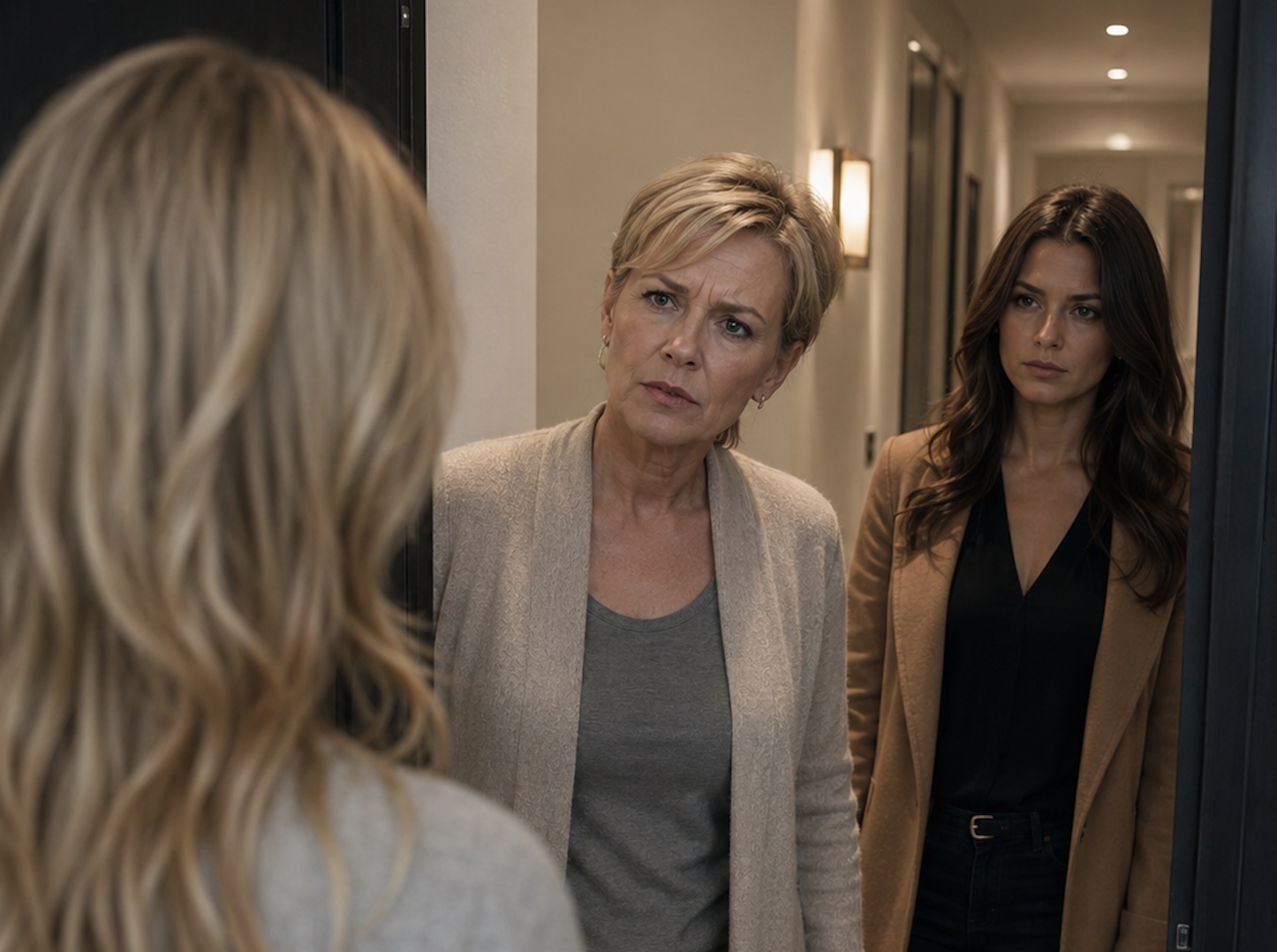
The doorbell rang at half past eight in the evening—just when Sveta had already changed into her home clothes, put the kettle on, and opened her book to the page marked with a bookmark. She was not expecting anyone. Alina always warned her before coming over, her colleagues never dropped by on Fridays, and she had not ordered any deliveries.
She walked into the hallway and looked through the peephole.
Two people were standing on the landing.
She recognized the first one immediately—Iryna Vadimovna, her mother-in-law. Tall, straight-backed, wearing the same beige coat she had owned for about five years, the one Sveta had once cautiously called “classic.” Her face looked like the face of a person arriving for serious negotiations: composed, emotionless, ready to speak.
The second woman was a stranger to Sveta. Around thirty-five, fair-haired, wearing a dark jacket. She stood slightly behind the mother-in-law, but not awkwardly. Calmly. Like someone who had come for a specific reason and knew exactly why she was there.
Sveta stared at them through the peephole for several seconds. Then she opened the door.
“Iryna Vadimovna,” she said evenly. “Good evening.”
Her mother-in-law stepped across the threshold without waiting to be invited. She simply moved forward, as if the question of whether she could come in had already been settled. She looked around. Then she nodded toward the woman beside her and said clearly, without hesitation, without apology:
“Sveta, meet her. This is the woman your husband lives with now.”
The hallway fell silent. Behind the wall, a neighbor’s television mumbled faintly. In the kitchen, the kettle gave a quiet whistle.
Sveta did not step back. Her face did not change. She simply stood there and looked—first at her mother-in-law, then at the stranger. The woman did not lower her eyes. Slowly, almost methodically, she looked around the entryway, then toward the corner of the living room visible through the open doorway. She looked at the apartment the way people look at a place they are already imagining themselves inside.
The silence lasted maybe three seconds—no more. But in those three seconds, Sveta had time to think about many things.
She had married Igor five years earlier. Not because it had happened by chance or because it was “time,” but because she had genuinely wanted to. They met at a corporate party hosted by mutual acquaintances. He worked for a construction company, spoke little but always to the point, and knew how to listen in a way that made it seem as though he heard not just the words, but everything behind them. Her friend Alina had said then, “He’s serious—not like the others.” Sveta laughed and replied that she would not make any predictions. She didn’t. But she started seeing him.
The first months were good. Igor did not rush her, did not pressure her, did not make loud plans out loud. He simply showed up. He came when he said he would. If he was late, he warned her. Such simple things, which, as it turned out, were rarer than people liked to think.
Sveta had bought the apartment before him—after eight years of work, two promotions, and one canceled vacation whose money had gone toward the down payment. A two-room apartment on the third floor in a quiet neighborhood, where there were hardly any cars in the mornings and cats sometimes crossed the courtyard. When Igor stayed overnight for the first time, she showed him the spare key and said, “Here, in case I’m at work.” He took the key silently and nodded. Not once did he speak of the apartment as if it were something shared. He would say, “It’s yours. You earned it. I’m not here for square meters.”
She believed him. Not because she was naive—simply because, back then, she had no reason not to.
At work, no one knew the details. Her colleagues saw that she came in on Monday with the same face she had worn on Friday, worked as usual, and answered questions calmly. Once, her department head, Sergey Mikhailovich, asked, “Is everything all right?” She replied, “Yes, just some family circumstances. I’ve already handled it.” He nodded and did not ask again. That was good—when a person understood that their involvement was not needed.
Natasha from accounting, with whom she sometimes had lunch, asked directly, “Did you and Igor split up?” Sveta confirmed it. Natasha shook her head sympathetically and said, “You know, I always thought he was somehow… well, I don’t know. Not on your level, maybe.” Sveta thanked her for the sympathy and gently changed the subject. She did not want to hear words like that, even if they were kind. Not because she disagreed. Simply because, at that moment, it no longer mattered.
Sveta worked as the chief technologist at a small production company—a responsible position with irregular hours and the habit of solving problems before they turned into disasters. Her colleagues said she had nerves of steel. She never argued, but she knew it was not quite true. Her nerves were ordinary. She had simply learned not to let them control her at moments when she needed her head, not her emotions. At work, people valued that. In her personal life, that quality was sometimes mistaken for coldness. But Sveta had long stopped explaining the difference.
It was exactly that habit—the ability to observe, assess, and not rush to conclusions—that helped her now. She had seen that something was changing in her relationship with Igor. She had seen it for quite a long time. She had simply given herself time—not out of fear, but out of honesty with herself. Before saying something out loud, one needed to be sure. She did not have to wait long to become sure.
She had met her mother-in-law three months after she and Igor started dating. Igor invited her to Sunday lunch and warned her, “Mom is strict, but kind.” Sveta arrived with a cake, behaved calmly, and answered questions politely. Iryna Vadimovna asked many things—where she worked, what exactly she did, whether her parents were alive. The questions were ordinary, but behind them Sveta sensed an inventory being taken: who this woman was, what she had, whether she was suitable. The cake was praised, though Iryna Vadimovna added that she herself baked better.
After lunch, while Igor was washing the dishes, Iryna Vadimovna came out to Sveta in the living room and said without any preparation, “You have your own apartment. That’s good. My son values such things.”
Sveta said nothing then. She did not understand whether it was a compliment or a warning. Over time, she realized it was both at once.
The first years of married life seemed calm. Igor did not interfere in household matters, he did not speak about the apartment, and Iryna Vadimovna visited on holidays and behaved with restraint. There was a feeling that everything had settled—not perfectly, but well enough not to expect anything bad.
Iryna Vadimovna had never been openly unpleasant. In the early years, she kept a polite distance, did not interfere, and gave just enough household advice for it not to look like interference. Once a week, she called Igor, and they talked for an hour. Sometimes, after those calls, he became thoughtful—not angry, just withdrawn. Sveta would ask, “Is everything all right?” He would answer, “Yes, just Mom.” Just Mom. It explained something, but not everything.
Once, during their second year together, his mother came to visit and stayed for dinner. After the meal, while Igor cleared the table, she said to Sveta quietly, almost in a friendly tone:
“You did well to register the apartment in your name. That’s right. A woman should have something of her own.”
Sveta thanked her. Iryna Vadimovna smiled and added:
“Although, of course, everything is fine between you two, so there is probably no need to think about such things.”
It sounded as though the sentence had two directions at once. Once again, Sveta did not understand whether it was a compliment or a warning. Now, standing in the hallway and watching that same woman bring some stranger named Katya to her door and start talking about housing, she finally understood. It had been neither. It had simply been inventory. That time—the first inspection. This time—the last.
The changes began around the third year. Nothing abrupt—just small shifts that were hard to describe. Igor started staying late more often. Not catastrophically late—an hour, an hour and a half. But if before he had always warned her, now he sometimes forgot. Their shared dinners, which had once happened almost every evening, became rare. Their conversations grew shorter—not scandalous, just short. As if he had run out of words for her, while still having enough for the rest of the world.
A few months before he left, there was another conversation she remembered. They were returning from visiting friends—late, in a taxi, both silent. Streetlights flashed outside the window. Suddenly Igor said quietly, without introduction:
“Do you ever feel like we exist next to each other, but not together?”
She turned to him and looked at him for several seconds.
“Yes,” she said. “I do.”
He nodded and turned back to the window. They did not speak again that evening. It was one of those conversations that could have become the beginning of something important—if both people had wanted to continue. But both remained silent. She—because she was waiting for him to be ready to speak honestly. He—for reasons she would learn later.
Sometimes afterward she wondered: perhaps she should not have stayed silent then. Perhaps that had been the moment when something could still have been changed. But then she would stop thinking about it, because thoughts like that led nowhere. Everything happened the way it happened. The other possibilities remained in that taxi, outside whose windows the streetlights kept flashing by.
There was one evening Sveta remembered clearly. They were sitting in the kitchen. He was drinking tea and scrolling through his phone; she was reading. Suddenly he said, without introduction:
“Have you ever thought about selling this apartment and buying something bigger? Together, with a mortgage.”
She looked up.
“No,” she said.
“It’s just a bit cramped here.”
“It isn’t cramped for me.”
He nodded and returned to his phone. The conversation ended there. But Sveta remembered it—the way people make a mental note of something that may later turn out to matter.
In the evenings, he began going to the kitchen with his phone. He spoke in a low voice. He went out onto the balcony and closed the door. He returned with the look of someone who had just spoken to someone important and was now coming back to something that was no longer quite as important. Sveta did not follow him or check anything—that was not her nature. But she saw it. And she understood.
She gave herself time. Not out of fear—she was simply used to confirming things before speaking. She did not have to wait long.
One Thursday, Igor came home later than usual. He placed a bag by the door—not large, but noticeable. He walked into the kitchen, poured himself water, and stood there for a moment. Then he turned and said:
“I need to live separately for a while.”
Sveta was sitting at the table with a book. She looked up. She looked at him calmly, without haste.
“I see,” she said.
“That doesn’t mean…”
“I heard you,” she interrupted quietly. “You need to live separately.”
He said more after that. That he needed to sort himself out. That it was hard to explain. That he did not want to hurt her. She listened and thought that a person who did not want to hurt someone usually managed to say so earlier. She did not say it out loud.
When he finished, she stood up, walked to the window, and looked out into the courtyard for several seconds. Under the birch tree sat a ginger cat—the same one she sometimes saw in the mornings. It was washing itself, paying attention to nothing.
“All right,” Sveta said. “Take what you need.”
He packed some of his things. He took his jackets, left his books. He did not touch the tools in the storage closet. In the entryway, he turned around.
“I’ll call,” he said.
“All right,” she answered.
The door closed. The apartment became quieter—with that special kind of silence that appears when something has ended, but not everything is fully understood yet.
For several weeks, he did not appear. He wrote rarely and briefly. “How are you?” “Fine.” “And you?” “Fine too.” Sveta answered the same way—without questions or accusations. She understood: if a person has left, messages cannot bring him back.
Those weeks while Igor was gone felt strange. Not heavy—strange. As if the apartment had suddenly become larger, though the number of square meters had not changed. In the mornings, she woke up and lay still for the first few minutes, listening to the day beginning outside the window—footsteps in the stairwell, voices in the courtyard, the first cars. Earlier, someone had breathed beside her at that hour, and she had grown used to it. Now she was getting used to something else.
She did not idealize what had been. And she did not erase it either. She simply sorted through it, the way people sort through things before moving: this should be taken along, this should be left, this should be thrown away. There had been good things. Evenings when they sat together and talked—truly talked, without phones, for a long time. Trips after which it felt good to return home. Moments when she looked at him and thought: it is good that he exists.
Then it became different. Gradually, almost imperceptibly—like the light in a room changing when a cloud covers the sun. Not sudden, but at some point you look around and realize it has become darker. When exactly it happened is hard to say. It simply happened.
She put the apartment into the order she had long wanted. She moved the shelving unit. She cleared out the storage closet—placed his tools in a box and set it near the door, neatly, without making a demonstration of it. She hung a photograph in the hallway that had been lying in a drawer for half a year. She bought new pillows. Life continued—not loudly, but steadily.
One evening, while sorting through a dresser drawer, she found a small photograph of herself and Igor from their first summer together, by the water. He was laughing; she was looking off to the side and smiling too, squinting in the sunlight. A good photo. Alive. She held it in her hands for a moment, then placed it in an envelope and put it among her documents. She did not throw it away—she simply put it aside. The past does not need to be destroyed. It is enough not to keep it in plain sight.
Work helped. She left at eight and came home at seven, and between those hours there was no time to think about what was missing. Her friend Alina came over with wine and a readiness to listen for hours. But Sveta opened the door, led her to the kitchen, poured tea, and said, “He left. I’m all right. Tell me what’s going on with you.”
Alina looked at her with the expression people have when they cannot understand whether a person is holding herself together or truly does not feel pain.
“Don’t you…” she began.
“Feel hurt?” Sveta interrupted. “Yes. But it’s a different kind of pain. Not the kind you need to pour out.”
Alina did not ask more questions. She simply sat beside her, and they drank tea, and rain fell outside the window. In its own way, it was good—to sit with someone who did not demand explanations or a specific kind of behavior from you.
Sveta did not consider herself cold. She had simply learned to live through difficult things internally—quietly, without making them public. She sat by the window at four in the morning when she could not sleep. She replayed moments in her memory that now looked different. She wondered: where exactly had things gone wrong? At some point, she stopped returning to that question. The answer would no longer change anything. The door had closed. She had to go on living.
Igor called the day after his mother’s visit. He said he had not known they were coming. That he had not asked his mother to do it. His voice sounded guilty—not theatrically, but genuinely.
“I understand,” Sveta said.
“It was wrong of her.”
“Yes.”
“Sveta, I…”
“Igor,” she interrupted calmly, “if there are questions about property, contact a lawyer. I have already told your mother everything. There is nothing more to discuss.”
He was silent for a moment.
“All right,” he said at last.
“All right,” she repeated.
The conversation lasted less than two minutes. She put the phone away and returned to what she had been doing—typing a report that had to be submitted by Friday. Work did not wait. Life went on.
The divorce was handled through a lawyer, without hurry. Igor did not argue about the apartment. Maybe he understood on his own. Maybe the lawyer explained it to him. They signed the documents on the same day, without meetings or long conversations. Sveta stepped out of the office and stood outside for a moment, breathing in the autumn air. No relief, no heaviness—just the next step.
But now—half past eight in the evening, the hallway, her mother-in-law at the threshold, and an unfamiliar woman looking around her apartment as if already calculating what could be rearranged.
“We came to talk,” Iryna Vadimovna said. “The situation needs to be resolved. There is no point dragging it out.”
“What situation?” Sveta asked. Her voice was even. Not hostile. Simply even.
“The housing situation. Igor is living with Katya now, and it’s cramped there, while here…” Her mother-in-law swept her gaze around the entryway. “There is something to discuss.”
There it is, Sveta thought. Not to explain. Not to talk. To resolve. The apartment.
She slowly straightened. Not theatrically—just the way a person straightens when they need to stand firmly. She moved her gaze from Katya back to her mother-in-law.
“Iryna Vadimovna,” she said calmly, “this apartment was bought by me before the marriage. With my money. It is registered in my name. It has absolutely nothing to do with how or with whom your son lives now.”
“But he lived here for several years. That counts too.”
“He lived here as my husband,” Sveta replied. “That does not make him the owner of someone else’s property.”
“Listen,” her mother-in-law changed her tone, “no one is claiming anything. We simply need to handle this like decent people…”
“Like decent people,” Sveta repeated quietly, “means not coming to my home without warning with the woman my former husband is now living with and saying that the issue of my apartment needs to be resolved.”
Iryna Vadimovna fell silent.
Katya had not said a word the entire time. She stood slightly behind and was now looking not at the apartment, but at Sveta. There was something in her gaze that resembled reassessment. She had arrived with one idea of the woman who lived here—and would leave with another.
When Katya had looked around the apartment that evening—methodically, practically, corner by corner—Sveta caught herself wondering what exactly the woman saw. The entryway with the photograph on the wall, which Sveta had hung only after the divorce. The corner of the living room with the new shelving unit, arranged the way she had always wanted. The shelves of books organized according to a system only she understood. An apartment where, over the past months, everything had become exactly the way she wanted it.
This was her apartment. Not only legally, but humanly. A place that reflected her, not a compromise between her and someone else. And the fact that someone had come here without invitation and was looking at that space with an appraising eye—that was what touched a nerve. Not strongly. Not with resentment. Simply the way it bothers you when someone takes what is not theirs without asking—even if only with their eyes.
At that moment, while her mother-in-law spoke about housing, Sveta thought about the strange nature of people. Here was a woman who had spent years drinking tea in this very kitchen, coming for birthdays, once even praising her pies. And now she stood at the threshold and spoke about the apartment—as if Sveta had merely been a temporary resident expected to make room. It did not anger her. It surprised her—quietly, without bitterness. Because it revealed something simple: people stand with their own. Iryna Vadimovna stood with her son. That could be understood without being accepted.
Sveta stepped toward the door and opened it wider—not rudely, without slamming it. She simply opened it. Then she stood in a way that made it clear: the conversation was over.
“If Igor has questions about property, he can speak to a lawyer. They will explain everything to him there. And your housing problems are better solved somewhere else.”
Her mother-in-law inhaled, ready to answer—and said nothing. She looked at Katya. Katya gave a slight shake of her head.
They left. Without words, without slamming the door. They simply left—the way people leave when they came for one thing and received something else.
Sveta closed the door quietly, without force.
She stood in the hallway for a moment, listening to the silence. Then she walked into the entryway, opened the dresser drawer, and took out the key—the one she had once given Igor and which he had never taken back when he left. A small key on a plain ring, with no keychain. She held it in her palm. Then she put it into her pocket.
In the kitchen, the kettle had cooled.
Sveta returned and put it on again. While it boiled, she stood by the window. The courtyard, the birch tree, the bench. The ginger cat was not there—gone somewhere on its own business. But the windows in the building opposite were lit, and in one of them someone was walking from corner to corner. It felt peaceful, somehow, to watch another life simply continuing in its own rhythm.
She made herself tea—strong, without sugar, the way she liked it. Then she returned to the sofa, switched on the floor lamp, picked up her book, and found the bookmark. Outside, it was quiet. Only rare cars passed below, fewer and fewer as the evening moved toward night.
The key remained in the pocket of her house pants. In the morning, she would put it in a drawer—or throw it away. She had not decided yet. There was no rush. Right now, something else mattered: the door was locked, the apartment was quiet, the tea was hot, the book was open to the right page.
Life—her own life, no longer shaped by other people’s plans for it—continued exactly the way she wanted.
And that was enough.