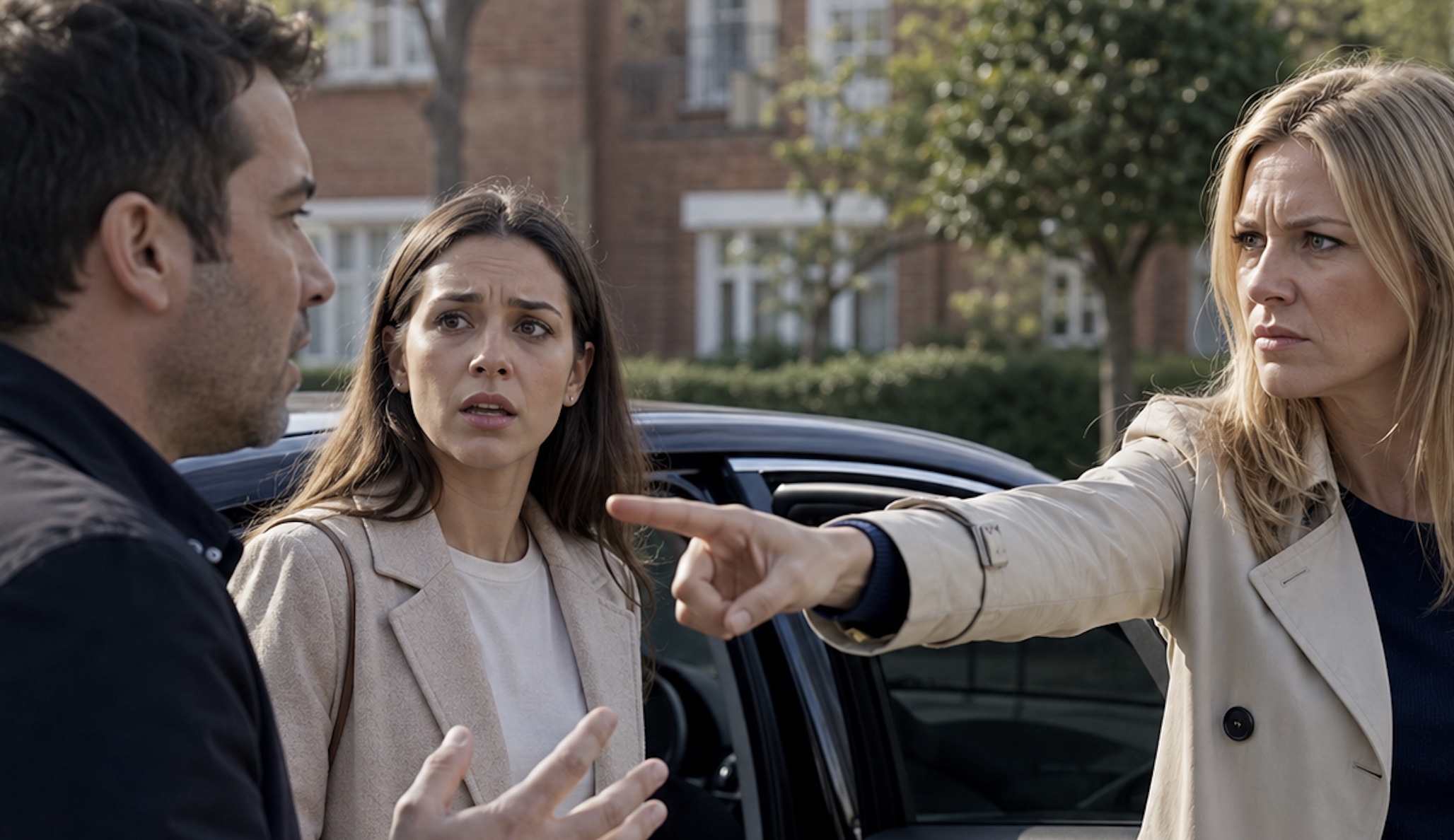
Oksana had bought that car herself — without anyone’s help, without advice, without joint trips to the dealership. She simply went in, chose it, signed the papers, and drove away. A silver Honda Civic, four years old, low mileage, clean interior. She walked around it three times, looked under the hood, and asked the seller to explain what was what. He explained, though with a slight surprise in his eyes. People were used to women coming with husbands or fathers, men who nodded and made the final decision. Oksana came alone — and nodded for herself. That evening, she drove home, parked the car in the yard under the streetlamp, and stood by the window for another five minutes just looking at it. For no particular reason. It simply felt good to look at.
From then on, the car became more than just transportation to her, though she would never have explained that out loud. She handled the inspections herself, arranged appointments with the mechanic herself, and kept all the documents in a separate folder in the glove compartment — insurance, registration papers, service book. She knew when the oil needed changing, never confused the fuel octane rating, and never forgot to check tire pressure before long trips. The order inside the car was her order: nothing unnecessary, nothing that belonged to someone else. She never left the keys lying around. She always placed them in the same pocket of her bag, and the spare set stayed at home in a desk drawer, under lock and key.
It was not paranoia. It was the habit of a person who knew the value of things because she had earned them herself.
In general, Oksana was the kind of person who treated her belongings differently from most people. Not out of greed or possessiveness — it was simply that, for her, there was a clear, unerasable line between “mine” and “someone else’s.” The things she worked for and bought herself carried more than just function. They carried time. Her time, her decisions, her effort. Giving someone the keys to her car meant handing over a piece of that. Not everyone understood that logic. Denis, as it later turned out, had not fully understood it either.
Oksana had another trait that people did not notice right away: she rarely repeated herself. If she said something, she said it once — clearly, without hints or evasions. She did not remind people later, did not clarify, did not ask, “Did you understand?” She believed an adult should hear things the first time. And if they did not, that was their choice — but the consequences were theirs too.
Denis had appeared in her life three years earlier, through mutual friends, at someone’s birthday party. He was the kind of man who knew how to be pleasant in company: he joked intelligently, listened attentively, never interrupted, and never drank enough to become embarrassing. At the time, Oksana was not planning any relationship. Work was difficult, she had only recently moved into a new apartment, and she generally wanted a calm life without extra people in it. But somehow, Denis quietly became part of it. They started seeing each other, then he moved in with her — first for a week, then permanently. These things happen.
He worked as a mid-level manager at a construction company, earned an average salary, and treated money carelessly — sometimes spending too much, sometimes borrowing before payday. Oksana did not openly judge him for it, but she noticed. What she valued in people was something else: keeping one’s word, respecting other people’s things, and being able to say no when necessary. With Denis, some things were fine, and others were not fine at all.
He was indifferent to cars. He did not have one of his own — not out of principle, it had just never worked out — and he managed somehow: metro, taxis, occasional rides with friends. He looked at Oksana’s Honda without much interest. Sometimes he asked her to drive him somewhere, and she did not refuse. Once, he asked to borrow the car for a day because he needed to help a friend move some things. Oksana thought for a second and said no. Not because she was being stingy, but because she did not want to: an unfamiliar person would be driving, she did not know how he handled a car, the insurance did not cover third-party drivers — why take the risk at all?
Denis did not argue then. He shrugged and said, “Fine, I’ll figure it out with my friend another way.” Oksana decided the subject was closed.
She was wrong.
The apartment was the same — only the other way around. The apartment belonged to Oksana, bought with a mortgage six years earlier, before Denis, before all of this. When he moved in, she did not change the paperwork, did not add him to the contract, and that was a conscious decision. Not from distrust, but from principle: let everything remain as it is until there is a real reason to change it. Denis never asked about it, and she never explained. It was her territory. He lived there as a guest — in the good sense, with her consent, by her rules.
He seemed to understand that rule in theory. But theory and practice are different things, especially when Vitalik is standing nearby saying, “Come on, she won’t find out. Just for a minute.”
Oksana did not know whether that was exactly how it had happened. But the version fit the logic. Vitalik knew how to persuade — not with arguments, but with tone. That casual “come on” after which it felt awkward to resist. Denis, apparently, had given in to it. And here was the result: the courtyard, the open hood, the folder with documents on the front seat.
Several times, Oksana had caught herself thinking that Vitalik was the type of person who did nothing bad openly but always seemed to keep some backup plan in mind. What exactly, no one knew. Maybe nothing specific. Just a feeling. Oksana had learned to trust such feelings. They rarely failed her.
Denis laughed it off. He said, “You’re too suspicious. Vitalik is a normal guy, he just has that kind of face.” Oksana did not argue. She simply kept her opinion and kept the spare keys where she kept them.
That friend — Vitalik, short, with permanent two-day stubble and a habit of keeping his hands in his pockets as if something important were hidden there — did not come to their home often, but he came regularly. He would show up without calling, sit in the kitchen, drink tea, and talk to Denis about his affairs — always vague, never quite clear. Oksana did not exactly dislike him. She simply did not understand what he really was. Denis would say, “He’s a normal guy, we’ve known each other since childhood.” That explanation was not enough for Oksana, but she did not interfere.
Oksana’s work had taught her to observe people well. Seven years in the procurement department of a large company meant constant negotiations, contracts, partners who smiled to your face and sent complaints behind your back. She had learned to read people not by their words, but by details: how a person held a pause when asked a direct question; how they looked aside when saying something unnecessary; how they rushed to explain something no one had even asked about yet. She noticed these details automatically, without thinking. And Vitalik had enough of them.
Once, Vitalik asked her directly to lend him the car — without Denis, meeting her in the hallway. He said it would only be for a short time, literally three hours, somewhere nearby. Oksana looked at him and calmly said no. She gave no explanation. Vitalik smirked and went into the kitchen to Denis. Oksana did not hear what they talked about there, but something in that smirk displeased her. Not anger, not offense — something else. Something like calculation.
On the evening when it all happened, she was coming home from work earlier than usual. A meeting had been moved, she had finished the day’s plan, and she simply went home — without calling, without warning. The heat was thick, the asphalt breathed warmth, and she was already thinking about how she would go inside, change clothes, and sit on the balcony with cold tea.
She turned into the courtyard and saw it immediately.
Her car was not quite the way she had left it that morning. It was in the same spot — under the same streetlamp — but something was wrong. Oksana did not understand at first what exactly. She slowed down and looked closer. The driver’s door was slightly open. The hood was open too. Denis stood beside it, and a little farther away was Vitalik, holding something in his hands. She could not make out what it was, but that was already enough.
Oksana stopped a few steps away. She simply stopped and looked.
Denis noticed her first. She saw his face change — not fear, no, something more complicated: a mixture of confusion and rapid inner calculation, as if he were already trying to find an explanation for something difficult to explain. He stepped toward the door and pulled it toward himself, wanting to close it, but he did it too quickly, and that movement only made everything more obvious.
“Oksana, listen, we were just…”
She did not answer. She slowly came closer — not quickly, not shouting, just walking — and looked at the seat. On the front seat lay her things from the glove compartment: the document folder, the small flashlight she kept there just in case, some papers. Everything had been taken out and spread around as if someone had been searching for something. She looked at the hood, then slowly turned her gaze to Vitalik. He was looking away.
Oksana held the silence. A long silence. The kind after which silence itself becomes pressure.
“You have exactly one minute to explain who gave you the right to dig through my car,” she finally said. “Otherwise you’re out of here immediately.”
There was no shouting in her voice. None at all. That was worse than shouting — the flat, cold tone of a person who has already made a decision and is now only waiting for the formalities. Denis knew that voice. He had heard it twice in three years: once when the conversation had been about money he took from their shared cash without warning her, and once when he had promised one thing and done another. Both times ended with him eventually admitting Oksana was right. Not immediately, but eventually.
“We just wanted to take a look,” he began. “Vitalik needed to check something. He understands cars. I thought there was nothing wrong with it…”
Oksana listened. She did not interrupt, did not move, only listened — and the way she listened made it clear that these words were not enough. Not because they were necessarily lies. Maybe they were not lies. They simply did not explain the main thing.
“I didn’t ask what you were doing,” she said when Denis paused. “I asked who gave you the right.”
Vitalik finally turned his head. He looked at her with the same expression he had worn in the hallway back when she had refused him. Only now there was not even a trace of a smirk in it.
“Where did you get the keys?” she asked, and although it was a question, it sounded like a statement.
Denis was silent for a moment. Then he said, “The spare ones were in the desk drawer. I knew where they were.”
Oksana nodded. Slowly, once.
“So you took the keys from a locked drawer without asking me, and opened my car for a stranger.”
“Well, not a stranger. It’s Vitalik…”
“For my car, he is a stranger,” she said. “I didn’t invite him there. I didn’t invite you there either. No permission, no phone call, not one word. You simply took the keys and got inside.”
It was not a monologue or an accusation speech. She spoke quietly, almost calmly, and that was exactly what made every word heavy. Denis did not interrupt. Vitalik stepped back slightly — barely noticeable, as if by accident, but both of them noticed it.
“Did you touch the documents?” Oksana asked.
“No, no, we only looked…”
“The folder is open.”
Denis fell silent.
She gathered the things from the seat herself — carefully, without rushing — placed the folder back in the glove compartment and clicked it shut. She checked under the mat, behind the seat. She closed the door. Then she lowered the hood — slowly, with a distinct click — and turned to both of them.
“Vitalik, you need to leave,” she said. “Now.”
He nodded, said nothing, and walked toward the exit from the courtyard. Oksana watched him until he disappeared around the corner.
Then she looked at Denis.
“We’ll talk at home.”
They went upstairs in silence. In the elevator, he opened his mouth twice and closed it again. She saw it from the corner of her eye but did not turn. At home, she put the kettle on, sat down at the table, and only then looked at him properly.
“There’s one thing I don’t understand,” she said. “You knew I was against this. I told you directly: no one takes my car without my permission. I told you more than once. You nodded.”
“I thought that applied to outsiders…”
“Vitalik is an outsider to my car. And so are you, if I didn’t give permission.”
“Well, we live together…”
“We live together in my apartment,” she said evenly. “That does not make you the owner of my things. My car is mine. My documents are mine. The desk drawer where the spare keys are kept is mine too. This was not discussed because I thought it was obvious without words.”
Denis was silent. Then he asked, almost quietly, as if he was not sure whether he should:
“Do you think we wanted to do something bad?”
Oksana looked at him.
“I don’t know what you wanted. That is exactly why I care. If you had called and said, ‘Vitalik says he knows cars, can he take a look?’ I would have answered. Maybe yes, maybe no. But you would have asked. Instead, you decided on your own. For me. About my property.”
The kettle boiled. She stood up, poured herself a mug, and came back.
“If this happens again — whether with the car or with anything else — I will ask you to move out. Not because I’m angry. Because this is about respect, and if there is no respect, nothing else works.”
Denis sat looking at the table. Then he nodded. Truly nodded, not the way he usually did — once, without words, without explanations. Just nodded.
Oksana took her mug, stood up, and went out onto the balcony. She sat there for a long time, drinking tea as it cooled, looking down at the courtyard, at the streetlamp beneath which her car stood. Silver, closed, in its place.
From upstairs, it was impossible to tell whether anything under the hood had been touched or not. Tomorrow, she would stop by the mechanic’s and ask him to check it. Just in case.
It was her “just in case.” Her car. Her business.
They had lived together for three years, and during that time Oksana had learned many things about Denis. He was kind — that was true, without irony. He could make dinner when she came home late from work. He remembered what tea she liked. He never raised his voice. When she was sick, he sat beside her, brought her water, and did not go out with his friends. All of that was real, and she valued it.
But there was another trait in him, one she had noticed long ago but had not named out loud. He did not know how to respect another person’s boundary when that boundary interfered with what he wanted right now. Not maliciously, not deliberately — he simply did not give it the same weight she did. For him, “no” sometimes meant “no, unless there is a good reason,” and he decided for himself whether the reason was good enough. If he decided it was not, he acted his own way. Quietly, without scandal, assuming no one would notice or that everything would be understood later.
Oksana noticed. She always noticed — she just did not always speak. Sometimes she let it pass because the matter was small. Sometimes she spoke — once, without repeating herself. He nodded. Some things he changed. Others he did not.
With the car, he had not changed anything. Or rather, he had never directly violated the rule: he had not taken it without asking, had not given it to others, had not sat behind the wheel without her permission. But she had felt it — this was not out of respect for her rule. It was because there had been no reason. Because he had not needed to. And as soon as the need appeared — and Vitalik was nearby with his “come on, she won’t find out” tone — the boundary did not hold.
Oksana thought about this not with anger, but with exhaustion. Explaining to an adult why you cannot take someone else’s things without asking is tiring. Not because it is difficult, but because it should not be necessary. It should be understood without words. The same way it is understood that you do not read someone else’s messages or open someone else’s envelopes. Not because there is necessarily something important inside. Simply because it belongs to someone else.
Vitalik disappeared from their life quietly — not demonstratively, not after a scandal. He simply stopped calling, stopped coming over. Maybe he understood on his own. Maybe Denis said something to him. Oksana did not ask. That was his matter.
Denis became more careful. Not only with the car — in general. He started asking where before he would not have asked. Small things: “Can I take this mug?” “Do you mind if I move this?” Oksana answered briefly: yes or no — and did not make an event out of it. She simply accepted as normal what should have been normal from the beginning.
Sometimes she thought that boundaries in relationships were a strange thing. On one hand, everyone talks about them: respect personal space, do not cross someone else’s limits. On the other hand, when it comes to real life, it turns out people have very different ideas about where that boundary lies. For one person, taking someone’s belongings without asking is natural between close people. For another, it is exactly the thing that destroys closeness faster than anything else. Not betrayal, not lies — but this small, daily carelessness toward what matters to the other person.
Oksana was not harsh. She was precise. Those are different things, though from the outside they can look the same.
Several weeks passed after that evening in the courtyard. Life returned to its rhythm: work, dinners, weekends. Denis did not bring up the subject again and did not try to explain what had happened differently. She did not bring it up either. Everything had already been said. There was no point repeating it.
But something in the air had changed — subtly, almost invisibly. Like the pressure before a storm: nothing has happened yet, but something is already different. Denis became a little more attentive. Not theatrically, not deliberately — just somewhat differently. Perhaps he felt that this time it had been serious. That she had not simply expressed dissatisfaction — she had drawn a line. Clearly and without unnecessary words.
One evening — about three weeks after everything — Denis suddenly asked her:
“Are you still angry with me?”
Oksana lifted her eyes from her book. She thought for a moment.
“No,” she answered. “I’m not angry. I just remember.”
He was silent. Then he nodded, got up, and went to the kitchen. She lowered her eyes back to the book.
Remembering is not a threat and not revenge. It is simply information about a person that she now has. What he will do when he thinks no one is watching. What matters more to him in the end — a rule or convenience. That information will not disappear. It simply exists now. And the next time she has to make some decision, it will be taken into account.
She did not know whether that was good or bad. That is simply how life works: people reveal themselves in small things, and afterward those things cannot be forgotten.
Outside the window, rain was beginning. Oksana closed the book, stood up, and went to the window. In the courtyard beneath the streetlamp stood her car — shining under the first drops, silver, neat, in its place. Exactly as she had left it. Exactly as she always kept it.
She stood by the window for another minute. The rain grew stronger — no longer a few first drops, but a real, steady autumn rain. The glass began to fog at the bottom. There was no one in the courtyard — only the streetlamp, the puddle beneath it, and the car that was not going anywhere and owed nothing to anyone.
Oksana returned to the sofa, opened her book, and found the page she needed.
The car still stood in the courtyard under the streetlamp. In the mornings, Oksana went out, checked it, got in, and drove away. The keys stayed in the pocket of her bag — always in the same one. The spare set was back in the desk drawer, only now she locked the drawer with a key. Not because she did not trust him. Simply because it felt calmer that way.
The next morning, she got up before Denis, drank her coffee standing in the kitchen, and drove to a mechanic she knew. She asked him to inspect the car — without explaining, just to inspect it. The mechanic went through everything in silence, then said, “Everything is fine. Nothing was touched.” Oksana nodded, thanked him, and drove to work.
On the way, she thought about the conversation with Denis from the day before — an important conversation, a necessary one — but it would not change a person. Words rarely change people. What changes things is what happens after the words: either a person draws conclusions, or they do not. She would learn that later. Not now.
For now, she simply drove. Steered. Listened to the radio. The car moved smoothly, as always. That was good.
The next day, Vitalik called Denis and suggested they meet. Denis said, “Not now. Later.” Vitalik asked, “Did something happen?” Denis answered shortly, “Everything’s fine.” And hung up.
Oksana did not hear this. She was in another room, reading. But after that call, Denis came into the kitchen, put the kettle on, and stood for a long time looking out the window at the courtyard.
There, beneath the streetlamp, stood the silver Honda.
In its place.