Kira met Igor at a time when she had already stopped looking — not deliberately, not as some proud decision, but simply because she was tired of the usual routine: dating apps, mutual acquaintances, café meetings where both people sat across from each other, silently filling out an invisible questionnaire.
Igor appeared differently.
They bumped into each other near the elevator in an office building. He was carrying coffee in both hands and somehow managed not to spill a drop, even though Kira accidentally brushed his shoulder. She laughed then, and so did he. The conversation that followed refused to end. They stood there in the hallway for nearly twenty minutes, still holding their cooling coffee.
After that came several months of the kind of period people later remember as the easiest: everything is interesting, everything feels new, and you still do not know the other person well enough to see them completely. Kira saw a calmness in Igor that she liked. He did not rush her, did not pressure her, did not demand anything faster than she was ready to give. That was rare. She appreciated it.
They moved in together a year and a half after they met.
The apartment was hers — a two-room place in a good neighborhood, which Kira had bought before Igor ever came into her life. She had bought it when she finally decided to stop waiting for the perfect moment and stop postponing her own life. For several years, she had saved money, lived in rented apartments, counted every expense, and eventually signed the papers.
The apartment was registered in her name. Only hers.
It was her choice, her investment, her space. So when Igor suggested they live together, she agreed without making a big issue of it. But somewhere deep inside, she understood very clearly: this was her home, and she was inviting him into it. It was not shared property that had somehow appeared between them on its own.
Money had not come easily to her back then. Kira worked as a manager in a small company — not a glamorous career, but a stable one, with clear prospects for growth. She saved methodically, almost without slipping. She kept a spreadsheet of her expenses, denied herself unnecessary purchases, and did not take a vacation for two years in a row. Sometimes colleagues invited her out after work, but she usually refused — not because she did not want to go, but because each time the same thought clicked in her mind: that is money disappearing into nowhere.
When she finally saved enough and signed the contract, she walked around for several days with the feeling that she had done something truly important. Not for anyone else. For herself.
The first years of their life together were calm. They did not have theatrical fights or beautiful reconciliations. It was simply the ordinary life of two adults who had agreed to be together. Igor was neither a perfect man nor a difficult one. He was a person with his own habits, his own evening fatigue, his own Mondays when he wanted nothing except the sofa. Kira was an ordinary person too.
They lived together. Not without friction, but they managed.
Igor knew the apartment was registered to Kira. It had never been discussed as a problem. It was just a fact, something that existed and that they both accepted. Kira never turned it into a topic of conversation. She never reminded him of it, never emphasized it. In everyday life, it did not matter.
It became important only when someone else decided it did not matter for entirely different reasons.
At first, Valentina Sergeevna was present in their lives only as much as seemed reasonable: Sunday phone calls, visits on holidays, sometimes dropping by to bring something homemade — a jar of jam or a bag of apples from the garden. Kira treated her evenly, without admiration and without dislike. Just an ordinary mother of a grown son. Not the first, not the last.
But gradually, something began to change.
Not suddenly, not in one day — more like boundaries usually shift: first a little, then a little more, and at some point you look around and realize you are standing in a completely different place.
Valentina Sergeevna began calling more often. At first, it was about practical things. Then it was for no clear reason. She asked what Kira was cooking for dinner, how she was feeling, whether she was tired from work, whether she was spending too much time with her friends.
The questions themselves were harmless — exactly the kind of questions a person asks when they want to seem caring. But behind them, Kira sensed something else. It was not interest in how Kira was doing. It was interest in what was happening inside her son’s home.
Then the advice began.
Quietly, casually, as if by accident. Valentina Sergeevna would say it in conversation with Igor, fully aware that Kira could hear her: apartments in this area are selling very well now. Or: I saw that someone in your building sold their place and bought two smaller ones — very practical. Or: the market is good right now; you should not delay.
Kira heard these phrases. She noticed them. She carefully stored them away in her memory — and said nothing. She did not rush. She preferred to understand where everything was going before doing anything.
Igor, meanwhile, either did not notice these conversations or pretended not to. Kira could not tell which was true, and that was perhaps the most unpleasant part. Not his mother’s words, but her husband’s silence.
One day in early November, Natasha called her — an old acquaintance with whom Kira had worked several years earlier. They still spoke from time to time. Natasha had called about something else entirely. They talked about work, about winter plans, and then, almost at the end of the conversation, Natasha said casually:
“Listen, last week I ran into a woman who knows your mother-in-law. We got talking, and she mentioned that Valentina Sergeevna was looking for buyers for an apartment. At first I didn’t even realize she meant yours, so I asked her to clarify. Turns out, yes. Strange, isn’t it?”
Kira answered calmly that it was probably some misunderstanding. She said goodbye and ended the call.
For several minutes, she simply sat with the phone in her hand, staring out the window. Outside, it was dark, and a fine rain was falling — not pouring, but hanging in the air.
Her first thought was: impossible.
Her second was: why impossible?
That evening, when Igor went to take a shower, Kira pulled out the folder with the documents. She kept it in a drawer under the bed — not because she was hiding it, but because there had never been any need to keep it in sight. The ownership certificate, the purchase agreement, the registry extract.
Everything was in her name.
Only in her name.
She reread every document carefully — not because she doubted what was written there, but because she wanted to make sure she understood exactly what she had and what she did not have. She made sure. Then she put everything back and pushed the drawer closed.
She said nothing to her husband. Nothing to her mother-in-law.
She decided to watch how they would behave when the moment came.
Several times, Kira caught herself replaying different versions of that conversation in her head. How it might have gone if she had not known. If Natasha had not called. If she had not checked the documents three days earlier.
Most likely, Valentina Sergeevna would have spoken confidently, Igor would have remained silent, and Kira would have stood there feeling the ground disappear from under her feet — not because she did not know her rights, but because confusion in situations like that strikes before you have time to gather yourself.
That was why she was glad she knew in advance. Glad she had not waited. Glad she had checked the documents. Glad she had given herself time to prepare — not for a scandal, but for a conversation.
It came three days later.
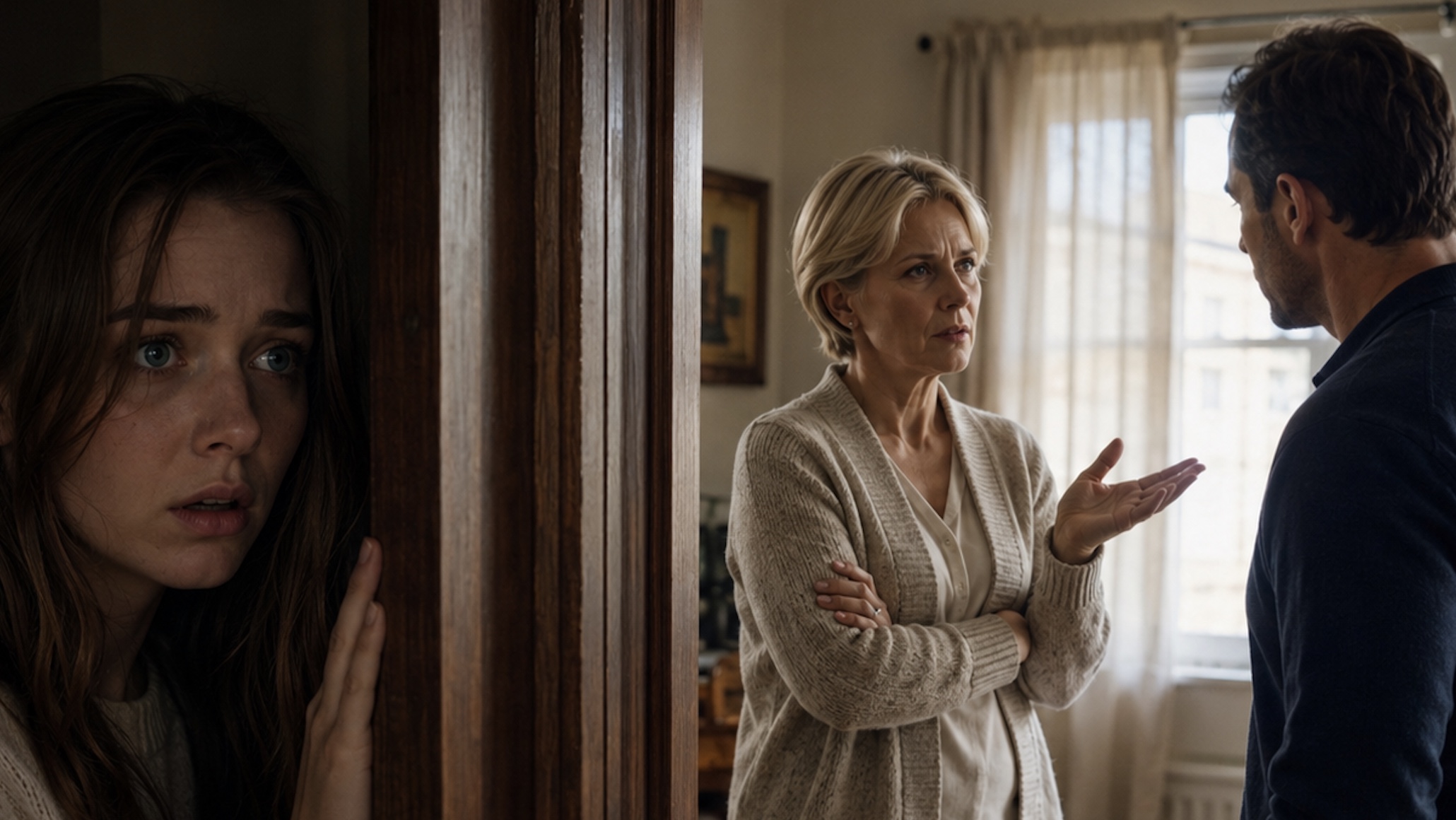
Valentina Sergeevna arrived on Friday evening. She had called ahead and said she wanted to talk about something important. Igor met her in the hallway, and they exchanged a few low words while Kira brewed tea in the kitchen. She heard the tone — businesslike, focused, not festive.
This was not a visit.
They sat down in the living room. Kira came out with three cups, placed them on the table, and sat opposite them. Valentina Sergeevna looked at her briefly, appraisingly, the way people look at someone from whom they do not expect resistance.
“I wanted to talk about the apartment,” she began in a practical tone, as if opening a meeting. “The situation is this: now is a good time to sell. I made inquiries, checked the prices in your area. Apartments are going quickly. Igor agrees.”
Kira looked at her husband.
Igor stared at the table.
“The daughter-in-law has nothing to do with this,” Valentina Sergeevna continued, as if Kira were not in the room at all. “The apartment will be sold, and the money will go toward something more sensible. I’ve already spoken to someone. He is ready to come and look at it next week.”
The room fell silent.
Kira did not jump up. She did not raise her voice. She did not start speaking quickly, interrupting and explaining. She simply sat and listened — attentively, the way one listens to something one has expected for a long time.
Valentina Sergeevna, clearly used to mistaking silence for agreement, continued. She spoke about the buyer, about timing, about why they should not delay.
Igor remained silent.
Kira looked at him calmly, without rage, without tears. She just looked and saw what, perhaps, she had known for a long time: he would allow this to happen. Not because he was a cruel person. Simply because he did not know how to stop his mother.
He never had.
When Valentina Sergeevna paused to take a sip of tea, Kira stood up.
She went into the bedroom, pulled out the drawer under the bed, and took out the folder — the same one she had reread three days earlier. Then she returned to the living room.
She placed the folder on the table in front of her mother-in-law and husband.
She did not throw it. She did not slam it down. She simply placed it there neatly, the way one places a document for signing.
“Here is the purchase agreement,” she said evenly. “Here is the ownership certificate. Here is the registry extract. Everything is registered in my name. Only mine.”
Valentina Sergeevna looked at the documents. Then she looked at Kira.
Something in her gaze changed. Not immediately, but it changed.
“Only the owner can make decisions about this apartment,” Kira continued. “That owner is me. No decision to sell can be made without my consent. No viewings. No negotiations with buyers. No conversations with outsiders about our home.”
She spoke without malice — evenly, clearly, the way people speak in business negotiations when they want the terms to be understood correctly and forever.
“Kira, wait,” Igor began. “Mom just wanted—”
“I heard what your mother wanted,” Kira replied without turning her head toward him. “And I explained how things stand.”
Valentina Sergeevna was silent.
That was unexpected. She was rarely silent. But now the documents lay in front of her, black on white, and there was nothing she could use against them. She had expected anything — objections, tears, quiet disagreement that could be worn down. She had not expected a folder of documents and that calm voice.
“I am not saying this out of rudeness,” Kira added, sitting back down. “I am saying it so there is no misunderstanding. This topic is closed.”
The pause stretched.
Outside, the rain continued — the same fine November rain that hangs in the air and is in no hurry to fall. The room was bright and quiet.
Valentina Sergeevna set down her cup. Picked up her bag. Said something about only wanting what was best — not an apology, not an admission, just words she needed to say in order to end the conversation somehow. Then she stood, said goodbye without her former confidence, and left.
The door closed behind her.
After her mother-in-law left, Kira stood by the window for a long time. She was not thinking about anything specific. She simply looked out at the street, at the streetlights reflected in the wet asphalt, at the few passersby with umbrellas.
Inside her, there was no triumph. No relief. Only a quiet exhaustion — the kind that comes not from physical effort, but from the fact that something important has finally happened, and now you need to stand still for a moment and let it settle.
She thought: good that I did not shout. Good that I did not cry. Good that the folder was in the drawer and I knew where it was.
Igor remained sitting at the table. He was looking at the folder of documents still lying in front of him, and he said nothing. Kira cleared the cups, rinsed them in the kitchen, and returned.
They both understood that now they needed to talk — not about his mother, not about the documents, but about something else, something more important.
About why he had stayed silent.
About what it means to stay silent when your mother says your wife has nothing to do with her own home.
About what happens next.
There was one thing Kira did not say out loud and barely allowed herself to think about. After that evening, she woke up several times in the middle of the night and lay in the darkness, staring at the ceiling.
She thought about Igor.
Not that he was a bad person — she did not believe that. She thought about how there is a big difference between a bad action and weakness of character, but sometimes the result for the other person is exactly the same.
He had not supported his mother. But he had not stopped her either.
He had not wanted to sell the apartment. But he had allowed things to go as far as that conversation.
What was that?
A love of peace and quiet? An inability to say no to his mother? Or something else — something she should not think about too long unless she was ready to arrive at conclusions she was not yet prepared to face?
The conversation was long and difficult — the kind you cannot redo and cannot pretend never happened. Igor said he had not known his mother had gone that far. He said he thought it was just talk. He said he had not wanted to turn it into a conflict.
Kira listened.
She believed him partly — believed that he had not planned anything bad. But she did not believe that he had not noticed. Not noticing something like that was also a choice. Just a more convenient one.
“Do you understand that she was talking to strangers about selling our apartment?” Kira asked. “Without me. As if I do not exist.”
“I understand,” he said quietly.
“And you stayed silent.”
“I thought it wouldn’t lead anywhere.”
“It would have, if I hadn’t known. If Natasha hadn’t called by chance.”
Igor did not answer.
There was no answer — only silence, and inside that silence sat a person who was ashamed.
Kira looked at him and thought that sometimes the hardest people are not the ones who deliberately do something wrong. The hardest are those who do it by inertia. Those who stay silent not because they agree, but because silence is easier.
Easier not to notice.
Easier not to stop anything.
Easier later to say: I did not think it would go that far.
There was one moment during that conversation that Kira could not get out of her head for a long time afterward. When she placed the folder on the table and began speaking — calmly, without breaking — she noticed how Valentina Sergeevna’s face changed.
Not immediately.
At first, it held the same expression as before — confident, almost condescending, like the face of someone who already knows how everything will end. Then something shifted. Not offense. Not anger. More like confusion.
The kind of confusion a person feels when they enters a room expecting to find one thing and instead finds something entirely different.
Kira felt no satisfaction from it. She simply noticed it — and continued speaking.
They did not reconcile that evening in the usual sense. There were no embraces, no promises. They simply talked. Long, honestly, uncomfortably.
By night, both of them were exhausted. They went to their separate corners — not with dramatic resentment, but with the heavy feeling that something had been named out loud, and now there was no way to pretend it had not existed.
After that evening, Valentina Sergeevna began calling less often. Her next visit came several weeks later. She was quieter than usual, without her previous businesslike tone. She did not return to the subject of selling the apartment.
Kira behaved evenly. Not coldly, not demonstratively — just evenly.
The boundary had been marked. Not with shouting. Not with scandal. With a document placed on a table.
Sometimes that is enough.
Kira sometimes thought about how the situation must have looked from Valentina Sergeevna’s side. Most likely, she did not consider herself to be doing anything wrong. She wanted to help her son — according to her own understanding, using her own methods. She probably sincerely believed that she knew better what the family needed.
That the money from the sale could be invested more wisely.
That an apartment was just an apartment — not someone’s personal history, not five years of saving, not documents signed with a trembling hand.
For her, it was square meters.
For Kira, it was something entirely different.
That difference was the root of everything.
The folder went back into the drawer under the bed. Kira put it away without unnecessary words, just as calmly as she had taken it out. The documents were in order. The apartment was hers.
That had not changed for even a second.
Now everyone simply knew it.
Valentina Sergeevna was not a villain. Kira understood that and did not try to convince herself otherwise. It would have made everything simpler, but it would not have been true.
Her mother-in-law was a woman used to controlling what she considered hers. And what she considered hers was her son’s life — his decisions, his money, his home.
The fact that the home turned out not to be his, she apparently had never taken seriously.
It was not evil. It was a failure to understand. Perhaps even a sincere one. That did not make it easier, but it did make it clearer.
After that call, Natasha wrote once more. A short message: Is everything all right?
Kira replied: Yes, we sorted it out.
Natasha sent a thumbs-up emoji and asked no more questions. Kira was grateful to her — not only for that accidental phone call, but also for not turning it into a story, not demanding details, not offering advice.
Sometimes the greatest help is saying something at the right time — and then knowing when to stop.
One day after that evening, Kira visited a neighbor — an elderly woman named Antonina Vasilievna, with whom she sometimes spoke in the elevator. The woman lived alone. She was observant and direct, the kind of person who said what she thought without softening it too much.
Kira stopped by under the pretext of returning some salt she had borrowed the week before. Antonina Vasilievna made tea, and they sat in the kitchen for about forty minutes, simply talking — not about anything important. About the neighborhood, the weather, the poor renovation in the entrance hall.
Kira told her nothing about her own situation.
She simply sat in another woman’s kitchen and drank tea. And surprisingly, it felt good — calm, without pressure, without the need to decide anything right away.
The next morning, Kira arrived at work earlier than usual. She made coffee in the office kitchen, sat down at her desk, and spent about ten minutes just sitting in the silence of the empty room.
Then she opened her laptop and began to work.
Not because she had stopped thinking about what had happened. Simply because work had always helped her keep from getting stuck. Specific tasks. Specific results. Something that depended on her and only on her.
She valued that — especially now, when so much depended on other people and on what kind of people they turned out to be.
Several weeks passed.
Life returned to its rhythm — work, evenings at home, weekends. She and Igor talked more than before. Not always about pleasant things, but more honestly.
Kira noticed the effort in him. He began telling his mother more often that certain topics were not open for discussion. It was not easy for him — she could see how carefully he chose his words, how he waited for her reaction.
Kira did not comment on it and did not praise him.
She simply saw it.
For now, that was enough to continue.
Several times, Kira returned in her thoughts to the phrase Valentina Sergeevna had said at the very beginning of that conversation: the daughter-in-law has nothing to do with this.
It had sounded like a dismissal — as if a person could be erased from her own home with one sentence.
Nothing to do with this.
As if Kira were a random guest who had simply been unlucky enough to be nearby when important decisions were being made.
Perhaps that phrase had hurt more than anything else. Not the threat of selling the apartment. Not Igor’s silence. But that careless “nothing to do with this,” spoken so easily, as though it were obvious.
That was exactly why she had gone to get the folder.
That evening, Kira opened her laptop and visited a website where she had looked at apartments in a neighboring district several months earlier — just out of curiosity. Prices had gone up. She looked through a few listings, read the descriptions, then closed the tab.
Her apartment was not going anywhere.
She had made sure of that in advance — calmly and without unnecessary words.
Life went on.
Not perfectly. Not without questions. But it went on.
Sometimes Kira thought about how much depends on whether you truly understand what belongs to you. That knowledge — quiet, without noise — was perhaps the most important thing left after that evening.
Not so you can cling to it desperately.
But so you can know.
So that, when the moment comes, you can simply stand up, walk into the other room, and return with the folder.