— Vera, you’re home early today? — Kirill called from the hallway just as she was hanging up her coat.
— Short shift. One appointment got canceled, and Svetlana covered the rest for me.
Vera walked into the kitchen, opened the fridge, clicked on the kettle — automatically, the way she had done every evening for the past three years. The apartment was quiet. Good quiet, in its own way.
The medical center where she worked as an administrator was only a ten-minute ride from home. The route had long become part of her body’s memory: bus stop, bus, three blocks on foot, elevator, door. Her work was not physically exhausting, but it drained her attention — eight hours at the reception desk, phones ringing, waiting lines, patient files, doctors running late. By evening, her mind became clear but silent, like a screen after it had been turned off. Vera had accepted this about herself long ago. She knew she needed twenty minutes of quiet — and then everything would be normal again.
At work, people respected her not because she was charming — though she was — but because she was precise. She never mixed up appointments, never misplaced documents, never said, “I think I passed it on,” when something had to be passed on for certain. Once, the chief physician told her that administrators like her were rare. Vera thanked him calmly — without flirtation and without unnecessary modesty.
She had bought the apartment before she got married. For several years, she had put money aside from every paycheck, taken a small installment plan, and at twenty-eight, received her own keys. A one-room apartment on the fourth floor, with a window facing the courtyard and old cast-iron radiators that heated the place so well she could walk around in a sweater even in winter.
Her own.
She rarely said that word aloud, but she said it to herself often. When her mother asked whether she felt lonely living alone, Vera answered no. And that was the truth.
Kirill entered her life when the apartment had already been bought and arranged. They met through mutual friends at a birthday party — loudly, casually, by chance. He joked pleasantly, did not try to make himself seem more important than he was, and knew how to listen. A year later, they started dating. Another year after that, they got married. He worked as a project manager at a construction company and had lived with his mother before the wedding. After the registry office, he moved his things in, took up part of the wardrobe, and hung his keys on the shared hook by the door.
The first year and a half was normal. Not perfect — Vera did not believe in perfect marriages — but normal. He could make breakfast on weekends. He remembered that she disliked loud television late at night. When she was sick, he did not get irritated; he brought her medicine. Small things, yes, but daily life is built from small things.
The dacha came to her a year after the wedding — from Aunt Galya, her mother’s sister, who had never married and had no children. Aunt Galya was a quiet, self-sufficient woman. She spent most of the warm months at the dacha, growing flowers and currants, making jam in a copper basin, reading thick books in cheap covers, and saying that city life was for people who did not know how to stop. She said it without judgment — simply as an observation.
Vera did not visit her often — distance, work, one thing after another. But she called every Sunday, without fail. Aunt Galya knew about every difficult patient who caused a scene at the reception desk, every exhausting week, every weekend Vera spent at home with a book instead of company. She never gave advice unless asked. She simply listened and sometimes said one precise sentence, without extra words. That was always enough.
One day, Aunt Galya told her something important — not as advice, but almost casually, while they were sitting on the veranda eating strawberries straight from a bowl.
— Vera, do you know the difference between a person who takes something from you and a person who asks you for something?
— One asks first, — Vera answered.
— No, — Aunt Galya said. — One believes it is his right. The other understands that it is not.
Vera nodded then without thinking too deeply about it. The strawberries were good, sunlight filtered through the apple leaves. It seemed like ordinary philosophy. Now she understood that Aunt Galya had been speaking from experience. Behind that phrase stood something she had lived through — someone who had once considered something his right. Aunt Galya never spoke about it directly. But she knew how to speak with precision.
When Aunt Galya passed away — quietly, in her sleep, in early May, just as the pear tree in the garden had begun to bloom — Vera went there that same day. She stood in the middle of the garden and looked at the house: wooden, painted green, with white shutters, exactly the way she remembered it from childhood. The air there was different, denser, smelling of resin and drying earth.
The notary read the will a few days later. The dacha — six hundred square meters of land, a small wooden house, a garden with three apple trees and one pear tree — was left to Vera. There were no other heirs. Vera completed everything properly: after six months, she entered into the inheritance, received the registry extract, and there, in black and white, stood her name as the sole owner. Property received through inheritance is not subject to division in divorce — she knew that, though at the time she was not even thinking in that direction.
Kirill took the news calmly — at least, that was how it seemed.
— The dacha is your business, — he said. — Go there if you want, rent it out if you want. I’m not really a country-house person.
Vera nodded. During the warm months, she went there on weekends — planted things in the garden, picked apples in September, sat on the veranda with a book. It was quiet there, smelling of old wood and apples. Something of Aunt Galya remained there — that part of her that knew how to stop and simply breathe.
Lyudmila Sergeyevna, her mother-in-law, lived in another part of the city in a two-room apartment she shared with a cat and a neighbor she had been friends with for thirty years. She was not a malicious woman, just loud, and she loved Kirill very much. That could be felt in every phone call, every visit, in the way she looked at him when he told a story. Toward Vera, she was neutral — no warmth, but no hostility either.
After the dacha, something changed.
The first question came as if by accident — over tea on a Sunday, when Vera and Kirill had come to his mother’s for lunch.
— Vera, is the dacha large? How much land is there?
— Six hundred square meters.
— And where is it?
— Outside the city, toward Kolomna.
— Good area, — Lyudmila Sergeyevna said thoughtfully. — Land must be expensive there now. I heard plots are selling well.
Vera answered evenly and changed the subject. But the questions did not stop. At the next lunch, they were about the house: what condition it was in, whether there were utilities, when the roof had last been repaired. Then, carefully, as if in passing, whether plots like that could be sold quickly and for a good price. Once, Lyudmila Sergeyevna said that an acquaintance had recently sold a dacha in a similar area and had been very pleased with the amount. She said it into the air, looking out the window. But the pause afterward was shaped in such a way that the answer was clearly expected from Vera.
Vera remained silent. She knew how to be silent convincingly — in a way that made the other person understand: the topic was closed not because she was confused, but because she had no intention of opening it.
At home, Kirill began bringing up money more and more often. His mother was having a hard time, her pension was small, her health was not what it used to be. Vera understood that wanting to help one’s parents was normal. But the conversations kept building, and one evening she said directly:
— Kirill, if you want to help your mother, help her. I’m not against it. But if you’re leading this toward the dacha — no. That is not up for discussion.
— I didn’t say anything about the dacha, — he brushed it off.
— Good, — Vera said, and closed her laptop.
She did not continue. She simply remembered that conversation like a mark on a map: here was the fork in the road.
Around the same time, she noticed that Kirill was calling his mother more often than usual. He would go into the room and close the door halfway. Before, he had spoken on the phone wherever he happened to be, without hiding. Vera noticed the change, but she did not ask. She was the kind of person who preferred knowing for certain over building assumptions.
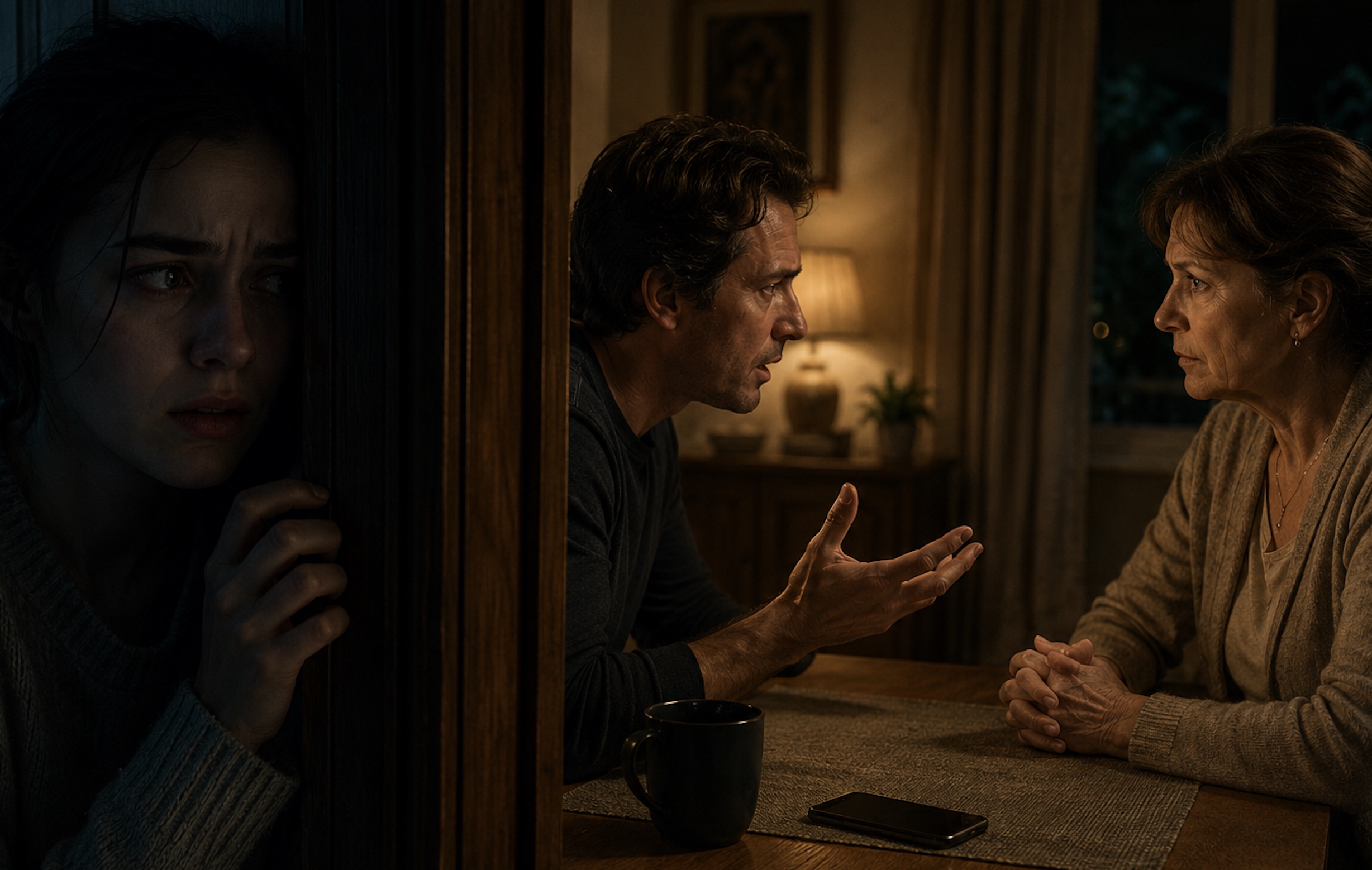
That evening, she came home earlier than usual — about an hour earlier. She opened the door with her key and entered quietly. The apartment was silent. Only Kirill’s voice came from the room — low, confident, businesslike. The kind of voice someone uses in a monologue when he is explaining a plan that has already been made.
Vera stopped in the hallway.
— …yes, I’ve already calculated it roughly. If we sell now, it’ll bring in a decent amount. I’ll transfer it to you as soon as everything is done. — A pause. — No, she won’t be against it. I’ll handle it.
Vera stood motionless. She needed one second — to be sure, to hear more.
— Timing? A month or two. First we’ll get it appraised, then find a buyer. It’s not complicated. The main thing is that she mustn’t find out ahead of time.
She mustn’t find out ahead of time.
Vera slowly straightened. Something inside her became very calm — that strange calm that comes when everything has already become clear and emotions simply cannot catch up with thought. She took hold of the door handle and opened the door.
Kirill was sitting on the edge of the bed, phone to his ear. He turned at the sound of the door and stopped mid-sentence. His face did not change immediately. For one second, it still held the same expression — focused, practical, businesslike — and only then did it begin to shift.
— I’ll call you back, — he said into the phone and put it away.
Vera leaned against the doorframe and looked at him in silence. She knew how to stay silent in a way that made the pause itself press on a person until he began to speak.
— Vera, it’s not what you think, — he started.
— You just said you would sell my dacha and transfer the money to your mother, — Vera said evenly, without the tone of a question. — And you added that I should not know ahead of time. What exactly did I misunderstand?
Kirill got up from the bed. He rubbed his face with his hand.
— I only wanted to help Mom. She’s in a difficult situation right now. She needs money urgently.
— Fine. Help her.
— But I don’t have that kind of money right now.
— I understand. But the dacha is not your money, Kirill. This is not a matter for you and your mother.
He took a step toward her and softened his tone.
— Listen, it’s just a plot of land. You go there three or four times over the summer. I don’t understand why you’re clinging to six hundred square meters when you could help a person.
Vera looked at him carefully, without anger, with the expression of someone hearing something important about the person standing in front of her.
— Kirill. The dacha belongs to me. It is registered in my name. I received it through inheritance, and it is not subject to division. I have the right to do anything I want with it — or to do nothing at all. You have no legal connection to it. Neither you nor your mother.
— I understand legally. But we’re family.
— If we are family, then you help with your own property. Yours — please. Mine — no.
— You’ve become greedy, — he said quietly, almost under his breath.
Vera did not answer. She simply looked at him for a few more seconds — calmly, the way one looks at a person one has finally understood correctly. Then she gave the slightest nod, as if putting an internal full stop to something, and left the room.
That night, she sat in the kitchen for a long time. She drank tea and looked out the window at the courtyard, where a streetlamp swayed slightly. Outside, life continued in its usual order — methodically and without unnecessary questions.
She did not think about how she felt. That was clear without words. She thought about facts. This conversation had not been the first. The questions about the dacha had not started yesterday; they had grown gradually. The half-closed door and “she mustn’t find out ahead of time” were not a slip of the tongue or an impulse. Kirill had not told his mother, “I want to help.” He had said, “I’ll sell it” and “I’ll transfer it.” First person, singular. Someone else’s property.
She also thought about what he had said at the end. “You’ve become greedy.” So in his picture of the world, a person who does not hand over what belongs to her to someone else without discussion is greedy. That was perhaps the most honest thing of all. It said a great deal.
She placed her cup in the sink, went into the room, and opened her laptop. She found information about filing for divorce through the court. They had little jointly acquired property — the apartment was hers, the dacha was hers, the car had been bought by him before the marriage. The division would not be complicated. But he was unlikely to go to the registry office and calmly sign mutual consent — so, court. The next day, she printed out the application form.
The following morning, Vera went to work as usual. She opened the reception area, turned on the computer, checked the schedule. Patients came one after another — as always on Monday, tightly packed. She made appointments, transferred calls, answered questions. Only during her lunch break, sitting in the small staff room beside the kettle, did she allow herself to think about the previous evening. Not about what had happened — that was clear. About how it had happened. Kirill had said, “She won’t be against it,” with a certainty that did not include verification. In his plan, she was background — something that existed nearby and did not object. That was the most accurate description of what had happened.
Svetlana looked into the room.
— Vera, the schedule for next month opened, and people are already calling.
— Coming, — Vera answered and stood up.
About two weeks after she filed the application, Vera received a call from an unknown number.
— Vera? This is Lyudmila Sergeyevna. Kirill doesn’t know I’m calling. Can we talk?
— We can.
— You understand, don’t you, that he only wanted to help? He’s a good son. He has always been a good son. Maybe it’s still possible to fix everything?
— Lyudmila Sergeyevna, — Vera said evenly, — I’ll answer once. Kirill discussed selling my property without my knowledge. This is not about whether he is a good son or not. This is about how he treats the people beside him. I understand that now. Goodbye.
She put the phone away. Lyudmila Sergeyevna did not call again. That evening, Vera thought that her mother-in-law had probably been sincere. She truly worried about her son. In her version of the world, all of this most likely looked different. Vera was not angry. She simply understood: they had different pictures of the world. And that cannot be cured with a conversation.
Kirill tried to talk once more — a week later, when he realized this was serious. He talked about family, about how everything could be discussed calmly, about his mother, who really was having a difficult time. Vera listened until the end. Then she said:
— Kirill, I’m not angry. But you planned to sell my property without my knowledge and give the money to another person. You said it yourself: she mustn’t find out ahead of time. This was not a misunderstanding and not a sudden impulse. It was a choice. You made it.
— Maybe we shouldn’t rush this? — he asked after a silence.
— I’ve already filed the application.
During the three months that the court process lasted, Vera did not regret her decision once. That did not mean it was easy — only that there was nothing to regret. She would have regretted staying silent. She would have regretted allowing the plan to work. She would have regretted discovering a year later that the dacha had been sold and the money transferred. That would have been a true reason for regret.
Her mother called as soon as she found out. She asked carefully whether it was true they were separating, what had happened, whether perhaps they could reconcile. Vera explained briefly — only the essence. Her mother was silent for a moment.
— Are you sure?
— I’m sure.
— Well, you know — call me if anything happens.
— I know, Mom. Thank you.
Her mother never pressured her. That was valuable. Especially now, when there were already enough people around with ready-made opinions.
The court took three months. Both of them came. Both of them signed. They crossed paths in the corridor before the hearing — both slightly early. Kirill wore a jacket and looked composed.
— Hi, — he said.
— Hi.
They did not speak again until it was over. The judge asked whether reconciliation was possible. Both answered no. They divided the jointly acquired things without conflict: some appliances, dishes, a few purchases — everything was settled quickly and calmly.
After the court decision came into force, Vera called her ex-husband and arranged to meet for the keys. He handed them over silently. She thanked him — humanly, without irony — and left. At home, she called a locksmith and changed the lock. Not out of fear. Simply because it was right. When a person no longer lives in your apartment, his key should no longer fit the door.
About a month after Kirill moved out, the neighbor from the landing, Klavdia Ivanovna, stopped Vera in the elevator.
— Vera, is everything all right with you? I see you’re walking alone now.
— Everything is all right, Klavdia Ivanovna.
— You separated?
— Yes.
— That’s a pity, — the neighbor said. — He seemed like such a pleasant young man.
— Yes, — Vera said.
The elevator stopped. She stepped out on her floor and opened the door. The apartment greeted her with silence — the same silence that had existed before him, and after him. Vera took off her shoes, hung up her jacket, went to the kitchen, and turned on the kettle. Everything as usual. A pleasant young man. Perhaps he had been. It was just that at some point, it became clear that behind that pleasantness lived a different understanding of what belonged to whom and who had the right to decide.
In March, they hired a new nurse, and for a while Vera trained her — explained how the appointment system worked, where to put patient files, how to speak with difficult patients. The new nurse was nervous at first. Vera spoke calmly and to the point — exactly the way one should when a person is trying to cope and does not need praise or pressure, only clear guidance.
At the end of March, the chief physician called Vera into his office and offered her the position of senior administrator — with a raise and expanded responsibilities. Vera asked for a day to think. The next day, she accepted. It was a good time to begin something new.
In spring, when the weather became a little warmer, she went to the dacha for the first time that season. She opened the gate with her key and walked through the plot. The soil had not warmed yet, the trees were only beginning to wake — tiny sticky leaves on the apple trees, buds on the pear. She stood by the pear tree and looked up. It would bloom, as always, in May. Aunt Galya had seen it every year.
Vera opened the house and aired the rooms. Everything was in its place. The round table, the tablecloth with a small pattern, the copper basin on the kitchen shelf. She pulled out a chair and sat down. Outside the window, it was quiet. Somewhere, a bird was singing. The apple trees stood in their early leaves.
Sometimes in the evenings, she found herself thinking about how life works. About the fact that some things only reveal themselves after they have already happened. That the conversation behind a half-closed door was not the event that destroyed her marriage. It was the event that made what already existed finally visible. “She mustn’t find out ahead of time” was not a slip. It was an honest description of how he saw her. And for that, strangely enough, she was almost grateful to him. Better to know.
The dacha was hers. The apartment was hers. Work was going well. Life without unnecessary people turned out not to be empty, but free — and that was a very pleasant discovery, although in truth it was not a discovery at all. Vera had always known it. It had simply been confirmed again. Clearly and without extra words.
Vera thought that this year she should plant strawberries — Aunt Galya had loved them very much. And repair the step on the veranda, which had been asking for it more and more insistently. And paint the fence on the south side, where the paint had peeled over the winter. There was enough to do — but these were good tasks, her own tasks, things no one could take away or rename as someone else’s.
At the end of April, she called her mother for no particular reason — no occasion, no news. They talked for about forty minutes: about work, about spring, about her mother planning to visit her sister. About the dacha, briefly: everything was fine, she would go there as usual. Her mother did not ask unnecessary questions. She simply talked. That was good too.
Vera would write everything about the dacha in a notebook. She would come the following weekend. Everything would get done in time. The conversations about selling the dacha had ended together with that marriage.
No one planned anything ahead of time anymore — because no one else had that time. The dacha stood where it had always stood: the lock on the gate held firm, the apple trees waited for summer, the garden was quiet and reliable.
And everything was exactly as she herself had decided — without other people’s plans, without other people’s deadlines, without someone else’s word “we’ll sell.”
Only her word.
Only her key.
That was precisely the order of things in which Vera knew how to live calmly, without looking over her shoulder.