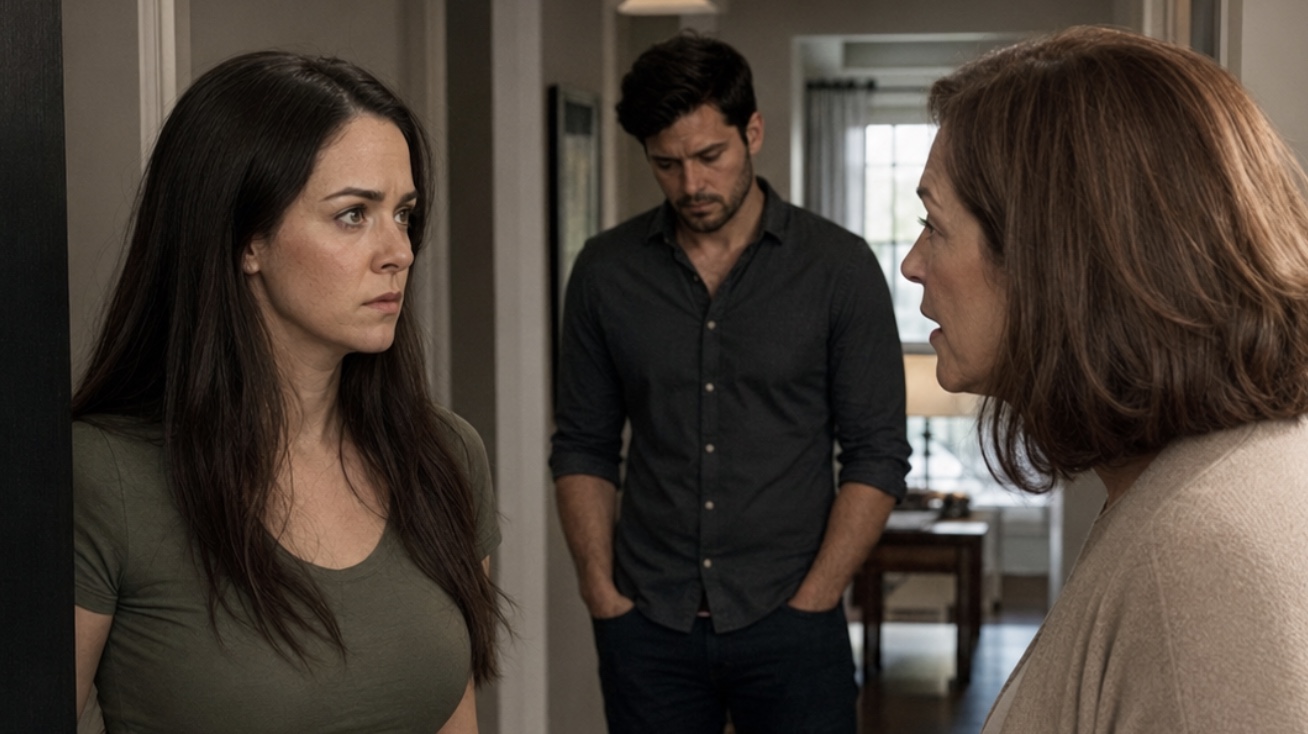
“We thought you’d leave without making a scene,” her mother admitted, calmly stirring her tea in a porcelain cup.
The spoon tapped softly against the delicate rim. The warm, domestic sound felt grotesquely out of place beside the icy horror spreading through Marina’s chest.
Marina stood in the doorway of her own kitchen, pressing a heavy work bag against her hip. The handles of professional pruning shears and a coil of green floral wire protruded from the top.
She was forty-two years old, and she had spent the last fourteen hours on her feet decorating an outdoor wedding ceremony at a country club. She had carried heavy buckets filled with freezing water, trimmed hundreds of delicate hydrangea stems, pricked her fingers bloody on Ecuadorian roses, and comforted a bride who had spent half the day on the verge of hysterics.
All Marina wanted was a hot shower and a soft pillow.
Instead, she had come home to a punch in the stomach.
A picture of perfect family harmony awaited her at the kitchen table.
Galina Petrovna, Marina’s mother, sat at the head of the table with the solemn expression of a wise family matriarch. To her right sat Marina’s twenty-eight-year-old younger sister, Dasha, lazily eating a large peach while stroking her visibly rounded stomach.
Across from them was Dasha’s husband, Vadim. He stared into his phone, pretending that none of this had anything to do with him.
“What exactly do you mean by ‘leave’?” Marina asked hoarsely.
Exhaustion made her left eyelid twitch.
“This is my apartment. I bought it eight years ago. With my own money. With the work of my own hands.”
“There you go again with your capitalist calculations,” Galina Petrovna sighed heavily, as though speaking to a stubborn child. “Mine, yours—why must you always divide everything? We are a family. Dasha is about to have a baby. Vadim, as the future father and head of the household, needs a separate room where he can work. An office. Four people cannot live comfortably in a three-room apartment.”
She paused and gave Marina a patient smile.
“And you are a single woman. You are hardly ever home because of that job of yours. You don’t need so much space. Besides, you have savings—the money you keep in my secure account. You can rent a sweet little place near your flower studio and eventually take out a mortgage. You are strong. You always manage.”
Marina lowered her bag to the floor.
Her legs suddenly felt weak.
The last three years flashed through her mind. Her life had become like an old tragicomedy in which the accommodating main character carried everyone else’s burdens while completely forgetting about his own needs.
Her floral business, a studio called Botanica, had been built with sweat, pain, and sacrifice.
Marina had started with a tiny flower kiosk near a subway station. She drove to wholesale markets before five in the morning, stood shivering inside refrigerated warehouses, and fought for favorable prices with suppliers.
Gradually, corporate clients began to appear. Then came expensive contracts for weddings, anniversaries, and private celebrations.
The business began making real money.
And the moment it did, Marina’s family gently but confidently wrapped its hands around her life.
First, Galina Petrovna moved into Marina’s spacious apartment.
“My blood pressure is unstable. I’m frightened of living alone outside the city. What if something happens and the ambulance cannot reach me in time?” she would complain, pressing one hand dramatically against her heart.
Marina gave her mother the bright, comfortable bedroom.
Then Dasha married Vadim, an unrecognized marketing genius who, for reasons no one could explain, never remained employed for more than two months.
The newlyweds rented an apartment until their landlady raised the rent. Vadim proudly announced that he would not tolerate such shameless robbery.
“Marinochka, let the children stay with you for a couple of months while they look for another place,” her mother begged. “We cannot leave them out on the street.”
A couple of months turned into two years.
Dasha and Vadim took over the living room. Marina moved into the tiny study, where she slept on a folding sofa. She woke at six every morning so she would not disturb her relatives and quietly made coffee while everyone else slept.
She paid every utility bill. She bought expensive groceries because Vadim preferred farm-raised meat and Dasha claimed she could not survive without fresh berries throughout the year.
But the family’s greatest asset was the so-called Emergency Fund.
Galina Petrovna had worked as an economist for a state-owned enterprise her entire life. One day, she sat Marina down for a serious conversation.
She explained that business was unpredictable. One month could bring enormous profits, while the next could bring nothing.
“Money must be kept in a reliable government bank,” her mother declared. “The account should be in my name because I am a pensioner and receive a better interest rate. That way no one can touch it.”
Marina had always trusted her mother without question.
Every month, she transferred one hundred and fifty thousand rubles from her profits into Galina Petrovna’s account. Sometimes she sent two hundred thousand.
According to Marina’s calculations, the account should now contain nearly five million rubles.
It was a substantial financial cushion, one that had comforted her during difficult periods.
“So you want me to leave my own home,” Marina said slowly as she entered the kitchen and sat on a stool. “Then I’m supposed to use the five million rubles in your account to buy another apartment. Is that right, Mom?”
“Exactly!” Galina Petrovna exclaimed, clapping her hands with delight.
She was clearly pleased that Marina had accepted the arrangement so quickly.
“That’s my clever girl. We will transfer this apartment to Dasha. She needs it more because she has a family and a child on the way. You are free as a bird.”
“All right.”
Something inside Marina tightened into a cold, rigid spring.
“Then tomorrow we will go to the bank and withdraw the money. I need to know how much I have for the down payment. Mortgage rates are high right now, so I’ll have to calculate everything carefully. Please get the account agreement and the bank records. I want to see the exact balance, including the accumulated interest.”
An unpleasant silence filled the kitchen.
Vadim stopped scrolling and froze with his finger on the screen.
Dasha choked on her peach.
Galina Petrovna nervously straightened the lace napkin on the table.
“Marinochka, why are you in such a hurry?” her mother asked.
Her voice trembled.
“Tomorrow is Sunday. Banks are closed. Then I have an appointment with my cardiologist. We can deal with it sometime next week.”
“Mom, I am not asking you to withdraw the money tonight. I’m asking you to show me the statements.”
Marina’s tone was firm.
She knew that nervous, evasive voice too well. Galina Petrovna had sounded exactly the same when Marina was a child and her mother had accidentally broken her favorite piggy bank before trying to blame it on a draft.
Marina stood and walked toward her mother’s bedroom.
She knew Galina Petrovna kept every important document inside a blue plastic folder on the bottom shelf of the dresser.
“Where do you think you’re going?” Galina Petrovna shouted.
She leaped from her chair with astonishing speed for a woman who constantly complained about her heart.
“That is my private space! Marina, stop immediately! How dare you disrespect your elders?”
But Marina had already opened the dresser drawer.
The room smelled of old perfume and heart medication.
She pulled out the thick blue folder.
Her mother tried to snatch it from her hands, but Marina pushed her aside, opened the zipper, and began sorting through the papers.
Birth certificates.
Old warranty documents for the refrigerator.
Medical reports.
And then she found the banking records.
Marina pulled out a heavy sheet bearing the logo of a well-known bank.
It was a statement issued eight months earlier.
Her eyes moved quickly across the page.
The line marked “Available Balance” showed:
0 rubles and 00 kopecks.
Below it was another sentence:
“Account closed at the client’s request.”
The air in the room seemed to become thick and sticky.
Marina turned the page, searching for some kind of explanation.
Beneath the bank statement lay a thick contract.
“Commercial franchise agreement…”
“Lease of business premises…”
“Purchase of equipment…”
Every document listed the same client:
Individual Entrepreneur Vadim Alexeyevich Smirnov.
Then came the receipts.
A high-end Italian coffee machine: half a million rubles.
Designer renovations in a fashionable loft district: one and a half million.
Premium coffee beans, rent, employee salaries, equipment, promotional expenses.
The total investment was almost exactly five million rubles—the same amount Marina had saved piece by piece over the years while denying herself vacations, new clothes, and even ordinary comforts.
She turned around slowly.
Her mother stood in the doorway, her face drained of color.
Behind her were Dasha, looking frightened, and Vadim, frowning with irritation.
“You spent my money on a coffee shop?” Marina asked.
Her voice was unnaturally calm.
She remembered how Vadim had strutted around six months earlier, calling himself a restaurateur and describing his fashionable new project to anyone who would listen.
The café had collapsed after only four months. It could not survive the competition or Vadim’s astonishingly poor management.
He had declared that honest entrepreneurs were never allowed to succeed in their country, then returned to Marina’s sofa and his video game console.
It had never occurred to Marina to ask whose money he had buried beneath the ruins of his ambition.
“Marinochka, sweetheart, please listen to me,” Galina Petrovna stammered, pressing both hands against her chest. “Vadim needed a chance to get back on his feet. He is a man. He must provide for his family. He wrote such a beautiful business plan. We wanted to increase your capital. We would have returned twice as much! How were we supposed to know the location had no foot traffic or that the suppliers would let us down?”
“So you secretly withdrew all my savings,” Marina said, carefully emphasizing every word.
She returned to the kitchen with the folder in her hands. The others followed her obediently.
“You invested everything in the ridiculous fantasy of a man who has never managed anything more complicated than a game controller. You lost five million rubles. And afterward, you sat down to drink tea and decided that I should pack my bags and leave my own apartment because the three of you need more space?”
“Money! Money! Is that all you can talk about?” Dasha suddenly shrieked.
Angry tears filled her eyes.
“All you care about are numbers and documents! Our family was falling apart! Vadim was depressed. He needed to fulfill his potential. But you wouldn’t understand that. You sit among your flowers and think only about work. You are a cold, heartless businesswoman. You have no idea what real love and support mean.”
Vadim cleared his throat and tried to look dignified.
“Marina, there is no need to turn this into a tragedy. Yes, the project failed. That is part of the risk of doing business. I’ll repay everything as soon as I find an investor for my next startup. We only wanted what was best. And about the apartment… honestly, what does one woman need with all this space?”
Marina stared at them and realized she no longer recognized the people standing before her.
Or perhaps she was seeing their real faces for the first time, without the comforting veil of family loyalty.
She remembered how her mother had always given the largest slice of cake to Dasha because “the poor child was delicate.”
She remembered paying for Dasha’s university education because “Mom cannot support a student alone.”
She remembered paying for their lavish wedding because “people will talk if we do something cheap.”
All these years, Marina had been nothing more than a convenient financial instrument.
A cash cow that never asked questions and quietly kept producing while everyone around her took whatever they wanted.
And now that they had drained her savings, they had decided to take the barn as well.
“Business risks, you say?” Marina gave a bitter smile and threw the folder onto the table. “Wonderful. I deal with risks every day. Sometimes flowers arrive frozen. Sometimes delivery trucks get stuck at the border. Do you know what responsible people do when something goes wrong? They accept personal responsibility.”
She walked to the window.
Evening shadows were thickening outside, and lights were appearing across the city.
Somewhere out there stood her studio, her work, and the real life she had pushed aside for the sake of this false family.
“Here is what is going to happen,” Marina said, turning around.
There was no trace of her former softness in her eyes.
She looked like a strict executive who had just discovered that a trusted employee had been stealing from the company.
“A locksmith will arrive tomorrow at ten in the morning to replace every lock in this apartment. Before he comes, you will pack your belongings and leave my property.”
“What?” Galina Petrovna gasped, grabbing the edge of the table. “You are throwing your own mother into the street? You are evicting your pregnant sister? God will punish you for this!”
“Into the street? Why would you be in the street?” Marina replied in an icy voice. “Vadim surely has an excellent crisis-management plan. He is a businessman, after all. He can rent a home for all of you. As for eviction, Mom, half an hour ago you suggested that I move into a rented apartment. Apparently, renting is perfectly acceptable.”
“I am not going anywhere!” Vadim slammed his fist against the table.
The gesture was far less intimidating than he had intended.
“We are registered at this address. You have no right to throw us out.”
“Vadim, you seem to have forgotten that your registration was temporary,” Marina replied calmly, taking her phone from her bag. “It expired a month ago. I deliberately chose not to renew it because I hoped you would finally understand that it was time to move out.”
She looked at each of them in turn.
“Legally, you are strangers occupying my property without permission. If one person or one suitcase remains here tomorrow at ten, I will call the police. I will also file a complaint concerning the theft of five million rubles.”
“What theft?” Galina Petrovna snapped, trying to regain control. “The money was in my account. It was legally mine. You cannot prove anything.”
“Mom, we live in the digital age. My banking app contains every receipt for every monthly transfer I made to you. Each payment was labeled ‘savings.’ If this goes to court, my lawyers will pursue a claim for unjust enrichment.”
Marina’s expression remained calm.
“Good lawyers are expensive, but believe me, I will hire the best out of principle. You will repay everything—the stolen millions, legal fees, and any additional damages I can claim. So I strongly suggest that you leave quietly.”
“I’m having an attack!” Galina Petrovna cried.
She collapsed onto the small kitchen sofa, rolled her eyes, and grabbed the left side of her chest.
“I cannot breathe. Call an ambulance…”
Dasha screamed and rushed to her mother.
Vadim began frantically opening the window.
Only yesterday, Marina would have run for the blood pressure monitor, poured heart drops into a glass, and begged her mother not to upset herself. She would have promised to forgive everything.
Today, Marina merely watched the cheap theatrical performance.
She walked to the medicine cabinet, took out the electronic blood pressure monitor, and silently wrapped the cuff around her mother’s arm.
Galina Petrovna immediately stopped moaning and stared anxiously at the screen.
The machine hummed as the cuff inflated.
A minute later, the result appeared:
130 over 85.
Pulse: 72.
“Perfect blood pressure for your age, Mom,” Marina said dryly as she removed the cuff. “Unlike your conscience.”
She placed the monitor on the table.
“Pack your things. There are boxes and large trash bags on the bottom shelf of the storage closet.”
Marina turned away and went into her tiny study, closing the door firmly behind her.
For the first time in years, she did not unfold the uncomfortable sofa.
She simply sat in the armchair and listened to Dasha sobbing, Vadim swearing, and her mother lamenting behind the wall.
Cabinet doors slammed.
Clothes were thrown into suitcases.
Her relatives loudly discussed what a heartless monster Marina had become.
For a moment, fear crept in.
She was destroying the world she had known for years.
Then she remembered the empty bank statement and her mother’s cold, calculating voice:
“You can rent a little place and take out a mortgage.”
The doubt disappeared, leaving behind a feeling of perfect clarity.
Morning began with the sound of suitcases banging against the walls in the hallway.
Marina stepped out of the study at exactly nine forty-five.
The entrance hall was filled with bags, boxes, and overstuffed suitcases.
Dasha, her face swollen from crying, was putting on her coat.
Vadim was dragging a heavy suitcase toward the elevator.
Galina Petrovna stood before the mirror, nervously adjusting her scarf.
She looked at her eldest daughter for a long time.
Hatred and genuine incomprehension were mixed in her expression.
In Galina Petrovna’s version of reality, she had always possessed unlimited authority over her daughters’ lives. Now that familiar system had suddenly stopped working.
“You will end up alone, Marina,” she hissed, placing one hand on the door handle. “Who could possibly need a woman like you, with your flowers and your impossible personality? You have no husband, no children, and now you have no family. You will sit in this empty apartment and howl from loneliness. One day you will remember my words, but it will be too late.”
“Goodbye, Mom. Leave your keys on the cabinet.”
Marina did not even flinch.
She looked at them as if they were strangers who had overstayed their welcome.
The door slammed shut.
A deep and unfamiliar silence settled over the apartment.
There was no television murmuring from her mother’s room.
There was no smell of the fried bacon Vadim loved to eat every morning.
Dasha’s cosmetic bottles were no longer scattered across the bathroom.
Marina walked slowly through the rooms.
They looked as though a hurricane had passed through them.
Dirty cups stood on tables. Bedding had been left in crumpled piles. Dust gathered in the corners.
Yet the air seemed cleaner.
Marina opened every window and allowed the cool autumn wind to sweep through the apartment.
At exactly ten o’clock, the locksmith rang the doorbell.
Six months passed.
Early spring burst into the city with brilliant sunlight and the ringing sound of melting ice.
Marina sat behind the wheel of her new snow-white crossover, purchased on credit, and smiled as she watched the road ahead.
In the trunk were samples of expensive Italian silk for another luxury wedding.
After that unforgettable autumn, her business had begun growing with astonishing speed, as though someone had removed a set of heavy chains from its shoulders.
She expanded the studio, hired two talented florists, and found an excellent manager who took over the paperwork and administrative routine.
Marina no longer had to wake before dawn or freeze her hands in wholesale warehouses.
She focused on the things she loved most: creative concepts, design, and working with high-end clients.
Her manicure was always immaculate now, and her eyes carried the calm, steady confidence that belongs only to people who are completely free.
The apartment had changed as well.
Marina hired a renovation crew and completely refreshed the interior, erasing even the memory of her relatives from the walls.
Her mother’s bedroom became an elegant walk-in wardrobe.
The former living room, where Dasha and Vadim had stayed, was transformed into a bright and comfortable relaxation area with an enormous sofa and a home cinema.
Marina slept in a large bed with an orthopedic mattress and woke whenever she chose.
The loneliness her mother had described as a curse turned out to be the greatest blessing of Marina’s life—a source of peace, strength, and energy.
She learned fragments of news about her relatives through mutual acquaintances and occasional cold messages.
As expected, Vadim had no brilliant plan for becoming rich.
They rented a shabby two-bedroom apartment on the far edge of the city, in a bleak residential district.
Galina Petrovna spent almost her entire pension on rent.
After months of unemployment, Vadim was forced to take a job as a delivery courier. The work was a devastating blow to his oversized ego.
Dasha gave birth to a boy and regularly complained on social media about the unbearable life of a young mother who had no one to help her.
Her posts always contained thinly veiled references to a cruel and selfish older sister.
Galina Petrovna tried several times to break through Marina’s defenses.
On New Year’s Day, she called from an unfamiliar number and cried into the phone.
She described how difficult it was to climb five flights of stairs in a building without an elevator. She complained that Vadim had begun shouting at Dasha because of their financial problems.
She appealed to Marina’s pity, brought up childhood memories, and tried to use the same old methods of control.
“Marinochka, we understand everything now,” her mother said tearfully. “Perhaps we could come back. I would look after the baby, Dasha could return to work, and we would not bother you. You spend all day at the studio anyway…”
But the old spells no longer worked.
Their power was gone.
“Mom, I have a meeting with suppliers from Ecuador in ten minutes,” Marina replied calmly, looking at her reflection in the panoramic window of her office. “I wish all of you health and strength in dealing with your difficulties. But my home is closed to you. Permanently.”
She ended the call and blocked the new number.
There was no anger left in her.
She did not want revenge.
Those people had simply moved permanently into the category of strangers.
Marina parked outside her studio and stepped into the spring sunshine.
She inhaled deeply.
The air smelled of melting snow, fresh pastries from the bakery next door, and the faint fragrance of mimosa flowers delivered to her shop that morning.
Life was beautiful.
It was unpredictable, generous, and full of possibility.
Most importantly, it finally belonged to Marina alone.
And for that privilege, losing five million rubles no longer seemed too high a price.