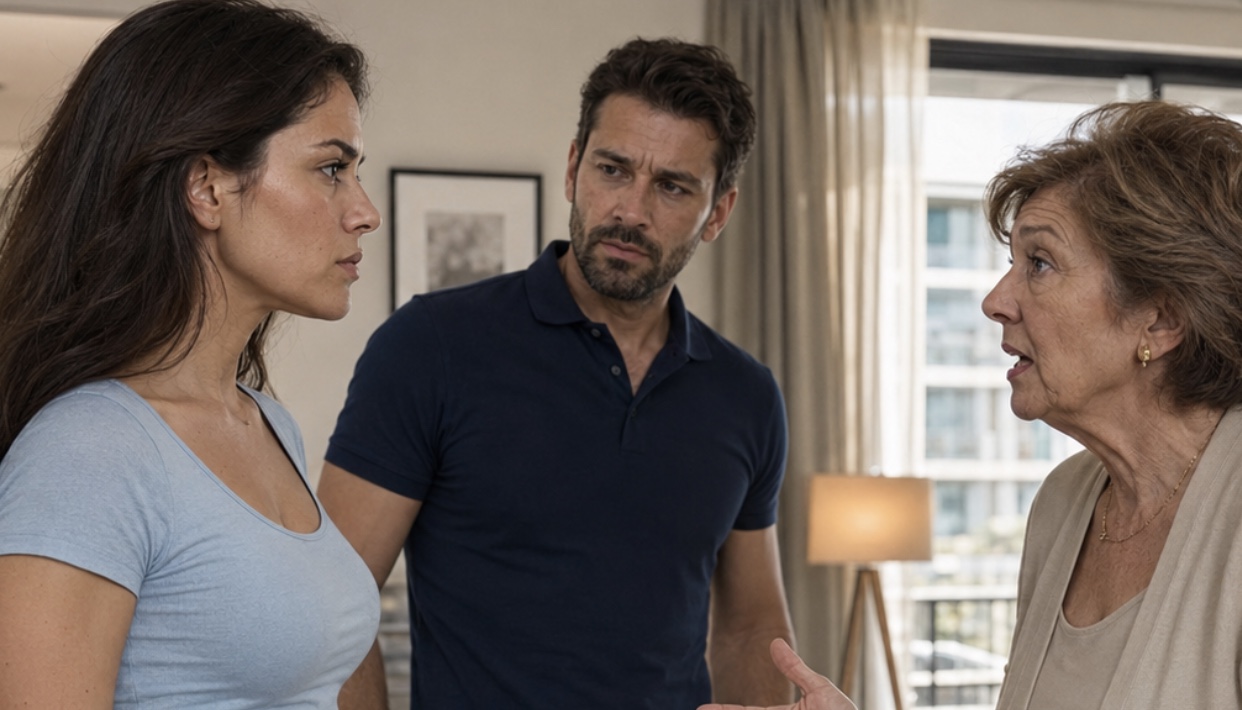
Anna, tell me the PIN for your banking app. I’m going to install it on my tablet so we can finally have one properly managed family budget.”
Anna froze, still holding the coffeepot.
The rich aroma of freshly brewed coffee filled the bright kitchen, mixing with the smell of warm pastries from the bakery on the corner. At the large dining table, which occupied nearly half the high-ceilinged room, sat her mother-in-law, Lidia Petrovna.
She was wearing a silk robe, her hair was styled to perfection, and in front of her lay a brand-new tablet—purchased, incidentally, with Anna’s credit card the previous Christmas.
Across from her sat Mark, Anna’s husband. He was slowly spreading butter over a crisp pretzel while pretending to be deeply absorbed in an article on his phone.
“Lidia Petrovna, perhaps I’m still half asleep,” Anna said, carefully placing the coffeepot on a wooden trivet. “Why exactly do you need access to my personal bank account?”
“Oh, Annie, don’t be childish,” her mother-in-law replied with a patronizing smile, her gold bracelet glinting as she moved her hand. “Mark told me yesterday that the two of you are hopeless when it comes to managing money. One month you receive some enormous utility adjustment, the next your car insurance goes up. I worked in a planning department for thirty years. I know how to organize financial flows.”
She straightened proudly.
“I’ll pay the insurance, transfer the rent, monitor household expenses, and help Felix a little whenever his start-up projects run into trouble. Every family needs one person in charge of the money. Remember that film Garage? ‘A betrayal committed at the right time isn’t betrayal—it’s foresight!’ No, wait, perhaps that line was from somewhere else. Never mind. The point is that the collective must trust its leadership.”
“Felix?” Anna repeated. “Your younger son? You want to support him with my salary?”
She looked directly at her husband.
“Mark, is there anything you’d like to say?”
Mark sighed theatrically, put down the knife, and rubbed the bridge of his nose like a man exhausted by unreasonable children.
At forty-five, he still cultivated the appearance of a bohemian intellectual: carefully maintained stubble, expensive horn-rimmed glasses, and a soft cashmere sweater.
“Anna, please don’t start,” he said. “Mom is right. You’re always working. You spend entire days at construction sites drawing flower beds and designing parks. You simply don’t have time to keep track of everything. A euro here, an automatic payment there, another subscription somewhere else—it all adds up.”
He gestured vaguely toward the kitchen.
“Yesterday we received an extra heating and hot-water bill for almost twelve hundred euros. Mom is only offering to handle the administration. She can give us a reasonable amount for personal spending every week. It would make life easier.”
“The heating bill was so high because your mother stays with us for three months at a time,” Anna replied, her voice becoming dangerously quiet, “turns every radiator to the highest setting, and then opens the windows because she says the apartment is too stuffy.”
She looked from Mark to Lidia Petrovna.
“And my money does not disappear without explanation. I am a landscape architect. I design public parks and private gardens. I earn an excellent salary, and I know exactly where every cent goes.”
“How materialistic you are,” Lidia Petrovna said, pursing her lips. “Everything is measured in euros with you. You even resent using a little heat for your own mother-in-law. Haven’t you seen Love and Pigeons? ‘Lyuda! Oh, Lyuda!’ Honestly, you are just as narrow-minded and provincial.”
She waved dismissively toward her son.
“Mark is a creative person. He is a producer. His mind should be occupied with art and ideas, not utility bills.”
“A creative producer who has not produced anything successful in two years except a party at a local bar that lost money,” Anna said, finally losing patience.
She picked up her laptop bag.
“No, Lidia Petrovna. My PIN will remain private. And if you are so eager to manage money, I suggest finding a job.”
She turned, walked out of the apartment, and quietly closed the heavy oak door behind her.
Anna could not concentrate for the rest of the day.
Detailed plans for a new botanical garden covered her desk. On her computer screen were cost estimates for rare plants ordered from specialist nurseries. Yet her thoughts kept returning to the conversation in the kitchen.
She was forty-two years old.
Eight years earlier, when she married Mark, he had seemed like a celebration in human form—a charismatic generator of brilliant ideas. Their first years together had genuinely been exciting.
Then the celebrations slowly ended, and ordinary life began.
It soon became clear that Mark was incapable of earning a stable income. His event-production agency existed mainly on paper. There were endless proposals, meetings, concepts, pitches, and promised investors, but very little actual revenue.
The entire financial burden gradually settled on Anna’s shoulders.
She paid the rent on their spacious four-room apartment in a desirable neighborhood—twenty-five hundred euros a month, including utilities. She bought the groceries and paid the lease on the new Audi Mark drove.
“How am I supposed to meet investors in some old wreck?” he had argued. “Image matters, Anna.”
But the most exhausting part was Mark’s family.
His mother, Lidia Petrovna, expected to be treated like a respected family matriarch while contributing nothing. His thirty-eight-year-old brother, Felix, was permanently “searching for himself.”
Felix had never managed to stay in one job beyond the probation period. He constantly borrowed money “until Friday” and never paid it back.
Anna endured it all.
She had grown up in a family where divorce was considered a disaster, almost a public disgrace. She honestly believed that every marriage went through difficult periods and that decent people supported one another during hard times.
Three years earlier, hoping to secure their future, Anna had opened a savings account. She and Mark had agreed that she would transfer fifteen hundred euros from her bonuses into it every month. The goal was to save enough for the down payment on a house.
Mark solemnly promised that he would contribute money from his future production fees.
Both of them had access to the account.
Perhaps I was too harsh this morning, Anna thought, rubbing her tired eyes.
After all, Lidia Petrovna came from another generation. Maybe she simply wanted to feel useful.
Anna decided to buy a good cake on the way home and have a calm conversation with everyone that evening.
Fate, however, had other plans.
On Thursday, Anna was working from home.
A meeting with a contractor had been cancelled, so she sat at the kitchen island making corrections to an automatic irrigation plan. Mark had gone downtown for an “important business lunch,” while Lidia Petrovna had gone shopping—carrying, naturally, her son’s credit card, which was ultimately paid off with Anna’s money.
Mark’s tablet—the same one on which his mother had wanted to install Anna’s banking app—was lying on the living-room sofa.
Suddenly, the screen lit up and emitted a short chime.
Then another.
And another.
Anna got up to pour herself some water and glanced casually at the display. The messages were coming from a family group chat. Since the tablet was unlocked, the full text was visible.
Felix: Mom, what’s happening? The agent called again. He says the lease has to be signed today. We need to transfer the deposit and first month’s rent before tonight.
Lidia Petrovna: Felichka, don’t panic. Mark promised he would withdraw the money today.
Felix: Won’t his bulldozer of a wife notice? She’d strangle someone over a single euro.
Lidia Petrovna: What can she do about it? She’s a workhorse. Mark said he’ll transfer the money from their savings account. He’ll tell her he invested it in shares or make up some other nonsense. She doesn’t understand finance. All she knows how to do is plant bushes.
Something inside Anna snapped.
It felt as though a fragile structure she had carried for years had broken loose and fallen soundlessly into a bottomless ravine.
She wiped her hands on a kitchen towel, walked over to the sofa, and picked up the tablet.
Her fingers were ice cold.
She opened the conversation.
It was a private chat between Mark, Felix, and their mother.
Anna was not included.
She scrolled upward through the messages, moving back through weeks and months. With every page, the fog that had covered her eyes throughout eight years of marriage lifted a little more.
There was no house deposit.
The savings account into which Anna had faithfully transferred fifteen hundred euros every month had been repeatedly drained by Mark.
The money had been used to cover Felix’s debts, finance expensive resort holidays for Lidia Petrovna, and purchase new watches for Mark.
Now the three of them were planning to use Anna’s money to pay the deposit, agency commission, and rent for a luxurious three-room apartment in the city center for Felix.
One message from Mark, sent on Tuesday, made Anna’s stomach turn.
Mark: Mom, I’ll try to pressure Anna into giving me the PIN for her main banking app. Then I can set up a direct payment for Felix’s apartment. She won’t even notice it in the statements. She never checks them. I’ll say it’s a new health-insurance payment.
Anna slowly placed the tablet on the table.
She was not shaking.
She was not crying.
Instead, an astonishing clarity settled over her mind.
It was the same sharp clarity she experienced when she discovered a critical error in a land survey and immediately understood how the terrain needed to be corrected to save an entire project.
She walked into the study, opened her laptop, and signed in to online banking.
Then she opened the savings account.
The balance was 340 euros.
Of the nearly fifty-four thousand euros she had deposited over three years, almost nothing remained.
The transaction history showed a long procession of transfers:
“Felix—living expenses.”
“Felix—loan repayment.”
“Mother—holiday.”
“Payment to property agent.”
Anna downloaded every account statement as a PDF and printed them.
Then she photographed the messages on Mark’s tablet, capturing the entire family conversation. She printed those as well.
After organizing everything into folders, she called her lawyer.
“Frau Wagner? Good afternoon, this is Anna. I need an urgent consultation regarding divorce proceedings and the unauthorized removal of marital funds. Yes, I have complete bank statements and written evidence. I can be at your office in one hour.”
On Sunday, Lidia Petrovna decided to demonstrate the “wisdom of the older generation” by preparing an enormous pot of goulash for lunch.
The smell of meat and spices quickly attracted Felix.
The table was set in the living room. Mark was in an excellent mood. He opened an expensive bottle of red wine from the collection Anna had purchased for Christmas.
“To family!” Mark declared, raising his glass. “The most important thing is that we always stand together.”
Anna did not touch her wine.
She sat perfectly upright, wearing a severe dark turtleneck. Beside her plate lay a thick cardboard folder secured with elastic bands.
“Lidia Petrovna,” Anna began, her clear voice cutting through the cozy atmosphere, “a few days ago, you asked for access to my banking application. I thought about it, and I realized that you were right.”
Mark smiled smugly and winked at his brother.
Lidia Petrovna’s face brightened.
“I knew common sense would prevail,” she said. “Just like in Moscow Does Not Believe in Tears: ‘I’ve been looking for you for so long!’ Now, hand me your phone.”
“I’m not giving you my phone,” Anna replied.
She placed one hand on the folder and released the elastic bands.
“I prepared something better. A complete financial report covering the last three years. Printed, categorized, and fully transparent—exactly the way you like it.”
She removed a thick stack of papers and placed it in the center of the table beside the pot of goulash.
Felix reached for the documents casually.
He turned over the first page and nearly choked on his wine.
His eyes widened.
The top sheet contained a full-color photograph of their secret conversation.
Mark: Mom, I’ll try to pressure Anna into giving me the PIN…
Mark snatched the pages out of his brother’s hands.
His face turned the color of dirty concrete.
He flipped through the papers frantically: screenshots of the messages, bank statements, and transaction records. Every stolen payment had been carefully highlighted in yellow.
“Anna… what is this?” Mark croaked, pushing his chair backward. “You went through my tablet? That is a violation of my privacy!”
“Your right to privacy ended when you began stealing my money,” Anna replied in a voice as cold as ice.
She looked directly into his eyes.
“Fifty-three thousand six hundred euros. That is the exact amount you removed from our so-called house savings account to support your irresponsible brother and finance your mother’s personal luxuries.”
Red blotches spread across Lidia Petrovna’s face. She clutched her chest, performing what appeared to be the beginning of a heart attack.
“How dare you?” she shrieked, forgetting all her beloved film quotations. “That money belongs to my son! He has the right to manage his family’s finances. Felix needed help. We had an obligation to support him.”
Her voice became even sharper.
“You are a cold, heartless witch. You care more about your bushes than about living people!”
“Please don’t shout, Lidia Petrovna,” Anna said without raising her voice. “This is a respectable building. The neighbors may call the police.”
Her calmness only infuriated them more.
“Your son did not earn a single cent of that money. I support him. I pay for this apartment. I pay for the vehicle he drives. Meanwhile, behind my back, you call me a workhorse and discuss setting up automatic payments from my salary account to cover Felix’s rent.”
“Anna, please, let’s discuss this calmly,” Mark said, switching to the warm, persuasive tone he normally used on clients.
He reached toward her with both hands.
“Yes, I made a mistake. I wanted to help my family. I’ll repay everything. I’ll find a proper job, I swear. We are still a family. We’ve spent eight years together.”
“Your family is sitting on either side of you,” Anna replied. “To the three of you, I was nothing more than an ATM.”
She rose from the table.
“My lawyer filed the divorce papers on Friday. She also submitted a formal demand for the return of the funds you removed without my informed consent. All the evidence, including your private correspondence, has already been attached to the case.”
“You won’t get that money back from us,” Felix said, glaring at her. “It was a joint account.”
“My lawyer disagrees,” Anna replied. “But that is not even the most interesting part.”
She removed the Audi keys from her pocket and placed them near the edge of the table.
Or rather, she reclaimed the spare set.
“The lease on the car is in my name. The contract will be terminated tomorrow, and the vehicle will be returned to the dealership.”
Mark stared at her.
“And as for this apartment,” Anna continued, “the rental agreement is also in my name. Yesterday, I submitted official notice to the landlord. The tenancy ends in three months.”
She glanced around the room.
“However, I have no intention of living with any of you for another day. I have already rented a small, comfortable apartment near the park. The movers are coming tomorrow morning to collect my belongings and the furniture that belongs to me.”
“What do you mean, we have to move?” Lidia Petrovna cried, grabbing her head. “Where are we supposed to go? Felix didn’t get the apartment because we failed to pay the deposit. Mark, do something! Tell this madwoman that we are not leaving!”
“You may remain here until the end of the month I have already paid for,” Anna said, checking her watch. “That gives you two weeks. After that, you will need to pay the twenty-five-hundred-euro rent yourselves.”
She looked at Mark and Felix in turn.
“Considering Mark’s damaged credit history and Felix’s official unemployment, I wish you every success navigating the modern housing market.”
Anna turned and walked toward the bedroom.
“You’ll regret this!” Mark shouted after her, slamming his fist onto the table so hard that the glasses rattled.
“You’ll end up alone with your precious drawings. Nobody wants an aging woman with a personality like yours.”
Anna stopped.
For a moment, she stood with her back to him.
Then she turned around and smiled—warmly and sincerely.
“You know, Mark, I would rather live alone with my drawings than spend the rest of my life dragging a cart with three clowns sitting in it.”
She nodded toward the table.
“Enjoy your lunch. The goulash appears to be getting cold.”
September sunlight fell gently across the new pathways of the city’s botanical garden.
Anna stood in the middle of the Japanese garden, examining the ornamental maple trees that had just been planted. Their leaves were already turning deep shades of crimson.
She wore a practical work jacket, jeans, and waterproof boots.
She looked ten years younger.
The permanent exhaustion had disappeared from her eyes, and her shoulders were no longer curved beneath an invisible burden.
Life in her new, bright two-room apartment was astonishingly peaceful.
No one turned the radiators to maximum heat.
No one asked her to transfer money into questionable business ventures.
No one tried to gain control over her bank accounts.
The money she was no longer spending on Mark and his relatives allowed Anna to hire an assistant at her architecture studio. She finally took a holiday in Italy—alone, without anyone complaining that every hotel was too expensive.
The divorce proceedings were almost complete.
Frau Wagner had turned out to be a legal shark.
Not only had she secured a property settlement that reflected Mark’s documented misuse of marital funds, but she had also forced him to sign a repayment agreement. The alternative would have been a formal fraud investigation.
Life had become considerably more difficult for Mark.
Unable to afford the expensive apartment, he, Felix, and Lidia Petrovna moved into a tiny three-room flat on the far edge of the city, in an aging concrete apartment block where the elevator had not worked properly in years.
To repay Anna, Mark was forced to swallow his pride and accept a job as a sales representative in a call center, working long shifts.
Felix continued drifting between temporary jobs.
Lidia Petrovna now directed her furious lectures not at her former daughter-in-law but at her sons, accusing them of flushing their lives down the toilet.
Anna’s phone vibrated briefly in her pocket.
She removed one gardening glove and took it out.
A message from Mark appeared on the screen.
For the past six months, he had written regularly, progressing through several emotional stages—from threats and accusations to self-pity and desperate apologies.
Anna, hello. Mom is in the hospital with high blood pressure. Felix is unemployed again. I can’t live like this anymore. I finally understand how badly I treated you. You were the best thing that ever happened to me. Please meet me for coffee. I miss you. Forgive me.
Anna looked at the message.
In the past, words like those would have filled her with guilt. She would have rushed to rescue everyone, transfer money, solve problems, and accept responsibility for things that had never been hers.
Now she felt only a quiet, peaceful emptiness.
It was like looking at an old technical drawing containing a fatal design error—a project that had already been rejected, filed away, and forgotten.
She did not answer.
Instead, she pressed “Delete conversation,” blocked his number permanently, and returned the phone to her pocket.
“Frau Anna!” the site supervisor called from across the garden. “Where should we position the stone lanterns?”
“I’ll show you, Thomas!” Anna called back.
She breathed in the cool air, scented with damp soil and pine needles, smiled at the autumn sun, and walked forward with a confident step—toward the beautiful new landscape she had designed for herself, measured carefully and built exactly as it should be.