The market opens at seven, and by eight I’m already standing by the third stall, weights in my hands. My job is to check the accuracy of scales. I travel from market to market and shop to shop, making sure sellers aren’t cheating their buyers out of a few grams.
“Irina Nikolaevna, at least you tell them my scales are honest!” laughs Ashot, the owner of the vegetable stand.
“Honestly, Ashot. You’re three grams short per kilo. Tighten the screw and you’ll be a saint.”
He adjusts the scales, I put a seal on them. I’m in a good mood. In a week, Matvey turns thirteen, and for the first time in years… Actually, I can finally buy him a real bicycle, not a secondhand one.
My phone buzzes briefly in my pocket. It’s a message from the building management company:
Oleg Viktorovich, this is a reminder about your overdue rent for the apartment at 14 Beregovaya Street, Apartment 37. The outstanding amount is…
I stare at my screen, not understanding a word. We don’t have any apartment on Beregovaya. For twenty-five years we’ve lived in a two-room flat that my dad gave us when he divorced my mom and left for his new wife.
Oleg gave me this SIM card five years ago, after he got a new number. He said he didn’t need the old one, and it was convenient for me—the plan was cheap. Apparently, somewhere he gave this number as a contact and forgot to update it.
“Irina Nikolaevna, are you okay? You’ve gone pale,” Ashot says, handing me a bottle of water.
“It’s nothing. Probably just a mistake. I’ll head out, still have two markets to do.”
But I don’t go to any more markets. I get in my car and punch the address into my GPS.
Beregovaya is a new district near the port. The building is yellow brick, with an intercom and planters filled with petunias. I climb to the fourth floor and press the bell for apartment thirty-seven.
A young woman opens the door. She looks about twenty-eight, her blond hair pulled into a ponytail. In her arms is a little boy, about three years old, in pajamas covered in tiny cars.
“Who are you looking for?” she asks.
“Does Oleg Viktorovich live here?”
“Olezhek is out on a trip, he’ll be back Friday. Are you from the management company? I told you, we’ll pay by the end of the month.”
I say nothing. I peer past her, into the hallway. Hanging on a hook is a blue windbreaker with a river port patch and a torn left pocket.
I’ve mended that windbreaker three times. Since spring, Oleg said he “couldn’t find” it, and probably left it on the tugboat.
“No, I’m not from the management company,” I say. “Tell Oleg that Irina stopped by.”
“Irina who?”
“His wife.”
The woman shifts the child to a more comfortable position and frowns. There’s no fear in her voice, only annoyance.
“Ex-wife, you mean. Oleg told me you’ve been divorced for ages. And that you’re… complicated.”
“I’m an inspector of scales, young lady. I’m precise. We haven’t been divorced a single day.”
The boy reaches for my earrings. He has Oleg’s chin with the same little dimple. Just like my Denis did as a child.
I walk down the stairs on foot. On the second floor, I stop and grip the handrail for a long time.
Oleg comes home at nine in the evening. There is no “trip until Friday”: navigation ended early this year, and I know it as well as he does. The moment he walks in and sees my face, he understands everything.
I expect him to start lying. He doesn’t. He puts his bag on the floor, takes off his jacket, and walks into the living room.
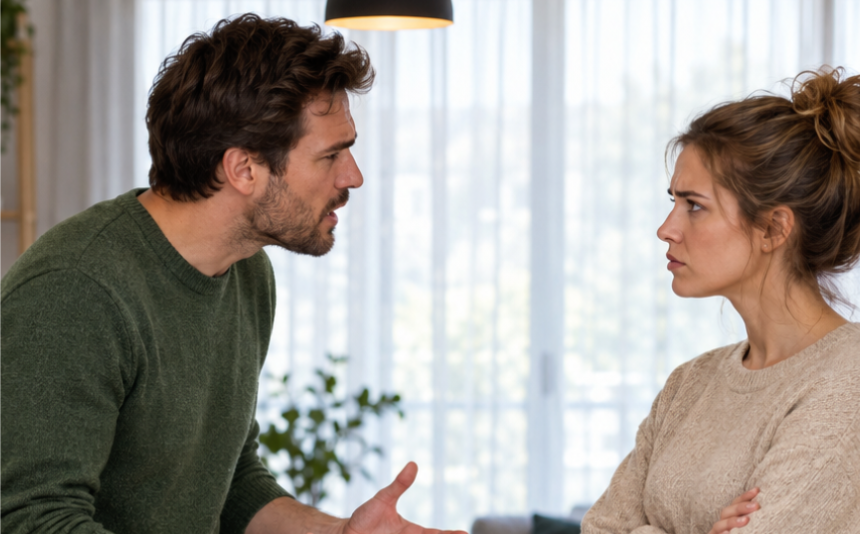
“Alyona called,” he says. “Why did you go over there?”
“I just got a message about an apartment debt. It’s in your name. The one on Beregovaya.”
“So what? That’s my apartment. I earned it. You have nothing to do with it.”
He speaks calmly, almost with pleasure, as if he’s been waiting for this conversation for years and is finally having it.
“Oleg, you paid for it for eight years. From which pocket?”
“From my own!”
“We’ve had a joint pocket since ’99. Did you forget we’re married?”
He sits down in an armchair and crosses his legs. He’s wearing a shirt I ironed for him just yesterday morning.
“I haven’t forgotten anything, Ira. It’s you who doesn’t know the whole story. At first, I rented that place. The owner was moving abroad and let it go for cheap. I ended up buying it. It’s registered only to me. Everything’s official, all the paperwork is clean.”
“And what about our child?”
“Our child—my son, Timofey. He’s three, and he hasn’t done anything wrong.”
“I’m not asking if he’s done anything wrong. I’m asking how many years you’ve been living double lives.”
“What does it matter?” Oleg shrugs. “You had your salary, I had mine. I fed the kids, paid the bills. What were you missing?”
I stay silent. I get up, walk to the closet, and pull out a stack of old calendars. I’ve saved them all since 2000. My habit: every evening, I write down on each day’s square what the money was spent on.
“Look,” I say, laying out the 2017 calendar in front of him. “November. ‘Coat — no. No money, Oleg said to wait.’ That’s my note.”
He doesn’t look.
“Here’s 2018. June. ‘Denis, summer camp at the sea — no. Oleg said, not many trips.’ Here’s 2019. ‘Braces for Matvey — later.’ 2020. ‘My dental work — later.’ 2021. ‘Coat — still no.'”
“What, you’ve been bookkeeping on me?” Oleg smirks. “For twenty years? Wow.”
“I managed the household, Oleg. I wore the same coat for five years so you could build your nest by the river.”
“Don’t make it so dramatic. So what, you wore a coat? People wore one overcoat through the war.”
He gets up and grabs his bag. At the door, he turns back—and in his eyes, I see something I never have before: he’s proud of himself.
“The apartment’s mine, Ira. If you want, file for divorce. Keep your two-room place, I don’t need anything from your father. But you’re not getting Beregovaya. I’ve thought it all through.”
The door closes behind him. I sit over the calendars until two in the morning.
In the morning, I take a day off work and go to the multifunctional center. I ask for a property statement on the Beregovaya apartment. They don’t give it to me: I’m not the owner.
So, I go see a lawyer. Anna Sergeevna Koltsova, my classmate—she’s been handling family cases for twenty years. She listens to me and files a request through the bar association.
The answer comes a week later. Anna Sergeevna calls me that evening.
“Ira, come in. And sit down when you get here.”
“What’s going on?”
“Just come. I’m not discussing this over the phone.”
On her desk, she has copies of documents: purchase agreement, property statement, and another paper she slides closer with two fingers.
“This is an application for using your maternity capital,” she says. “For buying the apartment on Beregovaya. For your youngest son, Matvey.”
“That can’t be. The certificate is at home in my jewelry box. I’ve kept it safe so Matvey could use it to cover part of his university expenses.”
“Maybe the certificate is there, but the money was taken eight years ago. Look at the signature, Ira.”
I look. At the bottom of the page is my signature—neat, with a long tail on the letter ‘k’. It’s definitely mine.
I never wrote that application. Or… did I?
I remember it at night, lying awake. Spring, 2017. Oleg comes home with a stack of papers and puts them on the hall table.
“Ira, sign these, it’s for Matvey’s savings account for his studies. The bank is opening it, the interest is good.”
I signed. I was in a hurry to get to the market; I had a scale check at eight. I trusted my husband. We’d shared a bed for twenty years.
In the morning, I’m back with Anna Sergeyevna. She explains what Oleg didn’t know, or didn’t want to know.
“Ira, listen carefully. The apartment was bought during your marriage with joint funds, so half is yours no matter what. But that’s not the main thing. If maternity capital was used, the property must be registered to all family members: you, Oleg, and both your sons. But he put it all in his own name.”
“So…”
“So, there’s a share of your Matvey in that stranger’s nest. And a share for Denis. And for you. That apartment half belongs to the very people he tried to hide it from.”
I stay silent. Then I start laughing and can’t stop. Anna Sergeyevna pours me a glass of water.
“But what about the signature? He deceived me.”
“The signature is yours, but you signed under false pretenses. That’s a separate issue, and a very serious one for Oleg. If you want, we can address it.”
But first, I don’t go to Oleg. I go to his mother.
Zinaida Fyodorovna lives with her daughter Larisa in a private house across the river. Larisa opens the door and immediately looks away.
“Ira? What are you doing here? Oleg isn’t here.”
“I know. I’m here for you, Larisa. And for Zinaida Fyodorovna.”
My mother-in-law is sitting in the room with the TV. When she sees me, she mutes the sound but won’t let go of the remote.
“Zinaida Fyodorovna, did you know about Beregovaya?”
My mother-in-law presses her lips together. Larisa stands in the doorway, fiddling with her keys.
“What’s there to know?” Zinaida Fyodorovna says. “A man needs comfort. You’re always at your markets, with your weights. At home, it’s instant soup. Alenka cooks for him, irons, greets him.”
“So, you did know. For a long time?”
“Six years,” Larisa suddenly says. “I was the one who christened Timosha.”
I turn to her. Larisa blushes, but looks at me defiantly.
“Don’t look at me like that, Ira. It’s your own fault. You kept him on a tight leash. Counting every penny. A man wants to live, too.”
“I counted every penny, Larisa, because your brother kept telling me we had no money. But it turns out we did. He was spending it on an apartment for his mistress. And on my son’s maternity capital.”
My mother-in-law drops the remote. Larisa turns pale.
“What capital?” Zinaida Fyodorovna asks quietly.
“The one Matvey, your grandson, was entitled to. Oleg stole it. Faked my consent, tricked me into signing. You baptized one grandson with the money meant for another, Larisa.”
I leave without waiting for an answer. Behind me, Larisa shouts into her phone: “Oleg, call me back immediately!”
Two days later, my doorbell rings. Standing there is Alyona—without her child, wearing jeans and a crumpled jacket. Her eyes are red.
“May I come in?” she asks. “I won’t stay long.”
I let her in. She sits on the edge of the couch and immediately hands me her phone.
“Look at this. I have to show you something.”
On the screen is a chat. A week ago, Oleg messaged Alyona:
“Don’t worry. Irka won’t do anything, she doesn’t get the paperwork. Denis is on my side—I’ll convince him to talk to his mother and get her to sign away her share. I’ll tell him it’s for the family. He’s obedient. Then I’ll put everything in your and Timka’s names, just like I promised.”
“Do you understand?” Alyona looks up at me. “He’s been telling me for five years that he’s divorced. That the apartment would be for me and Timosha. But when I went to register my son, the clerk said things are different. That there are some children and some capital involved. I found documents at home. Irina Nikolaevna, he lied to me too.”
“Why did you come to me, Alyona?”
“Because he wants your son to take his brother’s share. For my child. I don’t want that. I’m not a thief.”
She starts crying. I hand her a tissue and suddenly realize I don’t hold anything against her. She’s been deceived just like me. Only younger.
“What will you do now?” I ask.
“I’ll go back to my parents in Syzran. I’ll take Timosha with me. Let Oleg live in his apartment on his own.”
That evening, Denis arrives. He’s twenty-four, works as a marine engine technician at the shipyard. A true father’s son: never left Oleg’s side as a kid, went with him on the tugboats, knew every knot.
“Mom, Dad called,” he says at the door. “He asked me to talk to you. Said you misunderstood something and that you’re trying to ruin the family.”
“Sit down, son.”
I show him everything: the statement, the signed application, the calendars, and the chat Alyona forwarded to me. Denis reads through it all slowly, then puts the phone down.
“He told me there was no money for training camp in Samara,” Denis says quietly. “I was fifteen. I got accepted into the junior rowing team. The coach even called him. But Dad said there weren’t enough trips—told me to wait.”
“I remember,” I say. “You didn’t eat for a week.”
“But at that time he was paying for Beregovaya.”
Denis stands up and paces the room, then stops across from me.
“He wanted me to take Matvey’s share. From my own brother. For someone else’s child. And he said I’m obedient.”
“He’s your father, Denis. I’m not asking you to hate him.”
“I won’t. I just won’t listen to him anymore. I’m with you, Mom. All the way.”
Oleg comes by on Saturday. Confident, freshly shaven, holding a bouquet of chrysanthemums. He must assume Denis talked to me and everything’s settled.
“So, Ira, have you calmed down?” He offers the flowers. “Let’s be reasonable. You sign over your share, I leave you the two-room apartment, and I’ll pay alimony for Matvey. Everyone’s happy.”
I don’t take the flowers. He puts them on the side table, right where his papers used to be.
“Oleg, I went to see a lawyer.”
“So what? The apartment’s in my name.”
“The apartment was bought with Matvey’s maternity capital. You were supposed to divide it between me and both sons. You didn’t do that. And you slipped me that capital form as if it were for college paperwork.”
He stops smiling. All his pride drains from his face, like water off a tarp.
“You won’t be able to prove anything,” he says, but his voice is a lot quieter now.
“I’ve spent twenty-five years proving every shortfall. Here’s your shortfall.” I place a copy of the statement in front of him. “And here’s more.” It’s the correspondence with Alyona.
“Where did you get that?”
“Alyona brought it herself. She’s going to stay with her parents. With Timosha.”
“You’re lying!”
“Call her.”
He calls. The phone rings and rings. He tries again, but her number is unavailable. Oleg lowers the phone, and I can see his eyelid start twitching.
“Make your choice,” I say. “First option: on Monday we go to the notary. You sign over shares to me, to Matvey, and to Denis, just as you should. We file for a quiet divorce. You keep your share, live on it if you can.”
“And the second option?”
“Second: Anna Sergeevna files a fraud complaint. And then you’ll be answering to other people. Not me.”
“You wouldn’t dare,” he whispers. “I’m the father of your kids.”
“I would. You’re the father who stole your youngest son’s college money. And wanted the oldest to help you steal the rest.”
Denis steps out of the room. He’d been standing behind the door this whole time. Oleg turns to him, and for the first time, there’s a plea in his voice.
“Son, talk to your mom. You know I always did my best for everyone.”
“For everyone?” Denis looks down at his father—he’s half a head taller. “Dad, you didn’t even want to give me money for summer camp. You promised Matvey braces for three years. You never bought mom a single coat. Who were you doing your best for? Your mistress!”
“You don’t understand…”
“I do. Sign, dad. Or I’ll go with mom to the police myself.”
Oleg looks at his son, then at me. Then he grabs his chrysanthemums and leaves. He doesn’t slam the door—just pulls it softly closed.
On Monday, he comes to the notary. He signs everything in silence, eyes down. The notary asks twice if he understands what he’s doing. He just nods.
Alyona never came back to him. I find this out from Larisa, who calls me a month later.
“Ira, this is all your doing,” she says on the phone. “Alyona won’t even let him see Timosha, not even on video. He can’t split the apartment with your boys, can’t sell it, can’t live in it. He’s staying at our place, at mom’s, on the sofa in the hallway now.”
“I didn’t do anything, Larisa. I just stopped staying silent.”
“Mom cries every day.”
“Please tell Zinaida Fyodorovna that Matvey would love to see her. If she wants to see him.”
Larisa hangs up.
The last time I see Oleg is in October, in the courtyard. He’s waiting for me by the entrance, unshaven, still wearing that same old blue windbreaker with the ripped pocket.
“Happy now?” He takes a step toward me. “You took everything from me! My sons, my apartment, my whole life! Now I sleep on my mother’s couch, like a kid! I even got let go from the shipping company, fell asleep at the helm during a trip!”
“You’re the one who took everything from others, and now you’ve lost it yourself.”
“It’s you!” he shouts across the courtyard. The neighbor on the bench stands up. “It’s your calendars, your grams! You spent twenty years weighing me! Curse you and your scales, you hear me? I hope you never have a single happy day!”
I stand there, looking at him. I’m afraid—not for myself, but because I’ve spent twenty-five years living beside this person and never truly saw him.
“Go home,” I tell him. “To your mother. You have nowhere else to go.”
He yells something after me as I walk away, but I climb the stairs and don’t listen.
In December, I buy myself a coat. It’s dark blue, cashmere, with a wide collar. The saleswoman in the shop says it looks good on me.
“When was the last time your scales were checked?” I ask her at the counter out of habit.
“Scales?” She laughs. “We sell coats here, not potatoes.”
At home, my sons are waiting for me. Denis helps Matvey pick a summer camp by the sea—they’re arguing over the map. My dad calls from Tver to tell me he’ll visit for New Year’s.
“Irka, you’re amazing,” he says over the phone. “I always knew you wouldn’t let life break you.”
“Dad, come visit. I’ll greet you in my new coat.”
We’re renting out the apartment on Beregovaya. The money goes right into Matvey’s account—this time a real one, for his education. Alyona sent me a postcard from Syzran. She wrote just two lines: “Thank you for not touching Timosha. Forgive me.”
I put the postcard on the shelf next to the calendar. A new one, for the next year. Its boxes are still empty. And this time, I’m only writing down the good things.