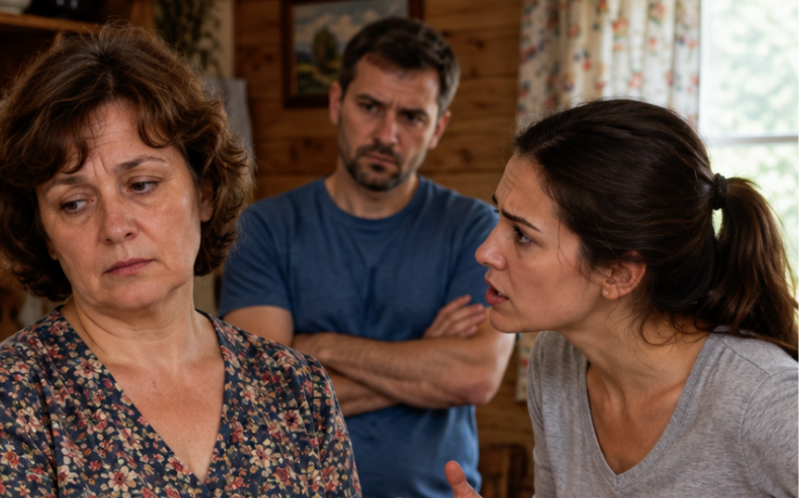
We’ve come for the harvest—open the gate, Denis!” Lidiya Pavlovna’s loud, confident voice sliced through the fading silence of a September evening.
Marina straightened her tired back and wiped the sweat from her forehead with the back of her hand. She and her husband were finishing up digging potatoes at their newly set-up dacha. By the fence, buckets filled with glossy tomatoes, crates of bumpy cucumbers, and a woven basket packed with fragrant apples were lined up. Marina was just counting in her mind how many bags to set aside for winter—enough for her sons, Artyom and Misha, who absolutely loved baked potatoes.
Outside the gate, the engine of an old minivan rumbled to life. Slowly, her husband’s younger brother Kostya got out and opened the trunk. Without even congratulating her older son on his first successful harvest, her mother-in-law marched down the path, dragging along a bunch of empty jute sacks. Kostya followed behind, carrying plastic crates.
“Alright, Kostya, get to work on the potatoes and pick out the tastiest ones,” commanded Lidiya Pavlovna, heading straight for the ripe tomatoes. “I’ll pick out the bigger tomatoes for now. We need a lot for the winter.”
Marina took a determined step forward and blocked her mother-in-law’s path to the buckets.
“Lidiya Pavlovna, wait,” she said coldly. “Who said you could take our harvest?”
The older woman stopped in her tracks, her eyebrows shooting up in genuine, unmistakable outrage.
“Marina, are you out of your mind?” her mother-in-law exclaimed, throwing up her hands. “Do close family members really need to ask for permission? We’re one family! Kostya needs vitamins—he works himself to the bone.”
Denis, who had been silently leaning on his shovel until now, looked at his mother with a piercing gaze. His face, normally calm and friendly, was now like stone as he asked a question that instantly shattered the guests’ brazen confidence:
“Mom, why did you come for our harvest when you gave your own dacha to Kostya?”
For a few seconds, a heavy, ringing silence hung over the property. Kostya stared down at the tips of his sneakers while Lidiya Pavlovna pressed her lips together, noisily inhaling the brisk autumn air.
***
For several years, Marina and Denis had spent every free weekend at Lidiya Pavlovna’s old dacha. It was a luxurious plot: fifteen fertile acres, a solid brick house, a massive greenhouse, groves of currants, and ancient apple trees. Every spring, the couple bought luxury seeds, pricey fertilizers, paint for the fence, and new hoses with their own money. Denis tirelessly fixed the sagging gate, replaced rotten boards in the beds, and revived the stubborn water pump. Starting in February, Marina would cover every windowsill in their city apartment with seedling boxes, and in summer, she canned jars of pickles late into the night.
Lidiya Pavlovna took all this effort for granted, but always shielded her younger son Kostya from any chore.
“Kostya is busy, he has important deliveries to make,” she would always reply when Denis asked his brother to come over for at least the weekend to help move manure. “He needs to work on his personal life, there’s no point in making the boy strain his back.”
Meanwhile, Denis’s mother-in-law always divided the harvested crops as she saw fit. She could load up Kostya’s trunk with boxes of premium strawberries and the best peppers, while leaving only a bucket of tiny carrots for Marina and Denis.
“You two spend all your time here anyway,” Lidia Pavlovna would explain kindly. “You’ll grow more for yourselves, your hands work magic. Kostya, on the other hand, has to buy his produce.”
But the real blow came last summer, when the mother-in-law invited her sons over for a Sunday lunch. While pouring tea, she casually announced:
“I’ve signed over the dacha to Kostya. I made it a gift. Denis, you’re a family man, you have your own apartment, but your younger brother needs a little help getting started.”
Marina couldn’t hold back and, right at the table, reminded everyone that Kostya hadn’t pulled a single weed from that plot in ten years. But the mother-in-law simply waved her off:
“It’s my property, and I have every right to do whatever I see fit with it!”
Denis took his mother’s betrayal very hard. He’d never laid claim to an inheritance, but knowing that all his years of unpaid labor were dismissed so easily cut him deeply.
“We’re never setting foot there again,” Marina firmly told her husband that evening.
They gathered all their tools bought with their own money from the now-stranger’s plot, returned the keys, and cut off contact. By August, the couple managed to scrape together their savings and bought their own small piece of land—six hundred square meters of pure chaos, with a crooked fence, nettles taller than a person, and a tiny plywood hut. They couldn’t afford to hire help, so they started fixing the place up themselves. Marina spent evenings after work digging out stubborn weed roots, while Denis worked on shoring up the fence until dark. Come spring, they put up a greenhouse made from old window frames and planted potatoes and greens. By autumn, their humble plot blossomed and gave them their first long-awaited, honest harvest.
***
All summer long, Lidia Pavlovna would call her elder son regularly. She never asked for anything directly, but every conversation circled around one topic.
“Deniska, how are things going over there?” she’d ask in a soft tone over the phone. “Are your homemade greenhouse tomatoes holding up? Did the potatoes sprout? I hear the Colorado potato beetle is really bad this year.”
Denis replied curtly and evasively, careful not to give away any details. He genuinely didn’t want to spark another round of family conflict. But Marina, sitting next to him, understood perfectly well the real reason behind this sudden maternal concern. His mother-in-law was already mentally dividing up someone else’s stores.
One day, during yet another phone call, Lidia Pavlovna casually remarked:
“Autumn’s coming soon, son. It’d be great if you could bring me three bags of potatoes—and Kosti could use some too. The market prices are outrageous right now.”
Marina took the phone from her husband and said calmly but firmly:
— Lidiya Pavlovna, we only have six ares of land. Every single kilogram of our harvest will go toward feeding our sons. We’re planning to stock up for winter ourselves and we have no intention of giving anything away.
This time, the mother-in-law chose to steer the conversation toward the weather, deciding her daughter-in-law’s words were just a passing whim. Denis didn’t argue with his wife, but after the call he quietly admitted:
— You know, Marina, it really hurts me. My mom keeps acting like my time and my effort belong to everyone else, except my own family.
Marina wrapped her arm around her husband’s shoulders. In her mind flashed memories from the past years: coming home exhausted from work and still going out to water the cucumbers, Denis fixing someone else’s greenhouse in pouring rain. Meanwhile, Kostya was out relaxing with his friends, always knowing his mom would supply him with free food.
— That’s it, Denis. I’m done being convenient for them, and I just won’t do it anymore, — Marina said firmly.
The couple made a firm agreement: if relatives politely ask for help, they’ll consider it. But no one will ever be allowed to dictate how they spend their time or use their harvest again.
***
On Saturday, Marina and Denis had been working in their garden since five in the morning. The day was bright, but chilly with that autumn air. Denis methodically dug his shovel into the dry ground, turning up big, clean potatoes. Marina, hands in thick garden gloves, sorted them into crates, setting any damaged ones off to the side. On the verandah of the small cabin, a thermos of linden tea was cooling, and the air was filled with the sweet scent of fallen grass and ripe apples. Everything was going smoothly—until Kostya’s minivan pulled up at the gate.
The arrival of Lidiya Pavlovna with empty bags caught the couple off guard. The elderly woman marched right across the freshly dug earth, eyeing up the greenhouse with a critical look.
— Oh, what a tidy greenhouse you have! — the mother-in-law exclaimed loudly, peering into the cabin. — And I see you’ve got a wonderful crop of potatoes. Well, Kostya, what are you waiting for? Open up the bags, let’s start gathering before it rains.
Marina threw her gloves onto the ground and stepped forward to meet the relatives.
— Can someone explain what’s going on here? — she demanded sharply. — Did you just come for everything to be ready and waiting?
Lidiya Pavlovna pursed her lips in displeasure but waved her hand in a conciliatory gesture:
— Oh, Marina, don’t start. In our family, we never used to count every cucumber. You have so many vegetables here, there’s no way all four of you will eat them in one winter! You should share with your loved ones.
Denis walked over to his brother and took the plastic crate from his hands.
— Mom, let me ask again about the dacha you gave to Kostya, — his voice trembled with barely suppressed anger. — Why should we give up our harvest when Kostya has a whole fifteen ares of great land himself?
Kostya looked embarrassed, shifting from one foot to the other, and started nervously justifying himself:
— Denis, you just don’t get it! The soil over there got rock-hard in a year, it’s all overgrown now. The greenhouse got damaged by wind in the spring, the glass broke, and I honestly don’t have any time because of work. I’m always busy with transportation gigs. We tried planting potatoes, but nothing came up.
“No time, huh?” Denis let out a bitter laugh. “I spent ten years digging this land with just a regular shovel and fixed the greenhouse myself. The only obstacle here has always been your laziness—not anything else.”
Kostya felt uneasy hearing all this talk about taking responsibility for the gifted plot. He grumbled, “You could have shared,” and shuffled over to his car. Lidiya Pavlovna pressed her lips together:
“I’ll remember this attitude. Now it’s clear what family is really worth.”
“Next time, let us know before you come,” Denis replied. “There won’t be any more unannounced visits here.”
His mother-in-law realized she’d be leaving with empty bags and headed for the exit, loudly accusing her daughter-in-law of being selfish.
***
After their loud relatives drove off, the plot finally fell quiet. For a few minutes, Marina and Denis sat in silence. The uncomfortable conversation had drained them, but both felt a sense of relief—they had finally stood up to pressure from others.
A week later, Denis heard from his mother that the land on the gifted dacha still hadn’t been dug up for winter. Kostya just put everything off until spring, even though the plot needed urgent care. Lidiya Pavlovna called her older son again, as usual complaining about her health.
“Deniska, it’s so hard for me on my own,” she sighed on the phone. “You could come, fix up the greenhouse, maybe clear away some old branches.”
“Mom, if you personally need specific help, just tell me,” Denis replied. “But I’m not going to take care of Kostya’s plot. He’s the owner; let him handle it.”
Marina didn’t get in the way of her husband talking to his mother. She just insisted their kindness shouldn’t turn into a burden. For the first time in his life, Kostya had to buy repair materials and hire someone to plow the land himself. The younger brother quickly realized that owning property takes not just money, but a lot of personal time too.
Lidiya Pavlovna still thought her older son was overly sensitive and refused to admit she was wrong. But after that, she never showed up at someone else’s dacha without an invitation again. The couple kept polite relations with their family, but now their boundaries were clear.