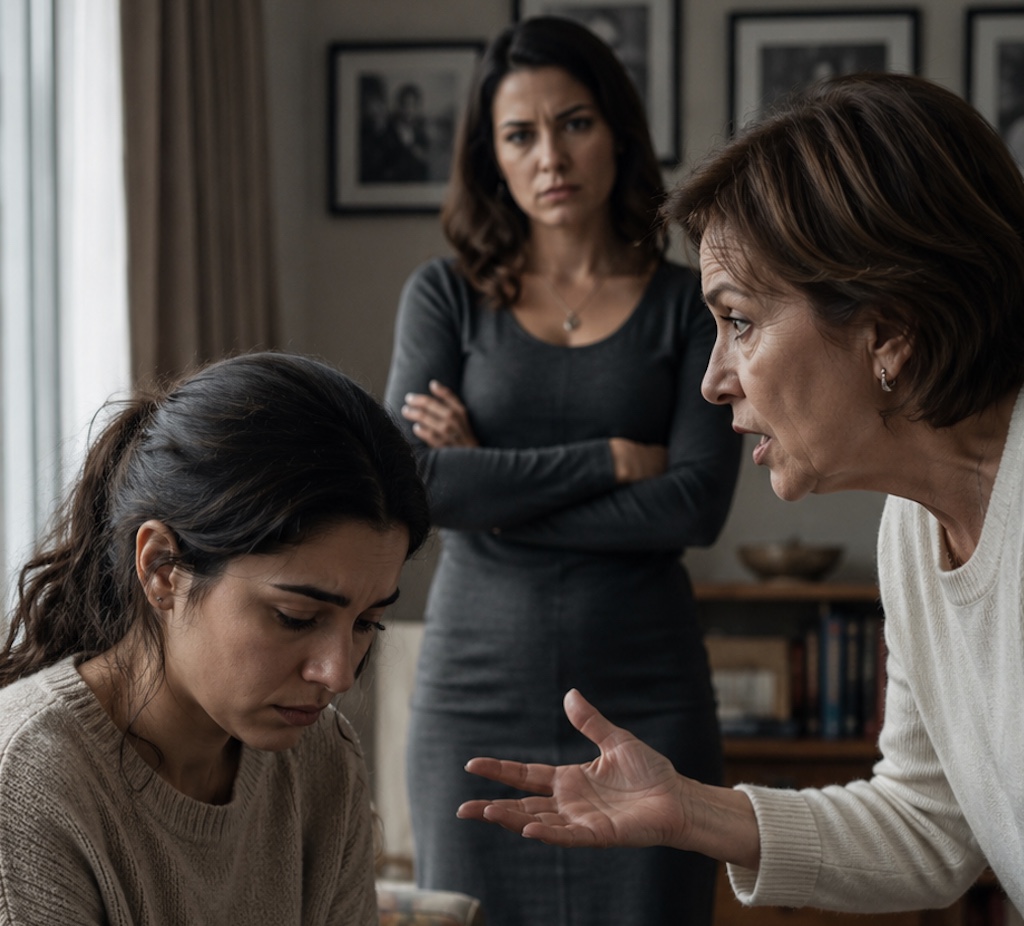
“Twenty-five thousand is nothing to you,” Marina Andreevna said, setting her cup down so sharply that coffee splashed into the saucer.
Early morning had only just begun in the dacha settlement outside Yaroslavl. The veranda of the old wooden house smelled of damp timber and strong coffee. Fog hung beyond the windows, and the wet apple trees stood motionless, as if someone had painted them there.
Across from her mother sat Elena, a laptop resting on her knees. She had just finished a night call with a client from Kazakhstan. Her eyes were burning, and her temples were pounding. She had come to the dacha for the weekend hoping to rest, but as usual, rest was not going to happen.
Elena closed her eyes wearily. The conversation she had been dreading all week had finally begun. And it had begun exactly as she had imagined — with an accusation.
“Mom, not now,” she said quietly.
“Then when? After your sister gives birth?”
Elena opened her eyes and looked at her mother. Marina Andreevna was sitting upright, lips pressed tight, wearing the expression of a person who had already made up her mind.
A year earlier, their life had looked completely different.
Elena and Artyom lived in a rented apartment in Kaliningrad, in a concrete apartment block with peeling walls in the entrance and the permanent smell of dampness in the stairwell. She worked as an accountant for a retail chain, while he worked at a service center repairing electronics. Their salaries arrived regularly — and just as regularly disappeared by the twentieth of each month.
One evening, they stood in front of the open refrigerator, staring at the empty shelves.
“Meat or pasta?” Artyom asked without smiling.
“Pasta. Four days until payday.”
“Then pasta with ketchup. A festive dinner.”
They both laughed, but the laughter came out short and joyless.
They had discussed moving to Moscow or St. Petersburg more than once, but every time they ran into the same problem: rent would be twice as high, and there were no guarantees. Artyom was the first to find a way out. At night, he began studying programming, sitting in the kitchen under the yellow lamp while Elena fell asleep in the bedroom. A month later, she took the leap too and accepted her first remote bookkeeping jobs.
That year was hard. They barely rested. They argued from exhaustion. Once, they did not speak to each other for three days simply because neither of them had the strength for words. But little by little, their income began to grow. Slowly at first, then noticeably.
They moved into an apartment closer to the city center, one with a decent entrance and a balcony. Sometimes they traveled to other cities while working remotely. Once, they sat in a café in Gdańsk — both with laptops open, the gray sea beyond the window, cold coffee on the table — and for them, it was just another workday.
But Elena’s mother never saw it as real work. For Marina Andreevna, work meant a factory, shifts, aching feet, and hands worn rough.
“You’re just sitting at home,” she would say over the phone. “What kind of work is that?”
Elena’s younger sister, Sveta, worked as a receptionist at a dental clinic, came home at eight in the evening, and complained about patients. Marina Andreevna was the one who called her “a real hard worker.”
For a long time, Elena tried to smooth everything over. She let the comments pass, changed the subject, smiled.
Once, she came to visit her mother in Yaroslavl. That evening, Sveta returned from work, collapsed dramatically onto the sofa, and groaned.
“I’m dying. My legs are gone. Eight hours at the front desk without a break.”
Marina Andreevna immediately brought her tea, stroked her hair, and tucked a pillow under her head. Elena sat in an armchair across from them, answering work messages. A client from Novosibirsk urgently needed her to recalculate a quarterly report.
“Well, at least you don’t get tired,” her mother said casually. “You sit at home.”
Elena said nothing. Only her fingers paused over the keyboard for a second.
The real turning point came later, in the ordinary silence of a weekday. She had worked until three in the morning on an urgent report — red eyes, cold tea, stiff back. She had fallen asleep right at her desk. In the morning, she woke to a notification: a voice message from her mother.
“Len, transfer about fifteen thousand to Sveta for a cosmetologist. Things are hard for her right now. Let her enjoy something at least.”
Elena listened to the message while sitting in the exact same position in which she had fallen asleep. For the first time, what she felt was not pity, but irritation. Heavy, dull irritation, like a stone pressing against her chest.
Two weeks later, Sveta called and announced, in a voice full of joyful panic, that she was pregnant. She and Roman had decided to get married quickly, while her belly would not yet show in the photos.
Wedding preparations began immediately, chaotically and noisily. At the shopping center, Sveta sorted through jewelry, frowned at the price tags, and complained.
“This is robbery. Eight thousand for these earrings? They’re not even gold.”
Marina Andreevna stood beside her, nodding sympathetically and glancing at Elena from time to time — silently, but with the expression Elena had known since childhood. It meant: Help. You can afford it.
Elena and Artyom discussed the wedding gift and decided to give fifty thousand. It was a significant amount for them, especially since they had only just started saving for a down payment on an apartment. But Elena wanted to do the right thing. She wanted there to be no complaints.
The complaints appeared that very same evening.
At the dacha, after dinner, when Sveta had gone off to call Roman, Marina Andreevna sat down across from Elena and spoke in the tone people use when the decision has already been made.
“Sveta will be on maternity leave soon. Roman isn’t earning properly yet. They’ll have nothing to live on. You have to help.”
“We already gave them fifty thousand,” Elena said evenly.
“That’s a gift. I’m talking about every month. Twenty-five thousand. It won’t be difficult for you.”
Elena said nothing.
“Your money comes easily,” her mother added. “You just sit a little longer at your laptop, and that’s it.”
Artyom, who was standing in the doorway to the veranda, slowly set his cup on the railing and looked at his wife. Elena felt something inside her stretch to its limit.
They moved into the kitchen. The kettle on the stove began to whistle, but no one moved to turn it off. The sound grew louder, filling the room, and their voices rose with it.
“Mom, my work is real,” Elena said, her voice tight but firm. “I am not obligated to support my adult sister.”
“Real?” Marina Andreevna turned away from the counter. “You sit at a computer! That’s not work, that’s fooling around. You just got lucky. The money came by chance, and now you’re being greedy with your own sister.”
“By chance? We spent a year barely sleeping so that—”
“Don’t start telling me about your suffering! Sveta is on her feet every day, while you sit in cafés abroad!”
The kettle kept screaming. Sveta sat by the wall, silent, staring at the floor. She did not say a single word against their mother. And that silence told Elena more than any shouting could have.
She looked at her mother, then at her sister, and suddenly understood with icy clarity: no one here was trying to understand her. No one was asking how she lived, how she worked, or what it cost her. They simply wanted money from her.
Something inside her, something that had been stretched tight for years, snapped without a sound. And in its place, there was emptiness.
Artyom took the kettle off the stove.
The kitchen fell silent.
Elena packed her things in twenty minutes. Her mother stood in the doorway, watching as she zipped up her bag, but said nothing. She only pressed her lips together. Sveta never came out of the kitchen.
The commuter train was almost empty. Elena sat by the window and watched birch groves, wet fields, and small stations with peeling benches rush past the glass. Inside, she felt something strange — not the guilt she had grown used to, but something hot and unfamiliar.
Anger.
And after it came freedom, light as an exhale after holding her breath for too long.
At home, Artyom did not ask questions. He put pasta on to boil, sliced tomatoes, and took two plates from the cupboard.
They sat down to dinner and spoke calmly, without drama, the way people discuss practical matters.
“We’ll help,” Elena said. “But only when we want to. No schedule. No obligation.”
“I agree,” Artyom said, nodding as he pushed a plate toward her.
Elena picked up her fork and realized that, for the first time in many long months, she did not feel indebted to anyone.
Just dinner.
Just evening.
Just their life.
Sveta gave birth in February — a boy, three kilos six hundred grams.
Elena came to visit a week later. She brought a box of baby clothes, a pack of diapers, and a folding stroller she and Artyom had spent an entire evening choosing online.
“Thank you,” Sveta said quietly, accepting the bags. “You didn’t have to.”
“I know,” Elena replied. “I just wanted to.”
They hugged — briefly, awkwardly, like people learning how to be sisters again.
Her conversations with her mother remained strained. The calls became rarer and shorter. But the subject of the twenty-five thousand was never raised again.
That evening, already back home in Kaliningrad, Elena sat by the window with her laptop. Beyond the glass, the lights of the port shimmered, and somewhere from the embankment came the distant cries of seagulls. She closed the laptop, leaned back in her chair, and froze for a moment.
Quiet.
Peaceful.
Her life.
Her money.
Her choice.