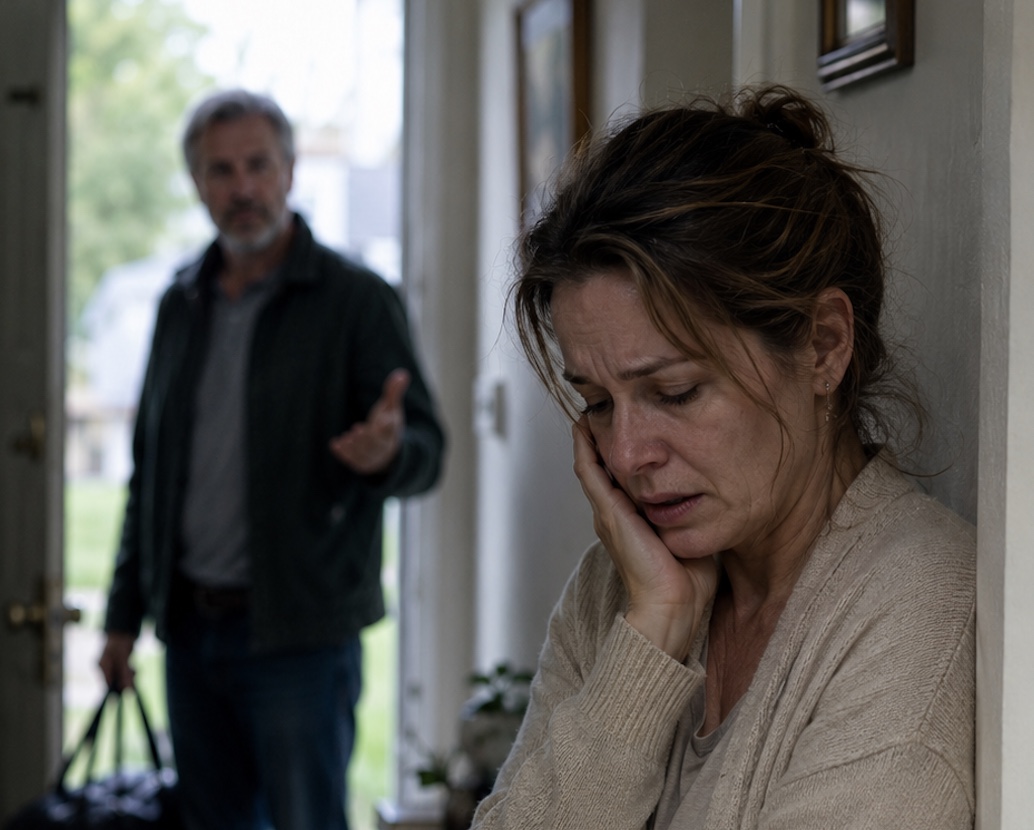
— Nadya, it’s me. We need to talk… about the divorce. And about the property too.
The mug slipped from her fingers and shattered against the edge of the sink. Pieces scattered across the floor; one shard slid beneath the refrigerator.
Nadezhda Petrovna stood frozen, the phone pressed to her ear, unable to move. The voice on the line was hoarse, unfamiliar, and yet so painfully recognizable that her throat tightened.
“Mom, what happened?” Katya peered out from the room, one hand gripping the doorframe. “Mom?”
Nadezhda Petrovna slowly lowered the phone. The screen was still glowing — an unknown number, no name.
She wanted to say it was nothing, that she had only dropped a mug. But she couldn’t. Because she had recognized that voice.
Too well.
Sergey.
Twelve years.
And now — him.
Once, everything had been different. Or perhaps, to be more honest, Nadezhda Petrovna had once believed that everything would become different.
They had met at the factory where they both worked: she was in accounting, he was in the workshop. Back then, Sergey Ivanovich was strong, cheerful, the kind of man who could make her laugh until she blushed.
They married quickly and moved into her apartment — a cramped two-room place she had inherited from her parents.
“Don’t worry, Nadyush,” he used to say, wrapping his arms around her in the tiny kitchen where even two people could barely turn around. “Once I get on my feet, we’ll move somewhere better.”
He never did.
First, the factory cut shifts. Then Sergey began jumping from one temporary job to another — loader, construction worker, and sometimes something no one could clearly explain. Then he started drinking. Not all at once, not suddenly, but slowly, like water rising in a basement: at first only a little, then ankle-deep, then up to the knees.
Katya and her younger sister Lena did their homework with the television turned up loud. Katya, only ten at the time, had figured it out herself. She would sit beside her sister, open a textbook, and raise the volume. When crashes sounded from the hallway, she didn’t flinch.
Only Lena sometimes whispered:
“Katya, when will he stop?”
“Soon,” Katya would answer. “Do your problem.”
The fights became more frequent. He slammed doors, threw things, shouted that no one respected him, that he was a stranger in his own home. Nadezhda Petrovna stayed silent, teeth clenched, because every word became another reason for him to explode.
And then he simply disappeared.
One morning she woke up and realized there was silence.
Real silence.
His jacket was gone from the coat rack. Money had vanished from the dresser drawer — money she had been saving for Lena’s winter boots. The television was gone too. So was the microwave. And the old laptop Katya used for school reports.
There was no note.
No phone call.
The girls hardly cried. Lena only asked:
“Mom, will Dad come back?”
“I don’t know,” Nadezhda Petrovna answered honestly.
Lena nodded and went to pack her schoolbag.
She was eight.
But Nadezhda Petrovna took it hard. For a long time, she didn’t remove his second jacket — the old one he had left behind. She jumped at every phone call. She kept setting an extra plate on the table, not intentionally, just out of habit.
One day Katya silently took the plate away, put it back in the cupboard, looked at her mother — and said nothing.
The years passed.
Katya finished school with mediocre grades, but managed to get a state-funded place at law school. She worked as a courier, then as an assistant at a legal office, bringing home crumpled bills and placing them on top of the refrigerator.
Lena trained to become a kindergarten teacher. Quiet and patient, she had always known how to get along with children.
Little by little, life improved.
Nadezhda Petrovna sold the old apartment. Not without pain, though on the last day she stood for a long time in the empty hallway. She helped her daughters with housing: Katya with the down payment for a studio apartment, Lena with rent.
With what remained, Nadezhda Petrovna bought a house outside the city. It was old, with a leaning fence and a porch that groaned pitifully under every step.
“Mom, it’s falling apart,” Katya said, walking around the yard.
“But it’s mine,” Nadezhda Petrovna replied.
And for the first time in a long while, she smiled.
They repaired the roof together as a family. Katya gave orders from below, her head tilted back, while Lena complained from above that tar wouldn’t wash off her hands and that she was, in fact, a kindergarten teacher, not a roofer.
When they fired up the bathhouse for the first time, smoke poured from everywhere — from the cracks, under the door, and even, it seemed, from the ground itself.
A neighbor shouted over the fence:
“Are you on fire or what?”
“We’re steaming!” Lena shouted back, coughing and laughing.
They made the house their own.
First came the vegetable garden, then a polycarbonate greenhouse, then a used car so Nadezhda Petrovna could drive to work in the city. She grew tomatoes, canned jars for winter, repaired the fence.
Life began to feel like a straight road — no potholes, no sharp turns.
And all that time, she never divorced him.
She simply never found the courage.
Every time Katya brought it up, Nadezhda Petrovna waved it away.
“What for? Who needs it? We’re living fine.”
“Mom, it has to be done officially. You never know what could happen,” Katya insisted.
“Later,” Nadezhda Petrovna would say. “We’ll do it later.”
“Later” lasted twelve years.
After that evening, Nadezhda Petrovna did not sleep all night.
She lay in the dark, listening to Katya breathing evenly behind the wall — Katya had come for the weekend and stayed overnight. Outside the window, rain rustled softly. Drops slid down the glass, and their shadows moved across the ceiling like something alive.
At dawn, she took out the folder of documents — the same one tied with a pharmacy rubber band and kept on the top shelf of the wardrobe. She sat at the kitchen table and spread the papers out before her.
The marriage certificate — yellowed, with a bent corner. She ran her finger over the date.
Twenty-six years ago.
A photograph was tucked between the pages: two young faces, she in a borrowed white dress, he in a jacket that was too tight across the shoulders. Both of them smiling. Both of them unaware of what would come later.
The girls’ birth certificates.
Old papers for the apartment, already sold.
The purchase agreement for the house.
Her name.
Only hers.
But the line in the marriage certificate — “entered into marriage” — stared back at her like a sentence.
“Mom, what are you doing here?” Katya appeared in the kitchen doorway, sleepy, wearing an oversized T-shirt. Then she saw the papers, and all sleep vanished from her face. “Is this because of yesterday’s call?”
Nadezhda Petrovna nodded without looking up.
“He called. Your father.”
Katya slowly sat down on the stool across from her.
“And what did he say?”
“About divorce. And about property.”
Silence followed.
Only the refrigerator hummed heavily, like an old man struggling uphill.
“What a bastard,” Katya said quietly. Not even with anger, but with a tired, bitter certainty. Then she looked at her mother closely. “Mom, you understand that legally you’re still…”
“I understand,” Nadezhda Petrovna interrupted.
She did understand.
That was what frightened her most. Not his voice. Not even the call itself. But the realization of her own mistake — a mistake she had carefully refused to notice for twelve years. Like that crooked fence she had kept meaning to fix until one day it collapsed.
Katya reached across the table and covered her mother’s hand with her own.
“We’ll sort it out. I’m a lawyer, remember?”
Nadezhda Petrovna wanted to smile, but her lips trembled, and she only nodded.
All day she wandered through the house as if lost. She washed floors that were already clean. She watered the same garden beds twice. In the evening, she sat on the porch for a long time, staring at the road leading toward the highway.
The road was empty and quiet.
But it seemed to her that somewhere beyond the bend, something was already moving.
He came four days later.
Nadezhda Petrovna saw him from the kitchen window — a figure by the gate, a dark jacket, a bag in his hand. At first she didn’t recognize him.
Then she did.
Sergey Ivanovich had aged as if twelve years had not passed, but thirty. His face was weathered and gray, with swollen bags under his eyes. His stubble was streaked with white. His hands were shoved into his pockets.
He stood there, looking over the property slowly, intently, as if taking photographs with his eyes.
The house.
The greenhouse.
The bathhouse.
The car in the yard.
Nadezhda Petrovna stepped out onto the porch. Her legs barely obeyed her.
“Hello, Nadya,” he said.
His voice was steady, almost businesslike.
“You’ve done well for yourself here.”
She said nothing.
He opened the gate himself — the hinges squealed — and walked along the path, glancing around like a buyer inspecting a property.
“Well,” he said, stopping at the porch, “we should do things fairly. We’ll divide it. I’m entitled to my share too.”
The door behind Nadezhda Petrovna slammed open. Katya stepped out in jeans, her hair still wet from the shower, but with such an expression that Sergey Ivanovich involuntarily took half a step back.
“And what exactly do you have to do with any of this?” Katya asked.
Her voice was calm, firm, professional.
He shrugged and gave a faint smirk.
“According to the law, I do. My wife” — he nodded toward Nadezhda Petrovna — “never divorced me. That means joint property. That means half.”
Katya narrowed her eyes but said nothing. Only the muscles in her jaw tightened.
Everything became clear quickly, in fragments.
He had no place to live. No savings either. For the past years he had drifted from one rented room to another, working here and there — watchman, loader, handyman. Then someone had suggested it to him, or perhaps he had figured it out himself: he still had a wife, there was property, and under the law…
“I didn’t come for nothing,” he said, looking past Katya at Nadezhda Petrovna. “I’m asking for what’s mine. Not someone else’s.”
Nadezhda Petrovna stood on the top step of the porch and felt the ground beneath her grow unsteady.
She felt embarrassed — in front of her daughter, in front of the neighbors, in front of herself.
She was afraid because there was law in his words, and she had never known how to fight the law.
More than anything, she wanted it all to vanish. For him to turn around and disappear back beyond the bend in the road, into the nowhere he had come from.
But he stood there at the porch, solid as a post.
And he had no intention of leaving.
The evening before the court hearing was quiet and windless. Even the apple tree outside the window did not move.
The three of them sat in the kitchen. The tea had long gone cold, but no one drank it. The mugs stood untouched, like props in a scene no one wanted to play.
Lena stirred a spoon through the sugar bowl. Katya leafed through the documents. Nadezhda Petrovna stared at the table.
Then suddenly she began to speak.
Quietly, haltingly — like a person who had kept a door closed for twelve years and had finally let go of the handle.
She told them she had waited.
Every day for the first two years, she had waited. She had hoped he would return, change, ask forgiveness. She had been afraid to file for divorce, because then it would have become final.
She would be alone.
Completely alone, with two girls and an empty hallway.
Katya set the papers aside. Her voice trembled, but her words were hard.
“Mom, he didn’t come back. Twelve years. He simply decided he could show up and take something. This isn’t love. It isn’t family. It’s arithmetic.”
Lena moved closer and wrapped an arm around her mother’s shoulders.
“You did everything yourself. The house, the garden, our life. He had nothing to do with any of it. Nothing at all.”
Nadezhda Petrovna began to cry.
The tears came easily, without gasping, without shame — like spring rain after a long winter. It was no longer the same helplessness that had lived inside her for years.
She cried and felt something release.
Something she had held on to for so long finally loosened its grip.
That evening, she stopped waiting.
The courtroom was small and official-looking — yellow walls, fluorescent lights, the smell of dusty paper. Nadezhda Petrovna sat upright, hands folded on her knees, trying not to look in his direction.
Katya handled everything.
Over the past few days, she had barely slept. She had gathered documents, filed requests, called people, and built the defense exactly as she had been taught at university and as experience had later confirmed — clearly, calmly, point by point.
The purchase agreement for the house: in Nadezhda Petrovna’s name, acquired seven years after her husband disappeared.
Receipts for building materials.
Payment records.
Bank statements.
Everything paid for with her money, her labor, her hands.
The neighbors came too.
Tamara Vasilyevna from the next plot — large, firm, and unafraid — spoke loudly enough for the whole room to hear:
“I saw this man for the first time a week ago. But I’ve known Nadezhda for eight years. She built everything here herself, with her own back.”
The second neighbor, old Nikolai, confirmed that in all those years he had never seen a man living in the house.
At first, Sergey Ivanovich looked confident. He leaned back in his chair and glanced at the judge with the expression of a man who knew his rights.
But when Katya began asking questions — when exactly he had left, where he had gone, why he had never once contacted his children, whether he had paid child support — he grew irritated.
He confused the dates.
Raised his voice.
Interrupted.
“I didn’t abandon my family,” he kept repeating. “I just left. There were circumstances.”
“What circumstances?” Katya asked evenly.
He did not answer.
The judge read the decision in a dry, level voice.
The property was recognized as Nadezhda Petrovna’s personal property.
The marriage was dissolved.
Sergey Ivanovich stood up. Silently, he took his jacket from the back of the chair and left the courtroom without looking back.
Exactly as he had done twelve years earlier.
Only this time, Nadezhda Petrovna did not wait for the door to close.
She turned to Katya, and for the first time in weeks, her face was calm.
Spring came late that year, but all at once — with warmth, the cry of rooks, and puddles reflecting the bright sky.
Nadezhda Petrovna knelt beside a garden bed, transplanting tomato seedlings. Her fingers were covered in soil, her apron was stained, and her glasses kept sliding down her nose.
“What kind of wind is this?” she muttered, shielding a fragile sprout with her palm. “And they call this April. Outrageous.”
The gate creaked.
Katya came in first, followed by her husband carrying their child. The little girl immediately reached for her grandmother.
“Mom, your hands are dirty, don’t touch her!” Katya called out.
“Yes, yes, just a second.” Nadezhda Petrovna rose from her knees, wiped her palms on her apron, and only then picked up her granddaughter, pressing her close.
Lena appeared next, carrying two bags that smelled of fresh pastry.
“I brought pies. Cabbage and apple.” She set the bags on the porch and turned to her sister. “Keep them away from Katya. She almost ate them all on the way here.”
“That is not true!” Katya laughed. “I only tried one. For quality control.”
The house filled with voices, the clatter of dishes, and laughter. The granddaughter stomped through the hallway. Katya argued with her husband over the kettle. Lena sliced pies and gave everyone instructions.
In the evening, when everything finally grew quiet, Nadezhda Petrovna opened the wardrobe to take out a blanket and found an old photo album.
She opened it.
Yellowed photographs.
Young faces.
A borrowed white dress.
She looked at them. Ran her finger over one picture.
Then she closed the album and put it back on the shelf beneath a stack of towels.
Just the past.
Not waiting.
Not pain.
It had been.
And it was over.