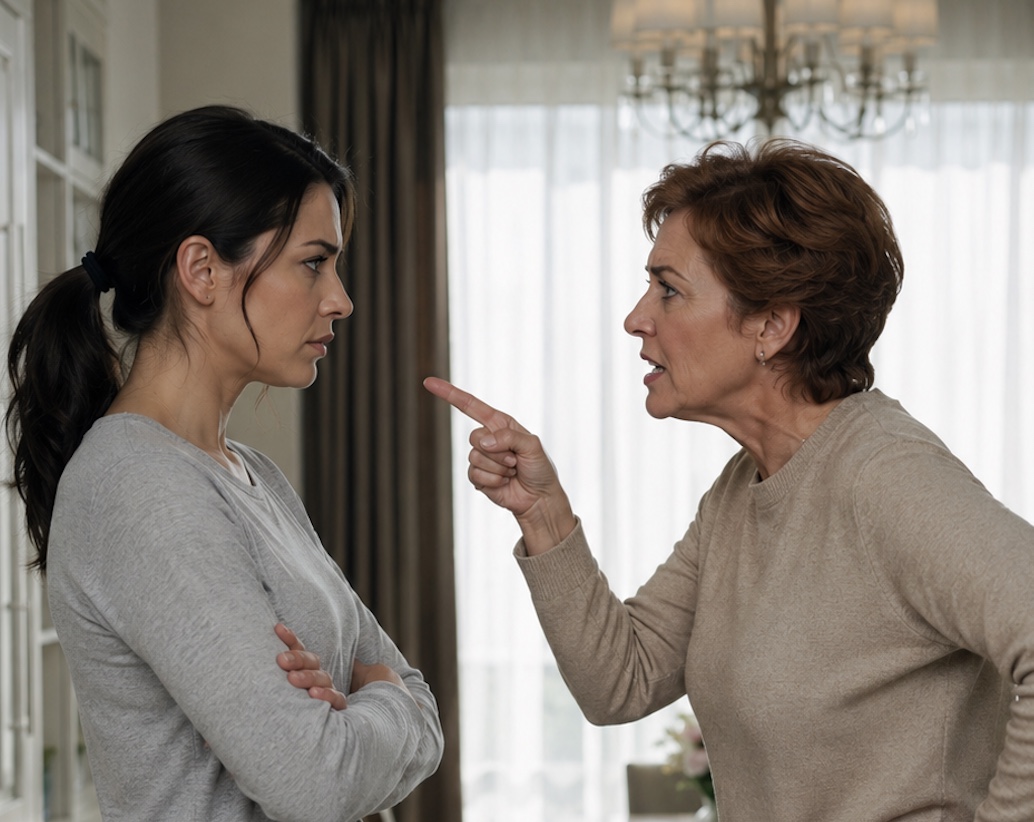
— So, you’ve decided to buy a car, have you? Provoking Lera again?
Lyudmila Petrovna stood in the doorway in her autumn coat, lips pressed tight, wearing that particular expression Ksenia had learned to recognize instantly over the years. It meant the verdict had already been passed; all that remained was to read it aloud.
“Lyudmila Petrovna, come in,” she said evenly. “Maxim is still at work.”
Her mother-in-law did not move.
“I asked you: are you buying a car?”
“We’ve been saving for a long time…”
“Saving, are you? And how is Lera supposed to feel? She’s on maternity leave, counting every coin, while you’re out here driving around in cars.”
Ksenia let out a heavy sigh. She already understood how this would go: once again, she would be blamed for someone else’s choices — choices she had never made.
Ksenia and Maxim met in their third year of university, while standing in line for coffee in the student cafeteria. He was ahead of her, counting coins for far too long, and she silently handed him the twenty rubles he was short.
“I’ll pay you back,” he said seriously.
“Of course,” she smiled, not believing him.
He returned the money the next day — with a chocolate bar. Three years later, they got married.
After the wedding, they started from nothing: a rented apartment on the outskirts of town, an old sofa, and a kettle that only worked when it felt like it. Ksenia worked as a marketer for an online school, while Maxim was an automation specialist at a large industrial company. In the evenings, they sat at the kitchen table and filled out expense spreadsheets. Every purchase was written down. Every thousand rubles was accounted for. They saved for a down payment carefully and patiently, like ants, giving up trips, restaurants, and new clothes.
“Another year and a half, and we’ll have enough for a one-room apartment,” Maxim would say, circling the numbers with a marker.
“If the kettle survives that long,” Ksenia would reply.
Lyudmila Petrovna came over on Sundays, and every time she repeated the same thing:
“Why do you need this mortgage? You could live with me and save much faster. I have two empty rooms.”
But Ksenia knew what was hidden behind that invitation. Maxim’s younger sister, Valeria, lived in one of those rooms. Even back then, Lera had a volatile and unpredictable temper. She could start a scandal because someone had put the wrong mug on her shelf. She could refuse to speak to her mother for a week because her mother had praised Maxim for receiving a bonus.
“Thank you, Lyudmila Petrovna, but we’ll manage on our own,” Ksenia answered every time.
And her mother-in-law would press her lips together exactly the way she had pressed them together today at the doorway.
They paid off the mortgage in four years. Without help. Without gifts. Without a single scandal.
Around that same time, Lera began dating Igor — a loud, broad-shouldered man who worked as a manager at a car dealership and loved saying, “You only live once.” Six months later, Lera announced that they were getting married. During a family dinner, looking straight at Ksenia, she said:
“Our wedding will be a proper one. Not like some people’s — twenty guests in a café and a cake from a discount supermarket.”
Ksenia said nothing. Maxim squeezed her hand under the table.
A week before Lera’s wedding, Ksenia doubled over in pain at work. The contractions began in the thirty-fourth week — sharp, terrifying, and wrong. An ambulance. A hospital. An IV drip. A white ceiling she stared at while clenching her teeth.
Maxim arrived within an hour and never left her side after that. His phone rang in his pocket every twenty minutes.
“Mom, I can’t come to the wedding,” he said in the corridor, thinking Ksenia couldn’t hear him. “I’m with Ksyusha. No, it can’t be postponed. Because a baby doesn’t ask when it’s convenient to be born.”
Their son was born on Saturday — the very day Lera walked down the aisle. He was tiny but healthy, with a serious, wrinkled little face. Ksenia held him to her chest and burst into tears — from relief, from fear, from happiness.
The whole family came to see them when she was discharged from the hospital. Lyudmila Petrovna brought an envelope with money and behaved with restraint. Lera stood aside in a new coat she had bought for the honeymoon that never happened, because Igor had “miscalculated the budget.”
“Congratulations,” Lera said without looking at the baby. “You could have at least chosen another day. Everything went wrong because of you. Maxim wasn’t there, Mom was nervous, and the photographer kept taking pictures of an empty chair.”
Ksenia stood there with her son in her arms and said nothing. Not because she was offended, but because something had become clear. For the first time, she understood that Lera was not simply jealous. Lera treated other people’s lives as a personal competition — and saw every bit of someone else’s happiness as her own defeat.
A year passed. Ksenia and Maxim were still living in their one-room apartment. The baby crib stood by the window, their belongings were neatly packed into plastic boxes, and a list was stuck to the refrigerator: “Savings for a larger place.” The numbers grew slowly, but they grew.
They did not complain. They simply lived — quietly, carefully, according to plan.
Meanwhile, Lera and Igor decided they had to “keep up.” At one of the monthly family dinners that Lyudmila Petrovna organized, Lera placed her phone on the table and began swiping through photos.
“Here’s the living room. Here’s the bedroom. Italian wallpaper, by the way. And here’s the kitchen — custom-made cabinets.”
“It’s beautiful,” Ksenia said.
“A two-room apartment,” Lera said, looking at her with that special expression that meant, “And what do you have?” “Normal people don’t live in a one-room apartment with a child.”
Ksenia learned the details later — not from Lera, but from Max, who had heard them from his mother. A mortgage on a two-room apartment. Plus a consumer loan for the down payment, because they had no savings of their own. Plus furniture bought in installments. Plus Igor, whose salary came and went unpredictably.
Six months later, Lera went on maternity leave, and the whole house of cards began to shake. The calls to Lyudmila Petrovna started — first once a week, then every day. Lera cried, Igor disappeared into side jobs, and the mortgage payment ate up two-thirds of their income.
Ksenia found out about it at another Sunday lunch, when Lyudmila Petrovna suddenly turned to her and said — not angrily, but wearily, like a person who had found an explanation and no longer wanted to search for any other:
“If you hadn’t been showing off how wonderful everything is for you, Lera wouldn’t have rushed into that mortgage. She would have lived peacefully.”
“I wasn’t showing anything off,” Ksenia answered quietly.
“And what about that list on your refrigerator? And those stories about how you paid everything off by yourselves? You think that doesn’t hurt?”
Maxim opened his mouth, but his mother stopped him with a look.
Ksenia sat there, her hands clasped under the table, and for the first time she felt not hurt, but helplessness. She was being blamed not for her actions. Not for her words. But for the simple fact that she was living a normal, peaceful life — and apparently, that was enough to make her guilty.
Everything changed in March, when Ksenia’s parents decided to move to the countryside. Her father had long dreamed of a house with a yard, and her mother was tired of the city noise. They left their three-room apartment in a residential district to their daughter.
“Live there, raise the little one,” her father said, handing over the keys. “You deserve it.”
No loans. No installments. Just parents helping their child.
The move took two weeks. Maxim assembled the child’s furniture while sitting on the floor surrounded by screws and instruction manuals he stubbornly refused to read. Ksenia washed the huge windows that let in so much light the apartment seemed even larger. Two-year-old Mishka ran through the empty rooms, laughing at the echo of his own voice, falling down, getting back up, and running again.
Everyone came to the housewarming. Lyudmila Petrovna brought an icon and a towel, following tradition. Lera came with Igor and their daughter. She walked silently through the apartment, lingered in the spacious kitchen, and ran her hand over the light-colored countertop. She said nothing. She smiled briefly — only with her lips.
That evening, as the guests were leaving, Ksenia went into the hallway to get her son’s jacket and heard Lera’s voice from behind a door that had not been fully closed.
“Igor, we can do this too. We need a three-room apartment. I don’t want to live in that hole anymore.”
“Lera, we still have twelve years left on the mortgage…”
“Then we’ll sell it and take out a new one. People manage somehow.”
Ksenia quietly stepped back. Her heart tightened — not from satisfaction, but from a bad feeling.
Four months later, everyone found out: Lera had sold the two-room apartment, added money, and taken out a new mortgage for a three-room apartment in a new building, with renovations also bought on credit. The monthly payment doubled. Igor took a second job. Lera began snapping at her daughter.
At the family lunch in October, Lyudmila Petrovna sat across from Ksenia and remained silent for the entire meal — unusually long for her. But when Maxim stepped out onto the balcony to smoke, his mother finally could not hold back.
“Why did you arrange that housewarming? You invited everyone, showed it all off… You knew Lera is impressionable. You knew she wouldn’t be able to resist.”
“I invited my family to my home,” Ksenia replied. “That’s normal.”
“Normal? Lera can’t sleep at night now. She sits there counting every last coin…”
Maxim returned from the balcony. He stood in the doorway and looked at his mother for a long, heavy moment.
“Mom, enough,” he said.
His voice was quiet, but firm — like a wall there was no point in pushing against.
“Lera makes her own decisions. And you know that. Stop blaming Ksyusha because we live a normal life.”
Lyudmila Petrovna opened her mouth — then closed it again. For the first time in all those years, her son had stood between her and his wife. And he had not stood on her side.
After that lunch, their relationship froze. Lyudmila Petrovna called Maxim less often. Lera did not call at all.
Ksenia expected to feel relieved, but for the first few weeks she moved through life with a dull anxiety — like a person who had grown used to constant noise and suddenly found herself in silence.
But the silence turned out to be healing.
On Saturdays, the three of them walked in the park by the river. Mishka fed bread to the ducks and was amazed every time that they were not afraid of him. Maxim carried his son on his shoulders, and Mishka laughed, clutching his father’s hair. Ksenia walked beside them and thought: this is what all those years of saving and quiet hard work had been for.
In the evenings, they discussed buying a car — calmly, practically, checking the numbers. They browsed travel websites and argued about where to go in the summer. Maxim wanted the sea; Mishka demanded “somewhere with dinosaurs.”
Sometimes Lera called — not Ksenia, but Maxim. She complained about the payments, her exhaustion, and Igor. And then she would slip in:
“I heard you’re buying a car. Wow.”
Lyudmila Petrovna occasionally called Ksenia with short, sharp remarks — about the car, about the vacation, about Lera, who was “having such a hard time.”
Ksenia listened, answered evenly, and hung up. The old, heavy guilt — the guilt that had lived somewhere beneath her ribs for years — was gone.
One evening, Ksenia stood by the window and watched the children playing in the yard. It was quiet, and everything outside was golden with autumn. On the hallway table lay the keys to the new car. Maxim had brought it home three days earlier, and Mishka still kept asking if he could “just sit inside.”
From the next room came Maxim’s voice as he read their son a fairy tale about a clever fox, slightly changing the words as he went. Mishka kept correcting him.
“Dad, that’s not what it says.”
“How do you know? You can’t read.”
“But I remember.”
Ksenia smiled.
Her phone vibrated on the windowsill. Lyudmila Petrovna. Ksenia looked at the screen without rushing to answer.
Once, that call would have made her tense up inside. Now it was just a light on the screen, glowing and fading.
She picked up after the fourth ring.
“Yes, Lyudmila Petrovna. I’m listening.”
Outside the window, children chased fallen leaves around the yard. Life was quiet, ordinary, and entirely her own.
And Ksenia had finally stopped apologizing for it.