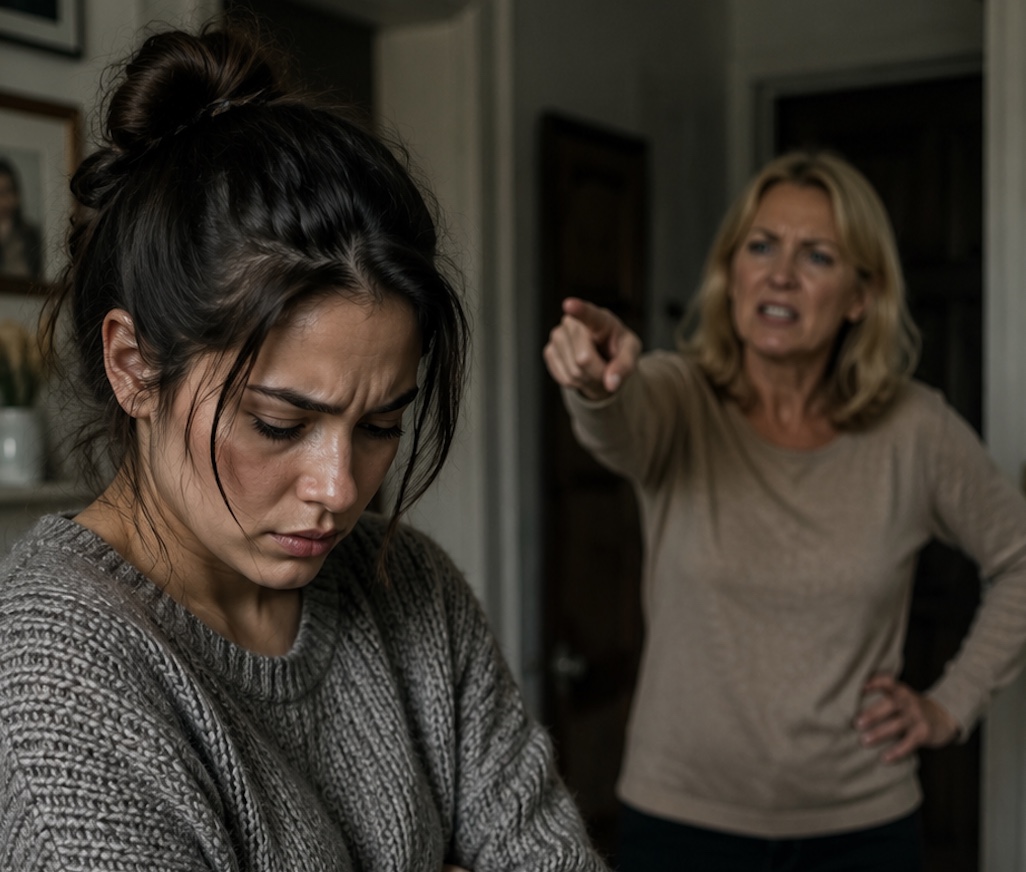
— Three days have passed. I warned you.
The door slammed shut.
Irina stood on the landing, clutching her son to her chest. Dima was sobbing into her neck. Against the wall, bags were piled up — packed in a hurry, lopsided and awkward. A child’s snowsuit with a missing button stuck out of one of them; from another, the edge of a terry towel peeked out.
The neighbor from the third floor cracked her door open, met Irina’s eyes — and immediately disappeared again, clicking the lock shut.
Irina couldn’t understand how it had come to this. Just a week ago, this had been home. There had been a husband. There had been a life. And now she was standing on the staircase with a child in her arms and bags at her feet — with nowhere to go.
Downstairs, the entrance door banged. Heavy footsteps began climbing the stairs.
Irina had always known life wasn’t fair. She had learned that early — in an apartment where her mother fell asleep at the kitchen table with her face pressed to the surface, while her father shouted so loudly the neighbors called the police.
“Why are you so quiet?” her mother would ask on the rare days she was sober. “You’re nothing like us.”
Her parents died one after the other: her father from cirrhosis, her mother six months later from pneumonia she refused to treat. Irina was twenty. She went to settle the inheritance and learned that the apartment had already been transferred to some strangers — her mother had signed the papers a few months before her death. The lawyer only spread his hands helplessly.
“You could contest it, but it would take years of court hearings and money you don’t have.”
She had no money. So Irina moved into a factory dormitory and found work as a cashier at a supermarket on the outskirts of town. The job was dull and mechanical, but it gave her a paycheck and the feeling that the ground beneath her feet had not completely disappeared.
Alexei entered her life quietly. Every evening, exactly at nine, he came to her checkout with the same two items — a pack of tea and oatmeal cookies.
“Do you always eat dinner this late?” she asked him once.
“Only when I have a reason to stay longer,” he replied, smiling in a way that made Irina feel warmth in her chest for the first time in ages.
Their relationship moved quickly. Alexei was calm, reliable, and not a man of many words. With him, Irina felt safe for the first time. When she told him she was pregnant, she expected anything — except what he actually said.
“Then we’ll get married. I’m serious.”
Meeting his family happened over dinner in his parents’ apartment. His father, Viktor Andreevich, sat at the head of the table in silence, occasionally nodding. His mother, Lyudmila Petrovna, studied Irina as if she were inspecting goods at a market — slowly, with narrowed eyes.
“Where do you work?” she asked.
“As a cashier. For now.”
“For now,” Lyudmila Petrovna repeated, pursing her lips.
Alexei’s younger brother, Kirill, sat glued to his phone without looking up. His older sister, Olga, a broad woman with a sharp voice, looked Irina straight in the eye and said:
“Marriages like this don’t last long. Don’t take offense — I’m just telling the truth.”
Irina didn’t take offense. She buried it deep inside.
After the wedding, the young couple moved into an old one-room apartment that belonged to Alexei’s family. It smelled of mothballs, the wallpaper peeled at the corners, and the sofa creaked with every movement. Irina tried to combine work with evening classes, but after Dima was born, she became completely exhausted. The baby slept badly, got sick often, and the nights turned into an endless carousel of feedings and rocking.
Lyudmila Petrovna came without calling. She opened the refrigerator, looked inside the pots, and shook her head.
“What are you feeding this child? Water?”
Then she left, leaving nothing behind but shame.
Olga, on the other hand, arrived with heavy shopping bags — grains, meat, baby food. She silently unloaded everything onto the table. But the moment Irina picked up her son, it began.
“Hold the baby properly. You’ll break his neck! Support his head — why are you holding him like he’s not even yours?”
Irina clenched her teeth and stayed silent. And when Olga left, she cried — from exhaustion, from anger, from the feeling that even help in that family sounded like a sentence.
The changes came gradually — not as a sudden revelation, but as tiny cracks in the wall Irina had built between herself and her husband’s family.
One February night, Dima’s temperature shot up to thirty-nine and a half. Irina called Alexei, but he was on the night shift and didn’t answer. She called her mother-in-law, who replied sleepily:
“Give him fever medicine and stop panicking.”
Forty minutes later, the doorbell rang. Olga stood on the threshold, wearing a coat thrown on in haste and holding a pharmacy bag.
“Move,” she said, pushing past Irina with her shoulder. “Where’s the thermometer?”
She stayed until morning. She sat beside the crib, changed compresses, and when Dima finally fell asleep, she silently washed all the dishes that had been sitting in the sink for three days.
Before leaving, she tucked money under the sugar bowl. Irina found it only that evening — three thousand rubles, folded into four.
A week later, Irina accidentally overheard a conversation. Lyudmila Petrovna had come over and started her usual routine — opened the wardrobe, shook her head.
“The diapers aren’t ironed. And you call yourself a mother.”
Olga, who had arrived at the same time, suddenly turned to her.
“Stop lecturing her. Help her yourself, then. Pick up the iron and iron them if you’re so perfect.”
Lyudmila Petrovna fell silent, turned crimson, and left.
Irina stood in the hallway with her back pressed against the wall. Her heart was pounding. Something inside her shifted — like furniture in a room being moved without permission. For the first time, she thought: maybe behind all that roughness there wasn’t contempt, but something else entirely.
But admitting that was impossible. The hurt was buried too deep.
That summer was hot and dusty. Alexei had long promised his friends they would go to the lake — fishing, grilling meat, sleeping in tents. Irina let him go easily.
“Go,” she said. “Dima and I will manage.”
He kissed his son on the top of his head, then kissed Irina on the temple, and left. She watched from the window as he got into the car, and even waved, though he no longer turned around.
The call came close to eleven at night. An unknown number. Irina stared at the screen for a long time before answering.
The voice on the other end was unfamiliar and broken. One of his friends. Irina listened and couldn’t understand the words because the words were impossible. One of the boys had started drowning — Alexei had jumped in after him. They pulled the friend out. They didn’t pull Alexei out.
She didn’t scream. She simply sank to the floor, still holding the phone to her ear, and stared at the wall where their wedding photograph hung — the only one, in a cheap frame from the supermarket.
Dima began crying in his crib. She stood up, took him into her arms, and rocked him. She did it automatically — her body remembered what needed to be done, while her mind understood nothing anymore.
She remembered the funeral in fragments. Black coats. The smell of fresh earth. Lyudmila Petrovna sobbing aloud. Viktor Andreevich suddenly looking small and old. Olga standing slightly aside, her face like stone.
People came up and said things. Irina nodded.
Then came days that all looked the same. She forgot to turn off the stove. She poured tea and found it cold three hours later. Once, she realized she was standing in the bathroom in front of the mirror and couldn’t remember why she had gone there.
Five days after the funeral, the doorbell rang. Lyudmila Petrovna stood on the threshold in a black headscarf, her eyes sunken. But her voice was firm.
“The apartment is registered to the family, Irina. To Viktor, to me, to the children. Lyosha is gone. You need to move out.”
“Are you serious?” Irina whispered. “Your grandson lives here.”
“We won’t abandon our grandson. But you have three days. This is the right way.”
Lyudmila Petrovna turned and left without waiting for a reply.
Irina stood in the doorway. It felt as if the floor had tilted beneath her like the deck of a ship.
Three days. She packed slowly, as if underwater. She placed Dima’s rompers into bags, folded blankets. Her hands wouldn’t obey her. At one point, she picked up Dima’s rattle — the one Alexei had bought the day they learned the baby’s gender — and the handle cracked, breaking in half.
Irina looked at the broken pieces. And suddenly she laughed. Quietly at first, then louder — convulsively, breathlessly, throwing her head back. The laughter turned into sobbing, and the sobbing turned back into laughter, and she couldn’t stop, sitting on the floor among scattered baby clothes.
When she finally went quiet, the apartment was so silent she could hear the neighbor’s clock ticking through the wall.
And then the thought came — quiet, steady, almost calm:
“It would be easier to follow him.”
She wasn’t frightened by that thought. That was the most terrifying part — she wasn’t frightened.
On the second day, Lyudmila Petrovna did not come alone. Kirill followed behind her, wearing sweatpants and carrying a backpack. He walked through the apartment, glanced into the room, and said:
“The table will fit here fine. And the armchair by the window.”
Irina stood in the corner, holding Dima tightly. Her son clung to her sweater and stayed silent — he had long stopped crying, as if he understood that tears would change nothing.
Lyudmila Petrovna opened the wardrobe and began stuffing Irina’s things into a black garbage bag.
The front door slammed. Olga stood on the threshold.
For a second, she silently looked at her mother, at Kirill with his backpack, at Irina in the corner. Then a shadow passed over her face — heavy and dark.
“What is going on here?” she asked quietly.
“It’s none of your business,” Lyudmila Petrovna snapped. “The apartment belongs to all of us.”
“You buried your son a week ago, and you’re already dividing the apartment?!” Olga’s voice broke into a shout. “You’ve been like this your whole life! Remember how you threw my things into the trash when I tried to leave at sixteen?”
Kirill backed toward the door. Lyudmila Petrovna froze with the bag in her hands.
Olga stepped forward, took Dima from Irina’s arms, and put the bags back into the corner. Her movements were precise and quick — without panic.
Then she took out her phone and called a taxi.
“Come on,” she said to Irina. “There’s nothing left for you here.”
And Irina went with her. For the first time in many days, she didn’t feel fear — she felt someone’s hand holding her firmly.
Olga’s apartment turned out to be spacious and bright, with large windows beyond which poplar trees rustled. It smelled of coffee and clean laundry. There was a kettle in the kitchen, and a to-do list written in large, confident handwriting hung on the refrigerator.
For the first few days, Irina barely left the room. She lay beside Dima, stared at the ceiling, and listened to Olga talking on the phone behind the wall, clattering dishes, living.
On the third morning, Olga entered without knocking and placed a plate of omelet in front of her.
“Eat. Then we’ll talk.”
The conversation was short and harsh.
“You have every right to feel sorry for yourself,” Olga said, folding her arms. “But you have a child. So tomorrow, you get up, wash your face, and sit down at the computer. I found online accounting courses. Free ones.”
“I didn’t ask for help,” Irina replied dully.
“And don’t ask. I’m not asking you either — I’m telling you.”
Irina wanted to get angry, but she couldn’t. Something inside her was broken — that spring that used to tighten at every rough word. Now Olga’s harshness sounded different. Not like a blow, but like a push in the back — forward, toward life.
The days began to follow one another. Olga bought groceries and left money on the shelf — “just in case.” She taught Irina how to make a schedule and divide her time between studying and caring for the child. Sometimes they argued — loudly, sharply, until the cups rattled on the table.
“You cook his porridge without butter? Seriously?” Olga would snap.
“My mother didn’t cook porridge at all,” Irina shot back. “I’m learning.”
“Then learn faster.”
But there was no anger in those words anymore. And Irina could hear that.
One evening, while putting Dima to bed, she caught herself thinking that Olga was neither an enemy nor a stranger. She was like the older sister Irina had never had: uncomfortable, prickly, impossible — and the only one who hadn’t turned away.
Six months passed almost unnoticed — like water slipping through fingers.
Irina worked remotely now, handling accounting for two small companies. Dima had grown, started walking, grabbing onto furniture and laughing whenever he fell. Olga’s apartment was now filled not only with her footsteps, but with a child’s squeals, toys knocking against the floor, and something that sounded like life.
One evening, Irina was sorting through an old bag — the very one with the snowsuit that had the missing button — when she found a photograph at the bottom. Alexei, about five years old, wearing a checkered shirt, squinting in the sun. She looked at the picture for a long time. Ran her finger along the edge. And for the first time, she did not cry.
Olga walked past and glanced over her shoulder.
“He looks like Dima,” she said. “So, are you managing now?”
Irina was silent for a moment.
“Because of you.”
Olga gave a short snort, turned away, and went into the kitchen. But Irina still managed to notice how her shoulders trembled.
Her relationship with Lyudmila Petrovna and the rest of the family never healed. Olga did not forgive them — and had no intention of doing so. But it no longer wounded Irina. She had a home now. She had support. And she had a person she had once hated with all her heart — who turned out to be the only real family she had.