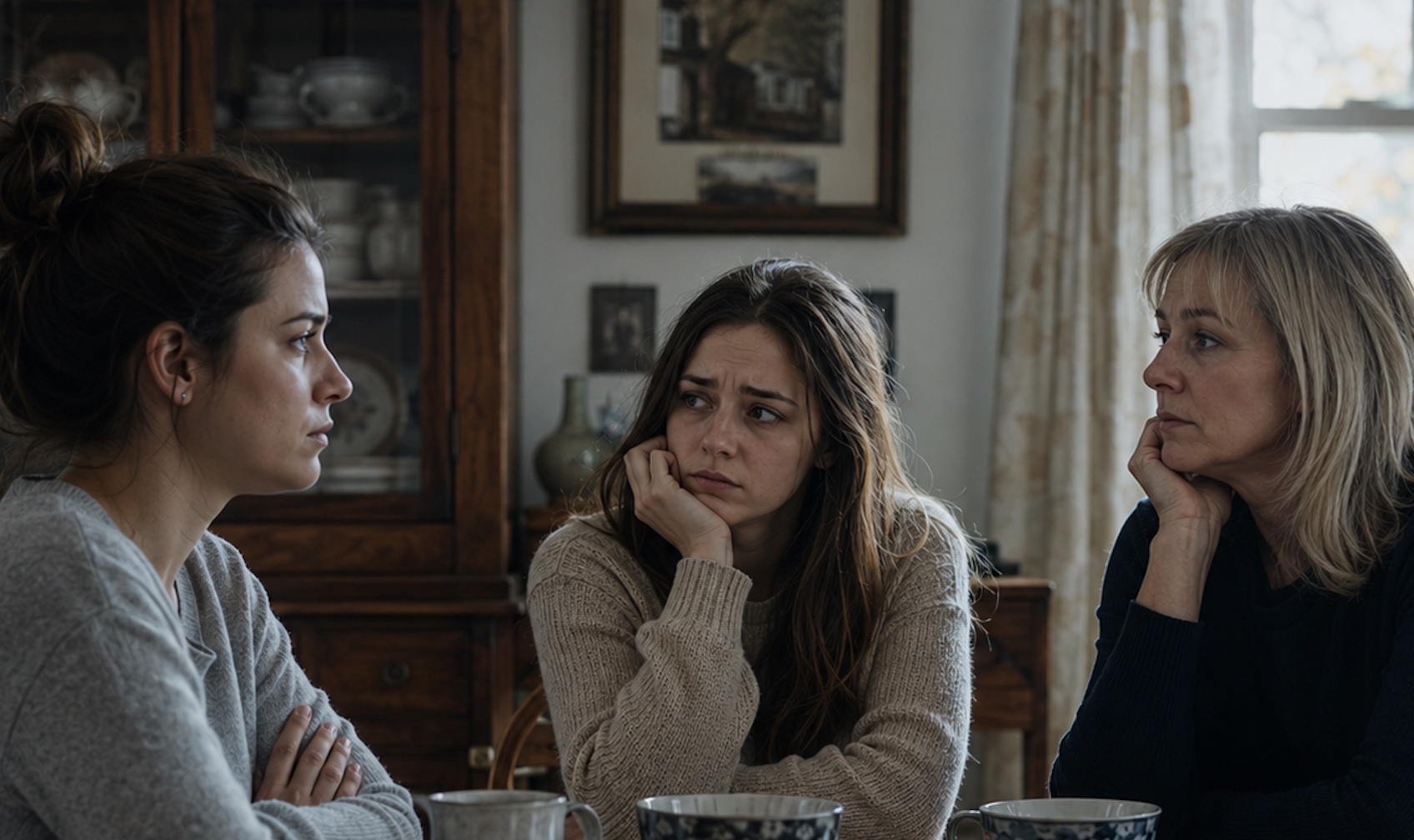
— Lena, we need to talk. It’s urgent.
Tamara Sergeyevna stood by the kitchen table, unable to bring herself to sit down. Her fingers kept worrying the edge of the oilcloth. In front of her lay a sheet torn from a notebook, covered in numbers — a column of amounts underlined in red pen.
Elena looked at the paper, then at her mother. Everything was clear without a single word.
— Katya again? — she asked evenly.
— She’s short. Just a little. I would help her myself, but my pension won’t come for another two weeks…
Lena slowly took off her coat and hung it over the back of a chair. Then she sat down. Silence filled the kitchen — thick, heavy, suffocating.
— Mom, — she finally said. — Katya’s debts are your problem now. I’m not giving any more money.
Tamara Sergeyevna froze. The clock on the wall counted out the seconds. Neither of them looked away.
No one had ever said that rule out loud. It simply existed — like the air, like the wallpaper in their parents’ apartment, like the smell of borscht on Sundays.
Katya was the younger one. Fragile, sensitive, disorganized. She needed help. She needed guidance, backup, forgiveness. Lena was the older one. Strong, smart, independent. She would manage. She always managed.
Lena remembered getting a B in math in third grade and seeing her father frown.
— You can do better than that. You’re not Katya. We expect more from you.
That same day, Katya came home with a failing grade in reading. Their mother stroked her head and said:
— It’s all right, sweetheart. We’ll read it together again tomorrow.
Lena didn’t feel offended. Or rather, she learned not to feel offended. She clenched her teeth and became an excellent student. Then a scholarship student. Then a professional people valued at work. She rented her own apartment at twenty-three. Bought her own car at twenty-eight. On her own, on her own, on her own — those words became the foundation of her life.
Meanwhile, Katya dropped out of college in her second year. She got a job as a sales assistant and quit a month later. Tried freelancing — it didn’t work out. Took out a microloan for a new phone and failed to calculate the payments.
— Lena, help your sister out, — her mother would call. — It’s not much, twenty thousand. She’ll pay it back.
Lena sent the money. Katya never paid it back. Two months later, the call would come again.
— Mom, she’s an adult. Let her deal with it herself.
— How can you say that? She’s your sister! Her character is different, you know that. Not everyone can be like you.
And Lena would send the money again. Every time, with the quiet hope that this would be the last time. That Katya would finally get on her feet, find a decent job, grow up. Every time, that hope died the same way — with the next phone call.
Their father said nothing. He had removed himself from these conversations long ago, sitting in the room in front of the television and pretending none of it had anything to do with him. Tamara Sergeyevna carried everything alone: Katya’s irresponsibility, Lena’s growing resentment, and her own guilt — a guilt she would never have admitted to.
When Katya met Dima, the family exhaled.
He seemed calm and hardworking — a construction installer, good with his hands, kind eyes. After meeting him at a family dinner, Tamara Sergeyevna whispered to Lena on the phone:
— Maybe she’ll settle down now. A good man beside a woman — that can change a lot, you know.
Lena wanted to believe it. For the first two months, she almost did. There were no calls asking for money. Katya posted photos from their rented apartment: new curtains, dinner together, a cat named Barsik. An ordinary life, the kind ordinary people lived.
Then one day Lena stopped by without warning to bring Katya a winter coat. She had bought herself a new one, and her sister had always liked the old one.
Dima opened the door. Unshaven, with a dull, exhausted look in his eyes.
— Katya isn’t here. She went to see a friend, — he said, avoiding Lena’s gaze.
In the hallway stood two pairs of shoes and a bag full of empty bottles. On the kitchen table lay three overdue utility bills. Lena only glimpsed them while setting the bag with the coat down in the entryway, but her eyes caught on them and would not let go.
— Dima, is everything all right with you two? — she asked carefully.
— Everything’s fine, — he answered.
And he smiled the way Lena herself smiled whenever her mother asked about another money transfer. With effort.
She understood.
Nothing had changed. Now Katya wasn’t only dragging her parents and sister down with her — she was dragging this young man too, the one who had fallen in love and decided love could fix everything. Lena knew that illusion well. She had lived with it for years. Only in her case, it had not been called love. It had been called duty.
She drove home in silence, gripping the steering wheel. Something inside her slowly, finally shifted — like the needle of a scale that had trembled in the middle for too long and at last dropped to one side.
Rescuing Katya did not help. It had never helped. Every ruble transferred, every broken promise forgiven — all of it had only given Katya permission not to change.
The phone rang at seven in the morning — at that merciless hour when bad news sounds especially loud.
— Lena, Katya is missing.
Her mother’s voice was not frightened. It sounded more like the voice of someone worn down by habit, someone running a marathon who had long ago stopped counting the kilometers.
At first, no one was truly worried. Dmitry thought Katya had gone to a friend’s place. They had argued over something small, and he was used to her going silent for a day or two after fights. She would cool off, then come back. It was normal.
But three days passed. Then five. Her phone was turned off. Her social media went silent. The friends Dmitry called all gave the same answer: no, she hadn’t come, no, she hadn’t written. He wandered around the empty apartment, fed Barsik, and could not understand at what point “she needed a break” had turned into “she isn’t coming back.”
Then the landlady arrived.
Natalya Petrovna was a dry woman of about sixty, carrying a folder of documents and wearing the kind of look that made people want to step back. She stood in the doorway and spoke clearly, without emotion.
— Three months. Not a single payment. The lease is in Ekaterina Viktorovna’s name. If the money isn’t paid by the end of the week, I’m going to court.
Seventy-two thousand.
Dmitry stared at her and did not understand.
— Wait, — he said. — What do you mean, three months? I paid. Every month, I transferred Katya my half.
He took out his phone and opened his banking app. The transfers were there in a neat row — the fifteenth of every month, the same amount each time. Then he showed the messages: “Baby, I sent the rent money,” “Okay, I’ll pay tomorrow,” “Done, don’t worry.” Screenshots, receipts, dates. Everything tidy. Everything in place.
Only the money had never reached the landlady. Not once in three months.
Natalya Petrovna looked at the phone screen, then at Dmitry. There was no pity in her eyes — only the tired efficiency of a person who had been deceived before.
— I don’t care who transferred money to whom. The lease is in her name. But you are the one living here. Sort it out.
She left a copy of the contract on the kitchen table and walked away. Dmitry sat down on a stool and stared at his phone for a long time — at the messages, at the affectionate “okay” and “done,” at the carefully transferred sums that Katya had accepted and spent. On the new sneakers she had bought in March. On the spontaneous trip to visit her friend in Kaluga. On endless food delivery orders. Little things — barely noticeable on their own. Together, they added up to seventy-two thousand of someone else’s money.
He called Tamara Sergeyevna because there was no one else to call.
After listening to everything, the mother called Lena.
— Come over, — she said quickly. — We need to decide what to do.
Lena came.
On the same kitchen table lay the same oilcloth, but the papers were different this time — printed messages from the landlady, screenshots of threats, figures showing the debt.
— We need to pay it off urgently, — Tamara Sergeyevna said quickly, swallowing her words. — Otherwise there will be a court case. You understand what that means. Pay it, daughter.
Lena looked at the paper and saw not numbers, but her whole life — a long chain of identical moments where only the amounts changed.
This was not an accident. It was not bad luck. It was a script written long ago, and all of them — her mother, her father, Dima, Lena herself — had obediently played their roles while Katya moved from one crisis to the next as easily as walking from one room into another.
— Mom, — Lena said. — No.
Tamara Sergeyevna did not understand at first. She blinked as if she had just been spoken to in a foreign language.
— What do you mean, “no”?
— I mean no. I’m not paying.
Her mother straightened up. Something familiar flashed in her eyes — that same mixture of hurt and righteous anger that had worked without fail for twenty years.
— She is your sister, Lena! Your own flesh and blood! How can you just stand there and watch her life fall apart?
— Her life is not falling apart because I refuse to pay. Her life is falling apart because we always pay.
— You’ve become cruel. I don’t recognize you.
Lena felt the familiar tremor inside her — the old reflex grown into her ribs: you’re guilty, fix it, give in. But for the first time in many years, she did not obey that reflex. She simply waited it out, the way one waits for a wave to pass.
— Mom, Katya is thirty years old. She is an adult. She chose to run away. She chose not to pay. These are her actions. And she should be the one to answer for them.
— So you’re abandoning her?
— No. I’m stopping the rescue. Those are not the same thing.
Tamara Sergeyevna sank into a chair. In the span of one minute, her face seemed to age ten years. Lena stood in the doorway and felt the words “cruel” and “abandoning” strike against her — and for the first time, the very first time, they left no bruises.
Lena left that evening and did not call the next day. Or a week later.
For the first time in her life, she did not sit waiting by the phone, did not check her messages, did not run through possible solutions in her head. The silence was hard — but not in the way it used to be. Before, it had been hard because of helplessness. Now it was hard because freedom felt unfamiliar.
News reached her in fragments, through her father, who occasionally sent short messages without punctuation.
Katya was found ten days later.
She had not disappeared — she had been hiding at a friend’s place in Kaluga. When Tamara Sergeyevna finally got through to her, Katya cried into the phone and promised to fix everything. The promises were as familiar as the wallpaper in the parents’ apartment.
But this time, no one rushed to fix anything for her.
The landlady took the matter to court. The debt officially fell on Katya — with a writ of enforcement, interest, and monthly deductions from her salary. And a salary finally appeared: Katya got a job as a cashier in a chain store. Not out of inspiration, but out of necessity. For the first time, life handed her a bill she could not pass on to her sister.
Lena heard about it from her mother. Tamara Sergeyevna called with a dry, tired voice, without her former pressure.
— Katya is working, — she said. — It’s hard for her.
Lena was silent for a moment.
— I know, Mom. She’ll manage.
Her mother hung up without saying goodbye. Lena placed the phone on the table and did not call back.
Autumn arrived almost unnoticed — yellow leaves on the balcony, the smell of apples in the supermarket, early twilight.
Lena bought herself an armchair.
An ordinary soft one, upholstered in gray fabric — the kind she had walked past for years, always thinking, “Later. Not now.” She placed it by the window, next to a floor lamp. In the evenings, she sat there, drank tea, and read — not news on her phone, but books. Real paper books, with folded corners.
At work, a colleague asked:
— Lena, did you change something? Get a new haircut?
— No, — she smiled. — I just started sleeping properly.
That was almost true.
She really had begun to sleep — deeply, without falling into three-hour pits of anxiety, without checking her phone first thing in the morning.
Katya did not call. Her mother called rarely and spoke with restraint. A distance settled between them — not hostile, but honest. Maybe it would shrink with time. Maybe it would not. For the first time, Lena allowed both possibilities and did not try to control the outcome.
One evening, she sat in her new armchair, looking at the streetlights beyond the window, and caught herself feeling something unfamiliar.
Not joy.
Not relief.
Silence.
The real kind. Inside her.
Without debt. Without guilt. Without waiting for the next phone call.
For the first time, her life belonged only to her.