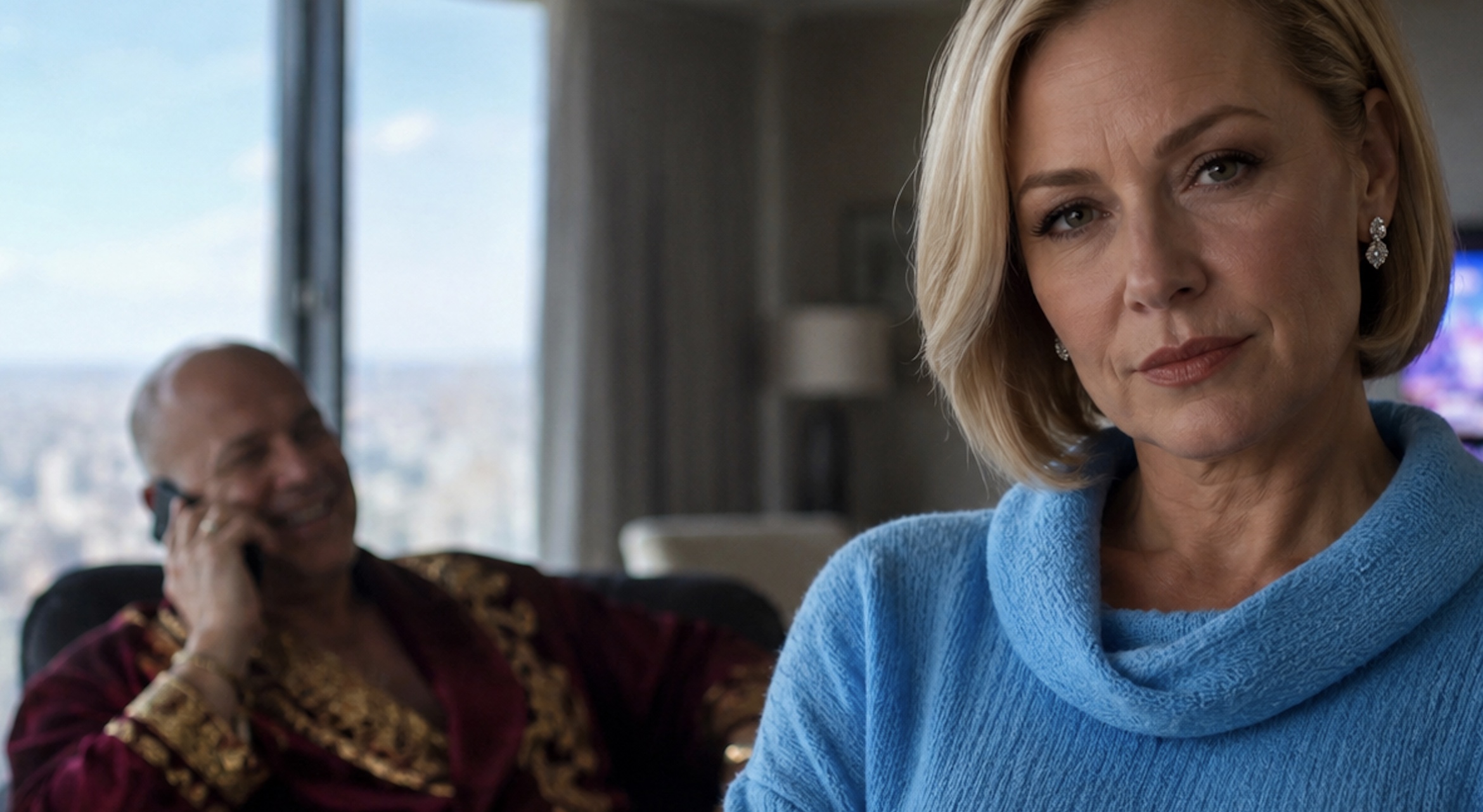
“Natasha, did you buy crab?” Anton’s voice drifted from the living room, lazy and demanding, as if he were asking about stock prices on the Tokyo exchange instead of dinner paid for with my money.
Without a word, I placed a package of frozen capelin on the counter.
“What crab, Antosha?” I asked, wiping my hands on a towel. “Yesterday we paid the utility bills, and the rates have gone up again. Today I bought basic groceries for the week. Kamchatka crab doesn’t fit into that budget in any possible universe.”
My forty-eight-year-old husband appeared in the kitchen doorway. He was wearing a burgundy silk robe embroidered with golden dragons — my reckless investment in his “home comfort,” bought with my New Year’s bonus.
“I asked you!” Anton clasped his hands dramatically, adjusting the collar that was slipping off his shoulder. “My nervous system is exhausted after yesterday’s stress at the employment office. Complete idiots work there! I need easily digestible protein and iodine for my brain. You’re a chef in a decent restaurant — can’t you arrange proper food for your own husband?”
“Protein and iodine are perfectly available in capelin,” I replied calmly, picking up the knife and cutting board. “Besides, cheaper seafood often contains plenty of trace elements. The Japanese invented surimi from white fish back in the twelfth century precisely to get the maximum benefit at minimum cost. So consider this your introduction to samurai discipline.”
I coated the pieces of fish in flour and dropped them into the hot pan. The golden crust was the result of the Maillard reaction — the chemical interaction between amino acids and sugars under heat. It was amazing how the simple laws of chemistry worked honestly and predictably, unlike the laws of human conscience.
Anton snorted loudly, making it clear that he was deeply disappointed in the institution of marriage, then retreated to the living room to suffer in front of the television. I watched him go and felt something inside me slowly begin to harden into clarity.
Five years. For five long years, my husband had been “searching for himself.” Before that, he had worked as a security guard at a warehouse that sold luxury bathroom fixtures, but he quit because “there was a draft around his feet.” Then he briefly worked as a driver for some businessman, but they “didn’t get along” — the employer had the nerve to expect him to arrive on time, while Anton considered punctuality a symptom of slave mentality. Since then, he had been looking for his true purpose while eating through my salary and demanding delicacies to support his fading spirit.
The front door slammed. Noyabrina Vasilyevna, my mother-in-law, appeared in the entrance. She had her own key, which she stubbornly refused to return, explaining that a sacred maternal duty required her to check whether her “little boy” was starving.
“In the Soviet Union, a wife protected her husband!” she announced instead of greeting me, theatrically placing her old-fashioned handbag on the kitchen stool. “I worked as a secretary at the Palace of Pioneers, and our director, Ivan Ilyich, always walked around with perfectly starched collars. His wife took care of everything at home, kept the household running, blew every speck of dust off him. But you, Natalya, have completely worn poor Antosha down with your nagging. A man is like a crystal vase — he must be treated gently!”
I put down the spatula, washed my hands, leaned against the sink, and crossed my arms.
“Noyabrina Vasilyevna,” I said, my voice as even as the hum of a reliable refrigerator. “Ivan Ilyich probably brought home a paycheck instead of lying on the sofa for five years waiting to be offered the position of general. Your son last worked in 2021. Since then, he has worn out two pairs of pants and completed every level in ‘Tanks’ on my computer. What kind of crystal vase is that? He’s more like a cast-iron basin.”
My mother-in-law threw up her hands in outrage, caught the open saltcellar with her wide sleeve, and sent it crashing to the tile floor. White crystals scattered everywhere.
“This… this is temporary! He’s simply too talented for dirty work!” she squeaked, frantically trying to sweep the salt into her palm and only smearing it across the floor.
Like a balloon suddenly losing air, she lost all her official grandeur at once and hurried back into the hallway.
The next day, I was supposed to work a double shift. The restaurant was expecting a banquet for sixty people, and I had mentally prepared myself for fourteen hours on my feet. But in the morning, a pipe burst in the main hall. The water was shut off, the banquet was canceled, and after the chaos of the early hours, I returned home by lunchtime.
I quietly opened the door with my key. From the living room came Anton’s lively, pleased voice. He was talking on the phone with his buddy.
“Where’s she going to go, Denchik?” my husband declared, crunching the pistachios I had bought over the weekend to decorate custom cakes. “Women after forty need the status of being married like they need air. Otherwise they’re ashamed in front of their girlfriends.”
I froze in the hallway. My coat remained hanging over my arm.
“I know exactly what to say to her,” Anton continued, happily sipping something from a glass that looked suspiciously like beer. “I tell her I’m depressed, that no decent jobs are being offered. I’m not going back to driving for pennies — I didn’t find myself in a garbage dump. Let her work. She’s a cook, isn’t she? Serving people is in her blood. Tomorrow I’ll tell her I need a massage chair for my back, something around a hundred grand. She’ll buy it like a good girl. I’ll lie there resting, and she won’t go anywhere.”
Nothing twisted in my chest. No tears came. My vision didn’t darken. I didn’t feel the urge to storm in and smash plates against the wall. There was only absolute, icy clarity. I understood then that all these years I had not been carrying a man lost in life, not a husband broken by circumstances, but a calculating parasite who had been cynically devouring my time, my money, and my life.
I went into the bedroom. From the top shelf, I pulled down two enormous plaid bags — the legendary kind shuttle traders used in the nineties. Then I opened Anton’s wardrobe.
No hysteria. No shouting. I moved with clean, methodical precision. Sweaters, trousers, a collection of T-shirts, socks. I threw everything into the bags without even trying to fold it properly. Then I went to my desk, took a sheet of paper and a pen.
“Sports channel subscription — 1,500. Pistachios and craft beer every week — 8,000. Silk dragon robe — 12,000. Your mobile phone bill — 1,000. Total: 22,500 rubles of pure loss for this month alone.”
I stepped into the hallway, dragging the overstuffed bags behind me. The heavy plastic rustled loudly enough to finally attract the attention of the “master of the house.”
Anton came out of the living room. His face showed mild confusion, which quickly shifted into his usual patronizing expression.
“Natash, why are you home so early? And why did you drag out that junk? Are you going to the dacha or something? Listen, who’s making dinner? I’m already hungry.”
“I’m not going anywhere, Anton,” I straightened up and looked directly into his eyes. “You are. On foot. In search of yourself and your dignity.”
“What?” He smirked, assuming this was just another female whim. “Hormones acting up again? Come on, stop this circus. I’m tired today. I looked through three top-manager vacancies. I’m under stress.”
“I heard your conversation with Denchik.”
The smirk slowly slid off his face like cheap ice cream melting in the sun. He blinked several times.
“So what?” Anton tried to switch on his usual lazy confidence, but his voice betrayed him and cracked. “Men talk. We exaggerate. You still won’t go anywhere! Who needs you at forty-one with your endless stove schedule?”
“I do,” I said, handing him the sheet with the calculations. “The one person I definitely don’t need is myself in the role of unpaid maid. This is your bill for the last month. Don’t bother paying it. Consider it my final charitable donation to the fund for the protection of endangered infants in adult bodies.”
“You have no right!” he shrieked, staring at the bags in horror. “This is jointly acquired property! I’ll file for division of the apartment! You’ll end up on the street!”
“This apartment was gifted to me by my grandmother three years before our marriage,” I said, pulling the keys from my pocket and opening the front door wide. “Article 36 of the Family Code of the Russian Federation. Property received by one spouse as a gift is that spouse’s personal property and is not subject to division. Out. Right now.”
Anton turned pale. His reinforced-concrete confidence melted before my eyes. In one minute, the smug king of the sofa became a frightened, flabby little man in a ridiculous robe.
“Natasha… come on, what are you doing? I was joking! Natash, really! I don’t even have money for the metro!” He tried to grab the doorframe, looking into my eyes with pathetic hope.
“Walking is excellent for blood circulation. It produces endorphins and lowers cortisol,” I said, calmly but firmly pushing the heavy bags out onto the stairwell. His worn-out sneakers flew after them.
He stood in the hallway outside. The burgundy silk of his robe fluttered absurdly in the draft. No my money, no comfortable sofa, no hot dinners, and no right to return.
“You can keep the robe,” I said, taking hold of the door handle. “Wear it when you visit your mother and she starts telling fairy tales about crystal vases.”
“Natasha, I’m not leaving!” he shouted, taking a step forward.
“You are,” I smiled. For the first time in a very long time, the smile was completely sincere and relaxed. “You won’t have anywhere else to go.”
I slammed the door right in front of his nose and turned the key twice in the lock.
Silence settled over the apartment.
It smelled of cleanliness, freedom, and just a little of freshly fried capelin.
It was the best smell of my life.