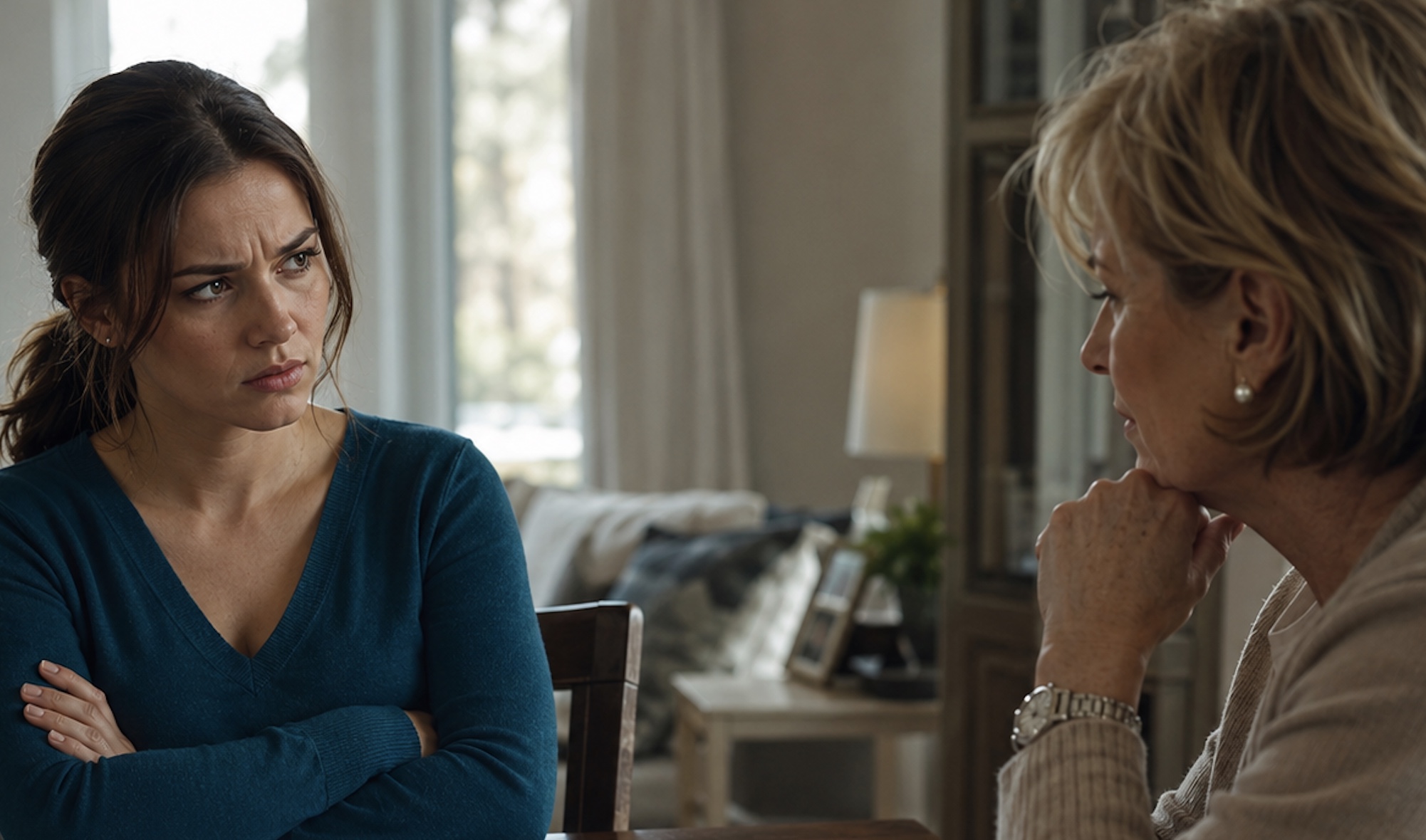
— Artem, are you serious? You forgot again?
Lidia stood in the doorway of the apartment, heavy shopping bags in her hands, staring at her fiancé as he guiltily fiddled with the strap of his watch. She had just returned from the furniture store, where she had spent the entire day choosing a sofa for their future home. Alone. Because once again, Artem hadn’t managed to get away from work.
“Lid, I’m sorry. The meeting dragged on. The director tore into us over the project, and I really couldn’t leave earlier,” he muttered, taking the bags from her hands and trying to catch her eye.
Without a word, she walked into the apartment, kicked off her shoes by the door, and collapsed onto the old sofa left behind by the previous owners. This apartment was her pride — a two-room place in a good neighborhood, not far from the metro, with windows facing a quiet courtyard. The very property she had been paying off for the past three years. Every month, saving part of her salary, denying herself small pleasures, spending every vacation at home instead of taking the seaside trips her friends kept dreaming about. And finally, two weeks ago, she had made the last payment and received the long-awaited documents confirming full ownership.
“Do you even understand how important this is?” Lidia said tiredly, running her fingers through her hair and rubbing her temples. “The wedding is in a month, the guests have already been invited, and we still haven’t properly furnished the apartment. I don’t want to bring you here after the celebration to a place with this ruined sofa and a wardrobe from the nineties.”
“We’ll furnish it. Of course we will,” Artem said, sitting beside her and trying to put his arm around her shoulders, though Lidia remained tense. “There’s just no time. Work is insane right now, clients demand reports every day, and at home Mom keeps calling about the wedding. The guest list needs changing, then the menu, then the flowers…”
Lidia winced involuntarily at the mention of his mother. Nina Viktorovna seemed pleasant at first glance — cheerful, talkative, energetic, always ready to help with advice and offer support. But lately Lidia had started noticing how easily those “pieces of advice” turned into instructions, and how innocent questions began sounding like interrogations.
“Why did you choose a white dress instead of a cream one?”
“Why order such an expensive menu? The guests won’t appreciate it anyway.”
“Maybe we should invite my colleagues too. They’ll be offended otherwise.”
“By the way, Mom invited us over for dinner tonight,” Artem added casually, scrolling through his phone. “She said she made your favorite roast with vegetables.”
“My favorite roast?” Lidia raised her eyebrows in surprise and turned to him. “Artem, I don’t even like meat that much. I’ve told you that at least five times. I prefer fish and poultry. Did you ever tell her?”
“Well… she tried. She cooked all day. Let’s not upset her, okay? Just eat a little and then say it was tasty.”
Lidia wanted to argue, but stayed silent. Exhaustion pressed down on her like a heavy blanket, and she had no strength left for another discussion. She simply nodded, got up from the sofa, and went to change.
At Nina Viktorovna’s house, they were greeted by the rich smell of fried onions, potatoes, and stewed meat. Artem’s mother bustled around the kitchen in a new floral apron, placing plates of salads, sliced appetizers, and hot dishes on the table.
“Lidochka, Artyomushka, come in, come in! Everything is fresh from the oven, still hot! Wash your hands and sit down quickly,” she said, kissing her son on both cheeks and ruffling his hair. She hugged her future daughter-in-law more formally, almost as if completing a necessary greeting ritual.
Dinner proceeded as usual. Nina Viktorovna chatted animatedly about the latest neighborhood news — who was getting married, who was renovating, who had bought a new car. She asked how the wedding preparations were going, clarified the menu details they had already discussed ten times, and returned once again to the guest list. Lidia answered automatically, nodding and agreeing, while feeling an inexplicable tension growing in the air with every passing minute.
“And how are things with the apartment?” Nina Viktorovna suddenly asked, carefully cutting the meat on her plate without looking up.
Lidia froze with her fork halfway to her mouth. Something in the question immediately put her on guard.
“What things? Everything is fine. I paid off the mortgage two weeks ago, the documents are already in my hands, and I don’t need to go to the bank anymore.”
“Ah yes, of course, I heard! Congratulations. That’s wonderful!” her future mother-in-law smiled, though her eyes remained cold and watchful. “So now it’s fully yours. Registered only in your name, right?”
“Of course,” Lidia said, placing her fork on the edge of the plate. “I bought it myself and paid for it myself for three years.”
Nina Viktorovna exchanged a quick but meaningful glance with her son. Artem lowered his eyes to his plate, methodically twisting pasta around his fork and pretending to be completely absorbed in his food. Something about that glance, about that silence, made Lidia straighten in her chair.
“You know, Lidochka, I’ve been thinking about this, even worrying a little…” Nina Viktorovna put down her cutlery and folded her hands on the table, assuming the pose of a confidential family conversation. “Since you and Artem will soon become husband and wife, legal spouses, perhaps it would make sense to… well, arrange the apartment differently. More properly, so to speak.”
“Differently?” Lidia slowly set her fork down, never taking her eyes off the older woman.
“Well, yes. Please understand me correctly. For a man, it’s very important to feel like… the master of the house. The head of the family, the support. And when everything is registered only to the wife, when she is the only owner… it somehow feels wrong. A man should feel that he also has a voice, that this is his home too.”
The air in the room seemed to thicken. Lidia felt her fingers curl into fists beneath the table. Heat rushed to her cheeks.
“It’s better to settle the apartment matter before the wedding,” Nina Viktorovna continued in a calm, confident tone, with not a trace of doubt in her voice. She said it as if she were stating an obvious, universally accepted truth that all decent people should understand and follow.
At that moment, Lidia finally understood that this had nothing to do with caring for her son or wanting the best for their future family.
“So you’re suggesting that I transfer my apartment — the one I bought with my own money and paid off for three years — to your son?” Her voice was quiet, almost a whisper, but there was steel in it. “Just like that?”
“Not transfer it completely, of course!” Nina Viktorovna threw up her hands, pretending to be genuinely surprised, even slightly offended. “Just register it jointly. Or at least give Artem some kind of share. You’re creating a family. There should be trust, stability, confidence in the future. Otherwise, what kind of family is it?”
“Mom, maybe this isn’t the time to discuss this?” Artem finally spoke, but his voice was quiet and uncertain, as if he already knew there was no point arguing with his mother.
“And when, Artem?” Nina Viktorovna turned to him. “After the wedding it will be too late to talk about these things. Then there will be talk of prenuptial agreements, division of property, courts, lawyers… Why all these formalities and bureaucracy if everything can be solved within the family, peacefully, without unnecessary papers?”
Lidia slowly leaned back in her chair and crossed her arms over her chest. She looked at Nina Viktorovna, then at Artem, and in her mind the picture of what was happening became painfully clear.
“Have you and Artem already discussed this before?” she asked calmly, though inside everything was boiling.
A heavy, awkward silence fell over the table. Artem continued staring at his plate without raising his eyes. Nina Viktorovna frowned.
“We did,” he finally admitted quietly. “I… we talked about it a couple of times. But I didn’t think Mom would bring it up tonight, during dinner. I wanted to talk to you myself later, in a calmer setting.”
“I see,” Lidia nodded slowly, her lips pressing into a thin line. Something inside her snapped and fell to the very bottom of her chest. “And when exactly were you planning to ask for my opinion? Or was I simply expected to agree silently because that was the ‘right’ and ‘family-minded’ thing to do? Just nod and sign the papers?”
“Lid, it’s not like that, you don’t understand…” Artem began, but she cut him off with a sharp wave of her hand.
“Nina Viktorovna, do you know how much I paid for this apartment?” Her voice had grown harder, colder. “Three years. Thirty-six months in a row. Every single month, without missing one payment, even when I barely had enough money left for food. I gave up vacations, new clothes, cafés with friends. I counted every penny and saved on everything so I could stay on schedule and avoid falling behind.”
“My dear, I understand all that perfectly, and I respect your effort, but…”
“No, you don’t understand,” Lidia said sharply, rising from the table. “You are asking me to give away the result of three years of my life, my work, my sacrifices, to a man who never once — do you hear me? — never once asked if I needed help with the payments. A man who did not invest a single kopeck in this apartment, who didn’t even help with repairs. And now you’re acting as if I’m the one who has to prove my trust in him, instead of him proving his respect for me and for my work.”
“But this isn’t about money, Lidochka!” Nina Viktorovna protested, rising too. “It’s about family, relationships, about a man feeling like a protector, a pillar of support. How can he be the head of the family if he doesn’t even have rights to the home?”
“Trust doesn’t begin with transferring property,” Lidia said calmly but firmly, taking her car keys from her bag. “Trust is built on respect. And respect means that important decisions affecting both people are made together, not discussed behind someone’s back. And they certainly aren’t imposed as an ultimatum over a family dinner.”
“You’re leaving? Right now?” Artem finally looked up at her, confusion written across his face.
“I’m leaving,” she said, picking up her bag from the chair. “And you know what, Artem? Your mother is right about one thing: the apartment really should be settled before the wedding. Because after it, I don’t want any claims or arguments about my property. No conversations about who is in charge and what belongs to whom.”
“What do you mean?” he jumped up from the table. “You’re not seriously thinking of canceling everything because of one stupid conversation, are you? Because of a misunderstanding?”
“This is not a stupid conversation, and it is not a misunderstanding,” Lidia stopped in the doorway and turned back. “This is a clear sign of how you see our future family. A family where my opinion isn’t even discussed, where I’m simply presented with a decision. Where your mother decides for me what I should do with my property and my life. And where you stay silent because it’s easier for you not to interfere, not to damage your relationship with your mother.”
“Lidochka, wait, let’s talk calmly!” Nina Viktorovna rose as well. “Maybe I spoke too directly, maybe too sharply, but I only want the best for you. I want you to be happy.”
“Do you know what’s the most frightening thing about this whole situation?” Lidia slowly turned around at the threshold and looked at both of them. “I’m not even angry. I can simply see what would happen next. The wedding, married life, children — and then the same conversations over and over again. About how ‘a wife should stay home,’ how ‘a man can’t be treated like that,’ how ‘this is how it’s done in our family.’ And every time I would step back and give in, because that would be ‘right’ and ‘family-minded.’ And in the end, I would be left with nothing.”
She walked out of the apartment, and the heavy metal door closed behind her with a dull, final thud.
The next few days turned into a nightmare. Artem called her ten times a day and wrote long messages in every messenger. At first, he apologized, said he had understood everything and that nothing like it would ever happen again. Then he tried to explain that his mother had “just been worried about her son,” that she “wanted the best,” that she “hadn’t thought about how it would sound.” Then he suggested they meet and discuss everything calmly, without emotions, like adults.
Lidia replied briefly and formally, agreeing to only one meeting — in a café, on neutral ground, where there would be no mother-in-law and no “advice.”
“I talked to Mom after that evening,” he began as soon as they sat at a table by the window. “She really did go too far, and she admits it. She says she was just scared for me, afraid I’d be left with nothing if… well, you understand.”
“If what?” Lidia slowly turned her coffee cup in her hands. “If I divorced you and threw you out on the street? Taking all your money and property with me? Artem, do you hear how that sounds?”
“No, not like that. It’s just… she worries. She’s seen different stories with acquaintances, where wives kicked husbands out of apartments after divorce.”
“Artem, this isn’t about your mother or her fears,” Lidia said, looking up at him. “It’s about the fact that you were silent that night at the table. You sat there and waited to see what would happen. You didn’t take my side, didn’t say that it was my decision and only mine. You didn’t protect me. You just stayed silent, as if you weren’t even there.”
“I didn’t know what to say!” he ran a hand over his face. “She’s my mother. She raised me alone. She wanted the best…”
“The best for whom?” Her voice sharpened. “For you? For herself? Definitely not for me. She suggested taking away the result of my work, my sacrifices, and you said nothing.”
He took a shaky breath, rubbed his face with both hands, and pressed his fingers against his eyes.
“Listen, let’s start over. From scratch. I’ll have a serious talk with her and explain once and for all that there will be no more conversations like that. That it’s your apartment and only yours. From now on, anything about our life together will be discussed only by us, without outsiders. I promise.”
“And what happens next time if she says I should quit my job because ‘a wife should be home with the children’? Or that we need to have a baby right away because ‘time is passing’ and ‘the biological clock is ticking’? Will you stay silent again and wait for me to handle it myself?”
“No! I’m telling you, I understand now, I…”
“You’re saying it now, after I already left and questioned the wedding,” she interrupted. “But back then, at that table, when it actually mattered, you were silent. And that tells me more than any promises or vows.”
Artem clenched his fists on the table and looked away, out the window. It was clear from his face that he was desperately searching for an argument, for words that could change everything, turn the situation around — but he couldn’t find them.
“A wedding is a decision to be together,” Lidia said quietly, looking down at her hands. “Not an exchange of guarantees in square meters. Not a demonstration of who is the head of the family and who supports whom. If that matters more to your mother than our relationship and our happiness, then I feel sorry for her. And if it matters to you too…”
She fell silent, leaving the sentence unfinished, hanging in the air between them.
“What are you trying to say?” Hurt and confusion entered his voice. “That I’m just like her? That all I care about is money and square meters?”
“I’m not trying to say anything,” she said, finishing her cold coffee and standing up. “I simply understood one important thing. Sometimes people’s true intentions, their real attitude toward you, are revealed not through loud demands or open conflicts, but through one ‘caring’ phrase said casually, as if it were obvious. And I’m grateful to your mother for that honesty and directness. Even if she didn’t plan it and didn’t mean it that way.”
As she left the café, Lidia did not look back. She walked along familiar streets, past shops and apartment buildings, and with every step it became easier to breathe. Somewhere inside, it hurt and felt empty, but at the same time there was relief — as if she had removed an unbearable weight she had been carrying for a long time without even noticing it.
Back home, in her own apartment — the one she had paid for herself, kopeck by kopeck, payment by payment — Lidia sat on the windowsill and stared out at the evening city for a long time. Streetlights flickered on one after another. Warm light appeared in the windows of neighboring buildings. Her phone was silent. Artem no longer called or wrote.
A week later, a friend wrote to her — a mutual acquaintance of hers and Artem’s, someone they sometimes met with:
“I heard what happened between you. Artem is telling everyone you’re too proud and stubborn, that you don’t want to compromise for the sake of family. His mother is telling people you used him so you wouldn’t be alone, then dumped him as soon as you got the apartment and paid off the mortgage. Just thought you should know what version they’re spreading.”
Lidia gave a bitter smile as she reread the message several times. She could have gotten angry. She could have started justifying herself, explaining her side to every mutual acquaintance, proving she was right. But what would be the point? Those who truly knew her would understand anyway. And the rest… for them, it would always be easier and more convenient to believe a neat, simple story about a “proud witch who threw away a good man” than to understand complicated details and nuances.
She typed a short reply:
“Thank you for warning me and telling me. But you know, I don’t regret my decision at all. It’s better to learn all this now, while it isn’t too late, than after the wedding, when nothing can be fixed.”
And she truly did not regret it for a second.
Several months passed. Autumn turned into winter, and then spring arrived. Lidia furnished the apartment exactly the way she wanted — without looking over her shoulder at other people’s opinions or tastes. She bought the very sofa she had chosen on that unfortunate day. She hung pictures and photographs on the walls that she personally liked, not ones that would look “solid and respectable.” She adopted a ginger cat from a shelter, something she had dreamed about for a long time but kept postponing because Artem was completely indifferent to animals and didn’t want “extra trouble.”
One warm May evening, returning from work with heavy grocery bags, she ran into a neighbor in the entrance hall — an elderly woman with whom she sometimes exchanged a few words about the weather and the news.
“Lidochka, where is your young man?” the woman asked, holding the door open. “I haven’t seen him in the yard for a long time. I used to run into him often, but now it’s like he vanished.”
“We broke up a few months ago,” Lidia replied simply and calmly, shifting the bags from one hand to the other.
“Oh, what a pity! He seemed like such a decent, well-mannered young man… Well, never mind, never mind. You’re still young and beautiful. You’ll definitely meet someone better,” the woman said sympathetically, patting her shoulder.
Lidia smiled politely and nodded, but inside she thought something completely different:
“Or maybe I won’t meet anyone. And that’s perfectly fine. It isn’t frightening. It’s better to be alone and free than to constantly prove your right to your own life, your own decisions, your own opinion. It’s better to live the way you want than to bend yourself to fit someone else’s expectations and demands.”
As she climbed the stairs to her floor, she once again remembered that ill-fated family dinner. Nina Viktorovna’s words, spoken so confidently and calmly, as if they were an undeniable, universally accepted truth. Artem’s silence — eloquent, meaningful, saying more than any words could.
Sometimes people’s real intentions, their true face, are not revealed through loud demands, open conflicts, or scandals. They hide inside one “caring,” “well-meaning” phrase tossed out casually between salad and the main course. In a suggestion that sounds like heartfelt advice, but in reality is a test — how far you are willing to step back, how much you are ready to give up, how easily you can be controlled and manipulated.
And it is good when that phrase is spoken in time — before you have fully tied your life to a person who cannot or will not stand beside you and protect you when it truly matters. Before you give someone else the right to decide for you.
Lidia opened the door to her apartment. Her ginger cat gave a long, happy meow, ran out of the room, rubbed against her legs, and purred. She picked him up and listened to the soft, steady rumble.
Outside the window, darkness had fully settled. The city was slowly falling asleep, preparing for a new day and new events. And inside this apartment — the one she had won from life herself, square meter by square meter, payment by payment, sacrifice by sacrifice — it was warm, cozy, and peaceful.
And it was her space. Only hers. Completely and entirely.
No one else had the right to tell her what to do with it, how to manage it, or whom to give it to.