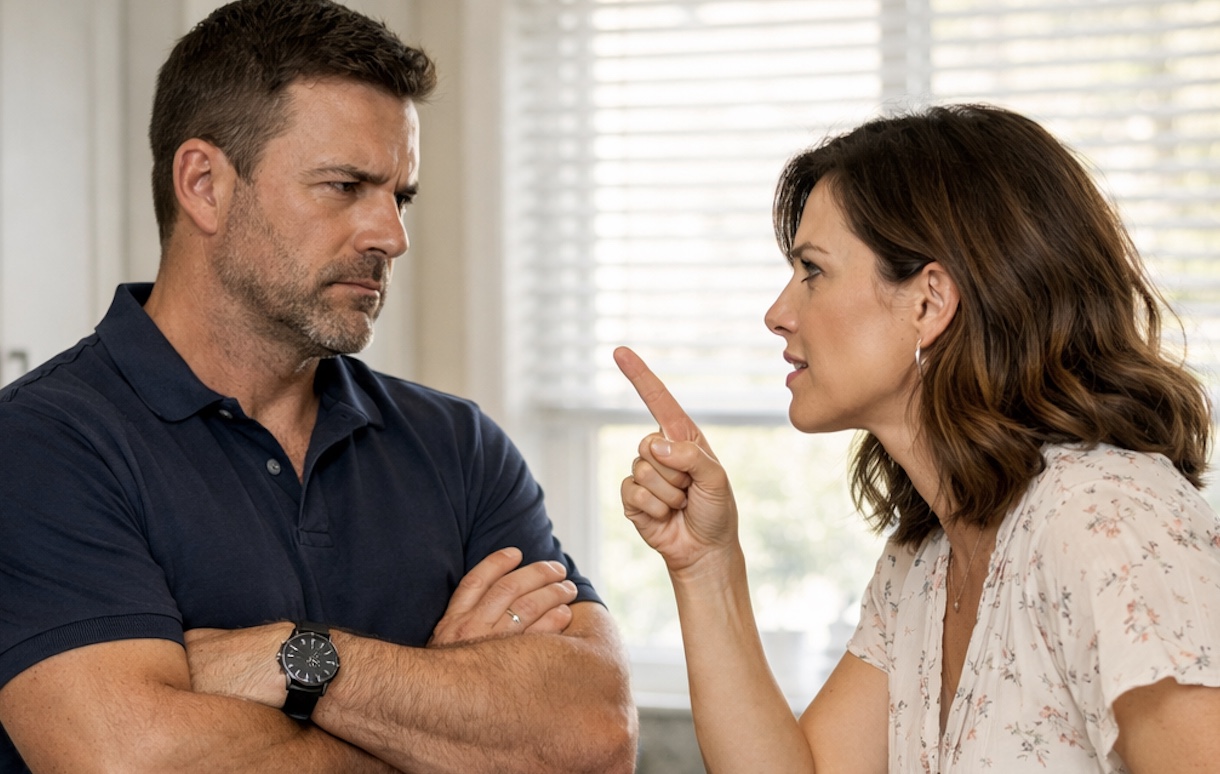
“Shut up, you cow! Where’s my borscht?” Viktor hurled the plate at the wall, and red splashes streaked across the wallpaper.
“If you don’t like it, cook for yourself!” I snapped.
He grabbed me by the shoulders and spun me around.
“Have you lost your mind? Forgotten who runs this house?”
“No, Vitya. You’re the one who forgot,” I said evenly, pulling a folder from my bag. “I’m the one in charge now.”
The color drained from his face so fast it was almost frightening. One second he was flushed with rage, the next he looked like a dead man. His hands trembled when he saw the notary seal on the will.
I had spent thirty years with that man. Thirty years swallowing insults, humiliation, and beatings. In the beginning, it all looked like love—flowers, compliments, promises that he would always protect me. Viktor was eight years older than I was, a construction foreman, solid and dependable on the surface.
But once we married, the mask slipped almost immediately. The first slap came just a month later because the soup needed more salt. I cried the entire night. In the morning he showed up with a bouquet of daisies, kissed my hands, and begged forgiveness.
“Marinka, you know how hot-tempered I am. But I love you, sweetheart. It will never happen again.”
It happened again a week later. Then again. And again.
I learned how to hide bruises under makeup. When friends asked questions, I gave them the same answer every time: “I fell down the stairs.” They nodded like they believed me. Everyone knew the truth, but no one said a word. Back then, that was how people lived—keeping silent.
Then the children came, one after another: Alyona, then Dima. I foolishly thought fatherhood might change him. It did not. He never hit me in front of them, and for years I counted even that as something to be grateful for. But the verbal cruelty never stopped.
“Mom, why does Dad talk to you like that?” five-year-old Alyona asked me once.
“Daddy is tired from work, sweetheart. Men have a hard life.”
“Then why do you cry at night?”
“That was just a dream, darling.”
Everything changed three months ago when my cousin from Yekaterinburg called.
“Marina, Aunt Valya passed away. She left a will, and it’s in your name.”
“A will? What are you talking about? She had nothing except that old Khrushchyov-era apartment.”
“Oh, she had more than that. She just never told anyone. There’s an apartment in central Moscow and money in the bank. At least fifteen million.”
I nearly dropped the phone.
Aunt Valya had worked her whole life as a cleaning lady at a research institute, pinching every penny. What I found out later stunned me: her husband, Uncle Tolya, had been a prominent engineer with valuable patents. After he died, she sold the patent rights and rented out the Moscow apartment. She lived modestly and saved everything.
There was also a letter attached to the will.
“I leave everything to my dear Marina. I know how hard life has been for her with that bastard. Let her finally begin again.”
For three months I handled the paperwork in secret. I told Viktor nothing. Why would I? He would have taken it all, just as he had taken my wages for decades. I hired a lawyer quietly and made sure every document was put solely in my name—the money, the property, everything.
“What is this?” Viktor shouted, shaking the papers so hard they rattled. Spit flew from his mouth. “Where did all this come from?”
“My inheritance from Aunt Valya. Fifteen million rubles and a three-room apartment in Moscow.”
He blinked, then barked out, “So these are our assets. Family money.”
“No, Vitya. They are mine. Mine alone. Look at the seal. Everything is under my name.”
He lunged toward me, but I stepped backward until I was standing near the door.
“And one more thing,” I said. “I’m filing for divorce. My lawyer is already preparing everything. Alyona recorded you beating me on her phone. Dima is a witness. The judge won’t be on your side.”
His eyes widened.
“You… you wouldn’t dare.”
“I already did. There’s also a police statement waiting with my lawyer. If anything happens to me, it goes straight into the case.”
That broke him.
Viktor sank onto a stool as though all the bones had left his body. His face turned gray. His arms hung uselessly at his sides.
“Marina… let’s talk. I love you.”
“Love? I’ve had enough of your kind of love to last a lifetime. Pack your things. You have three days.”
I couldn’t legally throw him out right away because the apartment had been privatized in both our names. But nothing stopped me from leaving.
The children supported me instantly.
“Mom, finally,” Alyona said, throwing her arms around me. “We thought you’d never do it.”
“If he lays a hand on you again, call me right away,” Dima said, fists clenched. “I’ll deal with him.”
A week later I flew to Moscow. I rented a place not far from the apartment I had inherited because I decided to lease that one out. With the first money I received, I bought decent clothes, got my hair done, and had my nails manicured. Looking in the mirror felt almost unreal. The woman staring back at me was beautiful—not a beaten-down shadow, not some worn-out drudge.
I found work as an administrator at a private clinic. The salary wasn’t extraordinary, but I had enough. More importantly, I had peace. No one shouted at me. No one degraded me. No one hit me.
For the first month Viktor called constantly—sometimes a hundred times a day. He threatened me, begged me, cried into the phone. I changed my number. He tried to use the children to reach me, but they shut him down.
Six months later Dima called.
“Mom, Dad’s drinking hard. He lost his job. He’s selling the apartment.”
“Let him sell it. I don’t care.”
“He wants money. Says you owe him help.”
“I owe him nothing, son. I spent thirty years paying debts that were never mine.”
Three months after that, my former neighbor called.
“Marina, Viktor was taken to the hospital. Cirrhosis. The doctors say he doesn’t have long.”
“Thank you for letting me know,” I said, and hung up.
I felt nothing. Not pity. Not sorrow. By then, everything inside me had already burned out.
Now it has been two years. I live in my Moscow apartment, the one I renovated and furnished exactly the way I once dreamed of. I still work at the clinic, only now I’m the senior administrator. And I met someone—Igor. He is calm, educated, gentle. He brings me flowers, takes me to the theater. He has never once raised his hand to me. Never even raised his voice.
One day he asked me, “Marina, what happened to you? Why do you flinch whenever I move too quickly?”
“That’s a long story, Igor,” I told him. “One day I’ll tell you.”
Viktor died a year ago. I did not go to the funeral. The children went. They told me hardly anyone was there—a few drinking buddies, two relatives, no one else.
Once Alyona asked me, “Mom, do you regret how everything turned out?”
“Regret what?” I said. “That I lost thirty years of my life? Yes. That I left? Never.”
“And if there had been no inheritance?”
“I don’t know, sweetheart. Maybe I would have endured it until the very end. It frightens me to even think about.”
Aunt Valya did not just leave me money. She gave me back my life.
A new life where I am a person, not a punching bag. A life where mornings begin with coffee and calm instead of fear. A life where happiness is something ordinary, not forbidden.
Sometimes I wonder what would have happened if I had found the courage sooner—before the money, before the support. Maybe I would have survived anyway. Maybe not. There is no way to know now.
But I know this much: no woman should ever have to endure humiliation or violence. Not for money. Not for children. Not for the sake of appearances. We only get one life, and living it in fear and tears is a betrayal of ourselves.
As for that plate Viktor smashed on our final day together—I left the broken pieces where they fell.
I never picked them up.
Let him clean up his own mess.
If he could.