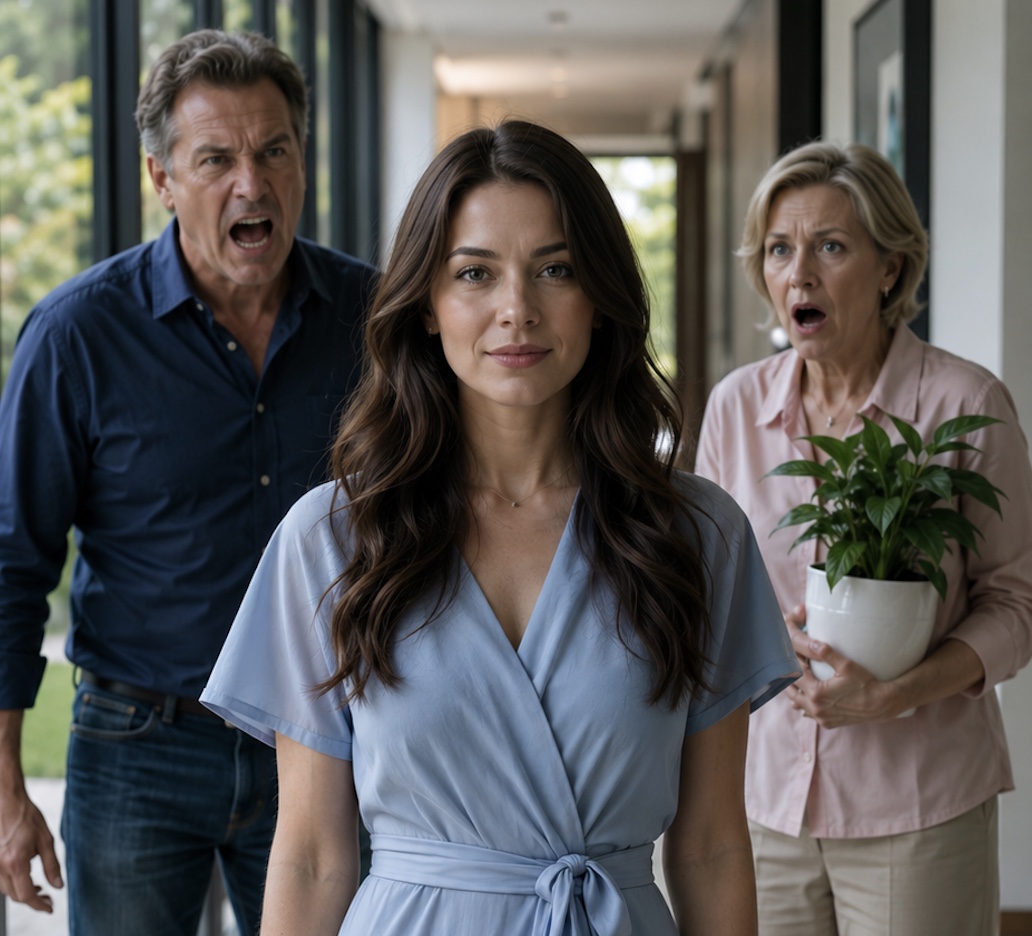
“Here’s how it’s going to be, Nina. Tomorrow we’re going to the notary, and you’re transferring this house to me. I’m the head of this family, and I need to feel my status! Otherwise, I’ll pack my things right now, file for divorce, and we’ll divide all this property through the court. Believe me, I’ll leave you with nothing — and buried in debt on top of it. Choose!”
His high, cracking voice bounced in a hollow echo off the freshly painted walls of the spacious hall. The air still carried the sharp, noble scent of expensive wood stain and Italian floor wax — the smell of my hard-earned dream, the dream I had paid for with five years of backbreaking misery.
My lawful husband, fifty-two-year-old Valera, stood in the middle of the gleaming living room, his legs planted wide apart, his filthy outdoor boots pressed against the snow-white porcelain tiles. Sweat glistened on his puffy face from the effort of shouting. He breathed heavily, giving off a sour smell of unwashed skin mixed with cheap cologne.
A true master of life.
A judge of destinies.
I looked at him in silence, feeling everything inside me tighten from a wave of numbness and nausea rising in my throat.
This luxurious plot of land in a prestigious green suburb had been left to me by my grandmother long before our marriage. Five years ago, tired of squeezing myself into a cramped two-room apartment in a panel building with paper-thin walls, I made the boldest decision of my life. I sold my parents’ country house, emptied every last coin from my savings, took out two heavy loans, and began the construction project of a lifetime.
How many tears of helplessness had I shed on that foundation? My once well-kept hands had become rough, covered in tiny cracks. Harsh cement dust had settled under my nails so deeply that no salon treatment could remove it. I was no longer a young woman, yet I personally bargained at wholesale markets over every pack of basalt insulation. I slept in a freezing car to guard stacks of bricks from thieves. I shouted myself hoarse arguing with lazy contractors. By evening, my back felt like a twisted, rusty spring. I would lie down with a groan, unable to straighten from the hellish pain in my lower spine.
And what was Valera doing all that time?
Valera was “providing a reliable rear and moral support.”
In five years, he had not invested a single ruble into this house. His laughable salary as a middle manager went only toward daily expenses — spare parts for his constantly breaking foreign car, branded fishing rods, and endless Friday drinking sessions with his friends.
But the moment the walls went up, the panoramic windows were installed, and the metal tile roof was finished, my husband miraculously transformed.
Every weekend, he began bringing crowds of his noisy friends here. He would slap the expensive facing bricks with his plump hand — bricks bought with my annual bonus — grill cheap sausages on the barbecue, and loudly announce so that all the neighbors could hear:
“Yeah, guys, I invested seriously here. This construction drained me dry! But now we’ve got our own family estate. I drew the design myself at night, checked every board with a level personally!”
I listened to those lies, swallowed my hurt, and stayed silent, obediently bringing them clean plates.
For what?
If I were completely honest with myself, it was because of my own cowardice. I was afraid of loneliness. At fifty, being left divorced, abandoned, and unwanted seemed like an absolute failure. And Valera, like a typical manipulator, read that weakness in me perfectly. Year after year, he wiped his feet on me more and more.
But today, he finally tore off the last mask.
Just yesterday, the construction crew finished the final interior work. With my own hands, I arranged the furniture and hung the heavy velvet curtains, ironed into perfect folds. Exactly one hour after the cleaning service left, my mother-in-law, Zinaida Pavlovna, appeared on the doorstep.
She floated into the house, clicking her heels, her thin lips pressed together in disdain. She smelled of mothballs and heavy vintage perfume — the kind that always gave me a migraine.
“Well, not bad, Ninochka. It’ll do,” she said through her teeth, running her finger over the Italian dresser as if searching for dust. “Only the staircase is a bit steep. Not good for my bad joints. Valerochka, my son, take my suitcases and bring them to that bright bedroom on the first floor. I’ll put my ficus there and hang my paintings. And you, Nina, take your little things upstairs. It’ll be good for you to run up and down the stairs — maybe you’ll shake some fat off your hips.”
I was speechless at her nerve.
“Zinaida Pavlovna, that is the master bedroom. Mine. And Valera and I were planning to move in here together.”
“Together?” My mother-in-law threw up her dry hands theatrically, gold rings flashing on her fingers. “And his mother is supposed to rot away in an old Soviet apartment in front of the television? Absolutely not, my dear! My son built this house, worked himself to exhaustion, and he has every right to move his mother into comfort in her old age. And besides, Ninochka, it’s time to register everything properly. The house was built during the marriage, so in reality, it belongs to both of you!”
That was the exact moment Valera puffed himself up and delivered his ultimatum about the deed of gift and the court.
I looked into his small, swollen eyes, where open, cynical triumph was dancing. He was sure I would break. My mother-in-law was sure too, already opening the doors of my new wardrobe as if she owned it.
I felt a sharp lump of tears, humiliation, and despair rise in my throat.
Was I really going to surrender?
Was I really going to hand over the thing I had paid for with my own health?
And then something inside me clicked, as if an invisible switch had been flipped.
The fog of sacrifice lifted. Cold, crystal-clear calculation instantly pushed out my panic.
I remembered one extremely important detail from the folder of documents safely stored in a bank deposit box.
I lowered my eyes, masterfully pretending complete surrender, and said quietly in a broken voice:
“All right, Valera. You win. You’re the man. You’re the head of the family. Tomorrow we’ll go to the notary. I’ll sign the deed of gift. Just please don’t divorce me.”
My husband’s face immediately smoothed out. He gave a smug snort, adjusted the leather belt under his protruding stomach, and patted me on the shoulder condescendingly, as if I were a beaten dog.
“That’s my clever girl. You should’ve done this a long time ago. Always pretending to be some independent businesswoman. Now get yourself upstairs. The house is mine now, and Mom needs the best bedroom!”
The notary’s office smelled of fresh paper and expensive perfume. A heavyset woman in a strict suit read the deed of gift aloud in a monotonous, rapid voice.
Valera sat beside me, his chest proudly puffed out. He was almost bouncing with impatience on the creaky chair. He wasn’t listening to a single word. He was busy typing messages to his friends, bragging about his new property.
“…the donor transfers free of charge into the ownership of the recipient the real estate object: a residential house, with an area of twenty square meters, cadastral number…”
Valera heard the words “residential house” and blissfully closed his eyes.
I silently took the pen and signed my name with a steady hand.
The notary certified the document. My husband practically snatched the papers from the assistant’s hands, lovingly stroked the thick pages, and spread into a victorious smile.
“Well, that’s it, Ninulya! Now I’m the full king and god here. Tomorrow morning I’m moving Mom in completely, furniture and all. And you… well, you can live here for now out of my mercy. In the guest closet.”
I merely smiled meekly at him in return.
Saturday morning turned out to be piercingly clear and frosty for autumn. The morning air was fresh and invigorating, and a light wind tugged at the yellowing leaves on the apple trees.
I stood on the high porch of my luxurious cottage, wrapped tightly in a warm cashmere cardigan. In my hands, I held garden shears, preparing to trim the faded rose bushes.
Valera’s SUV, stuffed with belongings, screeched to a stop at the wrought-iron gates. The doors flew open, and my husband, grunting loudly, began dragging out huge plaid bags. Zinaida Pavlovna followed, emerging from the car in her enormous purple puffer jacket, clutching a pot with a ficus to her chest.
“Open up, former mistress!” Valera barked, scraping the heavy bags along the expensive paved path. “Mother has arrived! Hand over the keys to the downstairs bedroom. We’re installing a bolt from the inside so you don’t wander in!”
I set the garden shears down on the wooden bench and slowly stepped forward with dignity, blocking their path to the marble steps.
“You won’t need the keys, Valera,” I said, my voice even and cold as steel.
“Have you completely lost your mind from grief?” Valera frowned, dropping the bags right onto the emerald lawn I had carefully seeded with my own hands. “The house is mine now! I’ve got stamped documents in my pocket! Now get out of the way!”
“You’re badly mistaken, dear,” I said smoothly, taking a folded official extract from the property register out of my pocket and opening it right in front of his nose. “The building we are standing in front of is officially listed as a ‘summer kitchen and non-residential utility structures.’ And the land underneath it is my indivisible premarital property.”
Valera froze.
His jaw literally dropped.
Zinaida Pavlovna stopped chewing her lip and stared at me, her ficus dangerously tilting in her arms.
“What the hell do you mean, summer kitchen?” my husband roared, spraying spit. “I read the deed! It says in black and white — residential house!”
“Absolutely correct,” I said, openly enjoying the way his face changed. “Only this three-hundred-square-meter mansion was never registered as a residential house, so we wouldn’t have to pay enormous taxes. Remember? You were sitting on the sofa eating sunflower seeds and said, ‘Great idea, Ninok, we’ll save money.’”
“So what? What difference does it make?” Valera shouted hysterically, feeling the ground slip from under his feet.
“The difference, my dear husband, is that on this huge plot, since 1985, there has been only one official ‘residential house.’”
I raised my hand gracefully and pointed to the farthest corner of the property, behind a tall corrugated metal fence.
There, in the deep shade of old overgrown trees, stood a crooked, black, completely rotten wooden shack, exactly twenty square meters in size. Its slate roof had collapsed inward, and its windows were smashed out.
“There it is. Your lawful mansion, Valera. That is the cadastral number the notary read out yesterday while you were sitting on your phone. I gifted you exactly what existed in the documents. You may own it fully, enjoy your status as master, and move your mother in there.”
A long silence fell over the yard.
Only a dog barking somewhere in the distance and the dry leaves rustling in the wind could be heard.
“You… you fraud!” Valera breathed. He jerked toward me, his plump fists clenched, his face twisted with rage. But I did not step back even a millimeter.
“Try touching me,” I said in an icy tone, looking straight into his bloodshot eyes. “There are cameras around the entire perimeter. You’ll be in a cell for assault before you know it.”
“The court will cancel everything! This is criminal! We’ll ruin you!” my mother-in-law wailed loudly, pressing her palm theatrically to her forehead as if she were about to faint.
“Go ahead and try,” I said with a contemptuous smile. “The donor was of sound mind. The transaction was completely voluntary and notarized. And if my businessman husband couldn’t be bothered to check the cadastral numbers and the area of twenty square meters, because he only noticed the pretty word ‘house,’ that is entirely his problem. You should read what you sign.”
I stepped down one stair, looming over them.
“And now listen to me very carefully, property owner. The land beneath your shed and around it belongs to me. Out of generosity, I will provide you with a legal easement — a narrow path half a meter wide from the gate to your rotten little shack, so you can crawl there if you like. But if you or your precious mommy step even one centimeter onto my lawn, or come closer than ten meters to my ‘summer kitchen,’ I will personally call the private security service of this settlement, and they will escort you out by the arms.”
Valera’s face stretched and turned an earthy shade. His stunned, almost insane gaze moved from my new cottage with its shining windows to the crooked black shed in the distance.
The illusion of his incredible greatness crumbled into dust right before my eyes, leaving only a pathetic, useless, deceived manipulator exposed in its place.
“Pack up your bags and get out of here, Valera. On Monday morning, my lawyer will file for divorce. And for now… welcome to your family estate. Just cover the roof with plastic, because they’re forecasting frost tonight. We wouldn’t want Mommy to catch a draft.”
I turned around, calmly climbed the steps, and entered the spacious hall, closing the massive door behind me.
Once inside, I walked into the living room, took a soft flannel cloth from the dresser, and slowly began wiping dust from the broad green leaves of my enormous indoor monstera.
Every movement brought me incredible peace.
For the first time in five long years, I felt the true taste of absolute, unconditional freedom — and crystal-clear justice.