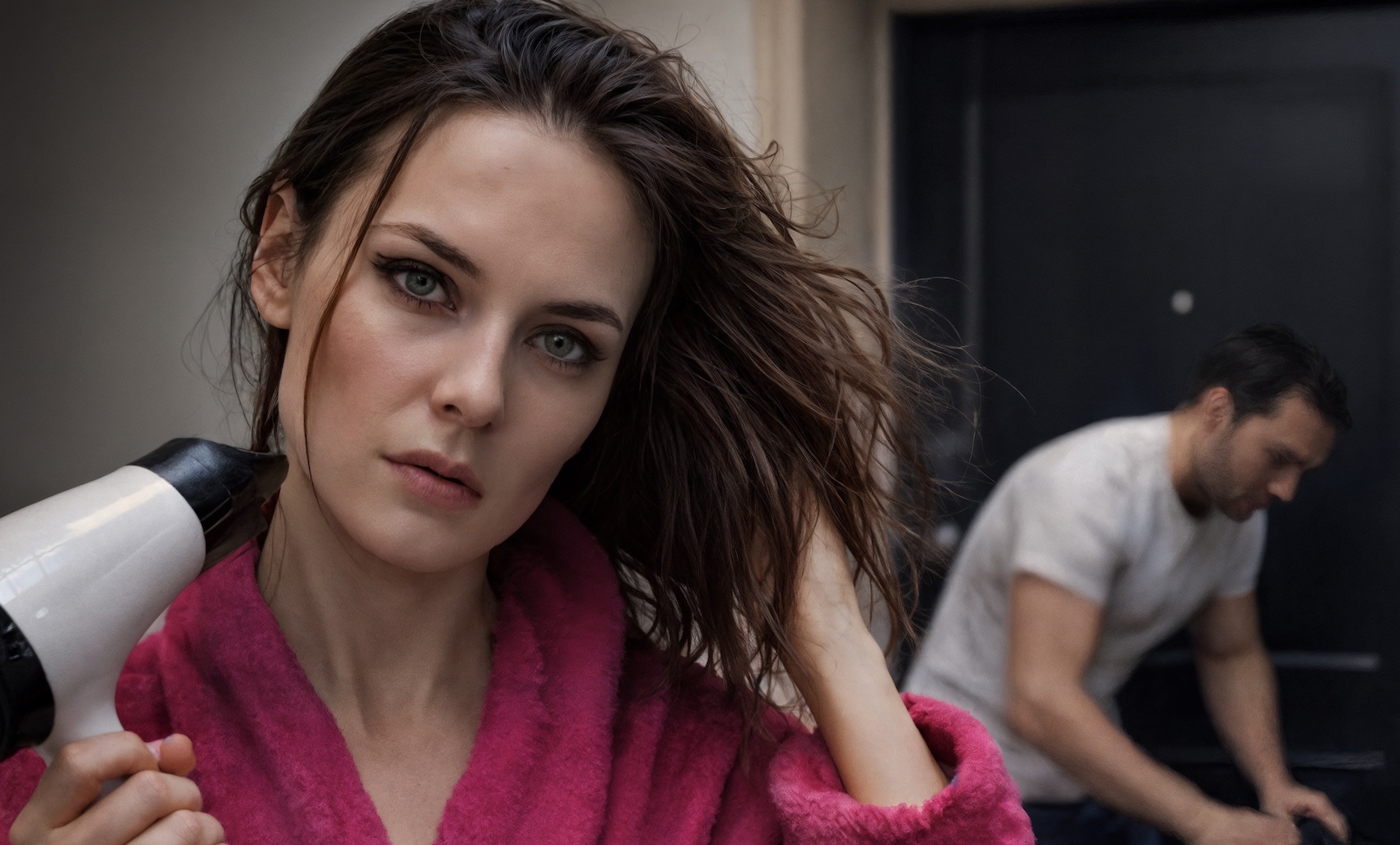
“Go ahead, live without me for a while. Maybe then you’ll finally come to your senses!” Anton yelled theatrically as he tossed a pile of socks into his duffel bag. One sock, rolled up like a little snail, sadly tumbled onto the parquet floor. “I do everything for this family, and you… you won’t even take out a loan for Lera! It’s for growing her business, by the way.”
I looked at my husband the way a doctor studies an interesting but hopeless MRI image: calmly, with faint professional curiosity.
“Anton, growing a business means having a business plan, not your sister wanting the latest iPhone so she can photograph the nails she files at the kitchen table,” I said, taking a sip of coffee. “And yes, pick up your sock. If you’re going to leave, at least do it with some dignity instead of shedding wardrobe pieces on the way out.”
My husband flushed dark red. His favorite tactic—punishing me with silence—had failed, so he moved on to Plan B: a hysterical exit.
“Then stay here alone! With your…” He jerked his head toward my daughter’s room. “Let’s see how long you two can last without a man in the house. I’ll come back when you apologize. And call my mother too—explain to her why her son is being forced to sleep at his parents’ place!”
The door slammed so hard that a volume of Chekhov fell off the shelf. Symbolic, really.
Three weeks passed in a strange, almost frightening… bliss.
It turned out that without “a man” in the house:
food no longer vanished from the refrigerator overnight;
the toilet lid was always down;
and my cortisol levels—the stress hormone that, when chronically elevated, breaks down muscle protein and raises blood sugar—had returned to normal.
For the first time in two years, my ten-year-old daughter Aline and I had peaceful dinners where we talked not about my mother-in-law’s problems or Anton’s supposed greatness, but about the structure of a paramecium.
“Mom,” Aline asked quietly one evening, winding spaghetti around her fork, “did Uncle Anton leave for good?”
“I don’t know, sweetheart. But it’s easier to breathe now, isn’t it?”
“Yeah. And nobody steals the yogurt anymore.”
But peace like that could not last forever. His “punishment period” expired on Saturday morning.
The doorbell rang—insistently, aggressively, as if there were riot police outside instead of actual people. I looked through the peephole.
Oh. The whole cast was here.
Anton, wearing the face of a martyr.
Galina Sergeyevna, looking like a prosecutor.
And Lera, with the expression of someone convinced the world owed her everything.
I opened the door.
“So, had enough fun?” my mother-in-law announced from the threshold, sailing into the hallway like an icebreaker plowing through Arctic waters. “Antosha has wasted away on my cooking—he’s got gastritis, after all! And you’ve probably been living in luxury here.”
“Hello, Galina Sergeyevna. Anton’s gastritis comes from his love of spicy and greasy food, not from heartbreak,” I said, leaning against the doorframe and not allowing them any farther into the corridor. “And what exactly brings you here? I’m not inviting anyone in for tea. My monthly toxicity limit has already been reached.”
Without taking off his shoes, Anton tried to push his way toward the kitchen.
“Marina, stop being dramatic. I forgive you. Come on, set the table—Mom brought cabbage pies. And by the way, Lera still needs the money. We decided that you’ll take out the loan, and we’ll pay it back. Half each. Later. Probably.”
Lera nodded while chewing gum.
“Yeah, Marina, you work at that private clinic, your salary is official and high. What, are you really that stingy? I’ll pay you back from my first clients. I’ll have a line of customers out the door.”
That was when I genuinely started enjoying myself.
“All right, stop.” I raised a hand. “Let’s break down this stream of nonsense point by point.”
Galina Sergeyevna drew in a deep breath, preparing one of her speeches about a woman’s role.
“Don’t get clever with me, young lady! A wife is supposed to be the neck that turns where the head looks… Family means everything is shared! But you count every penny! You have a husband worth his weight in gold, and you don’t appreciate him. In my day, women gave birth in fields and washed their husbands’ feet!”
“Galina Sergeyevna,” I interrupted in a soft but steel-edged voice, “historically speaking, mortality during childbirth in fields was around thirty percent, and foot-washing had more to do with the absence of plumbing than with any sacred meaning. We live in the twenty-first century, where slavery has been abolished, though mortgages unfortunately have not. And speaking of property—this apartment is mine. I bought it before the marriage. Anton is only temporarily registered here.”
My mother-in-law nearly choked on air. Her face broke into blotches, and her mouth opened and closed soundlessly.
She looked like a carp thrown up on shore, trying to grasp the concept of land.
“Don’t you bury me in facts!” Lera screeched. “You’re just greedy! We came to you like decent people, and you… Anton is under terrible stress because of you! He almost lost his job!”
“Lera,” I said, turning to her, “being a sales manager requires communication skills. If Anton sells construction supplies the same way the two of you are trying to sell me the idea of taking out a loan in my name for your benefit, I’m amazed he hasn’t been fired already. And by the way, a parasite is a biological term for an organism that lives off its host. In the financial world, that would be called a freeloader. Though usually, to pull that off, a person needs at least some charm, not just audacity.”
Lera jerked back, caught the coat rack with her elbow, and Anton’s coat fell right on top of her. She got tangled in the sleeves and nearly fell.
She looked like a drunken moth trapped in a wool sock.
At last Anton realized his triumphant return was falling apart. So he switched into “master of the house” mode.
“That’s enough! Am I the husband here or not? I’m back, which means everything goes back to how it was. Aline!” he shouted toward the room. “Bring me some water. Your father’s throat is dry!”
Aline came out of the room holding a thick book titled Fun Physics. She adjusted her glasses and looked at Anton over the top of the frames.
“Aline, bring me water!” Anton barked. “And why is the hallway dirty? Has your mother completely let herself go?”
I had already opened my mouth to throw them out, but Aline got there first.
“Uncle Anton,” she said in the quiet, calm voice of an honors student, “according to Newton’s third law, every action has an equal and opposite reaction. You were absent for three weeks and contributed no resources to the apartment ecosystem. Therefore, your status here has been reset to zero. You can get your own water from the tap. And what you’re calling dirt is actually my sneakers, because I just got back from a math olympiad.”
Anton froze.
“How… how dare you talk to your father like that?”
“You are not my father,” my daughter replied just as calmly. “You are a factor that increases entropy in our home.”
“What is she even saying?” Galina Sergeyevna hissed. “What entropy? Is she on drugs or something?”
“Entropy is a measure of chaos, Grandma,” Aline said with a smile. “And right now, you are raising it to critical levels. Mom, I’m going back to my problems. They’re more interesting than this.”
Aline walked away and quietly closed the door behind her.
Silence fell.
Not the ringing kind, but the heavy kind, dense as a quilt.
“All right then,” I said, pulling the front door wide open. “The show is over. Anton, I packed your things two weeks ago. They’re out on the landing in trash bags. Sorry about that, but the suitcase is mine. I changed the locks the day before yesterday.”
“You have no right!” Anton shrieked. “That’s marital property!”
“Article 36 of the Family Code,” I said crisply. “Property owned by either spouse before marriage remains that spouse’s sole property. The only things we acquired together were your gastritis and my stress eczema. I’m keeping the eczema. You can take the gastritis.”
I shoved the stunned Anton out onto the landing. Galina Sergeyevna and Lera stumbled out after him by sheer momentum.
“You’ll regret this!” my mother-in-law screamed as I closed the door. “Who needs a thirty-five-year-old woman with baggage?”
“Loneliness isn’t when no one is around, Galina Sergeyevna,” I said through the crack in the door. “It’s when someone is beside you and still makes you feel alone. And I’m doing just fine now.”
I slammed the door and turned the lock. Two full clicks. Click-click. The sweetest sound in the world.
They kept muttering on the other side, even kicking the door a few times, but by then it sounded like a television in a deaf neighbor’s apartment—annoying, but not enough to ruin your life.
I went back to the kitchen. Aline was sitting at the table, eating an apple.
“They gone?” she asked.
“They’re gone.”
“For good?”
“I think so. Now we’ll have to buy our own groceries instead of waiting for Uncle Anton to generously spare three thousand from his paycheck,” I said with a wink.
Aline bit into the apple, chewed, and then said the sentence that settled everything once and for all:
“You know, Mom, there’s more air in the apartment without them. Like when you finally take out a trash can that’s been stinking up the place for three years, and all that time we thought it was just the air freshener.”