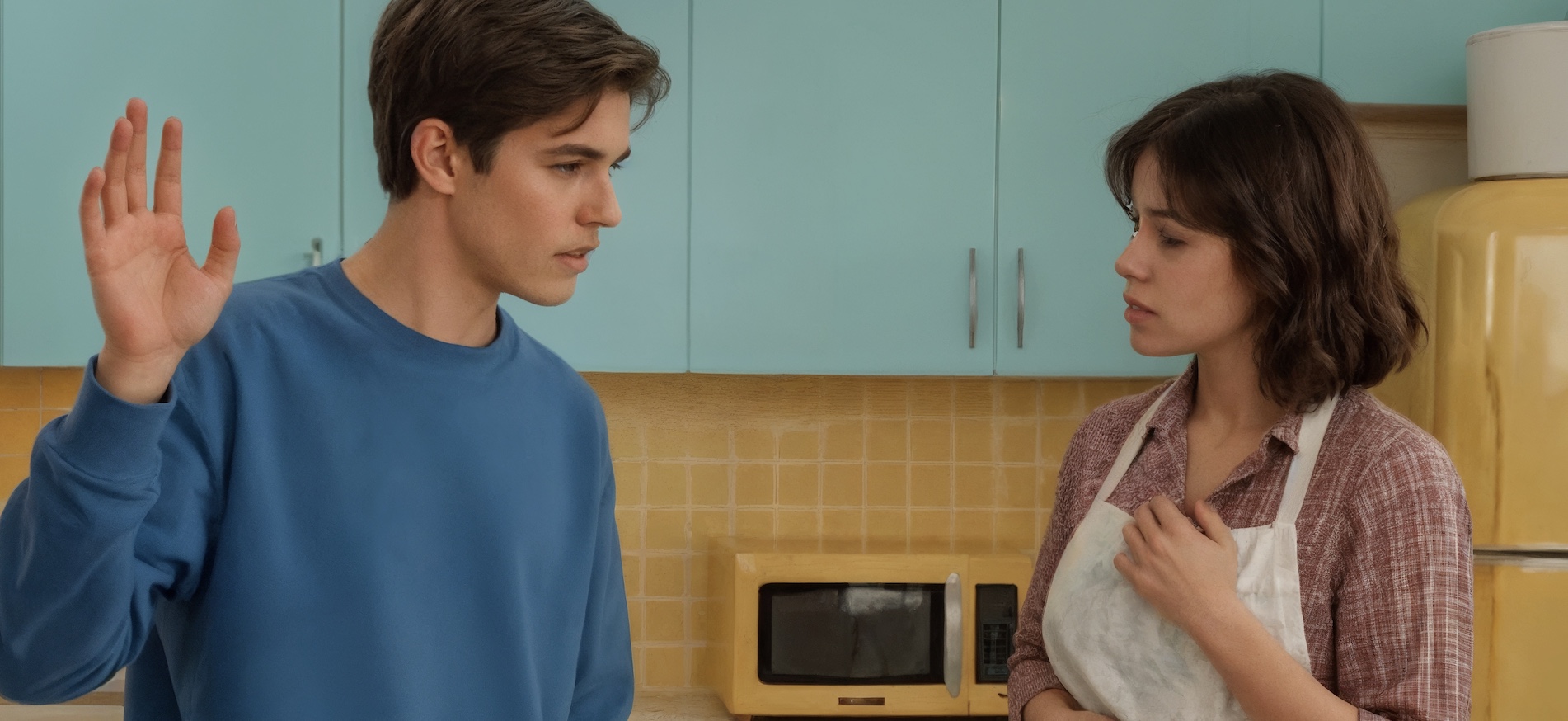
It started with a mug. Or, more precisely, with the sticky brown ring it left on the white engineered-stone countertop. I’d wiped it away three times already that morning, and it kept showing up again—like a stubborn birthmark. Alyosha’s stamp. Proof that he existed inside my perfect, ruler-straight world.
“Alyosh!” I called, and my voice came out exactly the way I wanted—not sharp, but weary and caring. It was my signature tone, polished by years of motherhood. The tone of a righteous martyr. “You put your mug down without a coaster again! I’ve asked you a thousand times!”
From his room—the one I privately called “the den”—came an indistinct rumble. Either explosions from a computer game or just the constant hiss in his never-off headphones. He didn’t hear me. Or pretended he didn’t. That was his main technique: selective deafness.
I inhaled deeply, gathering the sorrow of the entire world into that one breath, and went in. Like I always did.
The bed looked as if two wild animals had wrestled on it. Clothes were scattered on the floor—not filthy, no, just tossed there. Yesterday’s. The laptop was open, and the air smelled of dust and teenage laziness.
“Alyosha, I’m talking to you.” I stepped closer and touched his shoulder.
He jerked, pulling off the enormous headphones that made him look like a cartoon character.
“What?” Not a trace of respect in his voice—just dull irritation, as if I’d interrupted him while he was saving humanity.
“I’m saying: put the mug away. And make your bed. It’s eleven, Alexey. You’ve been up for three hours.”
“In a sec,” he muttered without looking at me. His eyes were glued to the monitor.
“Not ‘in a sec.’ Now. Immediately. And take out the trash—the bag is full. And…”
He spun around in his chair so fast I actually flinched back.
“Can you just… leave? You’re in my way. I’m playing. And stop whining first thing in the morning. Mug, bed, trash… You sound like a scratched record.”
I went rigid. Not because of the rudeness—I was almost used to that. But because of the word whining. It hit me right in the gut.
“I’m not whining, Alexey! I’m trying to keep this house in order! The house you live in!”
“Yeah, right,” he snorted. “You’re not keeping order. You’re just looking for reasons to pick at me. You’re bored, so you trail me everywhere. Get a hobby.”
Get a hobby. This kid—this snotty teenager I birthed in agony—was advising me to find a hobby. A familiar, tight spring of resentment snapped in my chest.
“My hobby is you!” I shouted. “Your life! Your future! And you don’t appreciate any of it! Just like your father!”
There it was. I hadn’t meant to, but it burst out anyway—the comparison to his dad. My sharpest weapon and my deepest wound.
Alyosha suddenly perked up. He took the headphones off completely.
“And what about Dad?”
“That’s what!” I dropped onto the edge of his unmade bed, feeling myself sink into my familiar, sweet swamp of self-pity. “He thinks that tossing money onto my card means he’s done his job as a father. But the fact that his son is a teenager, that you need someone to talk to, that you need a male example—he doesn’t care. His deals matter more. He’s been living in his own world for a long time. And you and me? We’re just an annoying inconvenience that calls sometimes and asks for something. He didn’t even ask how you’re doing in math. He doesn’t take part at all…”
I talked and talked—about my husband’s coldness, his distance. I poured my loneliness and my anger at my marriage straight onto my son. Alyosha listened in silence, and I thought I saw sympathy in his eyes. I thought he was on my side. That we were one team against an indifferent world.
How blind I was.
That evening there was a parent meeting at school. I walked there like I was going to war. I was prepared. I knew I’d hear about slipping grades and distracted behavior. But that day I wasn’t going to listen—I was going to speak. Accuse. Find allies.
Maria Semyonovna, the homeroom teacher, a woman with sharp, tired eyes, read through the class’s general achievements and problems in a flat voice. I waited for my moment. And when she asked, “Does anyone have individual questions?” I raised my hand like the model student.
“Yes, Irina Petrovna, go ahead.”
I stood so everyone could see me. So everyone could hear my pain.
“Maria Semyonovna, dear parents—this isn’t a private issue. It’s a bigger one. Something I’m sure every mother here worries about!” I swept my eyes across the room. A few women nodded sympathetically. “I’m talking about our children’s total indifference! Their pitch-black ingratitude! I, for example, have devoted my entire life to my son Alexey. I gave up my career so he could have the best of everything. I monitor his studies, I hire the best tutors, I make sure he’s fed and well dressed! And what do I get back? Rudeness, laziness, and zero motivation! I’m fighting like a fish on ice! We practically don’t have a father in the picture—he’s completely absorbed in business—so the whole weight of raising our son is on me! And I’m asking you: what else am I supposed to do? What other sacrifices should I make so my son finally gets serious?”
I sat down, pleased with myself. It had landed hard. I’d stated the problem, displayed my devotion, and even neatly shifted some blame onto my husband. Perfect. Now it was Maria Semyonovna’s turn. I expected something like, “Yes, Irina Petrovna, we understand, it’s very difficult, we’ll do our part…”
But she said nothing. For a long time. The pause became uncomfortable. The room hung in tense silence.
“Thank you, Irina Petrovna, for your honesty,” she finally said, her voice even and without a hint of sympathy. “But I’d like to ask you a question in return. You just listed everything you do for your son. Have you ever tried… not doing some of it?”
I blinked, confused.
“What do you mean?”
“I mean literally. Have you tried stopping the constant monitoring of his homework? Stopping the reminders about lunch? Stopping being a twenty-four-hour service desk?”
“But… then he’ll completely slide! He’ll turn into a slob and get nothing but failing grades!” I protested.
“Maybe,” Maria Semyonovna said calmly. “Or maybe, after collecting a couple of bad grades and walking around in a wrinkled T-shirt, he’ll understand that actions have consequences. That you are not responsible for his life—he is.” She paused again, cuttingly. “I spoke with the school psychologist about Alexey. He has no intellectual issues. But he has classic symptoms of a teenager who’s suffocating under overprotection.”
“What?!” I sprang up. “My care is suffocation?!”
“Care, Irina Petrovna, is giving a child a fishing rod. But you don’t just give him fish—you clean it, fry it, cut it into pieces, and feed him with a spoon. At fifteen.” Her gaze sharpened. “Alexey is rude not because he’s a bad kid. He’s rude because it’s the only way he knows to defend his boundaries. To tell you: ‘Mom, step back. Let me breathe.’ That’s his cry for help. And the louder you shout about your sacrifices, the louder and rougher he will shout back. So, returning to your question—‘what else should you do?’ The answer is: nothing. Start doing something for yourself. And maybe then your son will see beside him not a household employee, but an interesting person he can respect.”
It was a knockout. Public. A few mothers who had been nodding at me just moments earlier now watched with open curiosity, like I was a guest on a talk show who had just been exposed. The teacher—my potential ally—had just called me the cause of the problem. Me. The victim.
I didn’t answer. There were no words. I grabbed my purse and walked out under a buzz of whispers. My cheeks burned. Blood pounded in my ears. All the way home I didn’t replay clever comebacks—I replayed her phrases:
“Let me breathe…”
“Household employee…”
“An interesting person you can respect…”
I burst into the apartment.
“Alexey! Come here!”
He came out, stretching lazily.
“What are you yelling for?”
“I was at the parent meeting!” I shot back. “I was ashamed! Ashamed, do you hear me?! The teachers are complaining! Your school psychologist says you’re out of control! That you have no motivation! It’s those computer games! And your rudeness!”
I waited for him to shrink. To get scared.
But he stared at me with lazy contempt.
“And what did you expect?” he said. “For them to pat your head and hand you a ‘Hero Mom’ medal? That’s what you were aiming for.”
“What? What was I aiming for?!”
“For everyone to know how miserable you are,” he said, coolly. “How hard it is raising a failing son. It’s your favorite song. You sing it at home, you sing it at school. Well—here you go.”
I raised my hand to slap him, but my arm froze in midair. In that exact moment my phone rang. It was Sergey. I put it on speaker. Let him hear. Let him participate.
“Yes?”
“Ira, why are you yelling? What happened now?”
“Your son!” I spat, breathless with rage. “He’s talking to me like dirt! He doesn’t respect me at all! After the parent meeting!”
“Lyokha,” Sergey’s voice turned to steel, “hand me the phone.”
Alyosha reluctantly took it.
“Yeah, Dad.”
“What the hell do you think you’re doing?” Sergey snapped. “Why is your mother in hysterics again? When are you going to act like a normal person instead of some thug?”
And then Alyosha landed the blow—the one I’d prepared for him myself.
“And when are you going to act like a normal father?” he answered calmly, almost lazily. “Why do you only care that Mom is hysterical, and not how I’m doing? Have you ever called just to ask how I am—without her complaints? She literally says you don’t care about me. That you buy us off with money and don’t take part in raising me at all. So what do you want from me right now?”
Dead silence filled the line. I watched Alyosha’s knuckles turn white around the phone. And I… I stood there staring at him, suddenly horrified, realizing that this creature—coldly using my own words as a weapon against his father—was something I’d helped create. With my hands. With my endless complaining. With my hypocrisy.
“We’ll talk when I get there,” Sergey said in an icy voice, and hung up.
Alyosha threw the phone onto the table and looked at me. There was no triumph in his eyes—only emptiness.
“Happy now?” he asked, and disappeared into his room.
I was left alone in the kitchen. Humiliated at school. Humiliated by my own son. And worst of all—exposed. Exposed to my husband, my child, and for the first time in my life, it felt like I’d been exposed to myself.
What if… what if they’re all right?
The night was sticky and airless. I couldn’t sleep. I lay staring at the ceiling, where headlights from passing cars flickered, and replayed the day over and over. Every word. Every smirk. My son’s contempt. My husband’s ice-cold tone. And above all—the teacher’s calm, brutal verdict: “household employee,” “suffocating atmosphere.”
By morning I’d reached the only conclusion my mind could tolerate: it was a conspiracy. All of them were in on it. My husband—always irritated by my calls. My son—hungry for unlimited freedom. And that teacher, that incompetent hen who needed a scapegoat to cover up her own failures. Yes. That was it. I wasn’t guilty. I was the victim. It felt easier the second I decided that.
But I needed confirmation. I needed someone on my side. I needed my one true ally: Sveta—my college best friend, Alyosha’s godmother, the only person who had always backed me.
I dialed her, ready for a long, sympathetic talk. I needed to unload—tell it all in the right tones so she could truly feel how deeply I’d been humiliated.
“Sveta, hi! Do you have half an hour? Something happened yesterday… you’re going to fall over.”
“Hi, Ir.” Sveta sounded tired. She had her own hell—an elderly mother after a stroke. But mine felt worse, more unfair. “Honestly, I don’t really. Mom’s worse again. What’s going on with you? Alyosha?”
“Him! Who else!” And I launched in. For fifteen minutes straight I painted the whole scene—my speech, the sympathetic looks from the other mothers, and then the teacher’s betrayal. “…And she tells me, in front of everyone—everyone—that I’m ‘suffocating’ my child! That my care is ‘control’! And his rudeness is a ‘cry for help’! Can you imagine the nerve? Instead of supporting me and helping me deal with that slacker, she blamed everything on me!”
I stopped, waiting for Sveta to explode with righteous anger at the teacher.
But Sveta was silent.
“Sveta? Are you there?”
“I’m here, Ir.” She sighed so heavily it sounded like she was carrying not only her sick mother, but my whole life on her back too. “Ir… have you ever thought… that maybe there’s at least a little truth in what she said?”
I went numb. A knife in the back—from the one place I never expected it.
“What? What truth?! The truth is I work myself to the bone for him and I get zero gratitude!”
“Ira, we’ve been friends thirty years. And for the last ten, I’ve been hearing the same thing. The same monologue: ‘Alyosha is wrong, my husband is wrong.’ It’s like you’re stuck in one day on repeat. You tell me your grievances, I sympathize, and nothing changes. You don’t even notice you’ve turned into a walking complaint.”
“What?!” I choked. “A complaint?! I’m sharing! You’re my best friend—who else am I supposed to talk to?”
“Sharing is one thing. Dumping tons of negativity on me while refusing to change anything is another. I’ve told you a hundred times: do something for yourself. Remember how you used to draw? Take a class, find a part-time job. But you don’t want to. You like being the center of your own tragedy. You like the role.”
“You… you’re talking like that… teacher,” I snapped. “What, are you in on it too?”
“Oh my God, Ira, what conspiracy?” Sveta’s voice hardened. “I’m just tired. Tired of being the shoulder you cry into while nothing changes. I’m sorry, but I can’t do it anymore. You don’t need me. You need a specialist—someone who’ll listen for money and ask you the right questions. I have the contact of a woman. A psychotherapist. Very strong. Call her. Or don’t. But please—don’t come to me with this anymore. I have my own problems up to my neck. I’m sorry.”
She hung up.
I sat there with the phone in my hand, stunned. It felt like betrayal. Total betrayal. The last fortress had fallen. Everyone had abandoned me. Alone. Completely alone in my righteous war.
A therapist… She thought I was crazy. She thought I was the one who was sick, not them.
I threw the phone onto the couch. The number—she sent it in a text. Anna Viktorovna. I stared at the name, torn between humiliation and… curiosity. Mean, acidic curiosity. What if I went? What if I went and told this Anna Viktorovna everything—so she’d understand what a victim I really was. So she’d give me a professional verdict. A certificate. Proof that I was right. And I’d shove it in Sveta’s face, and Maria Semyonovna’s, and Alyosha’s. Yes. That’s what I’d do. I’d prove they were wrong.
My fingers dialed the number on their own. I wasn’t going for help. I was going to war.
The therapist’s office wasn’t what I expected. No couch. No mysterious half-darkness. A bright room, two comfortable chairs, a bookcase, and a table with two glasses of water. Sterile. Unwelcoming.
Anna Viktorovna wasn’t what I expected either—neither a soft, motherly woman nor a distant professor. She was around my age, with short hair and very calm, attentive eyes. She looked at me as if she didn’t see my face at all—only an X-ray of my soul.
“Hello, Irina. Have a seat. We have fifty minutes. I’m listening.”
Her calmness irritated me. I launched into my rehearsed speech—about late, hard-won motherhood; about a husband who escaped into work; about a son who didn’t appreciate me; about a school that didn’t help. I poured out all my pain, my grievance, my righteousness. I expected sympathy in her eyes. Support in her voice.
She listened without interrupting, nodding now and then. When I finally ran out of air, she asked her first question.
“Irina, I’ve heard a lot about what your son, your husband, and the teachers do or don’t do for you. But what do you want?”
The question was so simple it caught me off guard.
“What do I want? I want my son to get serious! I want my husband to be more involved! I want everything to be… normal!”
“‘Normal’ how?”
“Well… that he does his homework without reminders. That he cleans up after himself. That he stops being rude. That my husband… calls not only to ask about Alyosha.”
“Okay. That’s what you want from them. But I asked what you want—for yourself. You personally, Irina. Not as a mother. Not as a wife. As… Irina.”
I went silent. It felt like a ridiculous question. What did I have to do with anything? My whole life was built around them. My desires were their desires.
“I… I don’t understand.”
“You do,” she said gently, and somehow it made it worse. “You just don’t have an answer.”
She continued, calmly, picking apart my story.
“You said you were forced to leave work. Who forced you?”
“Circumstances. Alyosha was often sick when he was little, I had to pick him up… Sergey said I didn’t have to work, he’d provide.”
“Did he say ‘you don’t have to,’ or did he say ‘I forbid you’?”
“Well… ‘you don’t have to.’ But that implied—”
“It implied nothing, Irina. That was your choice. Correct? You chose the family.”
She wasn’t arguing. She was stating facts. And those facts cracked my victim mask. I hadn’t been “forced.” I had “chosen.”
“Let’s imagine,” she went on, even quieter, “that tomorrow morning you wake up and a miracle happens. Your son becomes perfect: he does homework, cleans his room, says ‘thank you’ and ‘please.’ Your husband calls three times a day to ask how you are and brings flowers every evening. No problems. No complaints. What will you do from nine in the morning to six in the evening? The whole day. What will you do, Irina?”
I stared at her, speechless. The silence roared. I could hear my heartbeat in my temples.
What would I do? All day? Without his problems, his homework, the grievances that filled every hour?
Emptiness.
For the first time in my life I looked inside myself and saw not a loving, selfless mother—but a yawning black hole. And I was scared. Truly scared.
“I… I don’t know,” I whispered.
“That’s where we start,” Anna Viktorovna said. “Your homework for the week: change nothing. Just observe. And write down only bare facts, not feelings. ‘At 10:05 I reminded my son for the fifth time to make his bed. He didn’t react.’ ‘At 15:30 I called my husband. The conversation lasted three minutes. Two minutes forty seconds were about our son.’ Only facts. We meet next Thursday at the same time.”
I left her office like a beaten dog. I had come for confirmation that I was right, and I walked out with a diagnosis. And that diagnosis wasn’t about my son, and it wasn’t about my husband.
It was about me.
“A fact diary.” What nonsense.
I rode home in a taxi clutching my purse and simmering with anger—at Anna Viktorovna, at Sveta for giving me the number, at the whole world. I’d paid five thousand rubles to be humiliated, told that my “forced” decision was my decision, and shoved face-first into the emptiness inside me. And now I was supposed to play her stupid game? Write “protocols”? Fine. I would write. I’d gather so much evidence on both of them—Alyosha and Sergey—that she’d be horrified. She’d see what kind of hell I lived in and take her words back.
That evening, when Alyosha locked himself in his room and the emptiness in the apartment became almost physical, I sat down with a pretty notebook Sergey had once brought from Italy. I’d planned to use it for recipes, but never wrote a thing. Now it would serve a more important purpose.
At the top, in careful handwriting, I wrote: Observation Diary. Day One. And I prepared to document the proof of my martyrdom.
Friday
08:15 — Made breakfast. Cheese-and-tomato omelet, toast, fresh orange juice.
08:30 — Called Alexey to eat. No response.
08:40 — Called again. Said it would get cold.
08:50 — Alexey came out. Poured himself cereal with milk. Ate standing up, staring at his phone. Didn’t touch the omelet. When I asked, “Why won’t you eat real food?” he said, “Don’t feel like it.” Left, leaving his bowl with milk at the table.
12:20 — Called Sergey to ask how he was. Conversation lasted 4 minutes. 3 minutes 50 seconds about last night’s scandal, the parent meeting, and Alexey’s behavior. 10 seconds he asked what I’d cook for dinner.
15:40 — Alexey came home from school. Threw his jacket on the hallway chair. I asked him to hang it in the closet. He said, “In a minute.” Jacket still on the chair. (Checked again at 20:00 — still there.)
19:00 — Cooked his favorite lasagna.
19:30 — Called him to dinner.
20:00 — Called again.
20:30 — Alexey came to the kitchen, took three pieces of lasagna, carried them to his room. When I said we eat at the table “like a family,” he replied, “What family? I only see you.”
22:15 — Picked up his dirty plate from outside his bedroom door.
I reread what I’d written. There. Cold, undeniable proof. Breakfast ignored. Requests ignored. Family dinner ignored. A husband who only cared about “problems with our son.” I felt righteous satisfaction. I would collect enough facts to fill a book. Let her read.
Saturday
Sergey called in the morning.
“Hi. Listen, I can’t swing by today like I promised. Partners called an urgent meeting. Tell Lyosha. And… I’ve been thinking after yesterday. Maybe I really don’t talk to him enough. Buy him a new iPhone—the latest model. From me. So he knows his father thinks about him. I transferred the money.”
Again. Again he bought his forgiveness. Cancelled seeing his son and compensated with the newest phone. And then I’d be the one living with the consequences—explaining why “thinking” and “buying” are not the same thing.
10:10 — Called Sergey back. Conversation lasted 7 minutes. All seven I tried to explain that Alyosha doesn’t need an iPhone—he needs a father. Sergey said I was dramatizing and “making a mountain out of a molehill.” He said he didn’t have time for “teenage snot.”
I underlined the word snot twice.
When I told Alyosha about the iPhone, he didn’t look happy. He smirked.
“Of course. Easier to buy a phone than to drag his butt over here. Classic.”
There was so much bitter contempt in his voice it made my skin prickle. Then he looked at me and added:
“And you—what, you thrilled? Got your bonus?”
“What bonus?” I blinked.
“For snitching on me yesterday. He never calls and never buys gifts for no reason. Only after you throw a phone tantrum.”
I stared at him, wordless. In his cynical teenage logic, everything fit perfectly: I complain—Dad buys something. A system rehearsed for years. And I wasn’t a victim in it. I was the transmission. The trigger.
All day I mechanically documented facts. Dirty socks under the bed. Toothpaste left uncapped. The computer buzzing until three in the morning. Every note was supposed to prove I was right, but rereading them made a growing unease creep in. I wasn’t describing his sins.
I was describing my life—my empty life, filled to the brim with his socks and his toothpaste cap.
Tuesday
Something happened—something scary.
In the morning I found out my favorite coffee was gone. And without it I can’t wake up; my blood pressure drops. I peeked into Alyosha’s room. He was still asleep. Usually I don’t wake him—I let “the poor kid” sleep.
“Alyosh,” I shook his shoulder. “Sweetheart, wake up.”
He mumbled.
“Baby, I’m out of coffee. Can you please run to the store? My head is splitting.”
“Mmm… in a minute…” he muttered, pulling the blanket over his head.
“Alyosh, please. I feel awful.”
“Fine, I’m going, I’m going,” came an irritated voice from under the blanket. “Just leave me alone.”
I waited ten minutes. Twenty. Half an hour. He didn’t get up. I went in again—he was sleeping like a rock.
And something inside me detonated. Not rage—something colder, more calculated.
I got dressed. Took my bag. And left.
Not to the store. I just went for a walk. I left my phone at home—on the kitchen table, beside his dirty mug.
I wandered through the park. Sat on a bench. Watched mothers with strollers, old men playing chess. For the first time in fifteen years, I was… nowhere. No agenda. No running. No cooking, checking, cleaning. I simply existed.
I came home around three. My heart was pounding. What would I find—flooding, fire?
The apartment was quiet. His jacket still hung on the hallway chair.
I went into the kitchen. There was a bag on the table. Inside: my coffee and two croissants. Next to it—a note on torn notebook paper, written in his messy handwriting:
“Where are you? I called, you didn’t answer. Bought the coffee. Took money from the coin jar. I’m at school.”
I sat down and stared at the note.
He got up. He got dressed. He went to the store. He bought coffee. He tried to call me. And he went to school.
No reminders. No screaming. No martyr sighs.
I opened my diary.
Tuesday
09:00 — Asked Alexey to go to the store for coffee.
09:30 — Alexey didn’t get up.
10:00 — I left the house and left my phone.
15:00 — I came back. Coffee had been bought.
A fact. Just a fact. Emotionless and deadly.
When I didn’t control it—the result still happened. When I begged and demanded, I got “leave me alone” in return.
I removed all my actions—my “care,” my “necessity”—and the system didn’t collapse. It simply… worked. On its own. Without me.
And then I finally understood what the therapist meant about emptiness. If he didn’t need me as a perpetual engine and watchdog… then who was I? What was my function in this home?
I looked at my perfect, freshly scrubbed kitchen table. On it sat the coffee he’d bought himself. And for the first time I didn’t feel offended or angry.
I felt fear.
Cold, panicked fear of being unnecessary.
I went to my second session with Anna Viktorovna feeling like a victorious prosecutor. My Italian notebook, filled with tight handwriting, felt heavy in my hands—like a criminal case file. I had them: evidence, documented proof of laziness, rudeness, indifference. Today this cold psychologist would finally understand what she was dealing with. She’d see my situation was special—clinical—and her cute theories didn’t apply.
“Hello, Irina. Come in,” Anna Viktorovna said, pointing to the chair with the same serene politeness as last time. It made my teeth grind.
“Hello.” I sat, placing the notebook on my knees like a shield. “I did your assignment. I kept the diary.”
“Excellent. What did it show you?” she asked as though the answer was obvious.
“It showed I was completely right,” I declared, flipping open the first page. “My life is a nonstop battle against windmills. Look—Friday. I cooked the perfect breakfast: omelet, fresh juice. What did he do? Poured cereal. Ignored it. Showed total disrespect for my work!”
“I see a fact: ‘Alexey ate cereal,’” Anna Viktorovna said, glancing at the page. “The ‘ignored’ and ‘disrespected’ part is your interpretation. Correct?”
I faltered.
“Well… yes. But it’s obvious!”
“It isn’t obvious,” she said calmly. “Maybe he simply doesn’t like omelets in the morning. Did you ask him?”
“Why would I ask? I’m his mother. I know what’s good for him!”
“And that’s your first line for a new diary,” she said, still without sarcasm. “‘I believe I know better what my fifteen-year-old son needs than he does.’” She nodded. “Okay. Next. ‘I called him to breakfast three times.’ Why?”
“Why? So he’d come!”
“But he didn’t come after the first time. Or the second. What result were you expecting the third time?”
“I… I hoped he’d come to his senses!”
“Hope is a feeling. Factually, you repeated the same action three times, and it didn’t work. What does that tell you about your strategy?”
I went quiet, feeling my certainty crack. This wasn’t a conversation. It was an interrogation.
She kept going—page after page—turning every “fact” toward me like a mirror with a cruel angle. My obsession with the jacket. My repeated calls to dinner. My drama over the plate by his door. None of it was really about his misbehavior.
It was about my repeated, ineffective patterns.
My endless running in a hamster wheel I’d built myself.
And then we reached Tuesday. The coffee.
“And what happened here?” she asked, pointing to my short entry.
Stumbling, I told her everything—how I left, how I came back, how I found the bag and the note.
“So,” she summarized when I finished. “Let’s lock in the facts. When you controlled, demanded, and reminded—you got zero results and rudeness. When you removed yourself from the situation, stopped controlling—the task was done. Your son showed independence and responsibility. What conclusion did you draw?”
I sat staring at the beautiful Italian notebook—my weapon, my indictment—and understood it wasn’t a file on them.
It was a file on me.
On my life as a controller, a supervisor, a perpetual engine running on empty, producing nothing but noise and resentment. And when that engine stopped, the system didn’t collapse.
It functioned.
“I… I felt afraid,” I admitted. “Afraid I’m not needed.”
For the first time in the session, Anna Viktorovna’s mouth softened into the faintest smile.
“Congratulations, Irina. That’s the first real conversation we’ve had. Fear of being unnecessary—that’s what we’ll work with. Overprotection is only a symptom, a way to numb that fear. You’re afraid that if you stop being ‘Mom-as-a-function,’ nothing will be left of you.”
She was right. It was so accurate, so terrifying, I wanted to cry.
“So what do I do?” I whispered.
“Now the homework,” she said, businesslike again. “Harder this time. I want you to run an experiment. Radical. From today until next Thursday you fully remove yourself from responsibility for your son’s personal space and eating.”
“How?!” I blurted, horrified.
“It means: you do not enter his room. At all. You don’t clean, you don’t collect plates, you don’t gather socks. That’s his territory. You cook food for the household, put it in the fridge, and once in the evening you say: ‘Lyosha, dinner is in the fridge.’ That’s it. You don’t call him to the table. You don’t ask if he ate. You don’t heat it for him. You don’t make special meals because it’s his favorite. He’s a big boy. If he wants to eat, he’ll figure it out.”
“But he’ll starve! He’ll drown in filth!”
“That will be his choice, his responsibility, his consequences. Your task is to observe—not him. You. What do you feel when you desperately want to go clean his room? What do you do with your anxiety when he skips dinner? This experiment isn’t about him, Irina. It’s about you—your ability to tolerate your own fear and let go of control. Can you do it?”
I stared at her. It sounded insane. Cruel. Impossible. It meant blowing up the entire structure of my days. It meant declaring war.
But a tiny, frightened voice inside me whispered that if I didn’t do it, I’d stay trapped forever in this Groundhog Day of brown rings on white countertops.
“I… I’ll try,” I forced out.
On the way home I felt like a traitor—like I was walking back to commit sabotage in my own apartment. The plan was monstrous. My boy—my Alyoshenka—he wasn’t built for life! He’d die of hunger next to a full fridge!
I walked in. Quiet. Shooting sounds from the den, as usual. In the kitchen: a plate from sandwiches and an empty mug. A perfect excuse for a fight. A perfect excuse to go back to the old way.
“Not him. You.”
I clenched my fists. Walked past the table. Didn’t pick up the plate. Went into my bedroom and shut the door.
I sat on the bed, shaking. The experiment had begun. I felt like a bomb-tech who’d cut the wrong wire, and now my life would either explode—or… what?
I didn’t know.
And that was the scariest part.
The first day of my “experiment” I ran on adrenaline. It was almost fun. I felt like a spy in my own home. I walked past his room without looking in, even though instinct screamed: Check! What if he’s smoking? What if the window is open and he’ll catch a cold? I saw his dirty dishes on the kitchen table and… kept walking. Not doing was strangely sharp, almost painful pleasure.
At first Alyosha didn’t understand.
“Mom, did you take out the trash?” he yelled from the den that evening.
“No,” I answered calmly without lifting my eyes from the book I was trying to read.
A pause.
“Why not? The bag’s full.”
“Then someone who lives in this house will take it out soon,” I said to the air.
Half an hour later I heard him muttering as he dragged the bag to the door. A small victory. I even wrote it down: “20:15 — Trash taken out without my involvement.” I felt like a brilliant strategist.
Naive fool. I thought it would be chess.
I forgot my opponent didn’t play by rules—he flipped the board.
By the second evening the atmosphere in the apartment began to change. It thickened, turned sticky and hostile. His room became a bacterial war zone. A sour smell seeped out—stale food, dirty clothes, teenage rebellion. I held on. I pinched my nose walking past, repeating my mantra: “Not my territory. His responsibility.”
That night I didn’t sleep. I imagined stacks of crusty plates, mold, swarming germs. I dreamed I opened his door and a wave of trash and food scraps poured out over me. I woke in a cold sweat. My anxiety had become physical—a tight fist in my solar plexus.
“Ira, you sound like an addict in withdrawal,” Sveta told me on the phone. I’d called her when I couldn’t take it.
“I am an addict, Sveta! My drug is control! I’m going to die if I don’t go wash that damn pizza plate that’s been sitting on his desk for two days!”
“Hold on,” she said firmly. “You knew the withdrawal would come. Ride it out. You’re not fighting a plate—you’re fighting for yourself.”
By day three Alyosha moved from confusion to open aggression. He understood. This wasn’t my “forgetfulness.” It was a system.
He walked into the kitchen that morning. I was drinking coffee, looking out the window. A mountain of dishes sat in the sink—yesterday’s. His.
“Are you sick or something?” he asked, disgusted, scanning the kitchen.
“No. I’m perfectly healthy,” I said without turning.
“Then why is it such a dump? You’re ‘Miss Clean,’ remember?”
“My dishes are washed.”
He stood there, silent. Then he opened the fridge. The night before I’d roasted chicken. Like Anna Viktorovna told me, I’d said once: “Dinner’s in the fridge.” He ignored it, of course. Stayed up gaming all night.
“So nobody’s going to heat it up for me?” he asked, challenging.
“We have a microwave.”
He stared.
“No way. I’m supposed to do it myself?”
There it was—the moment.
I turned slowly.
“Alyosha, you’re fifteen. You can heat up your food. And wash your plate.”
“And what are you even needed for here, then?” he snapped.
It slapped me. Painful. Humiliating.
But beneath the rudeness I suddenly heard fear. His world—where Mom-the-function was always on standby—was cracking. He didn’t know what to do. So he attacked.
The old me would have burst into tears, screamed that I’d given my whole life to him.
The new me—shaking, terrified, but stubborn—said:
“I’m needed here to be your mother. Not your maid.”
And I turned back to the window, ending the conversation.
The explosion came two hours later. He had a birthday party to go to. I heard crashing from his room—drawers slamming, something falling. Then he stormed out, red-faced, hair sticking up.
“Where’s my blue shirt?!” he shouted. “The one with the white collar!”
“I don’t know,” I said evenly.
“How do you not know?! You always wash and iron it!”
“I haven’t seen it this week. It’s probably in your room.”
“In my room?! It’s a disaster in there!” He stopped, staring at me with eyes burning with hatred. “So that’s what this is. You’re doing it on purpose! You knew I had a party today! You’re getting back at me!”
“I didn’t decide anything, Alyosha. Your clothes are your responsibility.”
“My responsibility? Fine. Now you’ll get yours.”
He pulled out his phone. I watched him tap “Dad” in his contacts. My heart stuttered. Nuclear option.
“Dad! Hi!” he yelled into the phone. “Can you come over right now? Urgent! Mom… she’s lost it!”
He listened, then his face twisted into a triumphant grin as he looked straight at me.
“She isn’t cleaning! She isn’t cooking! The house is a dump! She says it’s some experiment from her therapist and now I’m responsible for everything! Dad, she’s seriously not okay! She’s messing with me! Yeah! Waiting!”
He slammed the phone down.
“Well, therapist?” he hissed. “Dad’s coming. And your experiment is going to end. Very fast. And very badly. For you.”
He went back to his room and slammed the door so hard plaster dust shook off the wall.
And I stayed in the kitchen, alone, listening to the clock tick in the sudden, crushing silence—counting down the minutes until my husband arrived.
The next forty minutes were a blur. I paced the kitchen, my hands alternately freezing and sweating. The wall clock ticked with funeral slowness. Each second dragged me closer to disaster. I tried to rehearse what I would say—words Anna Viktorovna had taught me: “boundaries,” “responsibility,” “my choice.” But the moment I pictured Sergey, all that trained courage evaporated, leaving only sticky, primal fear—fear of his anger, fear of the way one cold sentence from him could reduce you to nothing.
The doorbell rang like a gunshot.
I opened the door on shaking legs. Sergey stood there in an expensive cashmere coat, perfectly shaved, smelling of success and frost. He didn’t say hello—he just walked in, and the temperature in the hallway seemed to drop.
His eyes swept the entrance with disgust. They paused on the chair—where Alyosha’s jacket had been lying for five days.
“Where is he?” Sergey asked without looking at me.
“In his room,” I whispered.
“Lyosha! Out here!” Sergey barked, and his command-voice made the glasses in the cabinet tremble.
Alyosha came out. He was no longer the smug winner from half an hour ago. At the sight of his father he shrank, shoulders hunched. He’d summoned a storm and now feared it.
“What is going on here?” Sergey’s voice was quiet, but it carried a threat. He looked at his son.
“Dad, I… I told you. She—”
“Shut up,” Sergey cut him off and turned to me. “Explain. What circus is this? What therapist? What experiments?”
I inhaled. This was my moment. Either I broke and became the old Ira—crying, complaining—or…
“This isn’t a circus, Sergey. It’s my attempt to change a situation that has become unbearable.”
“Change?” he scoffed. “By turning the house into a pigsty and pushing your own son into a breakdown? Creative. Which scam artist taught you that?”
“Her name is Anna Viktorovna, and she’s not a scam artist,” I said, forcing my voice steady. “She’s helping me understand why our son stopped respecting me. And why our home turned into a battlefield.”
“I can explain that without a therapist!” Sergey stepped toward me. “You spoiled him with your stupid overprotection. And now, instead of pulling yourself together, you’ve swung to the other extreme! Since when is ‘parenting’ starving a kid and refusing to wash his clothes? Are you out of your mind?”
“I’m not starving him—there’s food in the fridge!” I nearly shouted. “And I’m not his laundromat! I’m his mother! I’m trying to teach him responsibility!”
“Responsibility?!” Sergey laughed—a cold, vicious laugh. “What responsibility at fifteen? His responsibility is to study. Your responsibility is to give him conditions for that—comfort, clean clothes, hot dinner, calm nerves! You get more than enough money for this. Or is it not enough? Want me to increase the allowance so you stop this nonsense and start doing what you’re supposed to do?”
Money. There it was—his favorite argument, his scalpel for any rebellion.
Alyosha stood aside, watching our fight with frightened curiosity, waiting for the verdict of the court he’d created.
And then I understood: this wasn’t even about Alyosha. Not really. It was about Sergey and me. Alyosha was the detonator. The real war was between Sergey’s world—where everything is purchased—and the place I was trying to reach, where some things couldn’t be measured in transfers: respect, value, me.
The old me would have cried and apologized.
But something had changed. That week of withdrawal, that fear of being unnecessary—it had cracked my shell.
I looked at Sergey. Straight on. Calmly. And I said something I’d never dared say in my life.
“Your money has nothing to do with this, Sergey.”
He blinked, caught off guard.
“What do you mean?”
“I mean you can’t solve this with money. You can’t buy my good mood. You can’t buy Alyosha’s respect for me. And you can’t buy yourself the right to stay out of our lives, then show up once a month like some stern judge. This problem is ours. Either we deal with it together like adults, or…”
“Or what?” His eyes flashed—dangerous. He wasn’t used to being contradicted.
“Or nothing. But it won’t be the old way anymore. I’m not going to be your emotional trash can where you dump guilt in the form of money. And I’m not going to be Alyosha’s maid—a person he gets to humiliate without consequences.”
I said it, and I couldn’t believe the words were coming from me. They rose from a depth I didn’t know I had.
Sergey stared at me as if seeing me for the first time—not Irina-the-hysterical, not the forever-unhappy wife, but… someone else.
He turned to Alyosha.
“Back to your room. Now.”
Alyosha vanished into the den.
We were alone.
Sergey took off his coat and tossed it onto the same chair—on top of Alyosha’s jacket—and walked into the kitchen.
“So the old way is over,” he said, more statement than question, pouring himself a glass of tap water. “And what’s the new way? You already planned it?”
“No,” I said honestly. “But I know where we start.”
“With what?”
“By stopping the pretending. Pretending we’re fine. Pretending we’re a family. Pretending you have a wife and Alyosha has a father. We’re three strangers living under one roof on one person’s money. Let’s at least admit that. That’s step one.”
He went quiet, staring out the window. In the glass I saw his tight, unfamiliar expression. He was thinking—really thinking. Not about deals or partners.
About us.
“Fine,” he said at last, not turning around. “Step one. Let’s say that’s true. What’s step two?”
I didn’t know what step two was. I only knew one thing:
I’d taken my step—my scariest and most important step of my life.
I hadn’t won. I hadn’t lost.
I’d simply stayed on my feet.
And that was more than I’d ever imagined.
When the door closed behind Sergey, I felt neither relief nor triumph—only a ringing emptiness, the kind that follows a very loud sound. I sank onto a kitchen chair. I was trembling—not with fear, but from the strain. The adrenaline drained away, leaving weakness and a surreal sense that none of this had happened.
Had that really been me speaking like that to Sergey? My all-powerful, terrifying husband?
“It won’t be the old way anymore.”
The words hung in the air like smoke after a shot. I still didn’t fully understand what they meant. I only knew there was no way back. I’d burned bridges—not only with him, but with the Irina I’d been for most of my life.
I sat like that for half an hour. The apartment was silent. Alyosha didn’t come out. I didn’t even hear the usual sounds of his game. He was hiding too—processing.
What was he thinking? Happy that his mother had finally pushed back? Or scared he’d cracked the fragile world where, despite all the screaming, life was still full and safe?
I had to move. Do something. If I stayed in that emptiness, I’d freeze there forever. I stood. My eyes went to the hallway chair: Sergey’s coat lay there, and under it Alyosha’s jacket—two symbols of male presence in the house, two challenges.
The old me would have hung Sergey’s coat neatly on velvet, and hurled Alyosha’s jacket into his room with a yell.
The new me… what did the new me do?
I didn’t know.
So I simply took both items and hung them in the closet. On ordinary hangers. Quietly. Without drama. Not because I was a servant—because I wanted order in my home. I wasn’t doing it for them. I was doing it for me. A tiny step toward rebuilding my own world.
Back in the kitchen, the mountain of dirty dishes no longer felt like a personal insult. They were just dishes. I washed them calmly, methodically—my cup, his plate, the pan. Scrubbing burnt cheese became oddly soothing.
That evening I didn’t cook an elaborate dinner. I boiled store-bought dumplings. In the past I would have seen that as a sin, proof I was a failed mother. That day I didn’t care.
I set the table—for two.
Then I walked to the door of the den. It was shut. I didn’t shout, “Lyosha, dinner!” I just knocked—two quiet, hesitant taps.
“Lyosha, I boiled dumplings. If you want some, come eat,” I said to the closed door, and went back to the kitchen.
I didn’t expect him to come. I sat down and ate alone, in silence. It was strange—not lonely, just… quiet.
His door creaked. I didn’t turn. I heard his steps. He came in, took a plate, served himself dumplings, and sat—not across from me, but off to the side, avoiding my eyes.
We ate in complete silence. No TV. No constant questions from me. Just forks tapping plates.
This silence felt different. Not hostile—awkward. Careful. Like two people who didn’t quite know each other.
“Thanks,” he said when he finished—softly, almost inaudibly.
And he put his plate in the sink. He didn’t wash it, but he didn’t leave it on the table either. A tiny shift. A compromise.
“You’re welcome,” I answered just as softly.
He went back to his room.
That night I fell asleep quickly for the first time in days. I didn’t know what tomorrow would bring. Would Sergey come back? Would he call? Would Alyosha start again?
But that evening, in that one small slice of time, there was no war in my home.
There was a truce.
Fragile, uncertain—but real.
In the morning I woke to the smell of coffee—real coffee, brewed. I went into the kitchen.
Alyosha was standing at the stove, clumsily handling a cezve. On the table, next to my mug, was a croissant from the bakery downstairs.
He noticed me and looked embarrassed.
“It’s… I forgot to tell you yesterday,” he muttered, staring off to the side. “Happy birthday.”
I froze.
It was October 22—my birthday. And I’d forgotten. For the first time in forty-six years, I’d completely forgotten my own birthday.
But he remembered.
He poured coffee into my mug. His hands trembled a little.
“It… didn’t really work. I think it boiled over,” he nodded toward the stove.
I sat down. Took the mug. The coffee was bitter, gritty with grounds—awful.
And it was the best coffee I’d ever tasted.
I looked at my son—my prickly, rude, unbearable, growing-up son.
“Thank you,” I said, and tears spilled down my cheeks.
For the first time in years they weren’t tears of resentment or self-pity.
They were something else. Something new I couldn’t name yet.
Alyosha panicked.
“What—why are you crying? Too bitter?”
“No,” I smiled through tears. “It’s perfect.”
He hovered awkwardly for a moment, not knowing what to do, then escaped back to his room.
I sat alone at the table with a mug of terrible coffee and a croissant, in silence—and suddenly I understood what my second step would be. And the third. And all the others.
They would be like this.
Small. Uncertain.
But mine.
I knocked on his door. He was at his computer.
“Lyosha, can I talk to you for a minute?” I sat on the edge of his—surprisingly made—bed. He tensed, expecting another “talk.” “I’m not here to yell. I… wanted to apologize.”
He lifted his eyes, surprised.
“For what?”
“For everything,” I inhaled, gathering courage. “Not for caring—but for how I did it. I thought love meant controlling everything, knowing better than everyone, living someone else’s life. I wanted so badly to be needed that I… suffocated you. The truth is, it was my fear—fear that if I stopped being ‘Lyosha’s mom,’ there’d be nothing left of me. I was wrong. And I’m sorry.”
He looked down at the desk, quiet for a long time. Then he glanced up. No mockery in his eyes.
“You just… drove me crazy,” he said—not angrily, just stating it. “For real.”
“I know,” I nodded, accepting the bitter truth. “I won’t do that anymore.”
It was the most honest conversation we’d ever had—awkward, brief, but real.
Later my phone rang. The screen said: Sergey.
I stared at his name. Before, I would have grabbed the call, hoping for an apology, or a birthday wish. Now I just watched it ring.
My entire marriage, my entire life, had been waiting—waiting for his calls, his approval, his money. Waiting for someone else to make me happy.
And in that moment I understood something simple and terrifying.
No one is coming to save you. Not your husband. Not your child. Not your friend. The only person who can pull you out of the swamp you built is you. Love that doesn’t begin with respect for yourself isn’t love—it’s poison. Control dressed up as care is still control.
I declined the call.
And I typed a message:
“I’ll call you later. Right now I’m drinking coffee my son made for me on my birthday.”