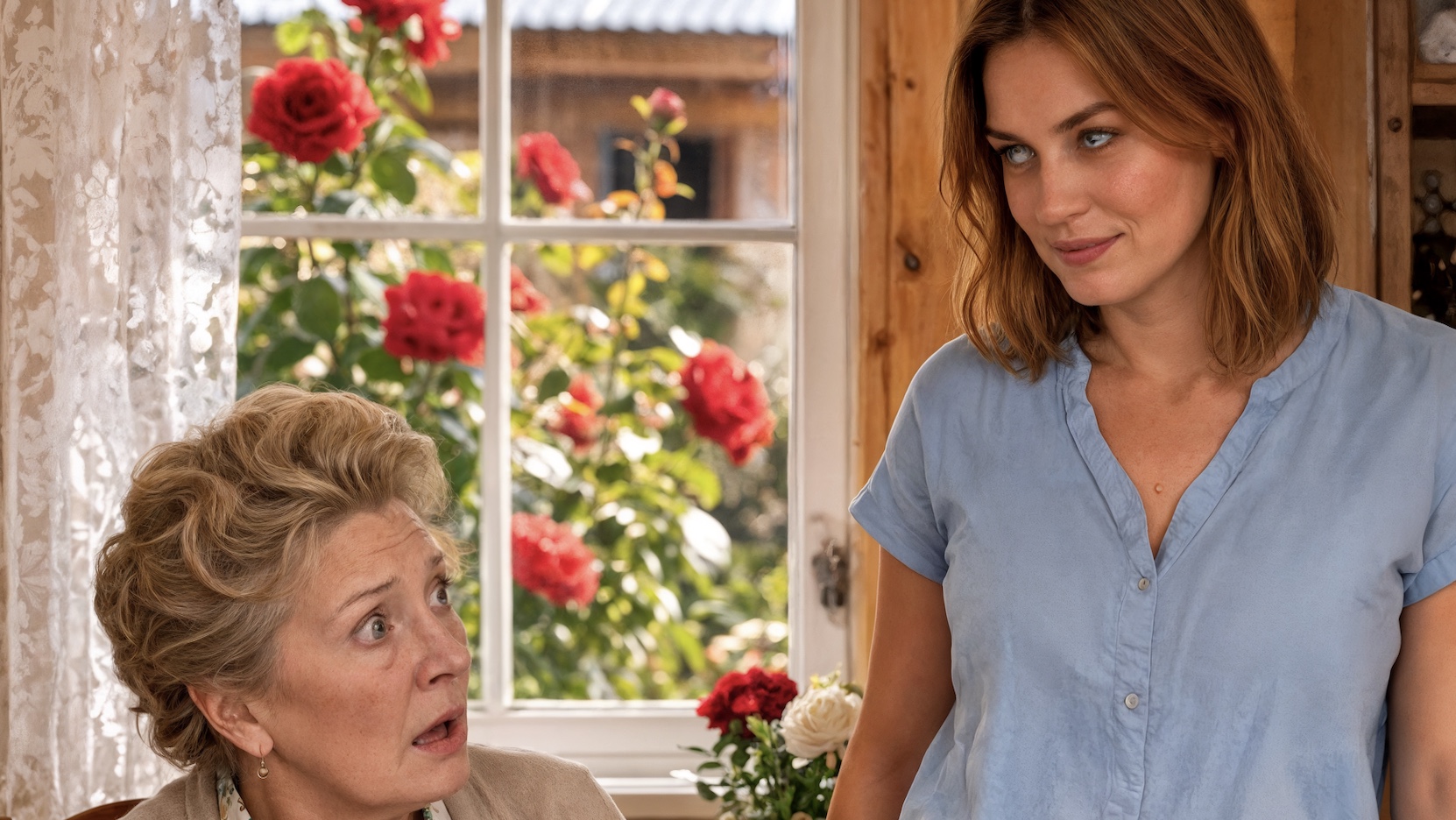
“We’ll take this wall down and turn the space into a lovely big living room,” a loud, authoritative female voice echoed through the wooden hallway. “And upstairs we can make two children’s bedrooms. Marinochka, your boys would be perfect here. Fresh air, pine trees everywhere, and the lake is only a ten-minute walk away. There’s plenty of room for everyone.”
A woman standing by the window with a cup of cooled herbal tea said nothing as she watched the scene unfold. In her own house—a place she had built with care, love, and attention to every detail—people who felt like outsiders were now behaving as if they belonged there. Her mother-in-law, Antonina Petrovna, moved confidently through the living room with a measuring tape in hand, stretching the metal strip from one corner to another. Close behind her bustled Marina, Anna’s sister-in-law, scribbling notes into a small notebook with brisk determination.
“Mom, and what are we going to do with the yard?” Marina asked, peering out the window at the tidy, lovingly maintained garden. “I don’t need any of these rose beds. The kids need a lawn where they can run around. We’ll put in a trampoline, maybe a frame pool. Those roses should be ripped out—they’re nothing but thorns and mess.”
Antonina Petrovna waved the tape measure like a conductor’s baton.
“Of course we’ll tear them out. And that glass greenhouse has to go too. Why bother growing tomatoes when you can buy them at the market? We’ll build a gazebo there instead, with a proper grill. Vadik loves cooking meat—he’ll finally have somewhere to invite his friends.”
They discussed the future redesign so casually, so confidently, as though they were standing in a furniture showroom instead of someone else’s home. Neither of them had the slightest intention of asking the owner for her opinion. Then again, Antonina Petrovna and Marina had not considered this house чужим for quite some time. In their world, where everything was measured by blood ties and old-fashioned family entitlement, a summer house purchased during a legal marriage automatically counted as shared property. And because the marriage of their beloved Vadim was falling apart and heading steadily toward divorce, they had come to “evaluate the half” that, in their absolute certainty, belonged to their side of the family.
Anna took a small sip of tea. It tasted bitter, just like the entire situation. The divorce from Vadim had begun several months earlier. It had not been a sudden decision. It had grown slowly, fed by years of small resentments, murky finances, and her husband’s constant failure to support her. Vadim was generous in spirit only when it came to his own hobbies and ambitions. He loved impressing people. He bought expensive fishing gear, changed cars more often than he changed winter tires, and kept throwing himself into dubious business ventures that always ended in failure.
The country house had been Anna’s dream and Anna’s project alone. She had imagined a home outside the city since she was young. For years she set aside part of every paycheck, saved her bonuses, and denied herself fancy vacations and designer clothes. When she finally had enough money to buy a plot in a good settlement, Vadim merely shrugged and said he had no desire to dig around in the dirt, though he did not object. The construction itself also fell entirely on her shoulders. She searched for work crews, chose the materials, and spent weekends at construction markets while her husband either slept until noon or left with friends for one more outing at some recreation base.
Vadim’s financial contribution to the project amounted to a decorative weather vane for the roof and a set of skewers in a handsome leather case. Yet the moment the house was finished, he became the first to bring noisy groups of friends there, proudly showing off “his property.”
Antonina Petrovna finished measuring one wall and, with a heavy sigh, dropped onto the soft sofa Anna had ordered to custom dimensions.
“Well, what can I say, Anya,” her mother-in-law said, smoothing her hair and looking at her daughter-in-law with the stern gaze of a schoolteacher. “The house isn’t bad. Of course, you can tell it was built without a man’s hand. The layout is foolish, and the hallways are too narrow. Still, it’s livable. Marina and I talked it over, and we decided not to drag this into court. Why waste money on lawyers? Better to settle it peacefully, as family.”
Anna set her cup down on the windowsill. Her calm looked almost unnatural, but inside she felt only a cold emptiness and a faint curiosity about just how far these women would go in their audacity.
“And how exactly do you propose we settle it peacefully?” she asked in an even tone.
Encouraged by her mother’s support, Marina stepped forward.
“It’s very simple, Anya. By law, everything acquired in marriage is split in half. The house is large—one hundred and thirty square meters. The plot is fifteen sotkas. We understand that you don’t want to leave, since you planted all your little flowers here. So here’s our offer: you keep the bathhouse. It’s spacious, and there’s even a lounge room upstairs. You can connect proper water there, put in a little kitchen, and live there happily. The main house will go to Vadim. He has a certain status, after all—he needs a place to entertain guests. And we need somewhere to spend summers with the children. We’ll divide the land with a mesh fence. Fair, isn’t it?”
Anna listened to this grand plan in disbelief. She could hardly accept that grown adults were capable of such clear, childlike shamelessness. In their minds, they had already moved her into the bathhouse, torn down her beloved greenhouse, and uprooted the roses she had grown from tiny cuttings brought back from a nursery.
“So you’re suggesting that I move into the bathhouse on my own property?” Anna asked, folding her arms across her chest.
“Why your property?” Antonina Petrovna shot back at once. “The land is shared! Vadik worked and provided for the family while you played around in the garden! He told me himself that he poured all his money into this house. He even had to buy his car on credit because the cash all went into your precious parquet floors!”
The mention of the car loan made Anna smile inwardly. That very car had become the starting point of the final collapse of their marriage. Her thoughts drifted back a year and a half, to events neither Antonina Petrovna nor Marina knew anything about.
At the time, Vadim had once again decided to reinvent himself—this time in logistics. To do that, he “needed” an expensive SUV. Anna had been firmly against it, warning him that their budget could not carry such payments. But Vadim, as always, did what he wanted. He took out a huge car loan and, on top of that, piled up microloans to fund his so-called business. Naturally, the business failed within a few months. The car was wrecked in an accident, the insurance covered only part of the damage, and debt collectors began calling not only Vadim but Anna as well, threatening lawsuits and property seizure.
The situation turned critical when the bank threatened to place claims on all jointly owned marital assets, including the country house into which Anna had poured her heart. Vadim panicked. He cried in the kitchen, begged her to save him from shame and the courts, and was terrified that his mother might discover the truth, since he had always played the role of a successful businessman in front of her.
That was when Anna set a hard condition. She had a substantial amount of money in a savings account—an inheritance from her grandmother, kept for a true emergency. She agreed to pay off all of Vadim’s debts, but in return demanded legal protection for her property.
They went to a notary. The conversation in the office was long and serious. The notary, an older, meticulous man, carefully explained all the legal consequences. A prenuptial agreement—more precisely, a marital property agreement—was drafted and signed. Under its terms, the usual regime of joint marital property was changed. Any real estate acquired during the marriage and registered in Anna’s name would be recognized as her sole personal property, indivisible in the event of divorce. Vadim voluntarily waived any and all claims to the land and the house, both now and in the future. In exchange, Anna transferred the money needed to clear his debts.
Vadim had signed everything gladly. He was thrilled to be rid of the collectors and save face. The contract had been entered into all the required registers, becoming a legal shield around the property. Anna told no one about it, believing it to be a private matter between husband and wife. Vadim, however, had apparently chosen to “forget” that the agreement existed—especially now that the marriage was ending. He was too ashamed to admit to his mother that he had traded away his supposed rights to the house in exchange for rescue from a debt pit.
And now Antonina Petrovna sat on the sofa, handing out orders about someone else’s home.
“You know, Antonina Petrovna,” Anna said as she walked to the table and sat across from her mother-in-law, “it seems Vadim forgot to tell you a few details about our property situation.”
“What details?” Marina asked sharply, lowering her notebook. “The law is the same for everyone. Half is ours. End of story. We could take this to court, and then you’d probably end up paying us half the value of the furniture too. So you’d better agree to the bathhouse while we’re still being kind.”
“Mom is right,” Antonina Petrovna added, smoothing the folds of her skirt. “We’re not greedy people. But we won’t give up what belongs to us. Vadik is living in a rented apartment now, suffering, while you sit here in a palace. Next week we’ll send workers over to start putting up the fence. And some of the furniture needs to be rearranged. That chest of drawers, for example—we’ll take it for the children’s room.”
She patted the carved oak dresser as if it were already hers. Anna had searched for months in antique markets to find that piece.
At that exact moment, a mobile phone rang, the melody cutting through the silence of the room. Anna glanced at the screen lying on the table. The name displayed there read: Notary Viktor Stepanovich.
For a brief second Anna paused. Then the corner of her mouth lifted in the faintest smile. The timing could not have been better. She did not even pick the phone up. She simply pressed speaker mode.
“Yes, Viktor Stepanovich, I’m listening,” Anna said in a clear, calm voice.
Antonina Petrovna and Marina froze. The word notary had a magical effect on ordinary people, inspiring equal parts respect and unease.
“Anna Nikolaevna, good afternoon,” came the deep, solid male voice from the speaker, carrying the unmistakable tone of a seasoned legal professional. “My apologies for bothering you on a weekend. My assistant is organizing our archive, and we needed to clarify a couple of details regarding your file. Is this a good time to talk?”
“Yes, that’s perfectly fine. I’m listening.”
“It concerns the marital agreement we certified a year and a half ago between you and your husband, Vadim Igorevich,” the notary said methodically.
At the mention of her son’s name, Antonina Petrovna craned her neck forward, and the color drained from her face. Marina leaned in too, almost dropping her notebook.
“In connection with your divorce proceedings,” the notary continued, unaware of the audience hanging on every word, “I requested a fresh extract from the Unified State Register of Real Estate to confirm that no encumbrances have arisen. I want to reassure you that the status of the property fully corresponds to the terms of the marital agreement. The land plot and the residential house located at your address are your one hundred percent personal and indivisible property.”
A sharp, ringing silence filled the living room. Outside, the wind rustling through the pine trees could be heard as clearly as if it were inside the house.
“Thank you, Viktor Stepanovich. That is excellent news,” Anna replied, carefully avoiding any glance at her husband’s relatives.
“I should also remind you,” the voice from the speaker went on, relentless as a verdict, “that under clause 3.1 of the agreement, Vadim Igorevich voluntarily waived any and all claims to this real estate, acknowledging that both the purchase of the land and the construction of the house were financed entirely from your personal funds. The property is not subject to division upon dissolution of marriage. Your husband has no right to reside there without your written consent, nor to dispose of any items located inside the house. If any representatives or relatives of his have questions, you may confidently refer them to me or present the certified copy of the agreement kept in your possession.”
“Thank you for the clarification and for your work. I have the certified copy with me. All the best.”
“Goodbye, Anna Nikolaevna. I wish you a smooth conclusion to the proceedings.”
Anna ended the call.
A heavy silence settled over the room. It felt as if the air itself had grown thick, difficult to breathe. Antonina Petrovna sat with her mouth slightly open, her eyes darting helplessly around the room as though searching for support from the very walls she had intended to tear down minutes earlier. Marina clutched her notebook filled with renovation plans so tightly her fingers had turned white.
“What… what marital agreement?” her mother-in-law finally managed, her voice trembling, stripped of all its former authority. “What was that man talking about? There must be some mistake! My Vadik would never sign something like that! He could never give away his own house!”
Anna rose unhurriedly, walked to the writing cabinet in the corner, took out a thick blue folder, and returned to the table. From it she removed several sheets of heavy paper marked with watermarks, blue seals, and holograms.
“It isn’t a mistake, Antonina Petrovna. It’s an official document drawn up in full compliance with the Family Code of the Russian Federation,” Anna said, placing the copy of the agreement in front of her mother-in-law. “You’re welcome to read it. Your son’s personal signature is on it.”
Marina snatched the document first. She scanned the lines quickly, her lips moving silently as she read. With every sentence, her face grew longer and paler.
“Mom…” she whispered, lifting terrified eyes toward Antonina Petrovna. “It says here that Vadim acknowledges the house was built with Anna’s personal funds. And that he renounces any property claims.”
“That can’t be!” Antonina Petrovna grabbed the papers out of her daughter’s hands. She tried to focus on the text, but her hands were shaking so badly the letters blurred in front of her. “He couldn’t have done this! Why? For what? He put money into this house! He took loans!”
“Exactly—loans,” Anna cut in sharply. Her patience had run out. It was time to say everything plainly. “Only he didn’t take them for the house. He took them for his absurd business schemes and an expensive car. And when collectors came after him and the bank threatened lawsuits, I paid off all of his debts with my inheritance. I saved him from ruin and disgrace. In return, I asked for only one thing—to legally secure what was already mine by every measure of fairness. My house.”
Her mother-in-law looked at Anna in stunned disbelief. The carefully built image in which her son was a successful provider and generous master of the house, while her daughter-in-law was a powerless woman wasting time in the garden, collapsed in an instant.
“He… he never told us,” Antonina Petrovna muttered weakly. “He said you were just divorcing because your personalities didn’t match. He said the house would be divided in court, but that he would nobly give you part of it.”
“Vadim has always loved looking noble at someone else’s expense,” Anna said calmly. “He was too ashamed to tell you that he ended up with nothing because of his own stupidity. It was easier for him to let you come here and humiliate me, demanding that I move into the bathhouse.”
Realizing there would be no children’s rooms upstairs, no lawn, and no frame pool, Marina abruptly changed tactics.
“Listen, Anya,” she said in a suddenly sugary tone, attempting friendliness, “of course Vadim was wrong not to tell us the truth. But we’re family. We’ve spent holidays together for years. Mom loves the air here so much. Maybe we could still come by sometimes on weekends? We won’t get in your way. I’ll keep the boys under control—they’re obedient.”
Anna looked at her sister-in-law in amazement. Fifteen minutes earlier Marina had been planning to uproot her roses and dictate terms. Now she was asking permission to come breathe the fresh air.
“No, Marina,” Anna said firmly. She went to the window and pushed it open, letting the scent of pine drift into the room. “You will not be coming here. Not on weekends, not on holidays. Our family ceased to exist the day Vadim and I filed for divorce. And after today—after the way you came here planning to divide up my property—I do not want to see you in my home again. Ever.”
Antonina Petrovna, beginning to recover some of her composure, flashed with angry indignation. Her wounded pride demanded an outlet. She began fussily gathering up her handbag, fastening it with trembling fingers.
“Come on, Marinochka!” she snapped, rising from the sofa. “There is nothing for us here. You’ve gotten far too full of yourself, Anna! You think a pile of papers makes you untouchable? My son will build himself ten houses better than this! And you’ll be left here all alone with your roses, unwanted by anyone!”
“Let him build them. I’ll be sincerely happy for him,” Anna answered, watching the two women make their way toward the exit.
Already in the hallway, Marina could not resist shouting one final remark.
“I’m going to tell Vadim exactly what I think! He should know better than to set up his own mother and sister like this! Coward!”
The front door slammed with a crash. Anna heard the crunch of gravel under the tires, the engine roaring to life, and the car speeding away in a cloud of dust down the settlement road.
She was alone at last.
The house felt quiet again, and easy to breathe in. No one was measuring walls anymore. No one was planning to demolish her greenhouse or tell her where she should live on her own land. Anna went back to the table, gathered the pages of the marital agreement, carefully returned them to the folder, and placed it back in the writing cabinet.
Then she stepped out onto the porch. The evening sun spread a soft glow over the garden. The roses Marina had wanted to rip out stood in full splendor, their heavy velvet blossoms wide open. There was still plenty to do ahead—prepare the flowerbeds for autumn, finish painting the fence, gather the harvest from the greenhouse. But it was good work. Work on her own land, in her own home, where there was no longer any room for чужие plans, toxic accusations, or hypocritical relatives.
Anna drew a deep breath, feeling an overwhelming sense of freedom and complete certainty about tomorrow. Tomorrow she would invite the neighbors over for tea and apple charlotte. But today, it was enough simply to sit on the porch and listen to the birds sing.