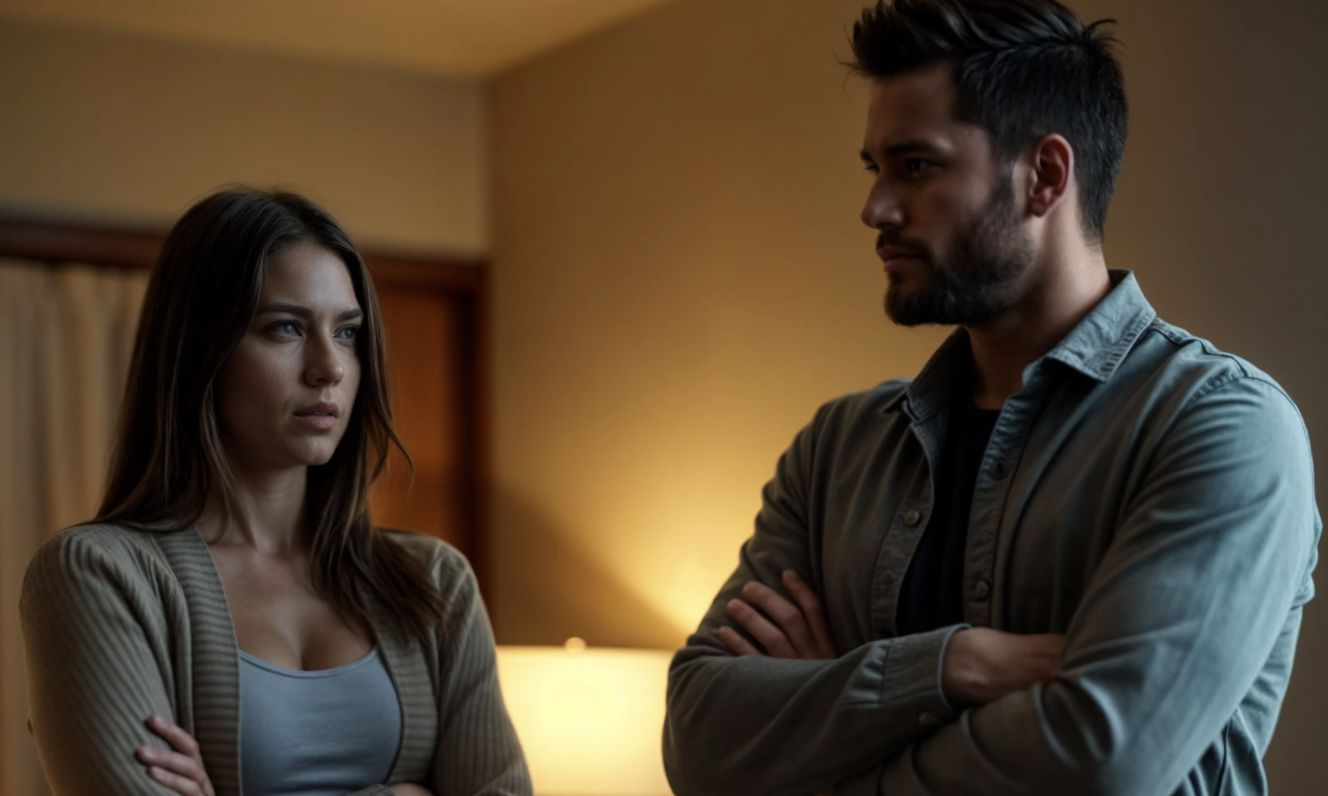
Katya, I talked to Mom today. A long talk—thorough. So, we’ve thought it over and decided it’s time for her to move in with us.”
Oleg said it in his usual, slightly lazy tone—the same one he used to comment on a football match or the weather outside. He was sitting deep in an armchair, legs stretched out, casually clicking through channels with the remote. The light from the TV pulled his relaxed, satisfied face out of the room’s half-darkness. The sentence was tossed into the air as something self-evident—something that needed neither discussion nor approval. Katerina, standing by the bookcase and dusting the spines of books, froze. Her hand with the soft cloth stopped halfway. She didn’t turn around. She let the words hang there, to feel the full weight and audacity of them.
When no answer came, he kept going, apparently taking her silence as agreement.
“Well, think about it—what’s she supposed to do, rot away alone in that village? Her health isn’t what it used to be—one thing hurts, then another. And what do we have? A three-room place, practically a palace. The far room is empty. Why should it just sit there unused? We’ll put Mom in it and everyone wins. She gets care and attention, and we’ll feel calmer knowing she’s close by, under supervision.”
He finally found some boring series and set the remote aside. Now he was looking at her back, expecting an enthusiastic reaction to his “responsible” decision. In his mind he already saw cozy family evenings, his mother’s pies, and the unquestioning support she’d always given him.
Katerina slowly put the figurine she was holding back on the shelf. She turned around. Her movements were smooth, deliberate—no fuss, no nerves.
“We decided?” Her voice was even and very quiet, but in the sudden silence it filled the entire room. “Please clarify who exactly is included in this ‘we’ of yours.”
Oleg tensed slightly. He heard the familiar steel in her tone—the kind that always meant an unpleasant conversation was coming. But he was ready; he’d prepared his arguments.
“Well… Mom and I. We talked, weighed everything. At first she resisted—said she didn’t want to get in the way of the young. But I convinced her. I told her you’d be happy. She’s even started packing a little, the essentials.”
He tried to flash his signature disarming smile—the one that usually smothered conflicts before they could ignite. This time it didn’t work. Katerina stared straight at him, her gaze cold and focused, like an investigator’s.
“So you and your mother decided she’ll live in my apartment. You convinced her I’d be happy. She’s already packing. Oleg, tell me—was my participation in this flawless scheme ever even considered? Or was I simply supposed to be informed when the train arrived?”
“Kat, don’t start, huh? What do you mean, ‘your’ apartment? We’re a family—everything’s shared! And this isn’t a whim, it’s a necessity! Are you really going to let my mother—an elderly person—rot alive in some dump when we have these conditions?”
His voice rose. It was his defense mechanism: paint her as a heartless egoist so she’d feel guilty and give in.
“She’ll help us too! You come home from work exhausted, you don’t want anything. But this way dinner will always be on the table, the house will be in order. My mom’s an active woman—she can’t sit around doing nothing. It’s for our common good!”
He jumped up and stepped closer, trying to take her hands. He looked at her pleadingly, like a child who desperately wants a new toy. But Katerina pulled her hands away—calmly, without sharpness—and looked him straight in the eyes.
“I don’t give a damn what you want, my dear. This is my apartment, and only I get to decide who lives in it. And your mother isn’t on that list.”
“But—how can that be?”
“This is closed, once and for all. Call her and tell her to stop packing.”
Katerina’s words dropped into the silence like stones into a deep well. Oleg stared at her, and across his face, slowly—like a photograph developing—spread a whole spectrum of feeling: from stunned confusion to a purple, bubbling resentment. He’d expected anything: tears, bargaining, a screaming match with shattered dishes—anything but this icy, absolute veto. Anything but this calm, humiliating superiority.
“You… you’re serious?” he forced out, as if he couldn’t get enough air.
“I’m never more serious.” Katerina answered without even honoring him with a real look. She went back to the bookshelf and resumed what she’d been doing, arranging the books by height. Every movement was deliberately calm, underscoring that, for her, the conversation was over.
“This is my apartment too! We live here together! I have the right—”
“You don’t have the right to decide for me,” she cut him off without turning. “You have the right to pack your things and move to your mother’s village. You can take care of her there. That would be your choice and your right. Here—my rules.”
After that he fell silent. Not because he agreed, but because he understood: the wall he’d been headbutting wasn’t cardboard. It was reinforced concrete.
The next few days turned into torture. They didn’t talk. They existed in the same space like two ghosts, carefully avoiding each other. The air in the apartment became dense, heavy—hard to breathe. Oleg tried to break the blockade: he sighed loudly at dinner, shoved his chair back with exaggerated noise, dropped his fork. He waited for a reaction—any reaction—that would let him restart the argument. But Katerina ate in silence, staring into her plate as though he were just another piece of furniture.
Then the siege began by phone.
Oleg started talking to his mother every evening—and always in the living room, where Katerina couldn’t help hearing him. It was a performance designed for a single audience member.
“Yes, Mom… Your blood pressure again? Why are you like this… Did you take your pills?… What do you mean you’re out—and there’s no one to go to the pharmacy?…”
His voice was loaded with sonly grief and barely hidden reproach—aimed, of course, not into the receiver but toward his wife.
Katerina sat with her laptop on her knees and worked without looking up. She heard every word: about the aching back, the leaking roof, the longing and loneliness. Valentina Petrovna was an experienced actress, and Oleg was a talentless—but very diligent—repeater.
After a week of this pressure Oleg decided the ground was ready for a new assault. He sat beside her on the couch while she was watching a movie.
“Kat, Mom called. She’s really bad. Says no one will help chop firewood for the winter. I offered to send money so she could hire someone, but she refuses. She’s afraid to let strangers into the house.”
He looked at her expectantly. Katerina paused the film and slowly turned her head.
“Then go and chop it. Take a couple days off. It’s your duty as her son.”
Oleg went blank. He’d expected guilt to finally sprout in her, but she once again raised an impenetrable shield of cold logic.
“I can’t drop work right now! My project is on fire! You know that!”
“So your work is more important than your mother’s health?” she parried, using his own weapon, meeting his eyes without a flicker of emotion. “Very convenient, Oleg. You want to solve her problems without sacrificing anything of yours—no time, no money, and most of all, no personal comfort. You want me to solve her problems by sacrificing my home and my peace. That won’t happen. Find other options. Hire her a caregiver. Buy her an apartment nearby. But your mother will not enter my life or my home.”
A week of cold war got Oleg nowhere. His tactic of psychological attrition shattered against Katerina’s deaf, impenetrable calm. He realized persuasion, hints, and pity stories no longer worked. In his mind—trained to choose the path of least resistance—only one crude but, he believed, effective method remained: force her with a fait accompli.
He decided that when his mother was already standing on the doorstep with suitcases, Katerina wouldn’t dare—wouldn’t be able—to make a scene. Public opinion in the form of neighbors would do its job. Basic human compassion would do its job. She would submit.
On Saturday the doorbell rang differently. Not the short trill of a courier, not the hurried buzz of a neighbor. It was long, insistent, confident—as if the person ringing wasn’t a guest but the owner demanding to be let in immediately.
Katerina had been watering flowers in the kitchen. She set the watering can on the windowsill and walked to the door, already instinctively knowing what was about to happen. She could feel it in the way the entire apartment seemed to freeze, in how all everyday sounds suddenly died.
She turned the key and opened the door.
On the landing—filling almost the entire space—stood Valentina Petrovna. She wore her best coat, a little hat perched on her head, and her face carried the commanding triumph of a winner. At her feet were two huge, battered suitcases, stuffed tight and cinched with rope for safety. Behind her loomed Oleg. He wouldn’t look at Katerina; his eyes drifted somewhere to the side, but a nervous, obsequious smile was stuck on his face.
“Well then, daughter, accept the new addition!” the mother-in-law boomed for the whole stairwell, stepping forward as if to squeeze into the hallway.
Katerina didn’t move. Silently she braced one arm against the doorframe, turning her body into a living barrier. Her arm was slim, but in that moment it seemed like a steel rod that couldn’t be bent. Valentina Petrovna ran into the invisible obstacle and stopped, confused.
“Oleg,” Katerina’s voice was perfectly even, without the slightest hint of surprise or anger, “what is this?”
Her husband fidgeted, shifting from foot to foot. Finally he looked at her, eyes full of cowardly pleading.
“Katya, but we decided… Mom’s really bad alone, I couldn’t leave her there…”
“That’s what you decided,” Katerina enunciated, cutting the words with pauses. “And I said—no.”
The mother-in-law snapped out of her first bewilderment. The realization that some little girl dared to stand in her way hit like a slap. Her face turned red.
“Who are you to decide?! This is my son’s apartment! I will live here!”
She tried to shove Katerina’s arm aside and push her way in. That was the last drop.
Without another word Katerina stepped back—not to let them in. She bent down sharply, grabbed the nearest suitcase by the handle, and with all her strength shoved it back onto the landing. The heavy case scraped across the tile and thudded into the railing. The second one followed, toppling and bursting open on impact, spilling old sweaters like guts from a torn belly.
“Why, you—!” Valentina Petrovna shrieked and clawed at Katerina’s arm with bony fingers. Katerina didn’t hesitate; she shoved her away hard. Not a strike—just a blunt push, like you push away something intrusive and unpleasant. The mother-in-law stumbled backward and nearly fell, her hat sliding sideways. Oleg lunged to catch her, babbling something in panic.
Katerina turned and, without looking at either of them, stepped into the hallway. She snatched Oleg’s jacket from the coat rack—the one he’d just come in wearing. Pulled his sneakers from the shoe rack. Scooped up his work backpack from the floor. And with the same cold, methodical fury, hurled it all onto the landing, right at the feet of the stunned pair. The pile landed beside the torn-open suitcase.
“Out. Both of you.”
The door slammed. One lock clicked. Then the second. Two dry, metallic clicks that put a period at the end of their married life.
For a moment there was stunned silence outside the door. Then the stairwell exploded. First came Valentina Petrovna’s muffled, furious scream—an avalanche of insults Katerina didn’t even try to make out. Then someone began pounding on the door—not with a fist but with a whole body, heavy, hollow blows. It was Oleg. He roared her name, mixing it with threats and pleas.
Katerina stood in the hallway with her back against the cold wall beside the door. She didn’t move. She listened to the noise the way you listen to thunder behind thick glass—a force raging somewhere else, in another world that was no longer hers. There was no strength in his screaming, only the hysterical weakness of a man whose favorite toy had just been taken away and whose humiliation was complete. Every blow was not a sign of power, but a sign of defeat.
She waited. She knew it couldn’t last long.
And it didn’t. Ten minutes later the pounding stopped. There were muffled arguments, shuffling feet, the scrape of suitcases being dragged away. Then everything went quiet.
Katerina slowly pushed away from the wall. Inside the apartment it was unnaturally silent. But the silence didn’t press down—on the contrary, it felt light and clean, like air after a storm. She went into the kitchen, poured herself a glass of cold water, and drank it in one swallow. Not a muscle in her face twitched. She felt no regret, no anger, not even satisfaction. She felt only one thing: order. The violated, defiled order had been restored.
She looked around her apartment—her books on the shelves, her flowers on the windowsill, her couch, where a hostile stranger would no longer sit. She walked through the rooms, mentally erasing the last traces of their presence. Here—this armchair where he’d sat when he announced his ultimatum. Here—in the hallway where they’d stood trying to crush her will by force.
She went back to the front door, took a cloth, and scrubbed the handles, the frame, the threshold—everything they’d touched. Physical cleansing of the space.
Her phone vibrated in her pocket. Once. Twice. Three times. She pulled it out. The screen showed “Oleg.” Dozens of missed calls, a string of messages. She opened the chat.
It was agony in text form: a flood of incoherent accusations, broken up by pathetic attempts to provoke guilt.
“You’ll regret this.”
“Mom’s heart is bad because of you.”
“How could you do this to me, I loved you.”
“You’re just a heartless bitch.”
Katerina read it without emotion, the way you read spam. She didn’t reply. Instead she walked into the bedroom, opened the closet—his half—and began pulling out his clothes. She didn’t fold or sort anything. She just grabbed everything—T-shirts, jeans, sweaters, underwear—and ruthlessly shoved it into big black trash bags. One bag. Second. Third. His deodorants, razor, random creams flew off the shelf. Socks and belts from the dresser drawer. She worked fast and efficiently, like a санитар clearing a room of hazardous waste.
When she finished, three tightly packed black bags stood by the front door. She took her phone, opened the camera, snapped a photo of the still life, and sent it to Oleg in the same chat—right under his last message about “heartless bitch.” Then she typed one short line—her final answer in their shared story.
“Tell me when you’re coming to pick up this trash. Leave the keys in the mailbox.”
After sending it, she didn’t wait for a response. She opened his contact, pressed “Block,” and confirmed. Then she silenced her phone, set it on the table, and went to take a shower. Hot water washed away the remains of that day, that marriage, that alien life forced on her. And when she stepped out—into a quiet, clean apartment that belonged only to her—she finally took a full breath for the first time in a long while.
On scorched earth, a new life was beginning…