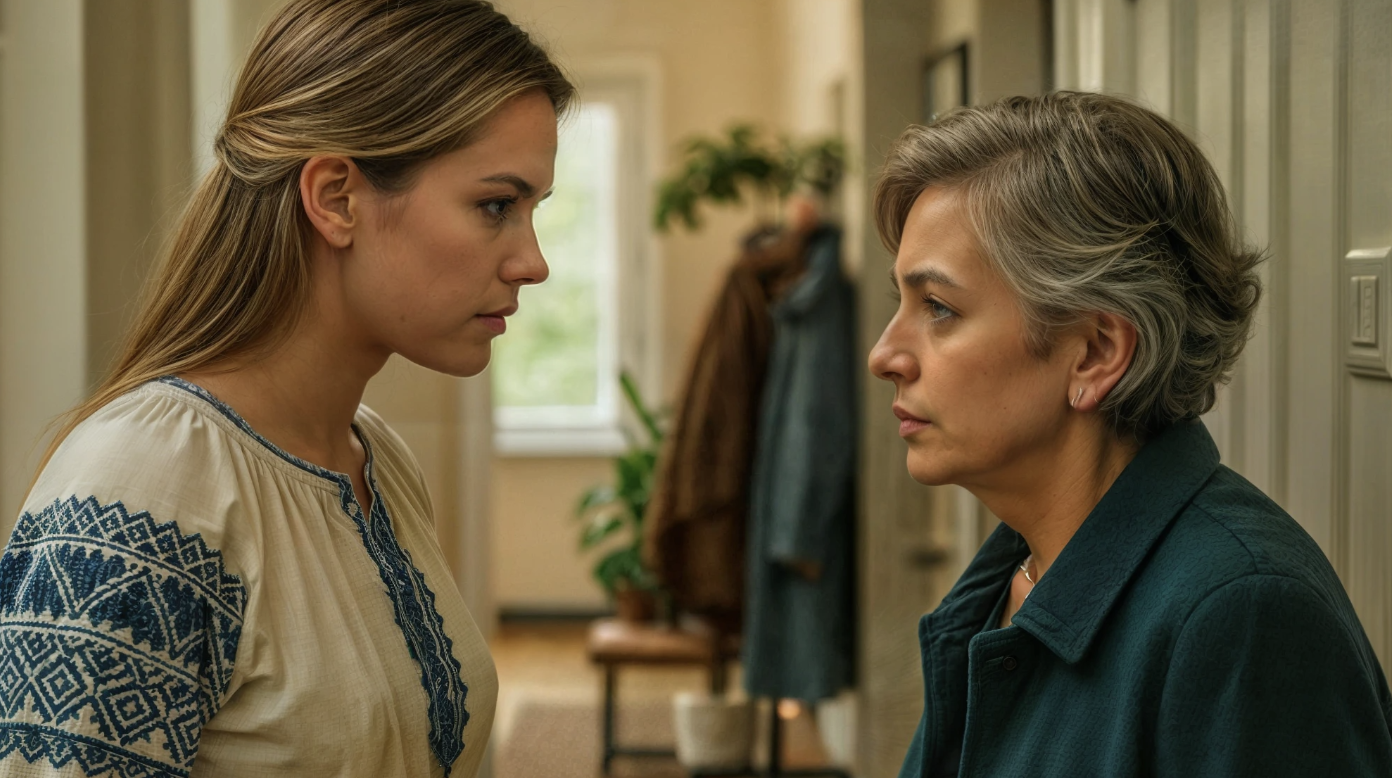
Roma, it’s me. Can you come over now? I urgently need the jars.”
Zhanna Arkadyevna’s voice in the receiver carried no trace of a question. It assumed no refusal, allowed no objections. It was that coaxing yet steely tone Roman had learned to hate since his teens. He closed his eyes and rubbed the bridge of his nose, trying to hold on to what was left of his evening calm. His shoulders—relaxed only moments ago after a long workday—tensed again, hardening into a familiar armor.
“Hi, Mom. It’s late, I just got off work. What jars? We’ll bring them tomorrow,” he tried to keep his voice even, without irritation, knowing any note of protest would be used against him.
Alina, sitting opposite with a book, lowered her gaze without meaning to. She couldn’t hear her mother-in-law’s words, but she knew that tone in her husband’s voice perfectly well. That tone meant their evening was over. That the usual slow, sticky manipulation was about to begin—exhausting, like toothache.
“What kind of jars… the empty ones you’ve got on the balcony! I suddenly got it into my head to pickle cucumbers right now, and Svetochka isn’t feeling well—she can’t go to the store,” Zhanna Arkadyevna sang into the phone. “She’s flat on her back, poor thing. And you—what, you’re tired? You don’t have the strength to help your own mother anymore? I’m not asking you to haul sacks.”
Roman said nothing. He stared at a single spot on the wall, and Alina could see a deep crease form on his forehead. He was trapped. Refuse—and he’d get a half-hour lecture about being cold and ungrateful. Agree—and he’d have to drop everything now and drive across the city for a whim that was most likely just a test of obedience. “Svetochka isn’t feeling well” was a trump card Zhanna Arkadyevna pulled out every time she wanted something. Thirty-year-old Svetochka, healthy as an ox, was permanently “not feeling well” whenever work, house chores, or a trip to the store came up.
Alina watched her husband open his mouth to object and realized it was pointless. It was easier to spend half an hour herself than listen to this performance on the phone and then look at her husband wrung out like a lemon. She decisively set her book aside and stood up.
“I’ll go,” she said quietly, but loud enough for him to hear.
Roman looked at her with gratitude and guilt at the same time. He covered the receiver with his palm.
“Alin, don’t. I’ll do it…”
“Sit,” she cut him off. “I’ll be faster.”
She came over, took the phone from his hands, and raised it to her ear. Her voice was pointedly polite, almost sweet.
“Zhanna Arkadyevna, hello. Roma is very tired. I’ll gather the jars now and bring them to you within half an hour.”
There was silence on the line for a second. Her mother-in-law clearly hadn’t expected this twist. Her game was designed for her son.
“Ah… Alina. Well then, bring them, if that’s how it is,” she finally snapped, unable to hide her disappointment.
On the balcony stood a cardboard box filled with dusty three-liter jars—an old relic they still somehow hadn’t thrown out. Alina picked up the box with disgust. The glass clinked dully. She carried the crate like a symbol of her husband’s obligations—ones he couldn’t seem to get rid of. Heavy, empty, and completely useless.
Her mother-in-law’s building greeted her with the familiar stale smell of old furniture and something sour from the kitchen. The dim light of the single stairwell bulb made the scuffed walls look even more miserable. Alina rang the doorbell. A few seconds passed before shuffling steps sounded behind the door. Zhanna Arkadyevna opened it, and the moment Alina stepped over the threshold, she understood she’d been pulled into a pre-scripted performance.
The scene was so predictable it stirred nothing but a dull, long-cured irritation. In the living room, flooded with blue light from a huge TV blasting some shrill talk show, Sveta sprawled in a deep armchair. The “poor thing flat on her back” was scrolling her phone, the screen casting a deathly pale glow over her face. On the side table sat a half-finished cup of tea and a plate with cookie crumbs. She didn’t look sick. She looked exactly as she always did—bored and utterly idle.
Zhanna Arkadyevna, posing like the mistress of a copper mountain, measured the box in Alina’s hands with a heavy stare.
“Finally. Put it here, on the floor,” she waved toward the hall. “Just don’t scratch anything.”
Alina silently and carefully set the heavy box down on the linoleum. She was about to turn and leave with a routine “goodbye,” but her mother-in-law clearly had other plans for the evening. She didn’t move, blocking Alina’s way out.
“Since you’re here, don’t stand there like a post,” she began in that commanding tone she used only with those she considered beneath her. “Look—dust everywhere, Svetochka’s under the weather, and my back is killing me. Wipe down the dresser real quick, and then wash the floors in the hall—you’ve tracked dirt in here with your box.”
Sveta lifted her head from her phone and, hearing that, couldn’t hold back a sneering smile. She sat up slightly, so she could better watch her sister-in-law’s humiliation. It was their favorite entertainment: together, corner Roman’s wife, and then complain to him about how rude and lazy she was.
Alina slowly straightened. She looked at the layer of dust on the dark polished surface of the old dresser, then at her sister-in-law’s satisfied face, and finally fixed her eyes on her mother-in-law. Something inside her clicked—not like a cup shattering, but with the dull, final sound of a rope being cut, one that had held her to politeness for far too long. She looked Zhanna Arkadyevna straight in the eyes, and when she spoke, her voice was calm and clear, without the slightest tremble.
“I didn’t hire on as your maid, Zhanna Arkadyevna. You have an adult daughter who lives with you—let her scrub your apartment spotless. I’m your son’s wife, and we have our own home and our own family. That’s it.”
For a few seconds, the apartment became unnaturally quiet; even the voices from the TV seemed to hush. The smirk on Sveta’s face froze, then slid away, replaced by stunned indignation. Zhanna Arkadyevna, faced with such unheard-of insolence, lost the power of speech. Her face darkened crimson, and her mouth opened and closed soundlessly like a fish thrown onto shore. When her voice finally returned, it broke into a shriek.
“Why you—what do you think you’re doing, you rude little brat?! Telling me what to do in my own house?! I’ll call Roma right now—he’ll divorce you this instant! He’ll throw you out into the street like a mangy dog!”
“You think so?” Alina asked calmly, almost with curiosity.
Without taking her eyes off her mother-in-law’s face twisted with rage, she pulled out her phone, found the contact “Husband,” and pressed call. Zhanna Arkadyevna fell silent, staring at her in confusion. Alina put it on speaker.
“Roma, hi,” she said evenly. “Your mother is demanding that I wash their floors and windows—otherwise you’ll divorce me. Do you confirm that?”
A short, very expressive pause hung on the line. Then came Roman’s tired, heavy sigh.
“Mom, give the phone to my sister.”
Still not believing what was happening, Zhanna Arkadyevna helplessly handed the phone to Sveta, who had gone stiff.
“Sveta,” Roman’s voice—cold as steel—reached all three of them, “you have half an hour to put the apartment in order. If I come over now and see you sitting while Alina works, I’ll throw all your stuff into the trash. And you’ll live on your own money. I’ve said my piece.”
The line went dead.
With a polite smile, Alina took her phone back from Sveta’s slackened hand. She nodded to her stunned mother-in-law.
“I think I’ll go. Sounds like you’ve got a deep clean coming.”
The door closed behind Alina with a soft, polite click that, in the new silence, sounded louder than a gunshot. For several seconds, Zhanna Arkadyevna and Sveta simply stood, staring at the door as if it were a portal into another reality—one they were now barred from entering. The blue light from the television continued to dance indifferently over the walls, pulling their bewildered, anger-twisted faces out of the gloom.
Sveta was the first to move. She slowly sank back into the armchair, but her relaxed posture had turned tense. The phone in her hand went dark.
“So you’ve played yourself?” her voice was quiet and venomous, like a snake’s hiss. “Happy? I told you—don’t mess with her. She’s not the type to stay silent.”
Zhanna Arkadyevna spun around sharply, her face still crimson. Shock was giving way to a blind, all-consuming fury that needed an outlet. And the only available target was her own daughter.
“Shut up, you freeloader!” she snarled, striding to the armchair. “You sit here all day, you never lift a finger! This is all because of you! If you were any use at all, if you ever once cleared your own plate, I wouldn’t have had to ask that… that upstart! You’ve turned my home into a pigsty and I’m supposed to clean up after you?!”
“I didn’t ask you to call her and humiliate her!” Sveta screamed, jumping up. “Those are your games, Mom! You like pitting them against each other, watching Romka get torn in half! You just didn’t calculate that his patience would run out! Now he’s going to throw my things into the trash, not yours!”
They stood facing each other—two women who for years had formed a single front against the outside world, and above all against Alina. But now, when their common enemy had struck a crushing blow and retreated, their alliance cracked, exposing the contempt that had been building up between them.
Their squabble was cut short by a sharp, demanding ring at the door—someone pressing the button not with a finger but with the whole palm. Both of them froze and exchanged a look. The same fear sat in both pairs of eyes. Zhanna Arkadyevna went to open the door, trying on a suffering expression as she walked.
Roman stood on the threshold. He wasn’t angry in the usual sense. He wasn’t shouting; his face wasn’t contorted. He was absolutely calm—and that was more frightening than any rage. His cold, dark eyes swept the hallway, paused on the dusty dresser, slid over his sister frozen in the living room, and stopped on his mother. He didn’t say hello. He didn’t say anything at all.
Silently, he walked past them, heading straight into the apartment.
“Romochka, son, you misunderstood everything! That Alina of yours—” Zhanna Arkadyevna started after him, but he didn’t even turn around.
He entered Sveta’s room—her holy of holies, the princess’s lair, funded by him. Without looking around, he yanked open the wardrobe and pulled out several large black trash bags from the shelf—bags Sveta bought but never used for their intended purpose. With businesslike method, he began sweeping dresses, sweaters, expensive jeans off the hangers and tossing them into the bag.
“Roma, what are you doing?!” Sveta shrieked, rushing at him. She grabbed his arm, trying to stop him. “Those are my things! Have you lost your mind?!”
He looked at her as if she weren’t his sister but an annoying insect. With one motion, he shook off her hand and went on. The second bag filled with shoe boxes holding brand-new heels, the third with handbags and cosmetics from her vanity.
“Son, stop! What are you doing?! That’s your sister! She has a heart condition!” Zhanna Arkadyevna wailed, throwing up her hands but staying in the doorway.
When the third bag was full, Roman tied it and dropped it on the floor with a dull thud. He straightened up and finally looked at them.
“Did you think this would last forever?” His voice was quiet, but it filled the room. “Did you think I’d keep paying for this circus? Your idleness, Sveta—and your manipulations, Mom?”
He took a step toward his sister, and she instinctively backed away.
“So here it is, Sveta. Either you find a job tomorrow—any job, I don’t care, mop floors for all I care—and you start helping Mom not with words, but with actions. Or these bags go with you to a rental apartment. Which you’ll pay for yourself. You’re not getting money from me anymore. Not a cent.”
Then he turned to his mother.
“And you, Mom—get used to it. Your source of funding and your errand boy are done.”
He didn’t wait for an answer. He simply turned, walked through the apartment, and left, quietly closing the front door behind him. Two women remained standing in a wrecked wardrobe amid three black trash bags, like burial mounds under which their old, comfortable life had been laid to rest.
Three days passed. Three days of deafening, unfamiliar silence. Roman’s phone stayed quiet. No plaintive calls from his mother, no passive messages from his sister asking him to “send something to the card.” In Alina and Roman’s apartment, a fragile, almost tangible calm settled in. They ate dinner, talked about their day, watched movies. They lived their own life, and that simple normality felt like something stolen—something that could be taken back at any moment. Roman was tense; he was waiting. He knew his mother too well to believe she would give up so easily. This was the lull before the final, decisive attack.
And it came.
On Saturday evening, just as they sat down to dinner, the doorbell rang insistently—not a short chime from a guest, but a long, continuous buzz, heavy with righteous indignation. Roman slowly set down his fork, looked at Alina, and she read it in his eyes: “Here we go.”
He went to open the door. On the threshold, like two statues of vengeance, stood Zhanna Arkadyevna and Sveta. They were dressed in their finest, as if arriving at a tribunal where they were both judges and prosecutors.
“We need to talk. Seriously,” Zhanna Arkadyevna declared without preamble, looking not at her son, but over his shoulder—straight at Alina sitting at the table.
Roman silently stepped aside, letting them into the apartment. He closed the door behind them and stayed there, leaning his back against it, cutting off their retreat—though retreat, in any case, wasn’t what they had come for. Alina didn’t stand; she only set her utensils aside, waiting for the inevitable.
“Go on. I’m listening,” Roman said calmly.
Zhanna Arkadyevna walked to the center of the room, and Sveta took her place beside her like a loyal adjutant.
“We’ve come to put an end to this, Roman,” his mother began, her voice ringing with restrained fury. “We’ve endured this too long. Since the moment… she appeared in your life,” she nodded with disgust toward Alina, “our family has started falling apart. She’s turned you against your own mother, against your sister! She’s gotten into your head, pulls your strings like a puppet! And you, blinded, can’t see that this hanger-on is simply using your money!”
“You spend everything on her while your own sister is forced to beg you for the bare essentials!” Sveta chimed in, her eyes flashing. “She lives in our apartment, wears things you could be buying for me!”
They spoke over each other, pouring out everything that had been building in them for years. The accusations were absurd, yet delivered with such unshakable conviction that for a moment they might have sounded believable to any outsider. Alina kept silent, watching them without hatred—more with detached interest, like an entomologist observing unpleasant but predictably behaving insects.
Roman listened without changing expression. He let them vent, climb all the way to their boiling point. Finally, Zhanna Arkadyevna, out of breath, stepped forward and said what they had come to say.
“Enough. We’re giving you an ultimatum. Either that little flirt gets out of our family and out of your life, or you’re no son of ours anymore. Choose, Roman. Either we are your blood, your family. Or she is.”
The room tightened with tension. Zhanna Arkadyevna and Sveta stared at him defiantly, sure of their power, sure of the unbreakable bond of blood, sure he would break now.
Roman slowly pushed away from the door. He stepped up to his mother, stopping so close he could see every wrinkle on her face contorted with spite. He looked her straight in the eye, and his voice was quiet, even—and therefore unbearably cruel.
“You want me to choose? Fine. I choose.”
He paused, letting them savor the moment they believed was their triumph.
“I choose my wife. I choose my home. I choose peace. I choose a life that has no room for your swamp. And do you know why? Because you’re not family. You’re consumers. A black hole that only takes—strength, money, time. You, Mom, never understood that your son grew up. And you, Sveta, never wanted to grow up yourself. The son who was your wallet and your shoulder to cry on died three days ago in your hallway. And I’m a stranger to you now. Alina’s husband.”
He turned and walked to the front door, swinging it wide open.
“Ultimatum accepted. You’re not my mother anymore. You’re not my sister anymore. Don’t call. Don’t come. I don’t know you. The money is over. Forever. Goodbye.”
He didn’t look at their faces as shock turned to horror and understanding. He just stood holding the door while they stumbled out onto the landing like blind people. Then he quietly, without slamming it, closed the door behind them. Turned the lock. Silence filled the apartment. Real silence. The silence of freedom.
He walked back to the table, sat down across from Alina, and took her hand in his.
The war was over…