The bag was rustling so loudly that Nika was sure the entire promenade would turn to look at her. Seagulls sat on the granite ledge, mothers with strollers strolled by, and an elderly fisherman carried a box on his shoulder. Nika hugged the bag to her side with her elbow and picked up the pace.
Inside was a glass bottle of hyaluronic acid serum with a golden cap and a crisp white label. This wasn’t some greasy tube with a yellow discount sticker from a chain store, but a real, expensive item. Nika had bought it herself, with her own money.
In two months, this jar would be twirled between the fingers of the very person Nika was hiding it from, like it was evidence. For now, she turned into the courtyard and transferred her purchase into an old canvas bag she used for extra shoes. She tossed her mittens on top to make it look like she’d just been out for a walk.
Petrozavodsk at the end of March offered no promise of spring and didn’t pretend otherwise. Lake Onega was trapped under gray, porous ice. The snowdrifts along the avenue had settled and darkened at the edges, like old bread crusts. The wind off the water crept under every collar.
Nika lived in Drevyanka, in a nine-story panel building with yellow balconies. The apartment was a three-bedroom. One room belonged to Nonna Arkadyevna, who had moved in “for a month to help with the child”—and never left.
Nika unlocked the door with her own key. Right away, Timosha came running out in pajamas covered with dinosaurs. He was five, with messy hair and a gap where his front tooth used to be. He barreled into his mom’s knees.
“Mom! Where were you? Grandma said you got lost!”
“I was out, Timosh. Watching the icebreaker docked at the pier.”
“Is it alive?”
“It’s sleeping. It’ll wake up in the spring.”
Nonna Arkadyevna peeked out from the kitchen. She was tall and lean, her gray hair pulled so tightly into a bun that it made her eyebrows look surprised. Her apron was starched to a crisp, and her thin lips formed a line—like a signature under a protocol.
For thirty years, she ran the cafeteria at the ship repair plant. She never lost her manager’s habits: she knew the value of every single potato.
“Had a nice walk?” her mother-in-law’s eyes flicked to the canvas bag. “Glebushka’s on shift ‘til night. Standing in the freezer at minus twenty-five, handling carcasses. My boy freezes to the bone so you all can live in warmth.”
Nika pulled off her boots and set them neatly on the rug, toe to toe. Just the way her mother-in-law liked.
“I know, Nonna Arkadyevna.”
“Knowing isn’t enough. You have to appreciate it.”
Gleb worked as a shift supervisor at the cold storage plant. He was broad-shouldered, with a heavy jaw and a side part that looked like it was ruled with a straight edge. He wound his wristwatch every morning at 7:15, never a minute later.
He was the only one who managed the family’s money. A weekly menu, written in Nonna Arkadyevna’s round script, was pinned to the fridge by a lighthouse magnet. Below it, a list of sale items was attached.
Instead of trout, there was sprat in tomato sauce. Broccoli was swapped for white cabbage—”it’s healthier, we grew up on it.” Instead of mangoes they bought pears, and sometimes just apples if pears got too expensive.
When they were renovating, Nika dreamed of olive-colored wallpaper. They ended up putting up ‘milky coffee’ instead because it was ‘practical and just like everyone else.’ For her thirtieth birthday, she asked for suede boots. Instead, she got a shapeless, dirty blue puffer jacket from a sale.
“You handle money like a hedgehog in fog,” Gleb said, flipping through channels. “Trust me. I know what I’m doing.”
“I know a thing or two myself.”
“You know how to draw little letters. But I know how much life really costs.”
Nika had been drawing letters since childhood. She graduated from the art and graphic faculty, specializing in fonts. For her thesis, she hand-painted Karelian runes on linen scrolls, earning a standing ovation from the committee.
Then came the wedding, Timosha, and Nonna Arkadyevna. Her fountain pens and ink moved into a box on the top shelf.
Last autumn, a famous calligrapher announced a master class in St. Petersburg. Nika found his page and looked through all his work. That evening, she approached her husband.
“Gleb, there’s a weekend course. I’d like to go. It’s important to me.”
“Now?” He didn’t even look up from his phone. “Let’s wait. Timosha has daycare, Mom has dental issues. No time for fountain pens.”
Nika heard that “let’s wait” so often it became like her second name. Nika-let’s-wait. Wait for the boots, for a vacation, for a new bed for their son.
A week later, scrolling through her feed, she came across an ad: the wedding agency “White Nights” was looking for a remote calligrapher to handwrite guest placements and invitations.
She took the box down from the shelf and photographed her college projects on the windowsill in daylight. She sent them in and instantly regretted it. A reply came forty minutes later.
“You’re hired. First order: 140 cards by Saturday. Can you do it?”
Nika worked at night. When Gleb was asleep and her mother-in-law’s shuffling had quieted through the wall, she sat at the kitchen table with a clip-on lamp. She laid out newspaper so she wouldn’t drip ink on the tablecloth.
“What are you rustling around with until three in the morning?” Gleb asked one night, yawning in the doorway.
“I’m watching lectures. On child psychology.”
“Alright, just don’t leave the light on for nothing.”
The money came to a card Nika had opened at another bank. The card was dark green, and she hid it inside a case from old sunglasses. The balance was growing, but she was scared to spend it, as if just touching it might make the money disappear.
She started small. She bought a Japanese calligraphy album she’d wanted since her third year in college. Then at the mall on Lesnoy Prospekt, she saw a mustard-colored wool coat with a wide collar.
She took the coat to her friend Dasha and asked her to keep it. Dasha shook her head but hung it in her closet next to her own jackets. Now there was also a new serum added to the collection.
At dinner, Gleb was eating pollock cutlets, talking with his mouth full.
“Mom’s birthday is in April. Find her a shawl. Only buy it on sale, don’t you dare pay full price.”
“Okay.”
“And buy my boots at the sale, too. I sent you the model number. The sale ends Friday.”
“Okay.”
Nonna Arkadyevna nodded approvingly and served her son another spoonful of mashed potatoes.
“That’s right, Glebushka. Money likes to be counted. For thirty years in the cafeteria, I kept track of every single spoonful of sour cream. Never failed a single audit.”
Nika quietly gathered the plates. Under the table, her fingers gripped the edge of her t-shirt so tightly that the fabric bunched up in folds.
The next day, she took Timosha to kindergarten and instead of heading to the shoe store, she walked along Lenin Avenue. There, rows of little boutiques had window displays still decorated with holiday lights that no one had bothered to take down since New Year’s. Slush made of snow and sand squished beneath her feet.
In one boutique, there was a sea-green silk dress with an open back. Nika tried it on. The shop assistant, a young woman with a pierced eyebrow, gasped:
“It looks amazing on you! It’s like it was made just for you!”
Nika twirled in front of the mirror. Then she took off the dress and hung it back on its hanger.
“It didn’t fit?” the girl asked, disappointed.
“It fit. I just wanted to know that I could.”
The girl didn’t understand, but she smiled.
Nika didn’t go to buy the boots until evening. The sale was already over by afternoon. She stood by the register for a moment, then took out her green card from its case and paid the difference.
That evening, Gleb turned the boot over in his hands, sniffed the sole, and checked the stitching.
“Did you get them on sale?”
“Of course.”
“Well done. See, you can do it when you want to.”
Two months passed. By the end of May, the ice on Lake Onega finally cracked and drifted north in massive white sheets. Bird cherry trees bloomed along the promenade and the wind turned softer. Nika had taken her coat back from Dasha in April and stowed it away deep in her closet with the winter clothes.
That day, she was at the agency on Onezhskaya Embankment, discussing a new order: sixty birch-bark wedding invitations in Karelian style. Her phone started vibrating.
“Veronika, where do you keep the garment bags? I decided it’s high time to clean out the closets, winter things need to go. I’ll sort your closet too, you’re welcome.”
Nika jumped up so quickly that a jar of paintbrushes on the table rattled.
“Excuse me, I have to rush home right now!”
The trolleybus crawled down the avenue like a sleepy fly. Nika stood by the door, counting the stops. At the last one, she bolted out and ran through the courtyard, past the swings and grandmothers sitting on the bench.
She was too late.
On the bed in the bedroom lay the mustard-colored coat, smoothed out as if on display. Next to it were a bottle of serum, a perfume flacon, a set of kolinsky brushes, and a book on Japanese calligraphy. Nonna Arkadyevna was sitting in the chair by the window, holding the green card between two fingers. The glasses case lay on her lap.
“There you are,” she said quietly. “I just did my own audit here. Spent thirty years catching shortages, I have an eye for this.”
“Put the card down, Nonna Arkadyevna.”
“I’ll put it down. Once you explain where all this came from. Did you take out loans? Microloans? Or is there a lover showering you with gifts now?”
“That’s none of your business.”
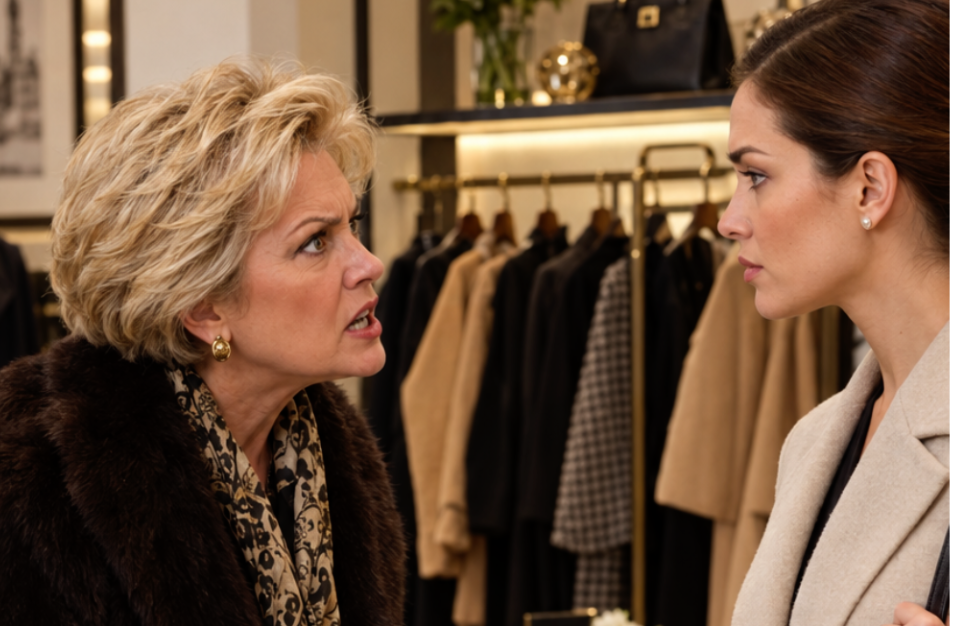
“It is my business!” Her mother-in-law straightened, and her bun seemed to get even tighter. “My son leaves his health in the freezer, and his wife buys herself furs behind his back!”
“It’s a coat.”
“Might as well be a quilted jacket! Whose money paid for it?”
The door slammed in the hallway. Gleb came home from work earlier than usual.
He walked into the bedroom still in his work jacket with the plant’s logo on his chest. He saw the bed, his mother in the chair, and the card. His face froze, cold as water in winter.
“Explain,” he said.
Nonna Arkadyevna handed him the card as if she were giving over hard evidence.
“Look at this, son,” she said. “Take a good look. I knew there was something fishy going on.”
Nika stood in the doorway. Just a minute ago, her heart was pounding and her mouth was dry. Now, suddenly, everything felt light, just like that relief you get when you finally put down a heavy bag you’ve been carrying for way too long.
“That’s my money,” she said. “I work. I handwrite wedding cards and invitations for an agency. By hand, with ink. At night.”
“What cards?” Gleb frowned. “You were supposed to be watching lectures.”
“I lied. And about the boots, too, by the way. The sale was over—I paid the rest from my own card.”
Nonna Arkadyevna gasped and pressed her hand to her chest.
“Glebushka, do you hear her? She lied! Right to our faces!”
Gleb took off his jacket and tossed it onto a chair. His voice was lower and quieter than before.
“Am I not providing for you? You have a roof over your head, food in the fridge, our son has everything he needs. What more could you want?”
“What do I want?” Nika stepped into the room. “I want pears! Not apples, pears, Gleb! I want my own jar of face cream, not the one your mom brings home because it’s on sale! I want the right to say ‘I want’ and not have you answer with ‘let’s wait’!”
“Don’t shout.”
“I will shout! I’ve been waiting for five years! I wait for boots and end up with a jacket only good for sitting on ice with a fishing rod! I wait for courses and get a list of discounts stuck on the fridge! I wait for you to ask, even once, what I want!”
Nonna Arkadyevna rose from her chair.
“Veronika, come to your senses. You’re saving up for Timofey’s education! That’s more important than your creams or coats. Gleb’s father and I have spent our whole lives…”
“More important to you!” Nika turned to her. “It’s always what’s important to you! Your teeth, your anniversary, your shawl at a discount! And nothing of mine ever matters!”
“How can you talk to me like that?”
“Just as you deserve. Politely. And with ‘you,’ not ‘thou.’”
Gleb stood in the middle of the room. Then he picked up an album from the bed, flipped through it, and put it back. He sat on the edge of the bed, right next to the coat.
“You… have been drawing? All this time?”
“Writing. Calligraphy means writing, not drawing.”
“How much did the coat cost?”
“Forty thousand.”
Gleb let out a long whistle, like a tea kettle. Nonna Arkadyevna threw up her hands in disbelief.
“Forty! For that money, you could feed a family for six months!”
“With your canned fish, sure,” Nika replied. “Maybe even a year.”
Gleb looked up at her. There was no anger or commanding confidence in his eyes anymore. He looked like someone who’d walked into his own freezer and didn’t recognize it.
“I didn’t know you felt this bad.”
“You never asked.”
Nonna Arkadyevna lingered a moment longer, as if waiting for her son to take her side. He didn’t. So she set her glasses case on the nightstand and quietly left the room without another word.
Nika took her tablet out of her bag and opened the folder with photos of her work. There were cards with monograms, invitations on birch bark, wedding menus written in golden ink. She handed the tablet to her husband.
Gleb scrolled slowly. He paused at one photo. It was an invitation where the letters intertwined into a branch of bird cherry blossoms. It almost looked like the script was swaying in the wind.
“Did you make this?”
“Yes, I did.”
“It’s beautiful,” he said after a pause. “Really beautiful, Nik. I never realized you could do this.”
“I’ve been able to do this since before I met you. You just never bothered to look.”
He lifted his head. There was something new in his eyes, a look Nika hadn’t seen throughout their years of marriage. It was respect—genuine and a little unsure.
“I’m sorry,” Gleb said. “I truly thought it was for the best. Mom always told me that money should be kept in one person’s hands.”
“In your mom’s hands, you mean,” Nika clarified. “You always put her menu up on the fridge, not your own.”
Gleb grimaced, but didn’t argue.
“Let’s sit down together and actually plan the budget—just the two of us. And there’ll be a separate category: ‘Nika’s personal expenses.’ No reports required.”
“No reports,” she repeated. “And no more ‘let’s wait’.”
“No more ‘let’s wait’.”
That evening, Gleb came into the kitchen, took the menu sheet off the fridge, and carefully folded it into quarters.
“Mom, this is yours. Take it back.”
“Glebushka, I was only trying to help you…”
“I know. But this isn’t a canteen, it’s our home. We’ll decide for ourselves what we eat now.”
Nonna Arkadyevna picked up the sheet with two fingers. Her lips trembled a bit, but she kept silent.
Gleb’s mother kept grumbling for a while. She called her daughter-in-law’s purchases “wasteful spending” and dramatically sighed whenever pears or a pack of trout appeared in the fridge. She’d complain to the neighbor about how “the young people have forgotten how to count money.” The neighbor would nod—though it seemed more out of politeness than agreement.
Gleb would still flinch out of habit at the price tag on Nika’s new leather bag. He’d open his mouth, then remember the budget category, and would only say:
“It suits you.”
In June, Nika traveled to St. Petersburg for a master class. Gleb bought her ticket for the “Lastochka” train himself and saw her off at the station. Timosha waved from the platform, shouting for his mom to bring him “a real feather, just like a wizard’s.”
She brought him a feather: steel, fine-tipped, in a velvet box. And she also came home with an invitation from a St. Petersburg studio to teach online classes there.
That night, it stayed light for hours over Lake Onega. Nika sat on the balcony with a sheet of heavy paper, tracing her name in ink—slowly, with flourishes and delicate lines. Now, she truly had the right to her own “I want.” And she had so much still ahead of her.