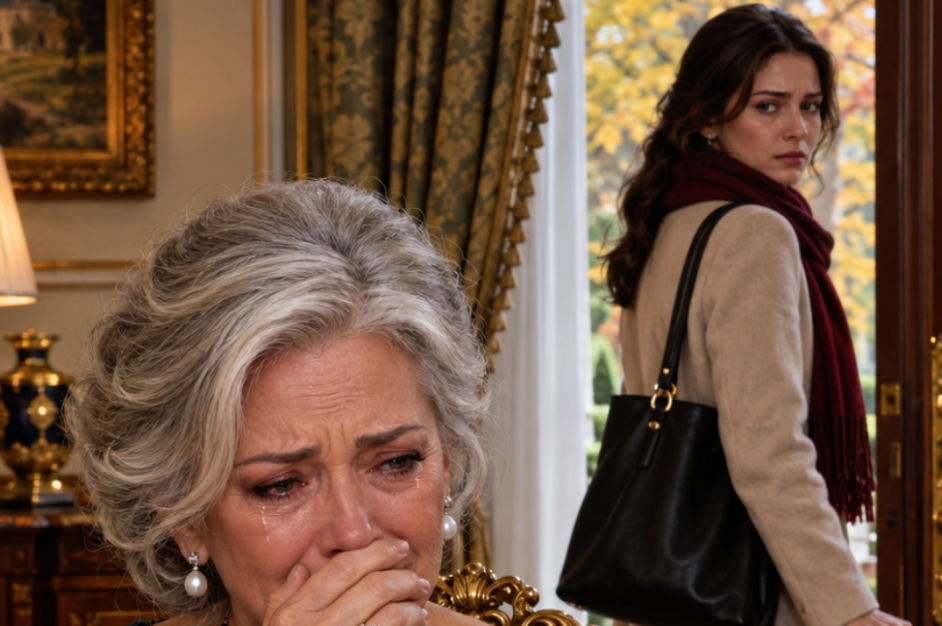
Sofia set her glass on the table and looked up at her mother. Margarita Stepanovna gripped the microphone like a judge about to pass sentence. All conversations in the room came to a halt.
“If you truly loved me, you’d just cure me of your presence,” her mother’s voice rang out, bright and almost cheerful. “You remind me that I’m old. And of your father, who might still be alive if you hadn’t panicked that night.”
Sofia didn’t move. Silence hung in the air. One guest covered their mouth with a hand. Her mother’s friend looked away. Margarita Stepanovna finished her glass of red wine and smiled as if she’d just toasted to everyone’s health.
Sofia stood up and picked up her bag. Her mother watched her with mild annoyance, the way you’d look at a waiter who’s late bringing the bill. As Sofia was leaving the room, she glanced back—her mother was already laughing about something with her friend.
A golden watch gleamed on her mother’s wrist, engraved with the words “To my beloved mom.” Sofia had given it to her three hours earlier.
As a child, her father taught her to fix a bicycle. She remembered his hands covered in grease, the smell of the garage, how he’d explain how the chain worked. When she was twelve, he lay down on the couch after work and never got up again. Sofia called the ambulance. But when her mother returned from the health resort, she only said: “You should have called sooner. This is your fault.”
She was twelve. She believed it.
For the next thirty years, Sofia paid. She settled her mother’s bills, insurance, appointments with private doctors. She covered credit card debts spent on antique vases. Margarita would call at ten at night to complain that Sofia hadn’t warned her about a money transfer in advance.
“I couldn’t plan, you understand. My blood pressure is all over the place.”
Sofia understood. She always understood.
One day, half a year before the anniversary, her mother showed up at Sofia’s office. No warning. The secretary awkwardly nodded toward the meeting room. Margarita sat at the table like a director before a board meeting.
“I need money urgently. For my friend’s operation. She has cancer, can you imagine?”
Sofia opened her banking app and transferred the money. A week later, she saw a photo on social media: her mother and that same friend at an exhibition, both wearing new dresses.
Sofia said nothing. She just carried on with her work.
The Monday after the anniversary, she went to see her boss.
“I want to transfer to Nakhodka.”
He raised his eyebrows.
“The salary’s twice as low there, you know that, right?”
“I know.”
He looked at her closely but didn’t ask anything else.
“I’ll have the documents ready by Wednesday.”
Sofia went to the bank. She closed the joint account with her mother, canceled all auto-payments, and revoked the utility payment authorization. The bank employee stared tensely at her computer screen.
“This is your mother, if I recall correctly?”
“That’s exactly why,” Sofia gathered her documents. “I’m doing what she asked.”
That evening she stopped by her mother’s apartment while she was visiting the neighbor. She left an envelope on the table. Inside was a short note: “Your wish has been granted. You’re free from my presence. And so am I.” Beside it, she placed the apartment keys.
She took only one thing with her—a photograph of her father.
Nakhodka welcomed her with rain. Sofia rented a small apartment on the outskirts of town, with just two windows. One looked out over the port. She changed her phone number. For the first week, she barely spoke. She went to work, came home, and sat by the window. No one called. No one asked for anything. The silence grew so heavy, her head ached for days.
After a while, things got easier. She learned to buy groceries just for herself. She stopped checking her phone every ten minutes. She learned not to expect a call telling her she’d done something wrong again.
Margarita Stepanovna realized something was wrong when the power was cut off in the apartment. She called the company and they told her no payments had come through for two months. She tried calling Sofia. The number was unavailable. She messaged her. The message was delivered. It was read. No response.
She called again. And again. The number no longer existed.
For the first week, Margarita was sure her daughter was just being dramatic. A grown woman acting like a sulking child. It would pass. She’d come back. Apologize. She always came back.
But the bills kept coming. The bank sent a late payment notice. The internet was cut off. Then the water. Margarita went to see her neighbor.
“Lyudmila, could you lend me some money? Sofia is late with the transfer, something about a technical error at the bank.”
Her neighbor stared at her for a long time.
“Margarita Stepanovna, you already owe me. Since last month.”
“I’ll pay you back,” Margarita smiled. “As soon as Sofia sends the money.”
“Don’t bother,” the neighbor said, closing the door.
A month later, she had to sell the apartment. The realtor valued it lower than Margarita expected. Buyers left without even coming inside. With the money, she bought a two-room apartment in a residential district. It was just enough.
She sat on the floor surrounded by boxes. The windows faced a construction site. Someone next door turned up the music. Loudly. Margarita knocked on the wall. The music got quieter for a minute, then started up again.
She tried calling the friend she’d gone to that exhibition with.
“Now’s not a good time,” the friend said quickly. “I’ll call you back.”
She never called back.
Margarita went to the clinic. No taxi this time. She took the bus. Waited two hours in line. The doctor looked at her over his glasses.
“Your blood pressure is normal. Your tests are good. You just need to move more.”
“But I get these attacks,” Margarita began. “I need a full checkup. My family history isn’t good.”
“Whose is?” the doctor closed the file. “Get more exercise. Next.”
She walked out of the clinic, unsure where to go. After doctor visits, she used to call Sofia. She’d complain. Sofia would offer to call a taxi. Margarita would say no, but knew the taxi was already on its way.
Now, there was no one to call.
She walked down the street and suddenly caught her reflection in a shop window. An elderly woman in an old jacket, her face worn out. She stopped. For the first time, Margarita Stepanovna thought: what if Sofia never comes back?
Sofia met Konstantin at the grocery store. He stood by the grains aisle, choosing buckwheat as if it was a life-changing decision.
“You’re new here,” he said, without turning his head.
“How do you know?”
“Small town. I know everyone.”
He turned around. An ordinary face. Not handsome, just calm.
“Konstantin,” he said, extending his hand.
“Sofia.”
They started seeing each other without any fanfare. He would come by after work with a bag of groceries and cook dinner. She’d sit in the kitchen and just watch. He didn’t need to tell stories. He didn’t ask her why she was there. He was just present.
One day he asked:
“Why did you move?”
“I wanted to disappear.”
“From whom?”
“From the life where I was always guilty.”
He nodded and never asked again.
A year passed. Then half a year more. Sofia went to her hometown for work. A meeting with suppliers, just one day. Konstantin offered to go with her.
“I need to go alone,” she said.
He understood.
After the meeting, there were three hours left before her train. Sofia walked through the city center, barely recognizing the streets. Everything seemed smaller. She turned into a park. On a bench near a closed fountain sat a woman, reading a library book.
Sofia stopped. Margarita.
Her mother looked different. Gray hair that she used to dye. A cheap jacket from the market. A worn bag on her lap. She read her book without looking up. Just sitting there. Like all the lonely elderly women in that park.
Sofia didn’t go over. She stood there, maybe for a minute. Then she turned and walked away. Heading to the station, she thought: this is it. Karma doesn’t punish loudly. It just takes away everything you lived off. And leaves you alone with yourself.
On the train, she took out her phone. She wrote to her mother’s old number: “Saw you today. You look simpler now. Take care of yourself.” She sent it. Didn’t expect a reply.
Margarita Stepanovna saw the message late in the evening. She read it. Then read it again. She wanted to answer. But what could she say? Sorry? Sorry for what exactly? For thirty years or for one remark at the party?
She put down her phone and looked out the window. The construction was finished. Now there was a playground. A woman was pushing a child on a swing. Margarita remembered how she once pushed Sofia on the swings, when Sofia was little. Before her husband passed away. Before she decided that someone had to be at fault.
She turned off the light and went to bed. Tomorrow she would go to the park again. Because that was her life now. Without her daughter. Without money. Without illusions. Simply her life. And oddly enough – for the first time in many years, she wasn’t afraid to be alone with it.
Sofia came back to Nakhodka late at night. Konstantin met her at the station. He hugged her silently. She leaned into his shoulder.
“Did you see her?”
“I did.”
“And?”
Sofia was silent.
“You know, I was afraid of this meeting my whole life. I thought she’d say something and I’d break again. But I looked at her and realized: she’s just an old woman now. No longer has power over me. No longer has a say. Now she’ll have to actually live. By herself.”
“Is that cruel?”
“No,” Sofia shook her head. “It’s honest. She was the one who asked me to disappear. So I did. And you know what? I’m grateful to her. If it weren’t for that remark at the anniversary, I’d have kept dragging that burden to the very end. Hers or mine.”
They walked along the embankment in silence. The sea wind was cold, but Sofia felt warm.
“Do you regret it?” Konstantin asked.
“Regret what?”
“That you didn’t go to her. That you didn’t talk.”
Sofia paused and gazed at the port lights.
“No. We’ve already said everything we needed to each other. She did, at that anniversary. I did, when I left. Anything else would be a lie—out of pity or habit. I don’t need either of those.”
They walked up to her house. Konstantin put the kettle on. Sofia sat by the window. Outside, the city lights glimmered—quiet, unfamiliar, but now hers.
“I lived for thirty years feeling like I owed something,” she said softly. “That I had to atone. That I had to stay close. That I had to pay. And only here did I realize: I owe nothing to anyone. My father didn’t leave because of me. My mother didn’t use me because I was a bad daughter. She did because I let her.”
Konstantin sat beside her and took her hand.
“You’re not cruel.”
“I know,” Sofia smiled. “I’m just alive. For the first time in forty-two years.”
She glanced at her phone. The message was delivered. Read. There was no reply. There wouldn’t be. And that felt right.
Disappearing from someone’s life isn’t always betrayal. Sometimes, it’s the only way to let a person grow. Or fall. And then learn to stand up on their own.
Sofia turned off her phone. Tomorrow morning, she would wake up with no guilt. No waiting for a call. No fear that she’d done something wrong again.
She would simply wake up. And it would be her life.