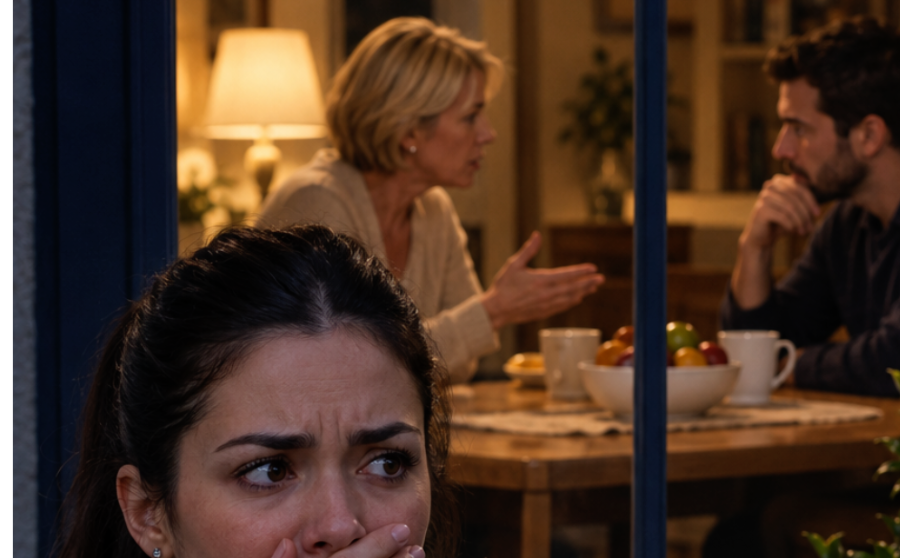
What Marina just overheard was never meant for her ears. That’s exactly why it upset her so much, bringing her to tears.
She had only stepped out onto the balcony for some fresh air. The June heat was stifling, making the house stuffy. The balcony overlooked the courtyard, where old lindens grew and children’s swings stood. As Marina took a few steps, she suddenly heard Artyom’s voice and froze. He was talking to his mother, Inna Petrovna. Their voices drifted through an open window on the first floor.
“You shouldn’t say that,” Artyom insisted, firm but persistent.
Marina realized he was disagreeing with his mom.
“She’s a great girl. Not only did she get into college on a scholarship, but she also graduated with honors,” he said.
“So what now?” Inna Petrovna laughed. “An honors degree isn’t going to land her a good job! Sure, if she’d studied to be an economist or a lawyer, maybe. But international relations? Translation? It’s nonsense!”
“Why is that nonsense?” the young man argued. “Graduates from the foreign languages faculty almost always find work. And Marina can work with foreigners—her English is advanced. Practically like a native speaker.”
“Why is he exaggerating?” Marina thought. “I still have a long way to go before I’m fluent like a native.”
“And where exactly has she achieved such heights?” Inna Petrovna’s tone turned mocking. “Remember how much people have to pay for tutors! And your dear Marina can’t even afford a decent jacket. Do you know what’s waiting for you with her?”
“She never went to tutors,” Artyom shot back. “She has a grandfather who worked as a translator for years back in Soviet times. Marina told me she’d speak only English with her grandpa since childhood.”
“And what good did that do?” the woman interrupted. “At best your Marina will end up in some translation office, working for pennies. Just like her grandfather spent his life translating technical documents. And now her parents are barely getting by, teaching at a provincial school for peanuts.”
Marina listened to the rest of the conversation, holding her breath.
Artyom’s parents had come out to the country house—where they were staying now—to deliver important news: this morning, he and Marina had submitted their marriage application at the registry office. The wedding is in a month.
Artyom’s mother had asked Marina all sorts of questions about her studies and her parents. His father, Vladimir Sergeyevich, was surprised to hear her hometown had several factories, three schools, and a population over fifty thousand. He said that was already too big for “the provinces,” calling it a pretty decent city.
As she answered Inna Petrovna’s questions, Marina noticed Artyom watching his mother. At first, his expression was normal, but then it shifted to something cautious, almost fearful.
Trying to figure out what could be causing this, Marina kept smiling and continued answering her future mother-in-law. At the same time, she wondered what could be so frightening for Artyom. Unfashionable jeans? Her modest blouse? And Inna Petrovna kept pursing her lips in a particular way—a look of disapproval evident in her eyes.
While talking about what her parents do in their free time, Marina suddenly seemed to remember something and switched the topic:
“Sorry, I just have to ask before I forget!” Marina said with a friendly smile, turning to Inna Petrovna. “We arrived and I immediately noticed your roses. What a beautiful flower garden! Did you create all this yourself?”
The question caught the woman off guard, just as she was about to say something. She nodded and answered yes, adding that Vladimir Sergeyevich and their daughter Veronika both help her with the work.
“But the design is always mine!” Artem’s mother added proudly.
“You know,” Marina continued quickly, keeping control of the conversation, “I think we’ve discussed most things, and some details can probably be decided without me. I’d love to take a walk in your garden and admire the flowers while you do that.”
Standing on the balcony, Marina realized she had missed part of the conversation happening inside the house.
“But do I even need to hear this?” Marina asked herself. After thinking for a moment, she decided, “I guess I do.”
“Artem,” Inna Petrovna kept pressuring her son, “she doesn’t want you, she wants the apartment! You even said that when she first saw it, she could hardly contain her joy! Of course—coming from some tiny room in a dorm to a three-room apartment with every convenience, that’s the ultimate dream for a poor girl like her!”
“Why are you saying that about her?” Artem tried to object.
“Just look at her from the outside!” his mother pressed on. “What has she seen in her little town? Local buses and old apartments. Her clothes are so random. I know small-town girls—they just want to latch on to someone, outdo anyone better off. I don’t know where you find these girls! Last time, you brought another one—I think her name was Olya. Same brash attitude, poorly raised. I barely talked you out of breaking it off with her. And now it’s happening again!”
“Marina isn’t like that!” her son tried to interject again.
“How is she different? You even said she’s tirelessly looking for jobs. If she gets hired, it’ll be because she’s so shameless! Last year, they hired a girl just like her in our department. Only two applications—both fresh from university. One was neat, well-mannered, polite. The other—just like your Marina! Cheap jeans, worn sweater. Only her smartphone was nice—must have eaten potatoes for a year to buy it!”
“What’s with the potatoes?” came a muffled male voice.
“Nothing, forget it,” the woman waved off Vladimir Sergeyevich. “I was on the interview panel that time, asking questions. The city girl thought everything through carefully before answering. But this ragamuffin—didn’t pause for a second! We asked her to come up with solutions—she rattled them off like she had them prepared! We even had to stop her! And guess what? The panel voted for this cheeky one! I was the only one opposed!”
“Well, isn’t that a good thing?” Artem said, reacting to what he’d heard.
“You think you’re clever, huh?” the woman laughed. “Your Marina’s going to claw her way up the same way! And not just at work. She grew up poor, now she’s trying to make up for it! Today she’ll want one thing from you, tomorrow something else. And you know what she’ll say once she finds a job? ‘My money is mine, but yours is for both of us! I need to get to the salon tomorrow—give me ten thousand!’”
“You’re being unfair,” the young man tried to protest. “Marina and I have known each other for a long time, she’s never acted like that. When I gave her a smartphone, she was genuinely upset, said I shouldn’t have spent so much.”
“That’s exactly it!” Inna Petrovna cut him off. “She’s just putting on an act for you, pretending to be all innocent! Did you tell her how you got the apartment? That it’s ours and stays in the family, you’re just living there? Did you tell her? And how did she react? Think about it—her face fell, didn’t it?”
“I don’t even know… You’re mixing everything up right now. I’m starting to have doubts myself. Maybe we shouldn’t register the marriage yet? Maybe we should just live together for a while?”
Marina didn’t hear what else Artyom said. But she realized, right then and there, that she needed to end things with him for good.
Carefully, making sure that no one in the house could hear her footsteps, she left the balcony and headed for the gate.
Marina was in luck. As she reached the bus stop on the main street of the village, a minibus pulled up. There were just a few passengers aboard. Settling into the back seat, she took out her phone and turned it off.
About forty minutes later, she got off at a stop a few hundred meters from Artyom’s apartment. She hurried between the high-rise buildings toward the right entrance, slowing her pace as she got closer—what if he’d guessed something and already arrived? But his car wasn’t in the parking lot.
Once inside the apartment, Marina quickly threw her things into two big bags in just three or four minutes. She remembered her laptop—the bag was out on the balcony. She dragged everything to the front door and paused.
“I’m so scatterbrained today,” she thought in frustration. “I need to call a taxi!”
Carrying her heavy bags out of the building, Marina headed to a wooden bench shaded by trees near the parking lot. Waiting for her taxi, she checked her call history. Artyom had called her eight times, the first call being twenty-five minutes ago.
“Should I call? Tell him everything?” Marina wondered. “No, I don’t even want to hear the voice of that mamma’s boy.”
Sitting in the taxi, Marina sent a message:
“I was standing on the balcony, I heard everything. Don’t call me. Your mother is right—you don’t need a pauper like me. There won’t be a wedding.”
After sending her message, Marina blocked Artyom’s number. Watching the cars go by, she fell deep into thought.
She could’ve gone to her brother Kirill or her cousin Nastya, but Kirill and his wife just had a daughter in April—they’re all squeezed into a one-bedroom apartment now. Nastya was out too—she lived with her husband and his mother in a two-bedroom. Both her aunts were also off the list: one lived out in the countryside, the other was in a completely different region.
“Looks like I made the right choice,” Marina thought to herself.
Not far from the river station, there was an apartment rented by two girls from Marina’s hometown. They weren’t exactly close friends, but they were kind—and wouldn’t turn her away. Once, they’d even said to her: “If you ever need anything, just come over!”
Worried that the girls might not be home, Marina searched through her phone for the right numbers.
“Come on over!” Darya answered before Marina could even finish speaking. “I’m at home today, and Lyuda will only be back from her shift tomorrow morning.”
Both of the girls worked as nurses at the hospital. They shared a one-bedroom apartment—small, but cozy.
“Why didn’t you call? I would’ve helped you with your bags!” Darya exclaimed as Marina lugged her suitcases inside. “These are so heavy! Are you hungry?”
“I’m not sure…”
“Oh, stop it! Forget about it! Just let it all go!” Darya concluded after listening to Marina’s story. “You’ll stay with us! I already called Lyuda. Do you see that chair by the wall? It folds out into a bed. We’ll find some bedding!”
“I’ve got my own, actually—two sets…”
The next evening, Artyom called. Knowing Marina had blocked his number, the young man used a different phone.
“I don’t get it, what happened? What did you hear?” Artyom began. “You misunderstood everything! Even my mom is confused—she never said anything like that! Where are you? I’ll come get you right now! You know I’m miserable without you! Or have you just been messing with me this whole time?!”
“Be quiet,” Marina cut him off. “I asked you not to call me. Do I have to change my SIM card now?”
“Marina, sweetheart, wait!” Artyom practically yelled into the phone. “You really took it the wrong way!”
“That’s enough,” Marina interrupted again. “What did your mom call me? A ‘country bumpkin’? Tell her she’s right. If you call again, I’ll swear at you so hard you won’t be able to breathe!”
“Good for you, Marinka!” Lyuda, who had just come back from her shift, smiled approvingly at her.
“It’s just a shame I didn’t learn sooner what kind of family they were,” Marina sighed.
A week passed. Marina checked job listings several times a day. Nothing seemed right. She called local translation offices and travel agencies. There were a couple of openings, but neither was suitable: one needed a technical document translator for little pay, the other a weekend bus tour guide.
A glimmer of hope appeared in the middle of the next week. A prestigious international company, with offices in several Russian cities and abroad, posted a vacancy.
The interview turned out to be quite serious. Eight people applied for the job: four of Marina’s former classmates and four more with over five years of experience.
The commission wasn’t especially impressed by Marina’s red diploma. But when a young, slender woman began asking questions in English and Marina answered without hesitation, the commission members looked at the young candidate in surprise.
Marina and the commission member spoke in English for about half an hour. Finally, a man—probably the head of the commission—interrupted their conversation:
“Elena Viktorovna,” he turned to the woman examiner, “how would you rate her knowledge?”
“It’s definitely at C1 level. Probably even higher,” she replied. “Marina,” she addressed the young woman, “did you attend a school with advanced English classes?”
“No, just an ordinary school,” Marina answered, blushing a little for some reason. “I just tried hard. I was interested.”
“You have a real talent,” Elena Viktorovna smiled. “You ought to be an interpreter at conferences, but you chose tourism instead.”
The conversation then turned to Marina’s future job. The commission chairman asked if she had a passport, if she could travel abroad for a long trip in the next few days, whether she had ever been to the United Arab Emirates, and if she knew a bit about the country’s history.
Marina replied briefly: she had a passport, she visited the UAE with her parents three years ago, she’d read a bit about the country’s history, and she could go on an extended business trip.
It so happened that Marina could only return to her hometown after two years. She decided to spend most of her two-week vacation with her parents.
Before her flight, knowing that Lyuda had recently gotten married, she called Darya and asked:
“My landing is at eight in the evening. Can I stay at your place for at least one night? You know, if anything, I can always get a hotel room.”
“Stop it! A hotel?” There was a hint of hurt in Darya’s voice. “I’ll pick you up! My parents helped me out, now I have a car. It’s old, but they checked it at the service station—they said it’s in great shape!”
The girls talked late into the night. Marina told her about her work, the constant heat, and how she wanted to help her brother:
“I was planning to save up money to buy my own apartment here. But Kirill and his family are living in a one-bedroom, it’s cramped for them. He helped me a lot while I was studying, so now I want to help him. They were thinking about taking out a mortgage, but if I help, they won’t have to.”
The next morning, Darya left for her shift. Marina took her suitcase out of the closet and carefully carried it down the porch steps. The taxi dispatcher told her the car would be there in about ten minutes, so she had to hurry.
When she got down the last step, she heard a voice both familiar and unfamiliar at the same time:
“Marina!”
She stopped, looking in surprise at Artyom, who was walking toward her from the parked cars. A woman was following him. Marina recognized her as Inna Petrovna.
“Why did you do that?” the young man said, pretending to be offended. “You never called! I only found out you returned from abroad yesterday through some acquaintances!”
“What acquaintances?” the girl asked in surprise.
“My cousin works at the hospital with your friend,” Artyom explained with a friendly smile. “They were together. She called me.”
The young man was about to say something else, but Inna Petrovna, who had just walked up, interrupted him:
“Marina!” the woman called out to the girl, her voice nearly breaking into tears. “Please forgive me! I was wrong! You shouldn’t have left back then! If only you had come inside, we could’ve talked it out! Artyom loves you so much! He can’t go a single day without thinking about you!”
“You know what,” Marina interrupted the woman, “you all can keep reminiscing here, but I don’t have time for that.”
“Wait, please!” Artyom tried to stop Marina. “There’s so much history between us! Let’s meet and talk things over! Marina, I’m so happy to see you! Honestly!”
“Well, I’m not,” Marina replied.
“Look,” the man continued as if he hadn’t heard her, “last month my sister Veronika got married, and all our money went towards the wedding. Now Dad needs surgery urgently. You just came back from abroad and probably have some money… Marina, if you can help…”
“This is unbelievable,” Marina said, realizing exactly what they wanted from her. She stared so coldly at Artyom that he immediately fell silent, looking at her in fear.
“You misunderstood!” Artyom’s would-be mother-in-law jumped back into the conversation. “We’ve been waiting for you, Marina dear! You and Artyom will have your own three-room apartment! He even got a raise!”
“Stop right there!” Marina raised her voice, cutting the woman off. “Two years ago, you said things about me that I don’t even want to remember! But now you need my help? Decided to turn to the ‘poor girl’, did you?”
Marina was about to say something else, but just then a taxi pulled up from around the corner.
Ignoring Inna Petrovna, who was mumbling something unintelligible, Marina loaded her suitcase into the trunk of the car and sat down in the back seat.
“I’ll head to my brother’s place,” Marina thought, “I’ll offer to help him buy a new apartment. And I’ll treat my nieces and nephews to some exotic fruits while I’m at it.”
“So where are we supposed to get the money now?” Artyom’s mother grumbled as she watched the car drive away in frustration. “Who would have thought that this small-town upstart would actually make something of herself!”
“Yeah, Mom,” Artyom responded bitterly. “She made it! But with your help, looks like I won’t achieve anything. I’ll probably end up single for life, too!”
Never listen to your mom when your heart is telling you something else. Most times, you’ll end up regretting it. That’s just the way life is.