On Victoria’s fridge door hung her mortgage payment schedule. Just a simple bank printout, two sheets, one hundred eighty tiny lines. Each month after making a payment, Vika would cross off a line with a red marker. Now, over seventy lines were already crossed out.
She bought her one-bedroom apartment in Kursk, on Magistralny, half a year before the wedding. It took her ten years to save up for the down payment. Vika worked as a translator of technical documents: during the day at a design bureau, and in the evenings and weekends she took on freelance jobs. Manuals for machines, certificates for pumps, drawings from German and English. She hadn’t had a weekend for years. The last time she took a vacation was when she was a student.
Back then, Dmitry was very proud of her.
“You’re amazing, Vika. Your own place at twenty-nine! I’ll help you with the mortgage, just wait and see. We’ll pay half and half. Or maybe even more from me.”
He worked as a manager at a company selling air conditioners. In summer he earned well, in winter less so. Six months later, they got married and Dmitry moved in with her.
He forgot about his promise to help with the mortgage within the first two months.
The first month, he sent her twelve thousand—exactly half of the payment—and even added a screenshot with a heart. The next month he said his bonus was delayed. The third, he needed to replace the tires on his Logan urgently. By the fourth month, Vika had to ask him herself.
“Dima, will you chip in for the mortgage this month?”
“Vika, you know things are tight for me right now. I’ll pay in the summer. Summer is the busy season, air conditioners—you’ll see, I’ll send you enough for three months all at once.”
But in the summer he bought himself a gaming console and a season hockey pass. After that, Vika stopped asking.
From then on, his salary went to himself: games for his console, Friday beers with friends, fishing, spare parts for the old Logan. Sometimes he bought groceries if Vika begged him. More often, he didn’t. The mortgage payment—twenty-four thousand a month—she covered. Utilities, too. Food, cleaning supplies, internet, even his socks.
“Vika, you’re doing just fine,” Dmitry would shrug. “You make more. What’s the difference who pays, we’re family.”
Dmitry’s mother, Lyudmila Stepanovna, was convinced her daughter-in-law lived in luxury.
“Vika’s swimming in money,” she would tell the neighbors. “Sits at home at her computer and rakes it in. Has her own apartment. Not like my Lerochka.”
Lerochka, Dmitry’s younger sister, was a hairdresser at a budget salon and always in debt. Lyudmila Stepanovna regularly called her son:
“Dima, Lera needs help. She can’t pay for her chair at the salon. She needs winter boots. She needs a new phone—her old one broke.”
Dmitry would immediately repeat all this to his wife.
“Vika, transfer ten thousand to Lera. Come on, it’s nothing to you. You won’t miss it.”
“Dima, I have a mortgage. I’m already doing everything on my own.”
“Oh, here we go. Stingy, Vika. Sorry to see you’d begrudge ten thousand for family.”
Vika would send the money. Not always, but often. She hoped that if she helped out, her husband’s family would accept her. That they’d stop calling her “rich girl” behind her back and looking at her with suspicion.
A year ago, Valeria wanted to take a colorist course. A reputable course, taught by a well-known master, with a certificate. Forty-five thousand rubles.
“Vika, please help her out,” her mother-in-law asked. “The girl is trying to grow in her career. She’ll get a raise later and pay you back for sure.”
Vika paid the entire amount herself, using her own card. She sent Valeria the receipt.
Valeria read the message but didn’t respond. Not even a thank you or a smiley. At a family dinner a month later, she raved about how great the courses were and how amazing the instructor was, but never glanced in Vika’s direction. When Lyudmila Stepanovna said, “Vika paid for you, you know,” Valeria just shrugged:
“So what? She has plenty of money. She doesn’t mind.”
Vika stayed silent then. But she didn’t forget.
Last autumn, Vika decided to pay off her mortgage ahead of schedule. She calculated that if she saved every penny from her side jobs and made a lump-sum payment every six months, she could shorten her term by about five years. Dmitry suddenly became interested.
“Hey, how about I save up for us? My bank account has a better interest rate than yours. You can transfer the money to me and I’ll keep it all together. I’ll add my own money too. We’ll pay it off faster together.”
Vika was thrilled. Finally, her husband wanted to pitch in himself. From October, she started sending him all her side job income. In eight months, up to and including May, she transferred 350,000 rubles to his account. She had no idea how much Dmitry contributed himself. He reassured her, “I’m adding my share too, don’t worry.”
In June, Vika asked him to transfer the money to her mortgage account—it was time for an early payment.
“Okay, Vika,” Dmitry said. “I’ll do it tonight.”
He didn’t send the money that night. Or the next morning. On the third day, Vika sat next to him and asked him to open the banking app.
There was only eight thousand rubles in the account.
“Dima, where’s the money?”
He rubbed his face for a long time. Then he admitted it.
“Vika, I gave it to Lera. She didn’t have enough for a car. For the down payment. She wanted to buy a Solaris with a loan. She really needs a car for her work, going to clients’ homes. I thought you wouldn’t mind. She’ll pay it back. Really. She’ll start with her next paycheck. I transferred her 342,000, and 8,000 is left.”
“Three hundred fifty thousand. That’s my money, Dima. I earned it over eight months of late nights. For the mortgage.”
“But she’s your sister! She’s struggling! Don’t you care?”
“I care that you lied to me.”
“She will return it! I told you.”
Valeria didn’t pay back a single ruble. Not after her next salary, not even a month later.
At the end of July, at Dmitry’s aunt’s birthday party, Valeria showed up with new earrings. Big gold ones, studded with diamonds. She showed them off to everyone, turning her head in the light.
“Bought them for myself,” she bragged. “A hundred and twenty thousand. Well, I deserve it. I got a matching bracelet, too.”
“What about the car?” Vika asked quietly.
“What car?” Valeria looked at her in surprise. “Oh, the car. I haven’t picked one yet. Might wait and see if prices go down.”
Vika looked at her husband. Dmitry just kept eating his salad, acting focused.
There was a huge fight at home. The first real blow-up in their six years of marriage. Vika was shouting, Dmitry was yelling back. He insisted it was none of her business what his sister spent money on. He told her it was her own fault for trusting him with the money in the first place. He accused her of being materialistic and only caring about her mortgage.
“My mortgage, Dima. The one you promised we’d pay half and half. Six years ago.”
He slammed the door and went to spend the night at his mother’s house.
Three days later, he came back. Quiet, with flowers in hand.
“Vika, come on, let’s just forget it. Seriously. I was wrong, I was an idiot. Lerka will pay it back, I’ll make sure of it. Let’s not fight anymore. My mom’s birthday is in a month. Sixty years. Just imagine how it’ll look if we show up divorced or fighting. Let’s at least make peace for my mom’s sake.”
Vika was exhausted. She was so tired. All she wanted was for this whole ordeal to be over.
“Fine,” she said. “I’ll come to the birthday. I’ll congratulate Ludmila Stepanovna. I’ll buy a present. But I’m not paying for the party. Not a single penny. You, Lera, and your mom can figure that out among yourselves. Deal?”
“Deal,” Dmitry nodded. “Of course. We’ll handle it ourselves.”
Nobody told Vika anything else about the birthday. All she knew was that they’d celebrate at the ‘Merchant’s Courtyard’ restaurant on Lenina Street, Saturday, six o’clock. That Valeria was handling the planning. That there’d be about twenty guests. Nobody asked her anything else or involved her in the arrangements.
She bought a good gift: a silk scarf and a certificate for three days at a spa resort. Paid for with her own money, of course.
A week before the party, her mother-in-law called. Her voice was unusually sweet.
“Vika dear, you’ll come on Saturday, right? You absolutely have to come. It wouldn’t be the same without you. You’re our most important guest.”
“I’ll be there, Ludmila Stepanovna. Of course.”
“That’s good. That’s wonderful. And don’t forget your bank card, just in case you need a taxi or something else.”
Vika didn’t get why the card was needed. She figured her mother-in-law was just nervous about the big party.
They arrived by six on Saturday. The restaurant was upscale: mirrors everywhere, velvet chairs, waiters in bow ties. The table was set for twenty-two people. There was so much food! Red fish, caviar tartlets, tiger prawns, various meat platters, three kinds of hot dishes. The table was lined with bottles: cognac, whiskey, champagne, wine.
“Lerochka organized everything!” Ludmila Stepanovna proudly announced as she welcomed the guests. “She did it all herself! Picked everything out, planned it all. Look what a daughter I have!”
The guests were in awe. Vika sat next to her husband.
All evening, Dmitry did his best to avoid her eyes. He drank cognac, laughed with his cousins, chatted with everyone except her. Vika thought it was odd, but she figured he was still feeling guilty about the fight back in July.
Ludmila Stepanovna praised her daughter at every toast.
“Let’s raise a glass for Lerochka! My generous girl! Just look at how she arranged everything! She spared no expense for her mother!”
Valeria was glowing. The diamond earrings dangling from her ears sparkled with every movement.
Around nine in the evening, Vika started to notice something strange. The relatives were exchanging glances. Dmitry’s cousin whispered something to her husband, and both looked over at Vika and smirked. Aunt Zinaida—the very one who got those earrings at her birthday—nodded pointedly toward Vika and winked at Lyudmila Stepanovna.
Vika felt a cold chill run through her.
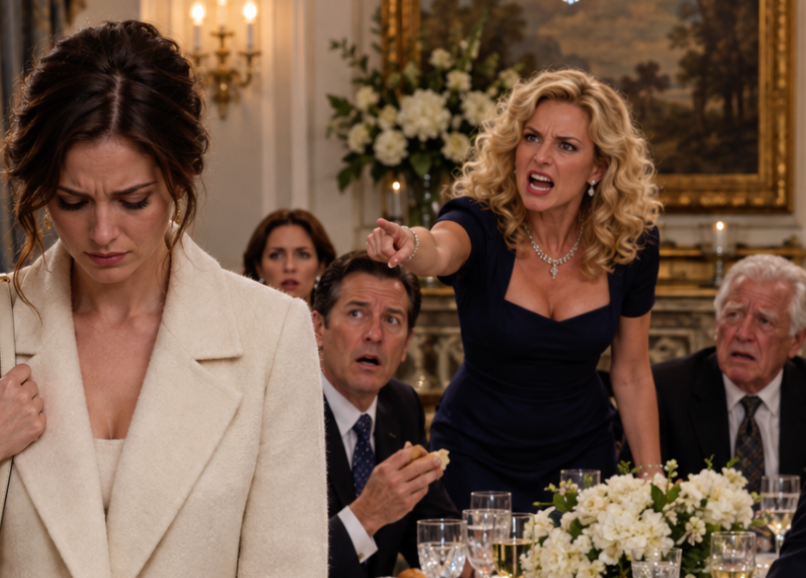
At ten, the waiter brought over a leather folder with the bill. He placed it in front of Lyudmila Stepanovna, as if she were the guest of honor. She opened it, took a look, and handed it to her daughter. Valeria glanced at the amount, smiled, and then pushed the folder right across the table to Vika.
“Here you go. This is for you.”
Vika picked up the folder and opened it. One hundred eighty-six thousand four hundred rubles.
“What is this?”
“The bill,” Valeria leaned back against the velvet chair, speaking loudly enough for the whole table to hear. “You’re the wealthy one here, so you can pay for the entire banquet! It’s Mom’s sixtieth—only happens once in a lifetime. It’s not like you’ll go broke. You have an apartment, you have plenty of work. Where else would Mom and I get this kind of money?”
The table fell silent. Twenty people stared at Vika. Some with curiosity, some with a smirk.
Lyudmila Stepanovna nodded in approval.
“Of course, Vika. You’re the most well-off among us. Who else but you? Surely you wouldn’t deny your mother-in-law on her special day?”
Vika looked at her husband. Dmitry sat, staring into his plate, silent. Even though he knew exactly what they had agreed on a month ago. Even though he nodded himself, saying, ‘We’ll handle it.’
That’s why he hadn’t looked at her all evening. He knew. They’d planned it all in advance. Valeria had ordered cognac and shrimp, counting on Vika to cover it. Everyone at the table knew. Everyone except her.
Vika closed the folder and set it on the table.
“Dima. We made an agreement. A month ago. I told you I’d come and offer my congratulations, but I wasn’t going to pay for the banquet. You said, ‘Of course, we’ll take care of it.’ Do you remember?”
Dmitry didn’t look up.
“Why are you picking on him!” Valeria snapped. “Are you really going to be stingy? For Mom? On her birthday? You’re humiliating our entire family! In front of everyone! Mom waited sixty years for this day, and now you!”
“Vika, how could you,” Lyudmila Stepanovna said in a trembling voice. “You’re doing this on purpose. You want to humiliate me. On my birthday. In front of the whole family.”
Vika looked at them and suddenly saw the whole picture with stark clarity.
Ten years without weekends off. Nights spent working on other people’s machine manuals. Six years paying the mortgage on her own. Feeding her husband. Sending ten thousand to Lera for shoes, for her phone, for her chair rent. Paid for courses and never got a thank you. Three hundred fifty thousand for a car that ended up as earrings. And not once, not even one time, had her husband stood up for her. Not once.
To these people, she had never been a family member, a daughter-in-law, or a wife. She was a wallet. The rich one. Someone to milk and to laugh at behind her back.
She raised her hand.
“Excuse me, young man,” she called to the waiter. He came over, sensing trouble. “Could you please split my order from the rest of the bill: just one banquet menu and my juice. Give me a separate check, please.”
The waiter looked confusedly at Lyudmila Stepanovna, then at Vika.
“Uh… Our banquet menu is six thousand eight hundred per guest. Plus juice, that’s three hundred fifty. So the total is seven thousand one hundred fifty per person. We can allocate this amount and re-issue part of the bill to a separate individual, if the banquet organizer agrees.”
“Perfect. Please bring the card terminal.”
The table suddenly erupted in murmurs.
“What are you doing?” Valeria hissed.
“Vika!” Lyudmila Stepanovna half-rose. “Sit down right now!”
The waiter brought the card terminal. Vika tapped her card. The machine beeped and printed the receipt. She put the slip into her bag, grabbed her coat from the back of her chair.
“Happy birthday, Lyudmila Stepanovna. I’ve already given you your present. Take care.”
She walked toward the exit. A commotion rose behind her. Someone in the family gasped, someone else laughed.
Dmitry caught up with her by the cloakroom, grabbing her arm.
“Vika, have you lost your mind? What are you doing? You’ve just embarrassed Mom on her birthday! Go back and pay right now! We’ll sort this out later!”
“No, Dima.”
“Vika, I don’t have that kind of money! Lera doesn’t! Mom doesn’t! You know that! We can talk later—just pay now!”
Vika freed her arm.
“Dima. I’m not going to discuss anything. Not now, not later. Not this bill, not Lera’s earrings, not the next set of your family’s demands. You knew this would happen. You didn’t meet my eyes all night because you knew. You told me ‘we’ll handle it ourselves’ a month ago and lied. Just like with the mortgage money. Just like with the car for Lera. Like always.”
“Vika!”
“Go to your mom, Dima. She’s waiting for you.”
She put on her coat, buttoned it up, and walked outside. A light September rain was falling. Vika ordered a taxi and stood under the canopy, breathing in the cold, damp air while she waited.
Dmitry stood in the doorway for a moment. Then he turned around and went back to the hall. Back to the table, back to his mother.
Vika found out what happened next at “Kupechesky Dvor” before her husband even got home. At half past midnight, Dmitry’s cousin Irina called her—partly out of sympathy, partly out of curiosity.
“Vika, you have no idea what happened,” Irina began, clearly enjoying the story. “Lera went straight at Dima: ‘You pay, since you let your wife walk out.’ But Dima only had thirty thousand left on his card. He said so. Lera started yelling that she didn’t have any money, either. The waiter stood by, then the manager came over. She said: pay up, or we call the police—your order’s done and you owe one hundred seventy-nine thousand, two hundred fifty rubles. Aunt Zina chipped in her share, five thousand, and left. Then a few more people added what they could to help cover the rest. After that, Aunt Lyuda burst into tears and pulled out her phone. She had money saved for bathroom renovations—one hundred thirty thousand. She’d been saving for a year and a half, from her pension. All of it went to pay.”
Vika stayed silent.
“And you know what’s funniest?” Irina went on. “Afterward, Aunt Lyuda asked Lera to at least pay back half. I mean—it was Lera who ordered everything, Lera who told everyone you’d pay. But Lera goes, ‘Why should I? I organized your whole birthday! You should be grateful!’ Aunt Lyuda started shouting. Lera yelled back. Dima tried to get between them. They ended up having a huge fight right by the cloakroom. Aunt Zina said she’s never seen a birthday like it.”
“Thank you, Ira, for telling me.”
“Don’t mention it. Honestly, good for you. I would’ve left too. We’ve all noticed how they’ve been taking advantage of you for ages. None of us just had the guts to say anything.”
Dmitry came home around three. Vika was still awake, sitting in the kitchen with a cup of tea.
“Are you happy now?” he asked as soon as he walked through the door. “Because of you, Mom had to spend her renovation savings. One hundred and thirty thousand! That was everything she had! Do you even know how long she was saving that money?”
“I know. Ira told me.”
“So what? Aren’t you ashamed? You need to pay her back. Do you hear me? You HAVE to give Mom her money back. This is all your fault. If you’d just paid like a decent person, none of this would’ve happened.”
“I feel sorry for Lyudmila Stepanovna,” Vika replied. “Really, I do. But Lera threw the party. Lera chose the cognac and shrimp for twenty people. Lera told everyone that I’d pay. Why should I be the one to pay it back?”
“Because you could have paid! You have the money!”
“I have money because I’ve been working every single day for ten years, with no days off. And Lera has earrings worth one hundred and twenty thousand. Bought with my money, by the way. Let her sell the earrings.”
Dmitry opened his mouth but couldn’t find a response.
Without a word, Vika got up, went to the hallway closet, and pulled out a clear folder. She placed it on the table in front of her husband.
It was a divorce application. She had filled it out back in July, after the earrings incident, but never filed it, still hoping for a miracle. There was also a bank statement: her transfers to his savings account since last autumn. Three hundred and fifty thousand. And his transfer to his sister. Three hundred forty-two thousand in one go, with the comment, “For a car.”
“What’s this?” Dmitry asked, dumbfounded.
“It’s a divorce application. I filled it out in July. After the whole earring mess. I wanted to wait, just in case you realized something. But you didn’t. I’m done supporting you, your mom, and your sister. No more restaurants, earrings, or renovations paid for by me.”
“Vika, is this because of the restaurant?”
“No. The restaurant just made everything clear. For everyone. Even me.”
A week later, Valeria showed up at her door. No call, just Saturday morning. She stood there wearing those same earrings, flashy manicure and all, making no move to come in.
“You owe Mom one hundred and thirty thousand,” she said from the doorway. “Because of you, Mom didn’t get her renovation. Do you even realize what you’ve done? You stripped an elderly woman of her dignity on her own birthday! Now all the relatives say our family’s daughter-in-law is a thief.”
“Lera,” Vika calmly replied, “you arranged the banquet. You chose the restaurant. You picked the menu. And you told everyone I’d be paying, even though I never agreed to any of it. You’re the one who owes Mom, not me.”
“But I have no money!”
“Yet you have those earrings. Worth one hundred and twenty thousand. Bought with my money, the money Dima sent you for a car. So where’s the car, Lera?”
Valeria flushed, red blotches appearing on her cheeks.
“That’s none of your business!”
“Exactly. And your mom’s renovation isn’t my business, either. Take care.”
Vika closed the door. Valeria stood outside for another minute, banging and yelling something about greed and how her brother would divorce her. Then she stomped off, heels clattering loudly down the stairs.
For the next two weeks, Dmitry tried everything to fix things. He brought flowers. He made her coffee every morning. He promised to pay the entire mortgage himself, for two whole years if he had to. He swore he wasn’t talking to Lera anymore. Said he’d tell his mom the truth about who was really to blame.
“Vika, it’s been six years. I was an idiot. Please, give me a chance.”
“Dima, six years ago you promised we’d split the mortgage. You promised Lera would pay back the money. You promised you’d cover everything yourselves at the anniversary. How many more chances do you want me to give you?”
He fell silent.
The next day, he transferred her twenty-four thousand—exactly one month’s payment. The comment read “Mortgage. I’ll make it right.” Vika saw the money come through and said nothing.
A week later, Dmitry came up to her in the kitchen, looking embarrassed, rubbing his neck.
“Vika. Listen. Could you send me back ten thousand from the twenty-four? The guys and I have a hockey trip to Belgorod—bus, tickets… I’ll pay you back later.”
Without a word, Vika sent him back the full twenty-four thousand.
“Why all of it?” he asked, confused.
“So you’ll stop pretending.”
One time, he tried something else.
“What about the apartment? I lived here for six years. We paid the mortgage while married. I could claim my share.”
“The apartment was bought before the marriage, Dima. It’s my personal property. You can try to claim compensation through court for contributions to the mortgage, but only if you prove you paid from our joint budget. But since you sent my 350,000 to your sister and never paid the mortgage yourself, I’m afraid you might end up owing me. Go to court if you want—I’ll bring the bank statements.”
He never mentioned the apartment again.
They officially divorced at the registry office at the end of October. By then, they had filed a joint application, there were no underage children, and the process was quick and uncomplicated. Dmitry packed up his things: his game console, his hockey membership, fishing gear, and three boxes of clothes. He moved in with his mother, into her two-bedroom where the bathroom tiles were still cracked and there was no money left for repairs.
A week before the divorce, Vika got a surprise call from Lyudmila Stepanovna. No shouting, no reproaches. Her voice was tired and somehow older.
“Vika. I found your voucher. To the spa. It was in your bag, I didn’t even open it that night.”
“It’s valid until spring, Lyudmila Stepanovna. Take the trip.”
Her mother-in-law was silent for a moment.
“Lera never paid me back a single ruble,” she said suddenly. “I asked her, even just twenty thousand. For the tiles. But she says, ‘You told me I could order whatever I wanted.’ I raised her alone. Gave her everything. And this is what I get…”
She didn’t finish. Vika stayed silent too. She genuinely felt sorry for this woman, truly sorry. But she wouldn’t comfort her—it was too much.
“Go to the spa, Lyudmila Stepanovna,” she repeated. “You need some rest.”
“I will,” her mother-in-law said quietly and hung up.
It’s said Lyudmila Stepanovna still doesn’t speak to Valeria. Valeria still wears the earrings. She never did buy that car.
The first Saturday after the divorce, Vika made an early mortgage payment. It wasn’t much, just what she’d managed to save in a month—now that nobody was asking for “a quick ten for Lera.” The bank sent a new schedule. The total term was down by four months.
She printed it out and took down the old one from the fridge, the one with seventy-eight crossed-out lines. She hung up the new one in its place. She looked at it—the long list of dates and amounts, now all hers.
Then she pulled a red marker out of the drawer and crossed off the first line.