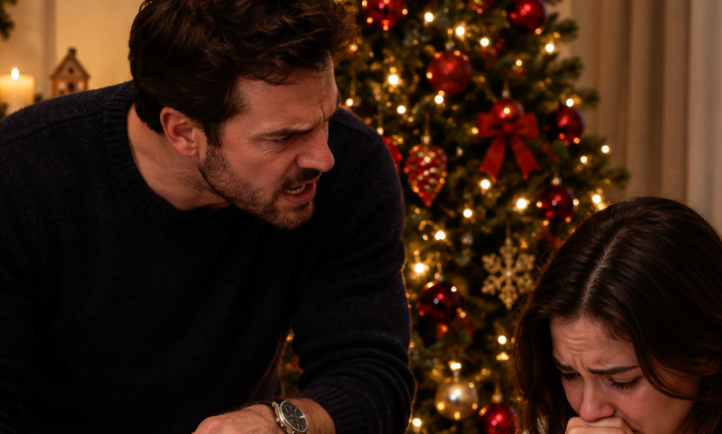
She never put the knife down. The blade slid over the slippery fish scales with a disgusting crunch, and tiny silvery plates scattered across the table—one even stuck to the glossy surface of the olive oil jar. The kitchen was filled with a strong, river-like scent—simple and familiar, so unlike the conversation Igor started after coming home from work. That scent felt more honest than his words.
“I heard everything loud and clear,” Vera said, not looking up from the fish. Her voice sounded muffled, as if coming from under a thick layer of ice. “So, the condition is pretty clear. Either I show up with the keys to the new crossover on a fancy tray, or I’m crossed off the guest list. Did I get your dramatic ultimatum right?”
Igor, stocky and sporting a neatly trimmed beard that tried to hide his slightly plump cheeks, shifted awkwardly from foot to foot on the slippery tile. He was unsettled. He was used to Vera being his quiet haven: accountant, dispatcher, and problem-solver all rolled into one. But now, that ‘haven’ stood over the sink holding a dangerous blade, her calm as icy and unbreakable as ever.
“You always take things to the extreme,” Igor grimaced, smoothing the cuff of his expensive but slightly tight shirt. “We’re talking about Mom’s big birthday. Sixty. Everyone’s coming: her university friends, relatives from the suburbs, those dull neighbors from the third floor, the Veshnyakovs. She wants to look her best. Arriving to her own celebration in style, not in some beater—that’s about status.”
“So I’m supposed to pull an amount from the business equal to a quality foreign car and give it to your mother—who hasn’t driven since the Soviet era?” Vera finally looked up. Her eyes were the color of wet asphalt, sharp and impossible to deceive. “Igor, the roof in our workshop is in critical condition. All last week you kept saying the rain would ruin inventory worth hundreds of thousands.”
“The roof can wait!” he blurted out, and then softened his tone, slipping into the voice of a secretive advisor. “Vera, she’s my mom. She means everything to me. She’s devoted her whole life to me. She wants a little flair, a bit of recognition. Can’t you understand that?”
“I understand that she devoted her life to creating a pretty image, not a real life,” Vera cut back coldly, returning to cleaning the perch. “She doesn’t need a car. It’s just a fetish. Showmanship.”
“It’s a gift! A gesture! A symbol of gratitude!” Igor began to lose his composure. He took a step forward, closing the distance, trying to physically pressure her with his presence. “Here’s what, Mom was clear: if you don’t respect her enough to give a proper present, she doesn’t want you at the celebration table. And I support her. This is an ultimatum.”
He expected an explosion—tears, shouting, dishes flying. He waited for Vera to start adding up the losses so he could condescendingly comfort her, offering some compromise. But Vera simply rinsed her hands in a stream of ice-cold water, dried her palms with a rough waffle towel, and turned to face him, blocking the kitchen doorway with her whole body.
“Fine,” she said quietly, almost matter-of-fact.
“What do you mean, ‘fine’?” Igor was taken aback. “You agree?”
“I said ‘fine’ about the second part. If I’m not supposed to come, then I won’t.”
Igor froze. Ugly burgundy spots started to creep up his cheeks and neck.
“Are you out of your mind? You want to make me look like a fool in front of all my relatives? Everyone’s going to ask, ‘Where’s your other half, Igor?’ What am I supposed to say? ‘She saved money on a present for my mother and stayed home to gut fish’?”
“Tell them the truth,” Vera took off her soiled apron and tossed it onto the counter. “Tell them your wife doesn’t have a spare one and a half million for Galina Petrovna’s image upkeep. Or make something up. You’re great at coming up with pretty stories.”
She walked out of the kitchen, leaving her husband alone with unfinished work and a heavy, sticky premonition that the ground under his feet—once seemingly solid—had suddenly begun to crack and sag.
Vera managed a shift at a logistics terminal—not in some glass tower with air conditioning, but in a huge hangar whipped by every wind, smelling of diesel, dust, and sweat. Her job called for nerves of steel, the ability to make split-second decisions that supply lines depended on, and the strength to outshout a furious long-haul driver who had just lost a run. That very real school of hard knocks is what allowed her, five years ago—when her father was laid up with a hypertensive crisis—to single-handedly pull the family’s transport business out of a debt hole and put it back on its feet.
Igor came into her life during that difficult time. Handsome, well-groomed, with a light sense of humor and a knack for saying all the right things. He was a sales manager in some digital field, which to Vera sounded like an easy and unserious contrast to her world of concrete and fuel. He never meddled in the business, comforted her after rough days, and Vera, tired of always being responsible, truly believed she’d finally found that ‘normal life’—quiet and reliable.
Galina Petrovna, Igor’s mother, lived in a Soviet-era three-room apartment in the city center, steeped in the scent of old parquet, furniture polish, and unspoken ambition. She carried herself like aristocracy stranded by fate in hard times. She had her own rules: never talk about money out loud (though alluding to it is fine—even necessary), never put bags on the hallway chairs, and never laugh loudly after nine at night. The money she lived off, as Vera gradually learned, was mostly earned by Vera herself, while Galina Petrovna graciously allowed her son to pass it along as though it were nothing less than expected.
The day after their kitchen argument, the atmosphere in Igor and Vera’s apartment felt like a battlefield where one side made a show of burying its dead. Igor wandered from room to room, sighing loudly, slamming the bathroom door. He was playing the part of a deeply offended man, a noble sufferer forced to endure the company of a philistine.
“Did you call the dealership?” he called, walking past the kitchen where Vera was sorting through a stack of shipping documents that morning.
“No.”
“Vera, the anniversary is the day after tomorrow! The car has to be parked outside Mom’s entrance with a huge bow. Red.”
“There’s no extra cash, Igor. Everything’s tied up in the business. The only free balance is about two hundred thousand. I can offer her a Volga River cruise. Or a fancy massage chair. Something real, not just for Instagram pics.”
Igor froze in the doorway. His eyes narrowed, looking suspicious.
“You’re lying. I happened to see a report on your desk. There are some serious sums in the business account.”
Vera slowly set down her pencil. The silence in the apartment grew heavy, taut like a string about to snap.
“You went through my work papers?” Her voice didn’t rise a decibel, but it was the same tone she used to scold movers for improper loading—a tone that killed any urge to argue.
“I’m your husband!” Igor burst out, his voice trembling traitorously at the end. “Everything’s supposed to be shared! The problems, the victories!”
“What we share, Igor, is the electric bill, the mortgage on this apartment, and the yearly trip to Turkey. The business—well, that’s thirty jobs, monthly hangar rent, and the tax office breathing down my neck. Your contribution to our ‘shared’ expenses these past three months has been about forty thousand a month. And now you’re asking for one and a half million, just like that. Do the basic math, Igor. The numbers just don’t add up.”
“So now you’re throwing my salary in my face?” Igor put his hand over his heart dramatically. “How petty. Mom always said: ‘She has the soul of a shopkeeper. Counts every penny.'”
“And your mother has the soul of an auctioneer,” Vera stood up from the table. “Except her merchandise is other people’s lives. The discussion’s over. There’s not going to be a car. That’s it.”
Igor stormed out of the apartment, slamming the door so hard the chandelier in the hallway shook. Vera went to the window. Down on the street, lit by the yellow glow of the streetlamp, Igor was waving one hand, glued to his phone. He was arguing furiously, most likely with the only person whose opinion actually mattered to him—Galina Petrovna.
Vera knew this wasn’t the end of it. Galina Petrovna was not a woman who backed down. She didn’t fight head-on—her style was a quiet siege, subtle sabotage, and pressure through third parties.
That evening, the phone rang. A cat’s smiling face popped up on the screen—it was Lena, Igor’s niece, sharp-minded and with a voice like a siren.
“Hi, Verunya!” she babbled. “Aunt Galya and I are just working out the seating for the jubilee… You’ll be there, right? Aunt Galya’s worried, says you’re planning some major surprise—everyone’s in suspense!”
“They’ve shifted to the tactic of surrounding and pressuring me with public opinion,” Vera realized instantly.
“There will be a surprise, Lena. Don’t worry,” she replied evenly.
“Oh, I’m so glad! Igor’s being mysterious about it too. He keeps saying: ‘Vera will take care of everything.’ Is it true you two are getting her a top-of-the-line Hyundai? Aunt Galya already told all her friends! She even hinted to the Veshnyakovs that they should park their old Lada far away on the day, to make room.”
Vera felt her jaw clench. The situation was worse than she thought. They weren’t just asking—they’d already promised everyone a show, selling the bear’s skin before the hunt was over. Now, if Vera backed out, she wouldn’t just seem stingy, but also a liar who had let down the expectations of an elderly woman right before her biggest celebration.
“Lena, please tell Galina Petrovna I’ll be there. And yes, I do have a very special gift for her—just the kind she truly deserves.”
After hanging up, Vera stared into the dark window, where her own pale reflection looked back. Something inside her snapped, shifted. Cold, rational fury, the kind she had felt during blown business deals, began to gather into a tight, heavy ball. She’d played by their rules for years—keeping quiet when Galina Petrovna “forgot” her birthday, nodding silently as her mother-in-law criticized her “unfeminine” style, overlooking the fact that Igor regularly “borrowed” large sums of money from her without ever paying them back, always with some vague excuse.
“Well then,” Vera thought, her lips curling into a strange, joyless smile, “if you want a circus, you’ll get the grandest show of your life.”
The next day, she took a day off work. But she didn’t go to the car dealership. Instead, she went to the bank, where she was a VIP client, and then to a private notary’s office she dealt with professionally. The information she received at the bank didn’t just make her angry—it made her break out in a cold, nauseating sweat, as if she’d found rotten, worm-infested beams beneath the floor of her own home.
It turned out Igor hadn’t just “looked over a report.” Two weeks earlier, he had tried to take out a large loan, using their shared country house as collateral. The bank refused, since the house was in Vera’s name—her father had gifted her both the plot and the house long before their marriage. But the very attempt itself! He’d been willing to risk their roof, the place where they spent their rare weekends together, just to fulfill his mother’s desire to impress her guests.
But that was only the tip of the iceberg. When Vera logged in to their online banking account, she pulled up the transaction history for her husband’s card, which was linked to their household account—he’d once asked her to set up autopayments for utilities.
There were premium restaurants (which they’d never visited together), boutiques with plus-size clothing—Galina Petrovna was a size 56. The “Sunduk” jewelry salon. A spa resort in Zheleznovodsk.
Six months. For half a year, while Vera worked tirelessly at the terminal, counting every penny to expand the car fleet, Igor was systematically funding his mother’s “deserved lifestyle.” Her mother-in-law’s pension was modest, but she lived without denying herself anything. Now it was painfully clear exactly who had been supporting that comfort.
Vera sat in her SUV outside the notary’s office, watching the traffic go by. There was no pain—just intense disgust, as if she’d discovered rotten meat in her own fridge, carefully wrapped in fancy gift paper. She remembered the contemptuous words: “shopkeeper” and “counts every penny.”
“Alright, Igor,” she thought, turning to her husband in her mind. “Let’s count everything. Right down to the last penny.”
The day of the anniversary was gray and slushy, exactly the kind of late autumn weather you’d expect in the Moscow suburbs. Galina Petrovna had chosen a restaurant in a historic mansion—columns, ornate molding, elegant tapestries, waiters in livery. The air was thick with grandeur, mixing with the scent of expensive perfumes and roasted meat.
Vera walked in when the first toast had already been made, but the main dishes hadn’t arrived yet. She wore a strict black tailcoat suit, the kind she reserved for only the most important client meetings. Her hair was pulled into a tight bun, and her makeup was minimal—just a light foundation and mascara. She looked like an auditor arriving at a feast during a plague.
Conversations stopped, smiles froze. Igor, sitting to the right of his mother, jumped up and knocked his elbow against a crystal glass. He was pale, dark circles under his eyes from a sleepless night. He must have wondered till the last minute whether she would show up and what she’d bring with her.
Galina Petrovna sat at the head of the table like a monarch on her throne. Her elaborate updo and heavy brooch (which Vera mentally estimated at forty-five thousand—she’d seen the receipt last week) were striking. She wore a condescending half-smile.
“And here comes our dear daughter-in-law!” she exclaimed, though there was iron in her voice. “We were starting to worry. Or is your gift so grand that it was hard to deliver?”
A restrained chuckle rippled through the hall. Lena, sitting nearby, shot Vera a meaningful wink.
Vera walked silently through the hall all the way to the birthday table. In her hands was not a box or a key, but a sturdy ivory-colored cardboard portfolio.
“Happy anniversary, Galina Petrovna,” Vera said clearly and loudly, breaking the conspiratorial silence. “Sorry for being late. Legal formalities take time.”
Igor’s eyes darted around, a glimmer of timid hope in them. He apparently thought these were car documents, rushed at the last minute.
“Verochka, dear!” Galina Petrovna made a dramatic gesture with her hand. “Why all the secrets? You could’ve just put the key on a napkin! So tell us, what did you choose? I was hoping for a dark cherry color. So classy!”
Vera stepped right up and placed the portfolio directly in front of her mother-in-law on the perfectly white tablecloth.
“The color of this gift, Galina Petrovna, is transparent. Clear as a baby’s tear. Or like an accountant’s report.”
“What?” The smile on the birthday woman’s face froze, then slid downwards like a poorly glued mask.
“Your present. You may look it over.”
Sensing danger, Igor reached for the portfolio:
“Vera, maybe later? Not now…”
“No, right now,” Vera intercepted his glance, and Igor saw in her eyes that same icy determination she had when she once fired a thieving warehouse manager. He shrank back, sinking into his chair. “Mom wanted this to be public and honest. So that’s how it will be.”
With barely concealed irritation, Galina Petrovna snapped open the locks of the portfolio. On top was not a glossy car catalog, but printed graphs and tables, all branded with Vera’s transport company logo.
“What is this supposed to mean?” she hissed.
— Here’s the financial report, Galina Petrovna. For the last two years. See these red columns? Those are transfers from my personal account and the joint account I share with your son—to cover your expenses. Restaurants. Spa treatments you pretended were union vouchers. This brooch right here. Another renovation in your Khrushchyovka apartment, which you claimed was government aid…
The room became so quiet that you could hear the faint hiss from the speakers playing soft background music. Everyone froze. The Vesnyakov neighbors held their breath. The lady from Moscow’s suburbs stopped chewing.
— Here, with all the supporting documents, the total comes to 1,800,000 rubles, — Vera spoke calmly, just like during a staff meeting. — That’s actually a little more than the car you wanted costs. So, consider it: you already have your car. Except you got it in cash, already spent on maintaining the illusion of a beautiful life.
— This is an outrageous lie! — Galina Petrovna tried to jump up, but got tangled in the long tablecloth. — That’s my son’s money! He has every right to help his mother!
— No, Galina Petrovna. That’s my money. Your son’s income is about forty thousand a month. Your average needs every month are about seventy-five. I’ve been covering the shortfall. Up until this morning.
Vera slowly looked around the table. She could see in their eyes not judgment, but greedy, impatient curiosity. All these people lived in Galina Petrovna’s world—a world of gossip and showing off—and tonight, they’d been served the main course of the evening.
— Igor, — Vera turned to her husband. He sat hunched over, avoiding everyone’s eyes. — On the last few pages of this folder, there’s a document for you personally. A notice of intent to divorce and a lawsuit for the division of joint property. I filed it today.
— Are you out of your mind?! — Igor shouted, but his voice was full of panic, not anger. — There are people here! It’s Mom’s special day!
— You set the rules yourself: ‘No car—no you at the celebration.’ Well, there’s no car. But I’m here, to officially hand you over into the full and exclusive care of your mother. Along with your financial flows. You’re all hers now, Igor. Let her support you, clothe you, and buy whatever your hearts desire. My financial commitment to your family is over.
Vera took a step back. Inside her chest she felt strangely empty, yet incredibly light, as if she had finally straightened her back after years spent bent under a heavy burden.
— Verochka, dear, — Galina Petrovna suddenly switched to a mournful whisper, and tears sprang from her eyes with remarkable speed. — What is this? We’re family! So we got a little heated, Igor and I, and I’m getting old, a little foolish… But why do this here, in public? Everything could have been solved in the family circle!
— In the family circle, Galina Petrovna, I spent five years solving problems. Problems you created. Now handle them yourself. Without me—and most importantly, without my wallet.
Vera turned and walked toward the exit. Her footsteps echoed loudly in the dazzling silence of the room.
“Wait!” yelled Igor, jumping up and knocking over his chair. “Where are you going?! Who’s going to pay for all this?!” He waved his hand at the tables groaning under the weight of food and drinks.
Vera stopped by the door, near the heavy curtain. She turned around. For the first time that evening, her face showed something unrelated to business. It looked like tired but genuine joy.
“And who’s the head of the family and the main breadwinner? You always wanted everything in our relationship to look ‘manly’ and solid. Now’s your chance. Be solid. Pay the bill.”
She pushed open the massive door and stepped into the cool, drafty lobby. The doorman in a fancy, gold-trimmed uniform nodded impassively and swung the street door open for her.
Outside, the same autumn rain was drizzling down, the one that always leaked through the roof of her workshop. Drops landed on her face, and Vera didn’t even bother to wipe them away. She got behind the wheel of her trusty, slightly battered SUV, which smelled comfortably of coffee, paperwork, and car air freshener.
Her phone on the passenger seat instantly vibrated, screen flashing. IGOR. Then again. Then LENA. Then an unknown number—probably someone from the family.
Vera picked up the phone, paused for a moment, then simply removed the battery and tossed both parts into the glove compartment. She clicked the lock closed.
She knew exactly what was coming next. There would be sieges, hysterical calls, mutual friends trying to guilt-trip her. Igor would beg, grovel at her feet, swear that it was all his mother’s fault, promise he’d change. Galina Petrovna might even call an ambulance just for show, to play the victim.
But all of that was just noise behind a thick wall now. The important thing had happened: Vera stopped being a resource for them. She was no longer a living bank—they’d just have to see her as a person again. A woman with her own job and her own problems, who would now solve them for herself, and herself alone.
She turned the key in the ignition. The engine purred as usual, quietly and confidently. The wipers cleared the sheet of rain from the windshield, revealing a wet, lamplit road ahead.
“Well then,” she said to the empty car. “Let’s go. I’ve got to get up early tomorrow. I need to deal with that leaky roof.”
Ahead of her was an empty, peaceful home where no one would turn up their nose at a simple dinner or demand the impossible. And for some reason, that thought didn’t scare her; it pulled her forward. She’d stop at a 24-hour supermarket, buy that expensive pasta Igor used to grumble was ‘just noodles,’ pick up a good Italian wine he never appreciated, and have dinner alone, watching as the rain washed all the autumn grime, the city’s fake shine, and the heavy burden of other people’s ambitions away.
Her soul, pulled into a tight, painful knot so many years ago, began slowly, with a muffled inner crack, to unwind. Not completely—at least not yet. But the process had begun.
The restaurant door closed behind her with a dull, final click, shutting Vera off from the world of dim light, cloying scents, and silent scenes. Inside the room, for a few seconds, absolute, oppressive silence took over, broken only by the hiss of the sound system coming from the speakers. Then a single, strangled sound broke out—it was Galina Petrovna throwing a folder of papers on the floor. It landed flat, and the sheets, covered in numbers, scattered like a fan across the glossy parquet.
Igor stood, leaning against the back of his mother’s chair, his fingers digging into the velvet upholstery. He wasn’t looking at the scattered papers, but at the empty space where his wife had just disappeared. His head was buzzing, his thoughts all jumbled, with just one piercing through the chaos: ‘She won’t come back. She really did it.’
“Well, dear guests, please don’t pay attention,” Galina Petrovna’s voice rang out sharply, her attempt to take control sounding desperate and all the more fake. She lifted her chin, but her cheeks trembled with a fine shiver. “Vera has a complicated personality, as you know. And her work is stressful. Apparently, she couldn’t stand the responsibility for such an important gift and threw a tantrum. What a shame.”
She tried to smile, but it was only a painful grimace. Her eyes, glazed with rage and panic, darted across the faces of the guests. All she saw there now was not respect, but greedy, unhidden curiosity. The Zubovs, neighbors from the third floor, whispered to each other, clearly enjoying the spectacle. The aunt from the Moscow suburbs, a large woman in sequins, stared at Igor with a silent question while slowly finishing her salad with red caviar.
“Igor, sit down, don’t embarrass yourself,” his mother hissed, tugging at his sleeve. Her manicured nails dug into his wrist. “Smile. Say something. Keep the toasts going!”
Igor sat down automatically. He picked up his glass from the table, still a little champagne left in it, and downed it in one gulp. The bubbles tickled his throat, but brought no relief. All he could see now—the glittering dishes, fancy dresses, satisfied and well-fed faces—made him feel sick. All of it was paid for. All of it—bought with her money. The money he had spent so easily, never thinking twice, convincing himself, “that’s how it should be,” that “Vera will understand,” that “after all, she earns well.”
“Mom,” his voice was a hoarse whisper. “Mom, did you hear what she said? She filed for divorce.”
“Nonsense!” Galina Petrovna snapped, but in her eyes flickered a real, primal fear. Fear not of losing her son, but of losing her lifeline. “She’ll cool down. She can’t manage on her own. Who would want someone like her? Works like a draft horse, there’s nothing feminine left about her. But you—you’re handsome and educated. She’ll come crawling back to you, head bowed.”
Igor looked at her and, for the first time in his life, saw not a wise, elegant mother but an aging, frightened woman with harsh lines around her mouth and a predatory sparkle in her eyes. All her supposed ‘grandeur’ was a cardboard set, and he, the fool, had mistaken it for a fortress.
The restaurant administrator approached them—a young man in a perfectly tailored suit, tablet in hand. His face wore a polite mask, but the corners of his eyes revealed the wariness of a professional sensing a brewing scandal.
“Sorry to bother you,” he addressed Igor, deliberately ignoring Galina Petrovna, which was a new and humiliating blow for her. “We are ready to serve the main courses. However, according to the contract, full payment must be made before we can start serving the hot dishes. Vera Andreevna only left a deposit. The remaining amount is one hundred twenty-seven thousand four hundred rubles. How would you like to pay?”
Galina Petrovna gasped. Igor felt sweat beginning to spread under his arms, despite the coolness of the hall. He frantically searched the inside pocket of his jacket for his wallet, pulling out all his cards: his main salary card that Vera topped up each month, the credit card connected to her account, and the extra one for “small expenses.”
He tried to pay with his main card using the mobile terminal, which the administrator produced with practiced ease. The screen flashed a red cross and the words: “Transaction declined.”
“Try another one,” the administrator suggested without a hint of emotion.
Credit card. Same story. “Card blocked by issuer.”
Igor felt faint. He opened his banking app on his phone, fingers trembling as he typed in the password. Balance on his main account: 3,811 rubles and 40 kopecks. The credit card—seventy thousand in debt, with no available limit.
“Igoryok?” his mother’s voice turned thin and shrill. “What’s going on? Pay up, don’t keep people waiting!”
“I don’t have any money, Mom,” he breathed, staring at the screen. “Not on my cards, not on yours. All our cards were linked to her accounts. She’s shut everything off.”
“That’s impossible!” Galina Petrovna jumped up, her chair crashing to the floor behind her. “This is fraud! I’ll call the bank! I’ll file a complaint!”
“Madam,” the administrator remained icy calm, “matters of fraud are for the authorities. Our concern is the payment for services rendered. If the bill is not settled within ten minutes, we will have to suspend the banquet service and call the police to draw up a report. I’m sure neither you nor your guests want that.”
The room erupted in noise. The guests finally shook off their stupor, voices of outrage rising:
“What do you mean? We’ve only just started!”
“And the cake? You promised a cake from the Metropol pastry chef!”
“Galya, what’s happening? You said you had everything under control!”
Galina Petrovna looked around at them, her gaze filled with hatred and despair. These people, who just an hour ago hung on her every word, now looked at her like she was a con artist. Her kingdom had crumbled in five minutes.
“Igor, call her!” she screamed, grabbing her son by the shoulders and shaking him. “Do it now! Demand she comes back and pays! Tell her my blood pressure is up! That I’m not well!”
Igor slowly lifted his eyes to her. There was no fear or confusion in them—only emptiness, and at the bottom of that emptiness, a dark, simmering anger. It wasn’t directed at Vera, who was just tired of carrying everyone. No—his anger was for this woman, his mother, who had turned him into an obedient boy, a decorative man, unable even to pay the restaurant bill.
“I won’t,” he said quietly.
“WHAT?!” Her scream rose above the buzz of voices.
“I’m not calling. She turned off her phone. And you won’t die, Mom. You love all this way too much,” he gestured around them. “You’d never die from shame. You’ll live on, just to hate everyone for having seen it.”
He stood up, straightened his jacket—which suddenly felt impossibly tight. His legs felt like jelly, but he forced them to move.
“Excuse me,” he addressed the manager, raising his voice to be heard over the noise. “Cancel the hot dishes. The banquet is over. Please calculate the final bill for what’s already been eaten and drunk. The advance paid by Vera Andreevna should cover it.”
“Banquet’s over—what do you mean?!” shrieked the glittery-dressed aunt. “Galya, I came from out of town! I spent money on a taxi! I even took out a loan for a new dress!”
“Aunt Valya,” Igor turned to her, and his voice had the same steel it once only had when Vera spoke. “My mother promised you mountains of gold. Now you see what those mountains were made of: sand. My advice? Hurry for the commuter train before they all fill up.”
He turned out the pockets of his jacket and pants. He dumped his coins, a few crumpled five-hundred ruble bills, and a couple of thousands onto the nearest table. It made a pathetic little pile.
“Here. This is all the cash I have. The rest is from the birthday girl. She’s got plenty. I’m sure if she sells a few of her jewels,”—he threw a glance at his mother’s brooch and necklace,—”she’ll more than cover the expenses. You might even have enough left for your taxi ride.”
“You… you scoundrel!” Galina Petrovna rasped, her face turning purplish-blue. She clutched at her throat, pretending to gasp for air. “My heart… my heart…”
“Don’t act, Mom,” Igor said this without malice, just tiredness. “You always said I had no backbone. I think today, I finally showed I have some. Just enough to walk away from here. Goodbye.”
He didn’t look back at the chaos unfolding behind him: the manager calling for security, the guests grabbing bottles and snacks from the tables as souvenirs, his mother—now done pretending—yelling at Aunt Valya, accusing her of being greedy. He just pushed open the heavy door and stepped outside.
A cold November wind mixed with rain slapped his face. He shivered but didn’t lower his head. His jacket was instantly soaked, but he didn’t care. He wandered down the sidewalk, not knowing where to go. The metro was too far and he had no money for a taxi. He just kept walking, and above the noise of panic in his head, Vera’s final words echoed loud and clear: “Settle up.”
He was paying the price. Right now. Paying with his status, his comfort, his illusion of importance. His life, so pretty and perfect on the surface, turned out to be nothing but cheap scenery, and the main prop—his breadwinner wife—had exited the stage, leaving him standing alone in the spotlight on an empty set.
Vera didn’t go home right away. She drove past her quiet residential neighborhood, merged onto the main road, and headed straight for the terminal. Nighttime, slush everywhere, but she felt no longing for those apartment walls where every corner reminded her of betrayal and lies. The terminal—her kingdom of concrete, steel, and strict order—now felt like a far more honest place.
She passed through the checkpoint, waving to the startled guard, and parked her car in her usual spot by the admin trailer. Nearly total silence surrounded her, broken only by the distant hum of the highway and the occasional shouts of the night shift movers. She got out, locked her car, pulled up her collar, and walked along the long, dark warehouse.
Here, under the open sky, surrounded by stacks of containers and the smell of machine oil, she felt at peace. Here, everything was real. Cargo is cargo. A route is a route. Missing a deadline meant real losses—not some imagined insult. Here, there was no room for pretending to have a ‘worthy life.’
She stepped into the trailer and switched on the light. On the table—a half-finished cup of cold tea from the morning and shipping schedules. Everything was familiar, her own. She sank into her chair, leaned back, and closed her eyes. Not to sleep. Just to listen to the silence, free of judging whispers, demanding tones, and calls from Lenochka.
The phone—or more precisely, its absence—was the strongest sensation. The silence in her pocket was deafening and… wonderful. No one could reach her now. No one could demand, wheedle, or manipulate.
She sat that way for maybe half an hour, maybe longer. Then she got up, went to the little fridge, pulled out a bottle of water. She drank, staring into the dark window, her pale face and dark circles under her eyes reflected back—but her gaze was clear and calm.
‘What’s next?’ she asked herself.
Next—divorce. A long, tiresome, and likely dirty process. Igor and Galina Petrovna wouldn’t just give up. They’d try to squeeze everything from her— the apartment bought during the marriage with her money but legally considered joint property. Maybe even a share in the business. They’d play on pity, on ‘five years together,’ on public opinion. Let them try. She held all the aces—detailed financial reports, proof that the investments in the business were her own, inherited from her father. She’d already tipped off her lawyer.
continued in the comments
Next—work. The same old leaky roof. The new contract with a supermarket chain. Finding a new manager to replace Igor, who was listed as her ‘development deputy,’ but whose real contribution was mainly feeding his mother’s appetite.
Next—life. Alone. For the first time in many years—completely alone.
Was she scared? A little. But it was a clean, healthy fear of the unknown—not the exhausting, nagging anxiety she’d felt for years, always trying to guess what new whim she’d be confronted with today.
She grabbed the keys to the trailer, turned off the lights, and stepped outside. The rain had almost stopped, and the sky in the east was starting to lighten, giving way to the dirty-gray shades of an early November morning. It was time to go. Not home—she’d head home later, only to pack up Igor’s things and leave them outside the door. First, she needed to stop by the 24-hour hypermarket on the outskirts.
She got in the car and started the engine. Before pulling away, she did something she hadn’t done in years. She turned on the radio, tuned it to a station playing loud, energetic rock, and cranked up the volume. The music filled the car, pushing out the last remnants of heavy silence. She smiled. Crookedly, uncertainly, but it was still a smile.
Igor made it to his mother’s apartment by dawn. He’d walked for several hours, soaked to the bone and chilled. Galina Petrovna opened the door—still in her evening dress, wrinkled and stained, her makeup smeared into a tragic mask. The air around her reeked of alcohol and cheap tranquilizers.
“Well?” she snapped instead of greeting, blocking his way. “Did you calm your idiot down? Did you threaten her with the police? Tell her you’d take her to court?”
“Mom, let me in, I’m freezing,” Igor mumbled, trying to squeeze into the hallway.
“I won’t let you in until you tell me you made her change her mind!” her voice turned shrill again. “I’m disgraced in front of the whole city! The Zubovs have already messaged me in the group chat! The neighbors! Everyone’s laughing!”
“NOBODY CARES!” Igor suddenly yelled, surprising even himself. His shout echoed through the empty entrance hall. “Nobody cares about your Zubovs, the neighbors, your damn anniversary! I have no home! I have no wife! I have no money! All I have is you and your endless complaints! Happy now?!”
Galina Petrovna recoiled as if struck. She looked at him with wide eyes, filled with horror—not because of his shout, but because she realized her grip was broken. Her boy, her obedient Igor, was no longer under her control.
She silently stepped aside to let him in. Igor wandered into the living room and collapsed onto the old couch, which still smelled of mothballs. He didn’t even bother to undress. He just lay there, staring at the cracked ceiling he’d once promised Vera he’d fix with her money—but never got around to it.
“Pay up,” the voice echoed in his mind again.
He was starting to see that the bill had only just come due. And that it would take him a long, long time to pay it off. Not with money—he didn’t have any left—but with himself. Every day spent in this stuffy apartment, under the heavy gaze of a mother who’d no longer see a successful son, only a living reminder of her own failures. Every attempt to find a job that could just cover the utilities, without the sure support of Vera. And every encounter with mutual acquaintances who would look at him with curiosity—and pity.
He wanted to cry. But there were no tears. There was only a cold, all-encompassing emptiness.
Galina Petrovna stood in the doorway of the living room, hugging herself tightly.
“What are we going to do?” she asked, her voice stripped of its former pride. There was only fear now—the fear of an old woman left alone with her debts and shattered illusions.
Igor didn’t answer. He closed his eyes. He had no idea what they were going to do. For the first time in his life, he didn’t even know what he himself would do.
Somewhere outside the window, the city was waking up in the gray morning light. Somewhere in that city, Vera was probably already having her coffee, making plans for a day that didn’t include him or his mother. Her life, hard but honest, was moving forward. His own life—easy and fake—had stopped right here, on the old sofa, surrounded by the scent of a past that would never come back.
The ending wasn’t marked by a slammed door. It was in the silence, in the dawn, in the unbearable weight of consequences he now had to carry alone. And the scariest thing was that, after all these years, this was the only burden that truly belonged to him.