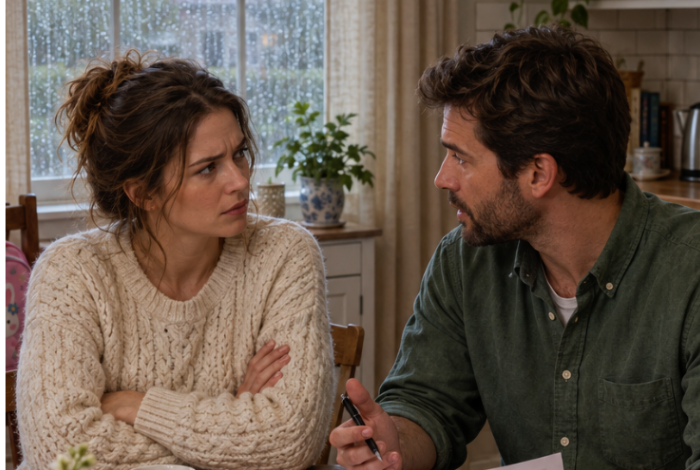
Roman kept stirring his tea for so long that I was surprised—he hadn’t added sugar for ages. The soft clinking of the spoon against the cup somehow annoyed me even more than if he’d been banging his fist on the table.
The youngest, Misha, was already asleep. Timofey was still working on his math homework in his room and every so often shouted, “Mom, do I really need to learn fractions?” Just your typical Tuesday. Navy-style pasta, cucumber salad, tea.
“Alina,” my husband said without looking up. “I found an option in Turkey. Mersin, second row from the sea, a house—not an apartment. Our own yard, a terrace, just like we always dreamed.”
I smiled. We really did dream about this, nearly ten years ago, in our rented kitchen with that eternally dripping faucet. “One day we’ll make it, Alina, and buy a house by the sea. You’ll have coffee on the terrace and won’t have a care in the world.” I still picture that coffee on the terrace sometimes, like a scene cut from a glossy magazine.
“That sounds amazing,” I said. “Will you show me?”
“I’ll show you. But there’s one condition.”
He finally put down his spoon and looked at me with that sharp, assessing look reserved for business negotiations.
“I want you to write a waiver. That if we divorce, you won’t make any claim on this house.”
My fork slipped from my hand and clattered against the plate. Timofey went quiet in his room, then went back to flipping the pages of his notebook.
“What kind of waiver?” I asked, even though I heard him perfectly well.
“Just a regular one. Simple. I’m buying the house with my own money. It’s my money, I earned it. You understand, don’t you?”
## How it all began
I first met Roman in our second year of university. He was studying economics while I was in philology. He borrowed thirty rubles from me for coffee at the campus café and only paid me back a week later, but included an Alyonka chocolate bar as a bonus. The chocolate was half-eaten—he couldn’t resist on the way over. I laughed until I cried and thought, “With this guy, I’ll never be bored.”
We got married in our fourth year. There wasn’t really a wedding: we signed the papers on a Wednesday and then went out for dumplings. Because we were newlyweds, the restaurant treated us to a shot of vodka on the house. Our parents helped us with the first down payment for a tiny one-bedroom apartment on the outskirts. We lived there for five years. The fridge sounded like a tractor, the upstairs neighbors did renovations every Sunday, and we survived on pasta with ketchup while making big plans for the future.
Back then, Roma was working three part-time jobs at once. I helped him prepare for interviews, drilled him with questions, rewrote his CV, and brainstormed better ways for him to present himself. When he finally landed a job at a big company—even if it was the most junior position—we celebrated with rotisserie chicken and cheap champagne. I remember him hugging me in the kitchen and saying:
“Alinka, everything I have, will be ours. Do you hear me? Ours.”
And I heard him. I believed him. Even now, I still remember the smell of that kitchen: roasted chicken and damp clothes drying on the radiator.
How I became “just a mom”
I graduated from university and got a job as a proofreader at a publishing house. It didn’t pay much, but I loved it. I enjoyed working with the texts, making edits in pencil, and breathing in the scent of fresh print. A year later, I was pregnant with Timofey.
Roman and I discussed everything back then. His career was finally taking off—promotions, business trips, more responsibility. Taking maternity leave seemed like the logical choice.
“Just stay home for now,” he told me. “You can always go back—the publishing house isn’t going anywhere. I’ll take care of us.”
So I stayed home. Timofey turned six months, then a year, then he started kindergarten, and I even picked up some freelance proofreading from home. But then Roman got promoted again, we needed to move to another neighborhood, then something else came up. A few years later, we decided it was time for a second child. But it turned out we had to wait longer than we’d thought. And then came Misha.
Now Misha is three. He goes to development classes on Tuesdays and Fridays, swimming lessons on Saturdays, and sometimes, when he’s in the mood, to the speech therapist. Timofey is in fifth grade: school, English classes, soccer practice three times a week. Homework, clubs, parent group chats, doctor’s notes, thermometers, vaccines, runny noses, fevers, and plays about autumn bunnies. All of this relies on me, like I’m an invisible support beam. I get up at six, go to bed at midnight, and in between, there isn’t a single moment that truly belongs to me.
I haven’t left the house on my own in ages, just because—without a to-do list. I can’t remember the last time I stopped by a bookstore. My old publishing house has long since closed, everyone I knew from there has moved to other cities, and my diploma is buried in a dresser drawer beneath my children’s birth certificates and medical records.
But I never complained. Honestly. I understood that Roma worked hard, that he had rough periods, that he needed his sleep. When he was swamped with deadlines and project submissions, I’d take the kids to my mom’s for the weekend. When he got home late, I’d warm up dinner. When he was sick, I sat by his bedside. I believed that’s what family is: everyone does their part, and together it all adds up.
Roma rented our apartment, paid the bills, bought groceries, covered my online editing courses, and even booked me a massage once a month. He thought that fulfilled his end of the deal. And I was grateful. I said ‘thank you’ so often, that the word started to lose its meaning.
—
Receipt
“Roma,” I said slowly. “Are you serious right now?”
“Absolutely. I don’t see the problem.”
“What problem? That I have to sign a piece of paper saying that if we divorce, I have no rights to the house we’re buying?”
“That *I’m* buying,” he corrected me. “Alina, come on, don’t make this harder than it needs to be. It’s just a formality. I’m investing a lot of money, what if something goes wrong? I want to protect myself. It’s normal nowadays. Everyone does it.”
“Everyone?” I repeated. “So the guys at your work ask their wives to sign such waivers?”
He grimaced.
“They don’t force them. They ask. It’s just a sensible precaution. You’re not claiming anything, right? You don’t work, I’m paying for the house. It makes sense.”
“Oh great, Count of Monte Cristo,” I said. I just needed to say something before my throat closed up. “At least he kept quiet about his treasures, while you’re adding them up out loud.”
“Don’t be sarcastic,” Roman frowned. “I’m serious. You realize the house is rightfully mine, right? You just stayed home while I worked hard. I’m not willing to take that risk.”
The silence in the room grew so thick, I could hear the kitchen clock ticking. Timofey coughed in his room. Then his chair creaked as he came out into the hallway, pretending to get some water. He looked at us both, saw my pale nose, his father’s tense back. He poured some water and left.
“Just stayed home.”
That phrase lingered between us like a small dark cloud.
—
Sleepless Night
I couldn’t sleep. I lay next to Roma, listening to his even breathing. He drifted off easily, like someone who thinks everything is settled and resolved. I stared at the ceiling, counting.
I know how to count. I’m a philologist, but having kids taught me the math of daily life.
I counted all the nights I stayed up with Timofey when he was teething. How many months I breastfed Misha, getting up every two hours. The number of times I waited in line at the clinic while Roma was at an ‘important meeting.’ How many evenings I finished school projects for the kids while he was ‘just finishing up some work.’
I remembered that time when Roma was on a business trip and called me in a panic: his report was due and he needed me to find a file on his laptop because he forgot the name. At that moment, I had feverish Misha in my arms and was searching for the file, sitting on the hallway floor. I found it. He said, ‘Thanks, you’re the best,’ and hung up. That report, by the way, earned him a bonus.
I caught myself thinking about all the possible career paths I never took. If I hadn’t gone on maternity leave, maybe right now I’d be a senior editor. Or working at a big publishing house. Or running the book blog I once dreamed about. But the scariest thing is—I’ll never really know what could have been, because I became “Timofey and Misha’s mom” and “Roman’s wife.”
Suddenly, after seventeen years, I realized I’d never once asked myself: what actually belongs to *me*? Not to us, not to the family, not to the kids. What’s mine? Besides an old diploma in the drawer and the right to pick curtain colors.
Before dawn, I got up quietly, went to the kitchen, and sat at the table. There, in the glow of a patch of sunlight from the wall lamp, I saw Timofey’s forgotten black marker. I grabbed a sheet of paper and wrote:
*”What have I contributed to our home in 17 years?”*
Then I made a list. It turned out to be a long one. And at the end, underlining it, I wrote: *”The question isn’t about a receipt. The question is how he sees me.”*
—
## My friend Sveta
In the morning, I took Misha to his activity group, then called Sveta. We’ve been friends since our first year at university. Sveta’s a lawyer, working at a small family law firm. She’s the one person I can call at ten in the morning and say, “I need to talk,” without explaining anything else.
We met at a café near her office. I told her everything. Sveta listened, stirring her coffee and never interrupting. When I finished, she sighed.
“You know what’s really sad?” she said. “This isn’t the first time a story like this has landed on my desk. But usually, women come in after it’s already too late. You came before. That’s a good thing.”
“What should I do? Should I sign it? He’ll just keep insisting anyway.”
“Alina, first of all, the document he’s talking about has no legal force. None at all. It’s just a piece of paper.”
I blinked.
“What do you mean?”
“Just like that. According to the Family Code, all assets acquired during marriage are considered joint property. All of it. It doesn’t matter whose name is on it, who earned it, or who brought in the money. The law recognizes that in a family, work is divided differently: some earn money, some run the home and raise the kids, and everyone’s contribution is valued equally. You weren’t ‘just sitting at home.’ In the eyes of the law, you were working—just for a different kind of ‘salary.'”
“And the receipt?”
“A receipt like that has no validity in these cases. The law doesn’t allow a spouse to give up their share of joint property with a simple piece of paper. For that, there’s a prenuptial agreement. It has to be done with a notary, with both sides agreeing, and in there you can set any terms: who gets what, how to divide things, how to compensate. And it’s important: the prenup can’t put one partner in an especially bad position.”
She took a sip of coffee.
“There is a nuance with property abroad—there, local laws matter too. You’d need to consult a specialist in international law for that. But either way, never sign anything in a hurry.”
I stayed silent for a long time.
“You know,” I finally said, “it’s not even the house I’m scared about. What really hurts is that he decided my part in our life was worth nothing.”
“Then,” Sveta said, “talk to him about exactly that. Not about the house. About how you actually mean nothing to him. The contract is just a symptom here.”
—
The Conversation I Put Off for Seventeen Years
I decided not to make a scene. That would have been too easy: Roman would have shut down, started making excuses, and the whole talk would just have turned into another argument about who owes what to whom.
Instead, on Friday night after the kids had fallen asleep, I set down two cups of tea and placed two sheets of paper in front of Roman.
“What’s this?” he asked, a bit wary.
“Look. It’s a list. I made it over the past three days. Let’s tally this up together.”
He raised his eyebrow, but stayed silent.
“This,” I pointed to the first sheet, “is everything I do in the house every day. Cooking, laundry, cleaning, groceries, school, doctors, activities, clinics, parenting, homework, organizing daily life. I checked average rates on job sites. A live-in nanny for two kids, housekeeper, cook, family assistant, tutor. If we paid market rates for all this, honestly, you wouldn’t make that much in a month.”
Roma frowned.
“Alina, that’s not fair. You chose to stay with the kids yourself.”
“No, Roma,” I replied calmly. “We chose. Together. Remember? You said, ‘Stay at home for now, I’ll provide for us.’ Remember that ‘we’? I accepted your offer, and now you’re saying I ‘just sat at home.’”
He was silent.
“Now, the second sheet,” I continued. “This is what I lost. My career, my work experience, my pension savings. I don’t have a single working year over the last eleven years. My degree sits in a drawer, my professional skills are outdated, my connections are gone. If you leave, I’ll have to start from scratch at thirty-nine, with two kids. But you, if you go, you’ll take your career, your salary, your money. And this house you want to buy—you want to buy it with money you could earn *because I took care of everything else*.”
“Alina…”
“Wait. I’m not done. Do you know how I feel? It’s not anger. It hurts. Because suddenly I realized: you think I have nothing. That I’m just an add-on to your life. That after seventeen years, I haven’t done anything worth even a share in our future.”
Roman leaned back in his chair, looking confused. For the first time, I saw something on his face I hadn’t seen before—not irritation, not confidence, but uncertainty.
“That’s not what I meant,” he said quietly.
“Then what did you mean?”
He rubbed his face with his hands.
“At work…” he paused, searching for words. “My colleague Sasha—his wife left him. He lost half of everything, even had to split the apartment. For a month he was just a shell of himself. At a work party, the guys started saying: ‘You have to protect yourself, sign papers, you never know.’ I… I guess I got scared. Not of you, just in general. Of everything we’ve built. But I didn’t mean to hurt you.”
“Roma, you did hurt me.”
“I understand. I get it now.”
—
What He Said Next
He was silent for a long time. Then he said something I really did not expect.
“You know, when I said you were ‘just sitting at home,’ something snapped inside me. I heard how awful it sounded the moment it left my mouth. But by then, it was too late. And I thought if I admitted it, it would mean I was wrong, and as a man… I need to be confident in my decisions.”
“So what now?”
“Now I just think I was an idiot,” he said honestly. That made me burst out laughing—not out of joy, but because all the tension popped like a soap bubble.
“There will be no handwritten note,” I added. “We’re going to see a lawyer. Together. If you want a prenuptial agreement, we’ll sign one. But only on fair terms. Taking into account what I’ve contributed. What I’ve lost. No signing anything ‘under pressure.’”
“Alright,” he said.
“And one more thing. You will never again say I was ‘just sitting at home.'”
“I won’t. I promise.”
“Roma, that’s not a request,” I looked him straight in the eyes. “It’s a condition.”
—
## What happened next
The next week, we went to the lawyer. I didn’t bring Sveta so there wouldn’t be ‘my side’ and ‘his side.’ I picked a neutral notary office. The lawyer, an elderly woman named Irina Sergeevna, listened closely to us and said exactly what I’d already heard from Sveta—just in a much more official tone.
“In your situation,” she said, “the fairest thing is to register the house purchase in both spouses’ names. This will protect both you, Roman Andreevich, and you, Alina Viktorovna. If you want a prenuptial agreement, I recommend including provisions that recognize each person’s contributions, including the non-financial ones.”
Roma nodded.
“We’ll think about it.”
We stepped outside into the dark autumn sky. Light rain was falling. Roman opened an umbrella, and the two of us walked under it together, just like we used to in college when we only had one umbrella for both of us.
“You know,” he suddenly said, “I just realized that in all these years, I’ve never really said thank you. Not offhand, but…”
“Roma.”
“No, let me finish. Thank you. For being there when I had nothing. For taking care of the kids and the house. For giving me the peace to work. Without you, I wouldn’t have become who I am. And that’s the truth.”
I stayed silent. Tears rolled down my cheeks, but not out of hurt.
“That’s what I needed,” I finally said. “Not money. Not the house. Just for you to see me.”
“I see you now,” he said.
—
## What changed
That month, we didn’t buy the house in Mersin. First, we decided to work on ourselves. Roman agreed that I needed to return to work, even if it was only part-time. We found a great nanny for Misha for a few hours a day, and I started picking up remote editing jobs. At first, just two or three a week, then gradually more. I rediscovered the thrill of a red pen and the familiar smell of manuscripts needing a touch-up.
I received my first paycheck from the new job in December. It was small, almost laughable next to Roman’s, but I used it to buy a book I’d wanted for ages and a pair of beautiful earrings for New Year’s. When Roma saw them, he said, “They suit you.” I smiled, because I realized the earrings had been bought with my own money, and that made them just a little more precious.
When we finally returned to the topic of the house, we decided to split it equally. No receipts, no paperwork “just in case.” Roman was the one who suggested it, and to me, it wasn’t a sacrifice—it was a sign of acknowledgement.
—
Instead of an Epilogue
Recently, Timofey, who is eleven, came up to me one evening and asked:
“Mom, is it true that you and Dad almost fought over the house?”
I sighed.
“Not because of the house, son. It was because of words.”
“What kind of words?”
I thought for a moment.
“Because one person told the other that they hadn’t done anything. But in reality, they had done so much—it just wasn’t obvious.”
“Like when I do the dishes, but you redo them anyway?”
I laughed and hugged him.
“Almost. Only I hope that when you grow up, you’ll never tell your wife that she ‘just stayed home.’”
“I won’t,” he promised seriously. “I’ll say ‘thank you’ instead.”
And suddenly it struck me: maybe it was all for a reason. Maybe our hardest conversation taught our children something truly important.