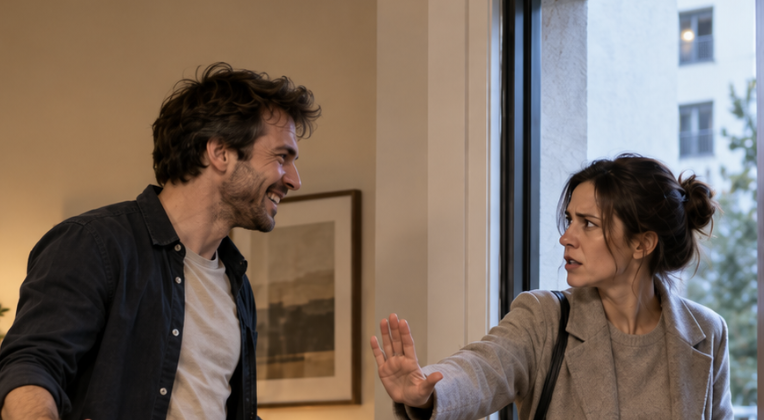
Roman had been rehearsing the sentence for three days.
He would stand in the hallway fastening his airport-service jacket, silently moving his lips as if memorizing instructions for scaring birds away from the runway.
“Ksyusha, we need to separate. I’ve made up my mind.”
Short. Mature. No tears.
Unfortunately, when he finally tried to say it, Ksenia flew out of the bedroom with a laptop under one arm, a handbag on her shoulder, and only one shoe on.
“Ksyusha, wait. We need to talk.”
“Roman, I have my first lecture at nine, and it takes twenty minutes to get to the university in traffic. Tonight.”
“It’s important.”
“So is mine. Two hundred and sixty students and ninety minutes about pine pollen. I’m leaving.”
The door slammed.
Roman remained in the hallway with his carefully prepared speech still trapped inside him.
At the university, Ksenia Vladimirovna Zagorskaya, candidate of biological sciences and forensic palynologist, spent two exhausting classes explaining why pollen was one of the most talkative witnesses in criminal investigations.
“A person can lie,” she told her students. “Fingerprints can be wiped away. Cameras can be avoided. But pollen doesn’t know how to keep quiet. It settles on cuffs, shoelaces, seams, collars. Later, it tells us exactly where you’ve been.”
“What if you wash the jacket?” someone asked.
“It stays in the seams.”
The students laughed when she added:
“People mistakenly think a washing machine is a lawyer.”
After the second lecture, Roman called.
“What time will you be home?”
“Maybe four.”
“We have to talk. Seriously.”
“Yes, yes. Prepare all the papers, okay?”
She meant the lecture printouts he had promised to collect from the printer.
Roman went silent.
“Are you joking?”
“I’ve just taught two classes. I’m no longer capable of joking.”
“Seven o’clock. Home. No later.”
He hung up.
Ksenia assumed he had argued with his supervisor again.
Then, in the corridor, she found her colleague Inna standing beside a windowsill pretending to read a conference announcement.
Her shoulders were shaking.
“You okay?”
“Perfect. Wonderful. Slava filed for divorce.”
Ksenia stared at her.
“He said we’d ‘outgrown the relationship.’ Eight years, Ksyusha. Eight years.”
There was little point offering empty comfort. Ksenia took Inna’s bag, handed her tissues, and led her to a nearby café.
Inna confessed that what hurt most was Slava’s confidence that she would beg him to stay.
“He told me not to make a scene. And I didn’t. I just stood there.”
“That was your mistake,” Ksenia said.
“What?”
“If he wants a divorce, give him one. But give it to him with enough acceleration to make his ears whistle.”
Inna almost laughed.
Ksenia continued:
“No flowers. No ‘maybe we’ll try again next month.’ Tomorrow, stop cooking for him. Go to a lawyer, not to your girlfriends. When he comes back for his razor charger, don’t invite him inside. Put it outside the door.”
“He’ll say I’m petty.”
“He’ll say you’ve changed. That line comes free with every divorce application.”
Inna finally laughed.
Then she asked:
“What if it were Roman?”
“My Roman spends his days using falcons to chase birds away from aircraft.”
“But what if?”
Ksenia stirred her terrible coffee.
“I wouldn’t cry first. I’d calculate first. Square meters. Registration. Ownership. Where the child is registered. Who owns what. Tears can wait until the weekend.”
She didn’t know how useful that conversation was about to become.
Ksenia came home at six twenty.
Roman was already waiting in the hallway, standing stiffly with his hands behind his back.
“Ksenia. We need to talk.”
“Give me two minutes. I’m changing.”
“This can’t wait.”
She froze.
“Did somebody die?”
“No.”
“Then it can wait.”
She changed into sweatpants and an old conference T-shirt, then went into the kitchen and started making tea.
Roman followed her.
“I filed for divorce,” he said. “We need to separate. More precisely, you need to move out.”
Ksenia slowly turned around.
Then she sighed.
“Did you all organize this together?”
“What?”
“Men. You’re the second one today.”
Roman blinked.
“What do you mean?”
“Inna’s husband announced their divorce today. I spent half the afternoon helping her. So, fortunately, I’ve already mentally rehearsed this.”
Roman had prepared himself for screaming, tears, thrown dishes, perhaps a call to her mother.
He had not prepared himself for administrative boredom.
“I don’t want a scandal,” he said. “We can do this like civilized people. I can help you pack.”
Ksenia laughed.
“You can help me pack?”
“I’m serious.”
“That’s why it’s funny.”
She waved him away.
“Go outside for an hour. I’ve had a long day.”
“You’re throwing me out?”
“I’m sending you for fresh air. You love fresh air. Birds. Falcons. Runways.”
Confused, Roman left.
On the stairs, he immediately called his mother.
“I told her. Yes. She’s packing.”
His mother, Tamara Igorevna, put down the phone.
“Our son is an idiot,” she told her husband. “He’s losing a woman like Ksenia.”
Viktor Pavlovich had spent thirty years working as a professional pyrotechnician. His philosophy was simple: if something started burning in the wrong place, intervene before it exploded.
“What are we going to do?” Tamara asked. “What about Mila? She’s six.”
“Be quiet.”
“What does that mean?”
“It means be quiet.”
He took his phone, went into the stairwell, and closed the door behind him.
He needed privacy.
Meanwhile, Roman sat on a park bench beside Alisa, the stretching instructor he had been seeing.
“How did it go?” she asked. “Did she cry much?”
“No. She took it calmly. She’s packing.”
“Just like that?”
“Yes.”
“Strange woman. I would have screamed.”
“She doesn’t scream,” Roman said. “She calculates.”
Then his father called.
“Are you sure you want a divorce?”
“I’m sure.”
“Have you thought about it?”
“I already filed. Ksenia won’t object. And I’ve thought about child support. I’ll pay what I’m supposed to. I’m not a monster.”
His father hung up without saying goodbye.
Roman assumed the connection had dropped.
Viktor Pavlovich stood by the stairwell window holding a photograph of Mila.
His granddaughter was sitting on a carousel horse, five years old, her hat crooked, one front tooth missing.
She was currently visiting Ksenia’s mother in Kimry, spending two weeks near the river and eating raspberries.
He remembered the day Mila was born.
He remembered carrying her through the maternity hospital corridor. He remembered visiting Ksenia constantly during those first months, pushing the stroller, bringing food, arguing about vaccinations.
Once his wife had snapped:
“Why are you always hanging around Ksenia? Let the mother raise her own child.”
And he had answered:
“I can’t breathe without Mila.”
Ksenia had overheard him. She said nothing, but before he left, she slipped a bag of homemade pastries into his coat pocket.
Now he was ashamed of his son.
Roman had the right to make his own choices. But Viktor Pavlovich intended to remain Mila’s grandfather.
Even if it meant betraying his own son once in his life.
He dialed Ksenia.
“Viktor Pavlovich?”
“Listen carefully, sweetheart. The apartment belongs to me. Legally. I’m the owner.”
Ksenia stopped packing.
“And I’m telling you this: stay there. You and Mila. Do you understand? Stay.”
There was a short silence.
“I understand.”
“Tomorrow we’re going to a notary. We’ll arrange everything properly so no clever idiot can challenge it later.”
“Viktor Pavlovich…”
“Later. Just be careful with him. My son gets nervous.”
“I’ll be careful.”
“As with a test tube?”
Ksenia almost smiled.
“Exactly.”
Roman returned at eight thirty with the posture of a man preparing nobly to endure his wife’s suffering.
Two suitcases stood in the hallway.
Both were his.
For a moment, he smiled.
“She actually packed.”
Then he entered the bedroom.
Ksenia was carefully folding shirts into bags.
His shirts.
None of her clothes were there.
“What is this?”
“Your stuff.”
“You’re packing my things?”
“Well, I’m not packing mine. Mine are staying.”
Roman stepped toward her.
“Ksenia, you don’t understand. This is my apartment.”
“No. It belongs to your father. You’re a tenant here just like I am. You’re simply a more arrogant one.”
“I’m his son!”
“And his granddaughter is registered here permanently.”
Ksenia folded another shirt.
“Mila Romanovna. Six years old. Registered here since birth. You registered her yourself, remember?”
“So?”
“So you cannot simply throw your minor child out.”
Roman opened his mouth.
“And,” Ksenia continued in the tone she used when lecturing students, “her mother has no other property. That mother is me, in case you’ve forgotten.”
Roman stared at her.
“So Mila stays here. And I stay with her.”
“I’ll keep Mila,” he blurted.
Ksenia studied him as if he were a specimen under a microscope.
“You honestly think the court will automatically give her to you? With your schedule? Night shifts, early departures, irregular hours?”
“I’m her father!”
“You’re the father who just told her mother to pack her things and leave.”
“Are you trying to set me up?”
“I don’t want you at all anymore,” Ksenia said calmly. “For roughly the last two hours.”
That broke his composure.
Roman moved forward, grabbed her shoulder, and started speaking loudly—accusing her of being calculating, cold, distant.
Ksenia pulled free and slapped him sharply across the face.
Roman stumbled backward into the wall.
“You hit me.”
“I stopped you. There’s a difference. Keep your hands off me. I’m not one of your trainees.”
His cheek burned.
“Listen carefully,” Ksenia said quietly. “My friend’s husband announced a divorce today too. I spent hours helping her. So by pure coincidence, I’m extremely well prepared.”
She raised her hand in a mocking gesture.
“If you thought you could throw your wife and daughter outside like garbage, forget it.”
“You can’t—”
“And another thing. This apartment isn’t yours. The owner is your father. Mila’s grandfather. And he told me to stay.”
Roman froze.
“What?”
“Tomorrow we’re meeting a notary. Officially. Legally.”
Roman stared at her.
For nine years, he had barely heard Ksenia swear. She spoke politely even to the family cat.
Now his calm, educated wife stood in front of him surrounded by bags of his clothes and looked capable of running a military evacuation.
The worst part was that she was right.
And his father had chosen her and Mila over him.
His hands began trembling.
Ksenia saw it, sighed, disappeared into the kitchen, and returned with water and a sedative.
“Drink.”
“What is it?”
“Twenty drops. I don’t need you collapsing here. Then I’d have to explain to Mila why her father died in the hallway.”
He drank without arguing.
His phone vibrated.
A message from his father:
“Do not touch Ksenia or Mila. They stay. And you…”
Nothing else.
Just the ellipsis.
Roman read it three times.
Somehow, the unfinished sentence was worse than an insult.
“Want me to call you a taxi?” Ksenia asked. “By the way, did you rent a place?”
“I…”
“If not, maybe you and Inna’s husband can rent together. He’s homeless as of today too. Cheaper for two. You can sit around discussing how inconvenient your wives are.”
Roman straightened.
“I’m not leaving. This is my home.”
“Fine.”
Ksenia picked up her phone.
“Then we’ll ask the owner.”
“Don’t.”
“Why? Viktor Pavlovich is polite. He’ll answer.”
“Don’t call my father.”
“Then decide.”
Roman raised one hand.
Surrender.
“Leave the things. I’ll get them tomorrow.”
“Fine.”
She extended her palm.
“Keys.”
“What?”
“Keys, Roman. You don’t get to wander in whenever you like. Call first, arrange a time, come get your belongings.”
“This is humiliation.”
“No. This is procedure. You started it. I’m simply following the protocol.”
Roman removed the apartment and building keys and placed them into her hand.
Then he took his jacket and left.
Outside, the June evening was annoyingly bright.
Roman walked along the building, furious.
First at himself.
How had he failed to think about the apartment registration? He was a man who could predict how birds would behave around a runway in crosswinds, yet he hadn’t predicted the actions of one woman in sweatpants.
Then he became angry at his father.
But even there he had to admit the truth.
His father had not defended Ksenia.
He had defended Mila.
And the idea that his own daughter needed protection from him was unbearable.
So Roman turned his anger toward Ksenia instead.
That was easier.
Surely she had called his father first. Surely she had manipulated everyone.
Then Alisa phoned.
“Where are you? I thought you were coming.”
“I’m not.”
“What do you mean? You said—”
“I said many things. Right now I have no apartment and no keys.”
“What does that have to do with me?”
“You kept telling me for three weeks: ‘Make a decision.’”
“Don’t blame me. You’re an adult man.”
Roman clenched his teeth.
“Your apartment has two rooms, right?”
“I live with my mother,” Alisa replied immediately.
Roman went silent.
“I understand.”
“What do you understand?”
“Everything I could possibly understand in one evening.”
He ended the call.
That morning he had possessed a home, a wife, a daughter, a father, and a beautifully rehearsed divorce speech.
By evening, only the speech remained.
And he had never even managed to deliver the whole thing.
Inside the apartment, Ksenia pushed Roman’s suitcases against the wall, washed her hands, and sat down for the first time all day.
Her head was buzzing.
Fragments of her pollen lecture mixed with suitcases, keys, notaries, and insults she had never previously used in her life.
She messaged Inna:
“Hold on. Apparently I’m getting divorced today too. Your instructions worked. Acceleration successfully applied.”
Inna answered instantly:
“ARE YOU SERIOUS?! I’m coming over.”
“Don’t. Come Saturday. We’ll calculate square meters and drink something unhealthy.”
Then someone knocked softly at the door.
Ksenia looked through the peephole.
Viktor Pavlovich stood outside wearing an old windbreaker and holding a large flat box.
The picture showed horses.
“Horse Farm. 240 Pieces.”
He cleared his throat awkwardly.
“Mila asked for it. She’s been asking since winter. I kept putting it off. Thought I’d save it for her birthday.”
“Viktor Pavlovich…”
“She’ll be back next week. Hide it if you want. You know better.”
Ksenia took the box.
It was surprisingly heavy.
“Thank you. Really. She talks about this farm all the time. She already has names for all the horses, including the ones she doesn’t own yet.”
“I can imagine.”
He looked somewhere near her shoulder.
“Ksenia… I’m ashamed of my son. I didn’t raise him to behave like this.”
“You raised him normally. He added a few things himself.”
“I’m serious about tomorrow. Ten o’clock. The notary is arranged.”
“I’m free at ten.”
Then Viktor Pavlovich noticed the suitcases against the wall.
He looked at them in silence for several seconds.
A former pyrotechnician examining an explosive charge that had malfunctioned without injuring anyone.
Finally, he nodded.
“Come in,” Ksenia said. “I’ll make tea. I have poppy-seed biscuits.”
“Poppy seed?”
He finally smiled.
“Well, if there are poppy-seed biscuits…”
He entered, carefully placed his shoes by the door, hung up his jacket, and walked toward the kitchen—somehow like both the owner of the apartment and an embarrassed guest.
Ksenia remained in the hallway for a moment, holding Mila’s toy farm.
A large piece of the family had broken off that day.
There would be court hearings. A notary. Explanations for Mila. Angry phone calls. Perhaps months of conflict.
But Mila still had her room.
She had a grandfather willing to carry a 240-piece horse farm across the city for her.
She had Grandma Lidia with raspberries and the river in Kimry.
She had Grandma Tamara, who was probably already scolding her husband for being silent.
And she had a mother who knew how to calculate square meters and had no intention of falling to her knees.
Ksenia placed the box with the horses on a shelf in the closet.
The rest, she decided, was not nearly as important