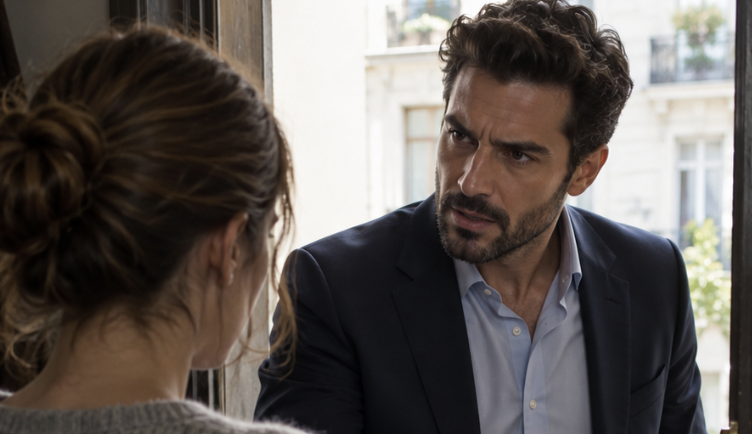
Veronika hung up the phone right in the middle of a sentence, and she enjoyed it. Rimma Lvovna’s voice cut off halfway through a word, like a fishing line sliced clean through. Refrigerators hummed throughout the shopping center, someone pushed a cart nearby with an awful metallic squeak, and even that sounded more pleasant than her former mother-in-law’s voice.
“Who made you so happy?” Zhanna pulled a package of chicken thighs from the refrigerated display and turned it over as though searching for a craftsman’s stamp. “You look like someone just asked you to water the garden with your own blood.”
“Rimma Lvovna. She told me Kostya is coming to see me.”
“Why?”
“She didn’t say. Just said, ‘Try to be a little gentler with him.’” Veronika picked up a bag of rice. “Gentler. I’m not a pillow.”
Zhanna stopped so abruptly that the shopping cart slammed into her thigh. She didn’t even wince. A woman who spent eight hours a day leading shepherd dogs through collapsed buildings barely noticed minor pain anymore.
“Wait. He divorced you a year ago. What else does he want?”
“No idea. Maybe he left his conscience at my place. Although no, he never brought one with him.”
“That’s an idea,” Zhanna snorted. “Tell him his conscience is at the dry cleaner’s and you lost the receipt.”
They continued along the shelves. Veronika caught herself mentally narrating everything happening around her. Her profession had gotten into her bones.
A woman in a gray coat takes a jar from the shelf, reads the ingredients, and puts it back without looking.
That was how Veronika had been describing films for blind viewers for seven years: briefly, precisely, without melodrama.
“You know what was worst about our divorce?” she said.
“The arguments?”
“There weren’t any arguments. That was the problem.”
“That sounds good.”
“It was like chewing cotton wool. He walked around the apartment sighing and asking, ‘Are you sure?’ ‘Maybe we should think about it?’ ‘Mom says…’ Six months of that sticky sludge. I lost six kilos and forgot how to sleep.”
Zhanna put a package of pasta into the cart and looked at her friend the way people look at a dog with splinters stuck in its paw.
“And how’s his mistress? Still alive?”
“Her name was Snezhana,” Veronika corrected with poisonous precision. “Although maybe she’s already been replaced. The schedule was pretty busy.”
“What, shift work? Two days on, two days off?”
“Every third day, with extra pay for nights.”
They burst out laughing beside the sausage counter, and the saleswoman gave them the disapproving look of someone who had to work today and would save her own fun for vacation.
“Are you even planning to let him in?” Zhanna asked at the checkout.
“Across the threshold? Probably not. I’m not a shelter for lost men.”
“You’re kind. That’s your biggest problem, Nika.”
“I’m not kind. I’m lazy. Fighting is work, and nobody pays me for it.”
Zhanna paid, picked up the bags, and suddenly remembered something.
“Listen, I’ll come by tonight. I’ve got news about Baikal. Yesterday he found a person under a concrete slab. Can you imagine? Through two meters of concrete.”
“Come over. I’ve got semolina cake left from yesterday.”
“Semolina cake is sacred.”
Veronika reached her building at half past six. The grocery bag was cutting into her palm, her purse strap kept slipping down her shoulder, and she was already planning her evening: soup first, then a shower, then some television series she had never watched and had no intention of watching—just something playing in the background.
“Nika!”
The voice came from behind her, painfully familiar.
Kostya appeared from behind a parked van, hurried toward her, snatched the grocery bag from her hand, and immediately headed for the entrance as if the keys to her apartment were still in his pocket.
“Come on, why are you standing there?” he called over his shoulder.
“Are you out of your mind?” Veronika stayed where she was. “Give me the bag.”
“Come on. I’ll carry it. I’m not a stranger.”
“You are exactly a stranger. Officially. With a court stamp.”
He turned around.
He had lost weight. His cheekbones stuck out, and his belt had been tightened to a new hole that looked as though someone had punched it with an awl. His shirt was clean, but the collar was stretched like something regularly washed by hand in a sink.
“Nik, we need to talk,” he said, giving her the same smile that had once worked on her. “And you’re going to like what I have to say. You definitely will.”
“I liked you once already. For three years. Then it turned out I wasn’t the only one.”
“Oh, don’t start. Seriously, you’re going to like this. You’ll thank me afterward.”
That “you’ll thank me” was what got her.
Not because she felt anything for him. Purely out of scientific curiosity, like watching a spider crawl into a coffee cup for reasons no one could explain.
She unlocked the entrance door and let him go ahead.
“Five minutes,” she warned him. “And only because I’m hungry and angry. When I’m hungry and angry, I don’t argue. I eat.”
“Great!” he said cheerfully. “Eating is good.”
Inside the apartment, he took off his shoes neatly and placed them with the toes toward the wall. He used to kick them off wherever they landed.
Veronika carried the groceries into the kitchen and started putting everything away while listening to him wander through the hallway and touch things.
“Are you conducting an inventory?” she called.
“Just looking around. Nothing’s changed here.”
“Something changed. You left.”
She put a pot of soup on the stove, turned on the heat, and went into the bedroom to change.
“So what brought you into my part of town?” she called through the wall. “Missed me? Make it quick. I’m hungry.”
“I’m hungry too,” came his voice from the kitchen.
She ignored that.
She pulled off her sweater, put on a T-shirt, and tied back her hair. The mirror reflected a thirty-four-year-old woman with the clear gaze of someone professionally trained to describe everything she saw.
And what she saw when she returned to the kitchen required very precise wording.
Kostya was sitting at the table.
A full bowl of soup stood in front of him.
He had already broken off a piece of bread.
“You’re still just as shameless,” Veronika said calmly.
She walked over, took the bowl from under his nose, moved it to her side of the table, sat down, and began eating.
“Hey!” Kostya actually half-rose from his chair. “Seriously? You begrudge me one bowl of soup?”
“You? Yes,” she said, nodding as she lifted another spoonful. “Tell me what you came for. And what exactly I’m supposedly going to love.”
He sat back down.
His fingers were trembling slightly, and that was the first thing that made her uneasy.
“Nik. Divorce is divorce,” he said solemnly. “But somebody has to feed me.”
Veronika choked.
Then she put down her spoon and started laughing—genuinely, until tears appeared in the corners of her eyes.
She hadn’t laughed like that in about three weeks.
“Thank you, Kostya. Seriously, thank you. That’s exactly what my day was missing.”
“I’m not joking.”
“That makes it even better.”
Her phone rang.
The screen said “Rimma Lvovna.”
Veronika answered and put it on speaker because the evening was clearly becoming entertaining.
“Veronika, did Kostya arrive?” Her former mother-in-law sounded worried and demanding at the same time.
“He did. He’s begging for food. What, don’t you feed him? Or did he run away from another girlfriend? Sorry—was he thrown out again, this time without provisions?”
“What kind of way is that to speak?” her mother-in-law gasped. “Don’t be stingy. Feed your husband.”
“Ex-husband,” Veronika corrected. “I paid the court fee for that ‘ex.’ I went to court twelve times and once to a lawyer who chewed gum and called me ‘young lady.’”
“You’re heartless.”
“I’m well-fed.”
She ended the call and placed the phone on the table.
Kostya shifted around in his chair like a schoolboy waiting outside the principal’s office.
“Where are you living now?” Veronika asked, finishing her soup deliberately slowly.
“With some people I know.”
“Who exactly? Egor?”
“I was at Egor’s. Three weeks. Then his wife said their kitchen wasn’t a hotel.”
“Smart woman. Then what?”
Kostya shrugged.
He was staring at the pot of soup with the same expression people use when looking at the exit from a burning building.
“Then I stayed with Asya.”
“Asya is which one?” Veronika raised an eyebrow. “The one after Snezhana?”
“Do you have to dig into everything?”
“Absolutely. Nobody pays me for it, so I do it free of charge, for the love of the art.”
“Asya threw me out,” he said through clenched teeth. “Changed the lock. Left my things on the landing in two bags. Like garbage.”
“Thoughtful of her. She could have left them without bags.”
“You’ve become mean.”
He suddenly leaned forward, his voice turning businesslike, as though he were about to offer her a profitable bottled-water contract.
That was, in fact, what he had done for the past four years: driving around to restaurants explaining to head waiters the difference between water from the mountains and water from beneath the mountains.
“Nik, that’s exactly the problem. Look at me. I’ve wasted away. I’ve lost twelve kilos.”
“You look wonderful. Enlightened.”
“The divorce is in the past. But you still have to feed me.”
“Old joke.” She stood and carried her bowl to the sink. “Come up with a new one. You used to be good at that.”
“I did!” He brightened and slapped his palm against the table. “Listen to this brilliant idea. I pay you. You cook, I come here for dinner. Three times a week. Fair exchange. Everybody wins.”
Veronika turned toward him.
She stared for about four seconds—exactly the amount of time she normally had to fit an audio description between two lines of dialogue in a movie.
“Maybe I should provide you with a bed too?” she asked.
“Yes!” Kostya answered with complete seriousness.
And that was when it actually became frightening.
“Perfect. How much would one night cost?”
The silence in the kitchen became as thick as jelly.
“Who do you think I am?” Veronika asked quietly. “A woman you can rent for the night? A prostitute?”
“Why use words like that?” He waved his hands. “Everybody benefits. You get money, I get pleasure. And a bed. And food. It’s fair, Nik. It’s more honest than—”
He never finished.
Veronika grabbed the pot by the handle and threw the rest of the soup into his face.
It wasn’t boiling. It had been off the stove for about twenty minutes and was merely warm.
Carrots, noodles, potatoes—everything she had cooked that morning to last two days.
Kostya shrieked in a high, thin voice like a car alarm and tumbled from his chair onto the floor.
He sat on the linoleum with noodles hanging from his ear while a greasy stain slowly spread across his shirt.
“You’re insane! You scalded me!”
“It’s warm.”
“My shirt!”
“You have another one. In the bag. Asya probably packed it for you.”
The doorbell rang.
Veronika wiped her hands on a towel and went to answer.
Zhanna stood outside wearing a jacket with the emblem of a canine rescue unit, holding a box and looking like someone prepared to spend the next forty minutes talking about her dog.
“Nik, you have no idea! He was under the slab! Through two meters of concrete! The handler from Tver didn’t believe him, but he—”
“Come in.” Veronika grabbed her by the sleeve and pulled her inside. “You’re going to love this.”
Zhanna stepped into the kitchen and stopped.
Kostya was struggling to his feet, holding on to the counter.
Liquid dripped from him.
He muttered something angry and unintelligible while fishing a piece of potato out from behind his collar.
“Oh,” Zhanna said. “Hello, Kostya. You look good. Juicy.”
“Go to hell,” he snapped.
“We’ve had a minor misunderstanding,” Veronika explained politely. “Zhann, I’ve got semolina cake from yesterday. Want some?”
“Do you even need to ask?”
Kostya left wet footprints behind him as he walked into the bathroom.
Water began running.
Zhanna waited until she heard the lock click, then turned to her friend.
“Right. Quickly. What happened?”
“He offered to pay me to feed him.”
“Okay. That’s rude, but survivable.”
“Then he offered me money for a night. Asked what I charge for sex.”
Zhanna’s eyes widened.
She put her box on the windowsill as though it was interfering with her ability to process the information.
“What a bastard. Nika, that’s not rudeness. That’s a diagnosis.”
“Don’t tell him. He won’t understand. He takes any word longer than three syllables as a personal insult.”
“I won’t explain it with words.”
“Zhanna.”
“I’m quiet.”
Veronika took out the semolina cake, cut it into large pieces, and set out cups.
From the bathroom came grunting and splashing.
Judging by the sounds, Kostya was trying to wash the stain from his shirt without much success.
He came out ten minutes later with wet hair combed back and a damp, blotchy shirt.
He sat on a stool, looked at the cake, then at the two women.
“I’m hungry,” he announced.
Nobody answered.
“So,” Zhanna said, breaking off a piece of cake, “imagine this: a collapse, three floors pancaked on top of each other, everyone is sure there’s nobody inside. And Baikal sits down and stares at one spot. Just sits there.”
“Does he always sit when he’s certain?”
“Always. He can’t lie. He’s a dog, not a person.”
“I’m sitting right here, by the way,” Kostya reminded them.
“We noticed,” Veronika said without turning her head. “Zhann, I’ve also got meat patties left from yesterday. And mashed potatoes.”
“Nika, you’re saving my life. I’ve been at the site since six in the morning.”
“Want me to heat them up?”
“If it’s not too much trouble.”
Veronika took out a frying pan, put four patties on it, and began reheating the mashed potatoes.
The kitchen filled with the sounds of a normal human dinner.
Kostya sat half a meter away from all of it, completely ignored.
He reached for the semolina cake.
Without looking at him, Veronika slid the dish to the opposite side of the table.
“What is this, kindergarten?” he exploded.
“This is pricing,” she replied. “You’re the one who likes talking about profitable deals. The cake is expensive.”
“I offered you money!”
“You offered me humiliation with a surcharge. Bad deal.”
Zhanna sat down, pulled the plate of patties and mashed potatoes toward herself, and started eating with the appetite of someone who had spent the day digging through concrete.
“Mmm. Nika. What do you put in these?”
“A little bread and a lot of anger.”
“I can taste both.”
Veronika looked at Kostya.
He sat there with his damp hands folded on his knees, watching Zhanna’s fork the way people watch the second hand of a clock while waiting for the dentist.
And then an idea came to her.
The kind of idea that comes to calm people who are extremely tired of someone else’s audacity.
She picked up her phone and called Rimma Lvovna.
Speakerphone.
One ring.
Then another.
“What now?” her former mother-in-law answered irritably. “Veronika, I’m busy. I have an order for five hats.”
“Rimma Lvovna, one question. You divorced Viktor Pavlovich, right?”
“Twenty years ago. What does that have to do with anything?”
“Imagine he comes to your place. Hungry. And offers you money for sex. Like you’re a prostitute. Would you agree?”
Kostya hissed and lunged toward the phone.
Without stopping chewing, Zhanna showed him her fist.
Her fist was exactly the kind of size that answered all possible questions.
Kostya sat back down.
“What kind of joke is that?” Rimma Lvovna’s voice shot upward. “Have you lost your mind?”
“Well, your son just tried to buy me. Cheaply, too. I’m curious where he got the idea. Maybe he had an example? Maybe that’s how he settled things with his girlfriends?”
“How dare you!”
“Quite easily. He’s sitting across from me waiting for me to serve him a meat patty. Ask him yourself.”
The line became quiet.
Something clicked faintly in the background, probably knitting needles.
“Kostya,” Rimma Lvovna said. “Kostya, is that true?”
“Mom, she’s twisting everything,” he babbled hurriedly. “I proposed a normal arrangement. Mutually beneficial. I—”
“An arrangement?” His mother’s tone changed so sharply that Zhanna froze with her fork in midair. “You offered a woman an arrangement? At thirty-seven years old, you wander around other people’s apartments bargaining for dinner? That is low. Do you hear me? Low!”
“Mom—”
“Don’t call me for a week. No. Two weeks.”
The line went dead.
Veronika placed the phone on the table.
“Well,” she said. “The family council has concluded. I’m not taking minutes.”
“You did that deliberately,” Kostya hissed. “You planned this.”
“I asked a question. A question isn’t a weapon. The answer is.”
Zhanna finished eating, carefully gathered the last of the mashed potatoes with a piece of bread, and stood.
“Okay, I need to go walk Baikal.” She put on her jacket and turned to Veronika. “Want me to take him with me?”
She nodded toward Kostya the way someone might point to a forgotten sack in the hallway.
“Take him,” Veronika agreed. “He’s all yours. Every last bit of him.”
“I’m not finished!” Kostya jumped up. “Nika, we’re not done talking! I have a concrete proposal. I’m willing to discuss the price—”
Zhanna took him by the elbow.
She simply grabbed him with two fingers just above the joint and led him toward the hallway.
He tried to resist, but soon discovered resistance was useless.
A woman who regularly carried forty-kilo male dogs through collapsed buildings understood physics much better than he did.
“Shoes,” she said, placing them in front of him. “Put them on. Or go barefoot. Makes no difference to me.”
“I was a guest here!”
“You were covered in soup.”
She opened the door and pushed him onto the landing.
Kostya turned around from the other side of the threshold, furious, wet, his shirt covered in stains, a noodle still stuck to his cuff.
“I’m not finished!” he yelled as the door closed. “I’ll come back tomorrow!”
The lock clicked.
The light was on in the stairwell.
Somewhere one floor below, a television was playing.
Kostya stood fastening his jacket with damp fingers while anger grew inside him in even rings, like the growth rings of a tree.
Zhanna came out after him, adjusted the strap of her bag, and started toward the stairs.
Then a thought came to him.
Fresh.
Logical.
This woman was independent, had a job, lived alone, had a dog.
“Listen,” he said to her back. “Wouldn’t you be interested? You know, like adults. I pay, you—”
He didn’t finish.
Zhanna spun around and struck him in the chest with her fist, short and direct, into the solar plexus.
Kostya folded forward, air whistling out of him.
The second blow came from her knee, upward into his face.
The third was an open-handed strike to the jaw.
That was enough for him to lose his footing and tumble down the stairs, hitting them with his back, side, and elbow on the way.
He stopped on the landing between floors.
“Don’t judge women by yourself,” Zhanna said calmly from above, as though giving a command to a dog. “One more word and I’ll break your nose.”
Judging by the look of things, his nose might already have been broken.
Blood poured out immediately, running over his chin and collar.
Kostya howled, clutching his face.
“Pig,” Zhanna added.
She stepped over his leg and continued downstairs.
The entrance door slammed shut.
A minute later, the lock clicked upstairs.
Veronika came out onto the landing in slippers, looked down, and descended several steps.
She was holding a pack of paper tissues.
“Wipe yourself,” she said, holding them out. “You look terrible.”
He snatched the tissues and pressed them against his nose.
They immediately turned red.
“What the hell is wrong with all of you?” he shouted nasally. “Idiots! All women are idiots! Nobody understands anything! I came in peace! I offered a completely normal arrangement, and you—”
Slap.
Sharp and clean, without a windup, directly across the cheek and carefully avoiding his injured nose.
Veronika didn’t even flush.
“What has gotten into you?” Kostya recoiled and nearly missed the stair beneath him.
“Watch your mouth,” she said. “That’s what your head is for. Not just something to pour food into.”
She turned and went upstairs.
Her slippers scraped against the concrete.
The door closed.
Kostya was left alone.
He sat on the step holding his nose while the lightbulb above him flickered like something from a cheap television drama.
His shirt was covered in soup.
His jacket was stained with blood.
One shoe was undone.
His elbow hurt.
He started counting the people responsible.
Snezhana was first.
A year earlier she had sworn she had waited for him all her life, and then one month after the divorce she explained that she had never signed up to financially support a grown man and asked him to clear his shelf in the wardrobe.
Then came two weeks at Egor’s apartment, until Egor’s wife explained that their kitchen was not a hotel and a guest was not a piece of furniture.
Then there was Asya.
Asya lasted the longest—four months.
She cooked for him, washed his clothes, even laughed at his jokes about glacier water.
Then one day he told her that she could at least find a side job while he was temporarily between contracts, and that evening he found his belongings outside the apartment.
In two bags.
Neatly tied shut.
He spat blood.
He had come in peace.
He had gone to his ex-wife, and an ex-wife was supposed to understand. She had cooked borscht for him for three years. Her hands still remembered how.
He had even offered money, honestly.
He could have simply asked.
And what had he received?
Soup in his face.
His mother had hung up and told him not to call for two weeks.
Her friend was completely crazy and hit like a dockworker.
And still, no matter how he looked at it, Veronika was to blame.
It had all started with her.
If she hadn’t filed for divorce, he would still be living at home, eating at home, sleeping at home, and none of the Snezhana business would ever have been necessary.
Well, it still would have been necessary, but discreetly, like normal people did things.
She had started the avalanche.
Because of her, his mother now refused to answer the phone, Egor wouldn’t open his door, and his phone account had run out of money.
Veronika was guilty.
And however long he thought about it, she would remain guilty.
He stood up, holding the railing, and slowly went downstairs, leaving dark drops behind him on the steps.
Veronika wiped the kitchen floor.
The soup had already dried, so she had to scrub it twice—first with a wet cloth and then again until it was dry.
She cleared the dishes from the table, washed them, and left the frying pan to dry.
She washed the pot last.
It smelled of carrots and stupidity.
Her phone vibrated.
Zhanna.
“Alive?” her friend asked without introduction.
“Alive. Men like that are hard to kill.”
“I think I broke his nose.”
“Then he’ll have something to tell his mother once she starts answering his calls again.”
“Nik, I don’t regret it.”
“Neither do I. Good night, Zhann. And congratulate Baikal for me. He did well.”
“He always does.”
Veronika ended the call and placed her phone on the armrest.
She didn’t care about her former husband.
Not at all.
They had separated, and that was that.
A full stop.
From now on, everyone carried their own bags.
Still, she opened her conversation with Rimma Lvovna and typed three words:
“Kostya tripped. Alive.”
The reply came forty seconds later.
“He’s not my son.”
Veronika looked at the message, shrugged, and put down her phone.
Then she sat in the armchair, turned on the television, and landed in the middle of a series she had never watched and had no intention of watching.
A woman on the screen was crying.
A man standing in a doorway was trying to prove something to her.
Out of habit, Veronika automatically narrated the scene to herself:
“A man stands in the doorway. The woman does not turn around. The woman picks up the remote.”
Veronika picked up the remote and turned up the volume