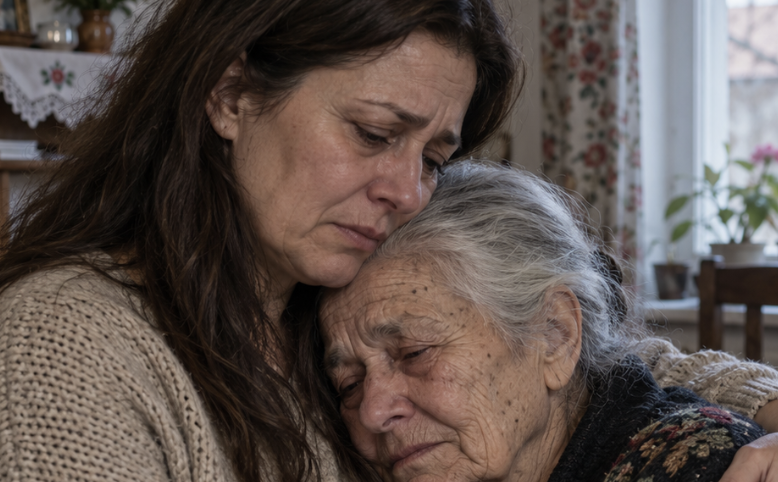
On the top shelf of Iryna Tymofiivna’s pantry stood fifteen jars of cherry jam. On every lid was a little square of graph paper tied on with string, bearing the same inscription in ballpoint pen: “For Mariana.” Beneath it was the year. The oldest jar had already darkened, and the jam inside had turned almost black.
Her neighbor, Valentyna Stepanivna, once asked why she kept so many jars if no one ever ate them.
Iryna Tymofiivna turned toward the stove and said that the cherry crop had been good that year and it would be a shame to let the fruit go to waste. Then she added quietly, no longer speaking to her neighbor:
“She’ll come one day.”
That evening, Mariana stood in the hallway of her Kyiv apartment, staring at the closed door to her daughter’s room. A moment earlier, the door had slammed so hard that a framed photograph had fallen from a shelf.
Solomiia was fourteen.
The argument had started over something trivial. Mariana had asked whether she had eaten, whether she had done her homework, and why she was once again sitting on her phone until midnight.
“You don’t hear me at all!” her daughter shouted before disappearing behind the door. “All you ever do is boss me around! I’d be better off living on my own!”
Mariana picked up the frame. The glass had not cracked.
But something inside her had.
Because she had heard those words before.
No—not heard them.
She had said them herself.
In exactly the same voice, with exactly the same anger.
Only back then she had been twenty-five, and she had not been standing in a hallway in Kyiv. She had been standing on the threshold of her mother’s house in the village.
Back then, everything had happened in a single evening, although the tension had been building for years.
Her father had died in the spring.
After the funeral, her mother seemed to turn to stone. She barely spoke, drank cold tea, and spent late nights sorting through her husband’s shirts.
Mariana lived nearby, worked at the local library, and could see that her mother was suffering.
But Mariana had Ostap.
He had found a job in Kyiv, rented a tiny apartment on the Left Bank, and asked her to move with him.
Not someday.
Now.
She came into her mother’s kitchen with the news. She had even bought a Kyiv cake, absurdly enough, as though they were celebrating.
Iryna Tymofiivna listened without looking up from the dishes.
Then she turned off the tap, wiped her hands on her apron, and said the words Mariana would remember for the next fifteen years.
“It hasn’t even been forty days since your father died, and you’re already packing your bags. Running after the first man who calls. Go, then. But remember this: if you leave, don’t come asking to return. I don’t need a daughter who abandons her mother.”
“I’m not abandoning you, Mom! I want to live my own life! You never listen to me. All you ever do is boss me around!”
“You know where the door is.”
Mariana did.
And she slammed it exactly the way Solomiia had slammed hers today.
Her mother did not come to the wedding.
Mariana called twice.
The first time, her mother hung up the moment she heard her voice.
The second time, she did not answer at all.
After that, Mariana deleted the number.
She did not block it.
She deleted it, as though that changed anything.
She knew every digit by heart.
Life moved forward, as life tends to do.
The rented apartment was eventually replaced by one of their own. Then came renovations. Then Solomiia was born.
Mariana went from being a librarian to becoming the head of a department at a publishing house.
No one at work knew about her mother.
When colleagues asked about her parents, she answered briefly:
“They’re both gone.”
And every time she said it, she wanted to step out into the stairwell and stand there alone for a while.
News from the village reached her in fragments.
Her distant cousin Ivanna occasionally wrote to say that her mother’s blood pressure had gone up, that she had replaced the windows, that she had sold her father’s car.
Mariana read the messages and never replied.
Over the years, the resentment had not disappeared.
It had simply stopped burning and become familiar, like an old callus.
But that evening, standing in the hallway with the picture frame in her hands, Mariana suddenly thought about something other than herself for the first time.
She thought about what it must have been like to sit alone in an empty house after burying your husband and hear your only child say, “You never listen to me.”
And what it must have been like to wait for a phone call that never came a third time.
She knocked on Solomiia’s door.
Her daughter did not answer.
Mariana sat down on the floor outside