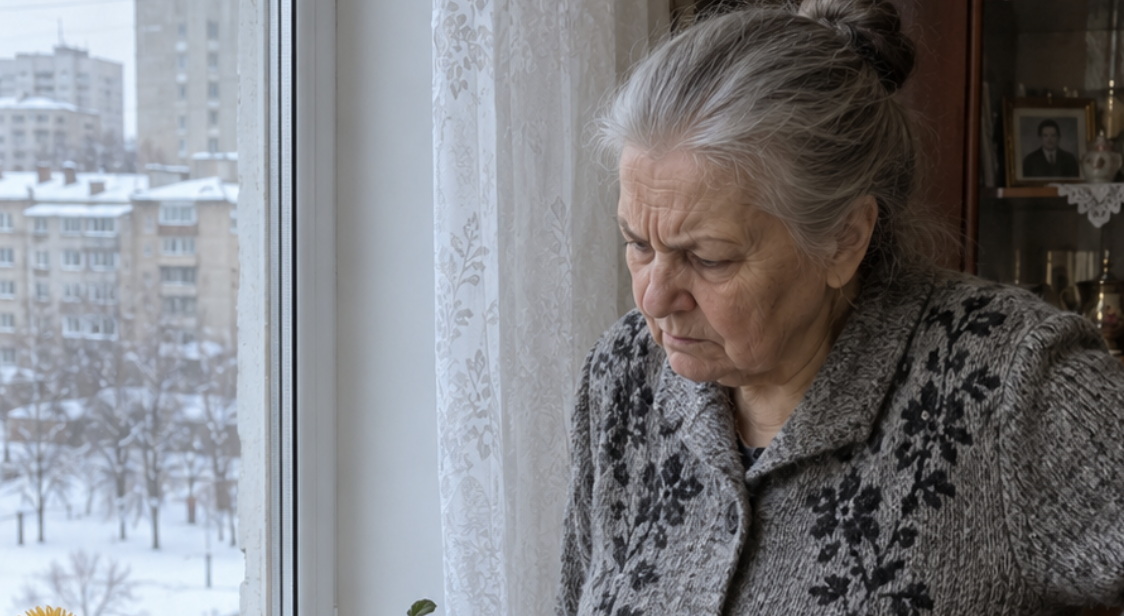
In Valentina Grigoryevna’s apartment, the third parquet board from the living-room doorway creaked. Not loudly, just a short sound, as if someone were letting out a barely audible sigh. Five-year-old Darinka had known about it since she was three and always stepped over it with a wide stride, holding her doll by the hand so that she wouldn’t step on it either.
“Mom, will we have a board like that in our house?” she once asked in the evening while Olena was putting her to bed.
“What kind, sweetheart?”
“You know, the one that yells at Grandma when I walk.”
Olena laughed then, but afterward she lay awake for a long time. The child had not said, “It yells when I walk.” She had said, “It yells at Grandma.” Because in that apartment, sooner or later, every sound ended with Grandma’s voice coming from the living room:
“Darinka, quieter! I already asked you.”
Five years earlier, Maksym had brought Olena to his parents’ three-room apartment. Valentina Grigoryevna had welcomed her daughter-in-law warmly and had even hugged her at the door.
“Why waste money on rented places?” she had said during their first dinner together. “We’ll live together. It’s cheaper that way. Besides, the apartment will belong to Maksym eventually anyway. Just contribute a little toward repairs, so that later you’ll have everything fixed up properly for yourselves.”
And they contributed.
Every month Maksym placed an envelope in the sideboard, on the second shelf behind the tea set with the gold trim. Valentina Grigoryevna recorded every amount in a squared notebook: date, sum, signature. Once Olena added up the entries and quickly put the notebook away because the total made her uncomfortable.
With that money, they could have gone to the seaside three times.
They had never gone even once.
Instead, the apartment got new bathroom tiles, new faucets, and new kitchen windows. Valentina Grigoryevna chose everything herself. Once Olena cautiously suggested light-colored wallpaper for the hallway and heard:
“Olena, for now you’re still a guest here. When you have your own home, you can put up whatever wallpaper you like.”
Olena remembered the words “for now” for a long time.
Everything in that house lived by rules.
Towels were folded into thirds, with the edge facing the wall. Cups in the cabinet stood with their handles turned to the right. Toys had to disappear from the carpet within ten minutes after playtime ended; otherwise Valentina Grigoryevna gathered them into a bag herself and hid them on the top shelf.
Afterward, Darinka would spend a week asking where her bunny had gone.
The little girl learned very early to ask permission.
Could she take a cookie?
Could she turn on a cartoon?
Could she sit on the sofa?
She never stomped her feet and never sang loudly.
Once, a neighbor from the fifth floor praised her.
“What a well-behaved child you have. Just like an adult.”
And somehow that compliment made Olena feel bitter.
Olena’s mother called on Wednesday while Olena was peeling potatoes.
“Sweetheart, are you sitting down?” her mother asked in the same voice she had once used to tell Olena that she had been accepted into university. “Your father and I sold Grandma’s house near Khmilnyk. And our plot by the pond too. We can’t manage that vegetable garden anymore. Our backs aren’t what they used to be. We’re giving part of the money to you. Don’t argue. We’ve already decided. Let it be a tiny apartment, even just one room, but it’ll be yours. So you won’t have to ask anyone where you’re allowed to put a cup.”
Olena went into the bathroom, turned the water on full blast, and only then began to cry.
So that her mother-in-law wouldn’t hear from the living room.
The door opened quietly, and Darinka slipped inside.
“Mom, did someone scold you?”
“No, little fish. Nobody scolded me.”
“Then why are you crying?”
“Because Grandma Lida and Grandpa Petro gave us a very big present.”
Darinka thought about this seriously, like an adult.
“You’re not supposed to cry over presents. You’re supposed to say thank you.”
“I will,” Olena said, hugging her daughter with her wet hands. “I definitely will.”
That evening, while Valentina Grigoryevna watched her television series, Olena and Maksym whispered in the kitchen.
Maksym turned a spoon in his hands for a long time.
“Mom will be offended,” he finally said.
“Probably,” Olena agreed. “But we aren’t doing anything wrong.”
“I know. It’s just… I’ve never told her anything like this before. Not like this. Without asking permission.”
Olena covered his hand with hers.
“You’re thirty-two years old, Maksym. You have a daughter who walks on tiptoe in her own home.”
He raised his eyes and nodded.
They decided to tell his parents on Saturday at the country house. Out there, beside the Southern Bug River, surrounded by garden beds, Valentina Grigoryevna always became a little softer. She had her tomatoes there, her asters, and her neighbor Nina Vasylivna, with whom she could discuss for hours whose cucumbers were better.
On Friday evening, Olena baked a plum pie.
Her father-in-law, Anatoliy Ivanovich, especially loved that kind, with a little tartness, and he always broke off a piece from the edge crust.
In the morning, Darinka circled around the car with her doll Hannusia.
The doll had been a gift from Olena’s mother and wore a yellow knitted hat with a pom-pom, which Grandma Lida had made herself in one evening.
“Mom, are we going to be in the way?” her daughter suddenly asked.
“In whose way, sweetheart?”
“Grandma Valya’s. She told Aunt Lidiya on the phone that guests should know when they’ve overstayed their welcome.”
Olena crouched and adjusted the elastic band in her daughter’s ponytail.
“We’re not guests. We’re going there with good news. And good news doesn’t bother anyone.”
August had been dry and warm.
A light haze hung above the Bug River, and the air smelled of cut grass and the first fallen apples.
Valentina Grigoryevna was tying up asters near the gate.
She straightened, looked at them, and instead of greeting them said:
“Why is the child wearing nothing but a T-shirt? There’s a draft coming from the river, and she’s practically naked.”
“Hello, Mom,” Maksym said, kissing her cheek. “It’s twenty-six degrees.”
“It’s twenty-six now. What about this evening?”
Then she looked at the pie in Olena’s hands.
“The edge is burnt.”
“Anatoliy Ivanovich likes the edge,” Olena replied calmly.
Her father-in-law had just appeared from behind the greenhouse. He wiped his hands on his trousers and spread his arms wide.
“Oh, my workers are here! Darinka, come here. The raspberries have ripened a second time. Do you know how sweet they are? You can pick them yourself. I’ll give you a little basket.”
Darinka looked at her mother, silently asking permission.
Olena nodded, and her daughter ran off.
Not on tiptoe.
Here, at the country house, with Grandpa around, she ran like an ordinary child.
They ate lunch on the veranda.
They talked about Colorado potato beetles, about how Nina Vasylivna’s rose had already bloomed for the third time, and about the new water rates.
Maksym barely ate.
Olena watched him crush a napkin in his fist.
When Valentina Grigoryevna poured the tea, he pushed his cup away.
“Mom, Dad. We want to tell you something. Olena’s parents sold their house and gave us money. We’re buying a one-room apartment. We’ll move out in a month.”
The cup in his mother’s hand stopped halfway to her mouth.
She slowly lowered it onto the saucer, so carefully that it didn’t even clink.
“You’re buying one,” she repeated. “Already buying one. You don’t ask for advice. You don’t ask permission. You simply announce it as a fact.”
“Mom, we’re adults…”
“Adults!” she laughed, short and bitter. “Maksym, you can’t even choose a lightbulb without me. And suddenly you’re buying an apartment. This was her idea, wasn’t it?”
She turned to Olena.
“Valentina Grigoryevna, this was our decision together,” Olena said quietly, without lowering her eyes. “We’re very grateful to you for these five years. Truly. But every family should have a home of its own.”
“A home of its own! And what is mine, then? A barracks? I let you in when you didn’t have a penny to your names. I taught you how to cook borscht because yours tasted like something a student would make! And now your parents throw you a few coins and suddenly you’re some grand lady!”
“Mom, don’t talk about her parents like that,” Maksym said. His voice trembled, but he finished. “They gave us practically everything they had.”
“And I gave you nothing, apparently? What about this apartment? I told you it would be yours!”
“You did,” Maksym nodded. “But I don’t want to wait twenty years, Mom. I want Darinka to grow up in her own room now.”
Anatoliy Ivanovich silently stood up, went into the house, and returned a minute later carrying a basket.
“Darinka, let’s go see Nina Vasylivna. Her cat had kittens. I’ll show you the ginger one. He’s the smallest.”
He had known his wife for forty years.
Once Valya got worked up, words didn’t help.
The only thing that helped was getting the child away.
“I raised a son only for this,” Valentina Grigoryevna continued, now speaking into the empty space. “Strangers have become more important to him than his own mother.”
Olena silently collected the plates and carried them into the summer kitchen.
She didn’t want to argue.
In five years she had learned one simple thing: resentment that is held like a key to a door doesn’t listen to explanations.
It listens only for signs that you’re still caught on its hook.
About forty minutes passed.
Olena was washing the dishes when she heard voices near the fence.
The window of the summer kitchen faced exactly that direction, toward the currant bushes, beyond which Nina Vasylivna’s property began.
“…a one-room apartment, can you imagine, Nina? The three of them will be packed in there like sardines in a tin,” her mother-in-law complained. “She put the idea into his head. He would never have done it himself.”
“Valya, you yourself said for years that the apartment would go to Maksym,” the neighbor answered calmly. “The children were waiting for it.”
“So what if I said it? Lida’s Inna is closer to me than those two. She comes every Sunday. Sometimes she brings cake, sometimes she checks my blood pressure. And these two live right beside me, yet I never hear a warm word from them.”
“So you really transferred it to Inna? Like you were planning to in the autumn?”
“I did. I signed the gift deed at the notary’s office back in November. I didn’t tell anyone, and you keep quiet too. It’s my property. I have the right.”
The plate slipped from Olena’s hands and quietly settled at the bottom of the basin.
It didn’t break.
November.
Last November Maksym had taken extra weekend jobs because Valentina Grigoryevna had said the entrance door needed replacing, “so that it would be safer for you in the future.”
December.
January.
February.
The envelope behind the tea set.
The squared notebook.
“So later you’ll be fixing it up for yourselves.”
Olena turned around.
Maksym stood in the doorway of the summer kitchen with a watering can in his hand.
He had heard everything too.
His face was as white as the wall behind him.
Olena dried her hands on a towel and stepped outside.
Maksym followed her.
“Good afternoon, Nina Vasylivna,” she said, appearing from behind the currant bushes.
The neighbor blushed and began adjusting her headscarf.
“Oh, Olenka… I just came over to get some marigold seeds…”
“It’s all right,” Olena said, smiling at her with complete sincerity. “You actually helped us. Valentina Grigoryevna, did I understand correctly? We spent five years setting money aside to renovate an apartment that has belonged to Inna since November?”
For a moment, her mother-in-law lost her composure.
Only for a moment.
“You shouldn’t eavesdrop! It’s my apartment, and I decide who gets it! I gave you a roof over your heads!”
Maksym placed the watering can on the ground.
Later, Olena would say that in that exact second, for the first time, she saw him not as his mother’s son but simply as a man.
A grown man.
And a very tired one.
“Mom. Tell me yourself. Did you transfer the apartment to Inna?”
“I did! She’s like a daughter to me! At least she calls and asks how I’m doing!”
“I call too, Mom. I live in the same apartment with you. Every morning I ask how you slept.”
“Don’t compare!”
“All right, I won’t. Just tell me one thing. What was all that money for? Every month. You told us it was for our renovations. For our future. Olena and I gave up everything. We bought Darinka’s winter boots on sale because ‘money had to go into the envelope.’”
“I spent it on you! On groceries, on electricity!”
“We bought the groceries ourselves, Mom. And we paid the electricity ourselves. I have the receipts on my phone.”
He paused.
“So it turns out you were simply taking money from us because we were your family.”
“Don’t you dare talk to me like that! I raised you alone while your father was away earning money!”
Olena took her husband by the arm.
She could feel his fingers trembling.
And strangely enough, she wasn’t angry with her mother-in-law.
What she felt was closer to relief.
As though someone had lifted a heavy sack from her shoulders, one she had carried for so long that she had stopped noticing it.
“You know, Valentina Grigoryevna,” she said, “you helped us a great deal today.”
“How exactly did I help you?”
“For five years, we felt guilty. Guilty for every cup left in the wrong place. Every toy on the carpet. Guilty because apparently whatever you did for us was never enough for us and we were ungrateful. But now that’s gone. We don’t owe you anything. And you don’t owe us anything. We can simply be family. If you want to.”
“Get out of here!” Valentina Grigoryevna covered her face with her hands. “Both of you! I don’t want to see you here!”
“We’ll leave,” Olena said quietly. “Take care of yourself.”
They packed their things in ten minutes.
Anatoliy Ivanovich brought Darinka back, seated her in the child seat, and buckled her in himself even though he kept getting confused by the fasteners.
Then he took a bag of apples and a three-liter jar of honey from the trunk of his old Tavria.
“Take these,” he said, looking somewhere toward the Bug River. “Don’t be angry with her, children. Her whole life, she was afraid people would leave her. She was so afraid that eventually she pushed everyone away herself.”
“Dad, we aren’t angry,” Maksym said and hugged his father so tightly that the older man coughed. “Come visit us. Whenever you want. No need to call first.”
“I will, son. When the honey runs out, I’ll come.”
The car had already turned onto the dirt road when Darinka suddenly clapped her hands.
“Oh! Hannusia! I left her on the bench near Grandma!”
Maksym slowed the car.
“Should we go back?”
Olena looked in the mirror.
Valentina Grigoryevna stood near the gate.
She wasn’t waving.
She wasn’t watching them drive away.
She simply stood there among her perfectly arranged asters, her hands hanging at her sides.
Olena had already opened her mouth to say, “Let’s go back,” but Darinka spoke first.
“No, Daddy. Hannusia can stay with Grandma. Because Grandma will be alone now. She’ll be sad.”
The car became so quiet they could hear a wasp striking against the window.
For a long moment, Maksym didn’t move.
Then he wiped his eyes with his sleeve and drove away.
They received the keys to their apartment three weeks later.
One room, a kitchen where two people could barely pass each other, and a large enclosed balcony overlooking poplar trees.
There was almost no furniture, and during the first few nights every word echoed through the empty rooms.
Darinka absolutely loved it.
She stood in the middle of the empty room and shouted:
“Hellooo!”
Then she burst into laughter because nobody told her to be quiet.
Olena’s parents were the first to visit.
They came by minibus from Khmilnyk with three large bags.
Her father brought a power drill and, in a single day, assembled a table from pine boards, put up bookshelves, and taught Maksym how to hang a curtain rod properly.
Her mother brought white lace curtains, cabbage pies, and a new doll.
Darinka named the doll Hannusia the Second.
“Well,” her mother said, adjusting the curtain and stepping back to inspect it, “now it’s a home. Small, but nobody tells you where you’re allowed to stand.”
One evening Darinka knocked over a cup of fruit compote on the light-colored table.
The red puddle spread toward the edge.
The girl froze, hunched her shoulders, and looked at her mother.
“Mom… are we allowed to spill things here?”
Olena came over, wiped the table with a cloth, and kissed the top of her daughter’s head.
“You are, sweetheart. A table is meant to be lived around. And we can wipe up a puddle.”
Darinka exhaled.
A week later, for the first time in her life, she sang at the top of her lungs in the bathroom.
Olena stood outside the door listening with her head resting against the wall.
Maksym took longer to adjust.
The habit of feeling guilty doesn’t disappear in a month.
He often sat on the balcony with his phone in his hand.
The word “Mom” would glow on the screen and then disappear.
“She isn’t answering?” Olena asked one evening, sitting beside him.
“She rejects the call. That’s six times already.”
“Call a seventh time.”
“Why?”
“Because a door should remain open from at least one side. If she ever wants to take a step toward us, she should know there’s somewhere to go.”
Maksym dialed again.
Long ringing tones.
He placed the phone face down on his knee.
“It’s all right,” he said, taking his wife’s hand. “We made our decision.”
And back in the three-room apartment in Zamostia, everything was as clean as Valentina Grigoryevna had always wanted.
Towels folded into thirds.
Cup handles facing right.
Not a single toy on the carpet.
Not a single sound.
Anatoliy Ivanovich watched the news with the sound turned off, reading only the subtitles.
“Maksym called again,” he said without turning around. “You should answer.”
“Let him learn what it means to hurt his mother,” she replied. “They’ll come running back when their money runs out.”
“They won’t, Valya. I visited them yesterday. Took them some honey.”
He paused.
“It’s cramped in there. And warm. The little one sings in the bathroom. Maksym laughs. I probably haven’t heard him laugh like that since he was in school.”
Valentina Grigoryevna wanted to answer but couldn’t.
She stood up and went into the room where Darinka used to sleep.
Hannusia sat on the windowsill in her yellow hat.
Anatoliy Ivanovich had brought the doll back from the country house without saying anything and simply placed her there.
Valentina Grigoryevna picked up the doll and noticed a folded sheet of paper sticking out of the dress pocket.
She unfolded it.
It was a child’s drawing made with felt-tip pens.
A small house.
Three figures beside it.
And one figure standing a little farther away, with a gray bun.
Above that figure, written in crooked letters, clearly with help from Mom, were the words:
“GRANDMA VALYA. COME VISIT.”
She sat down on the edge of the sofa.
The parquet board near the doorway gave a quiet creak, even though nobody was walking through the room.
The building was simply settling.
On the cabinet in the hallway, the phone lit up.
“Maksym.”
Valentina Grigoryevna walked toward it, holding the doll and the drawing against her chest.
For a long time she stared at the screen.
She extended a finger toward the green answer button.
Stopped half an inch away.
The screen went dark.
She remained standing there for a little longer, surrounded by the silence she had spent so long trying to achieve, and for the first time she understood how empty it really was.
Then she placed the drawing on the cabinet beneath the phone.
So that she would see it every time the screen lit up again.
And across town, in their little apartment, three people sat around a pine table drinking tea with mint that Grandma Lida had sent them.
Darinka was explaining to her father that Hannusia the Second knew how to sing too.
And no one in that little apartment walked on tiptoe.