Pavel and I were married for just five days. On the morning of the sixth, I packed a travel bag, slipped off my wedding ring, and carefully placed it on the bedside table.
But let me start at the beginning.
We met in winter. Our relationship moved quickly, and by early summer, we were married.
My mother tried more than once to make me slow down.
“Natasha, you barely know him.”
I would just smile. At the time, I didn’t think that mattered. What mattered was how safe and calm I felt around Pavel.
He worked as an archivist for the city administration. I had a small salon of my own where I worked as a hairdresser. I had been supporting myself for years and was used to relying on my own efforts.
At the wedding, I got to know Zhenya, the wife of Pavel’s closest school friend, Nikita.
 
As we said goodbye, she gave me a curious smile.
“If you ever need help, call me.”
Her words puzzled me.
Why would I need to call her?
After all, I had just married the quietest, most even-tempered man I knew.
My bridal bouquet was still standing on the windowsill in our new kitchen.
Beside it lay a present from my mother-in-law, Emma Arkadyevna: a neat beige apron decorated with flowers, wrapped in a clear plastic bag.
It took me two days to discover the small envelope tucked inside.
That morning, Pavel went to visit his mother.
He ate breakfast and left, leaving behind a plate with dried scrambled eggs, a mug with coffee at the bottom, and a crumpled napkin.
I looked at the mess and decided to let it go.
 
These were our first days as husband and wife.
We would get used to living together.
I unpacked the apron, intending to find somewhere to hang it, and an unmarked envelope fell out of the bag.
Inside was a neatly folded sheet of paper.
The handwriting was firm and precise, like a teacher’s, with the pen pressed hard against the page.
At the top, it read:
“A guide for a new wife.
Breakfast must be ready by eight.
Soup must always be served at lunchtime.
Shirts should be starched.
Floors must be washed every day.
Call once a week to ask after my health.”
Underneath, in larger letters, she had added:
 
“This is the routine Pavlik is accustomed to.”
I quietly folded the paper.
Then I put the envelope in the kitchen drawer beside the stove and hung the apron on a hook.
Pavel came home that evening.
He walked past the dirty dishes, settled onto the sofa, and turned on the television.
His breakfast plate was still on the table.
He looked at it, then at me.
“Natasha, what about the dishes?”
“You can wash your own plate,” I replied calmly. “You’re an adult.”
He stared at me in surprise.
He didn’t seem offended.
Mostly, he looked confused.
Then he got up without another word and awkwardly washed his plate and mug, clattering them around in the sink.
Watching him, I told myself that things weren’t so bad.
 
I had asked, and he had done it.
We would find our rhythm.
Later, when I went out to take the rubbish down, I ran into a neighbour.
She greeted me with a broad smile.
“Well, how are the newlyweds? I bet your husband is treating you like a queen!”
I smiled back and nodded.
Once I returned to the apartment, I spent a long time washing dishes, simply to keep my hands occupied.
That evening, Pavel called his mother.
The apartment was small, and I could hear every word through the wall.
“Mum… She’s already being difficult… Yes, she refused to wash the dishes… No, I had to do them myself…”
Apparently, Emma Arkadyevna had a great deal to say.
Pavel listened carefully.
Finally, he answered in a quiet voice:
“All right. I understand. Come over.”
 
My mother-in-law arrived on the third day.
Naturally, nobody had told me she was coming.
As soon as she stepped inside, she took off her jacket, walked into the kitchen, and ran a finger along the windowsill.
Then she held it up for me to inspect.
“Dust, Natasha.”
Next, she examined the stove.
She peered into the fridge and shook her head disapprovingly.
Then she opened a cupboard and rearranged the plates to match the way she kept them in her own home.
Pavel stayed beside her the entire time.
He silently agreed with every criticism.
Not once did he say:
 
“Mum, that’s enough.”
Eventually, Emma Arkadyevna turned her assessing gaze on me.
“Do you make him soup?”
“No.”
She looked at her son in astonishment.
“Pavlik, she doesn’t even make you soup?”
Pavel merely shrugged.
He wasn’t complaining.
He just made no attempt to stand up for me.
Somehow, that felt even worse.
My mother-in-law spent the rest of the day treating the apartment as her own.
She washed dishes that were already clean.
She washed the laundry I had done the day before.
She offered endless instructions on how food should be prepared.
Before leaving, she affectionately stroked her son’s head.
Then she turned to me.
“Natasha, you need to make an effort. Pavlik needs a comfortable home.”
After the door closed, I went into the bathroom and turned on the tap.
I didn’t cry.
I simply stood there, looking at my reflection.
 
My wedding dress was still hanging in the wardrobe.
I had only just moved into this apartment.
Yet I already felt as though I had come here to work as a housekeeper.
Pavel’s voice drifted in from the other room.
He was speaking to his mother again.
This time, he wasn’t even trying to keep his voice down.
“She can’t even make a decent soup, Mum… What am I supposed to do?”
I turned off the water and walked out.
A programme was playing on television. A woman was describing how her husband had controlled every part of her life.
She spoke calmly.
“I put up with it because I thought I would get used to it eventually. Everyone does, don’t they?”
Without saying anything, I switched off the television.
The following morning, Pavel was finishing a sandwich when he casually announced:
“Natasha… If this carries on, I’ll invite my friends over. They’ll explain things to you.”
He said it as casually as someone arranging for a repairman to come and fix an appliance.
I just looked at him.
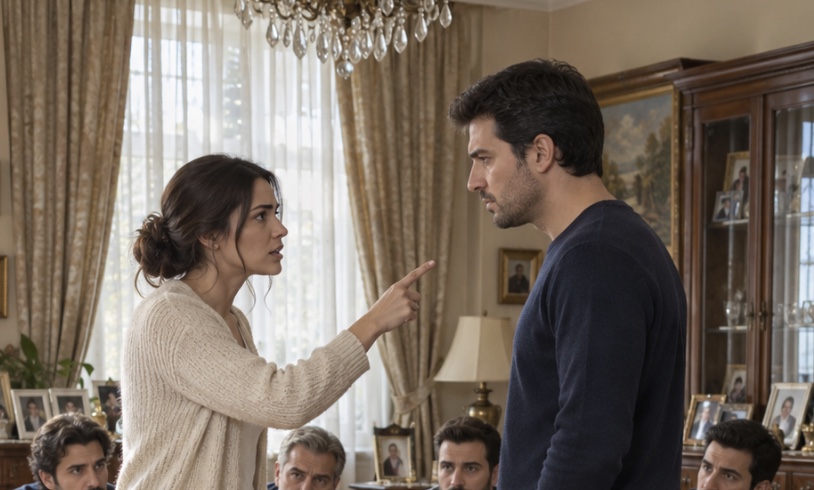
On the fifth day, Pavel really did call his friends.
That evening, four men gathered in our apartment.
They settled in the living room on the new sofa we had recently bought on an instalment plan.
 
Nikita sat closest to the door.
I barely knew the others.
I had only seen them at the wedding.
Emma Arkadyevna came too.
She took the armchair beside the window.
Pavel stood in the middle of the room and began speaking.
He sounded as though he were presenting a case in court.
As though I wasn’t even there.
He explained that his wife refused to behave like a proper wife.
She wouldn’t wash his dishes.
She wouldn’t make him soup.
 
She didn’t respect his mother.
He spoke quickly, losing his train of thought and jumping from one complaint to another. Yet beneath it all was an unmistakably childish hurt.
He sounded like a little boy who believed he had been punished unfairly.
My mother-in-law nodded approvingly at every word.
Eventually, one of his friends—I think his name was Sergey—spoke up.
“Pavel, tell her that yourself. What does any of this have to do with us?”
“I have told her!” Pavel threw up his hands. “A hundred times!”
Then he pointed dramatically towards the kitchen.
Through the open doorway, everyone could see the washing machine.
“There! Look! She won’t even do the laundry! I ask her, and she tells me to wash it myself!”
I followed the direction of his hand.
He was pointing vaguely towards the control panel.
He didn’t even know where the power button was.
Because he had never started a washing machine in his life.
Not at his mother’s house.
And certainly not here.
I stood up calmly.
I walked into the kitchen, opened the drawer beside the stove, and took out the envelope.
Then I returned to the living room.
“May I say a few words now?”
I wasn’t addressing Pavel.
I was speaking to his friends.
Sergey nodded without saying anything.
 
The others watched me closely.
Nikita lowered his eyes.
I unfolded the paper and read the entire thing aloud.
The mandatory breakfast.
The daily floor washing.
The soup.
The starched shirts.
The weekly calls to my mother-in-law.
And finally:
“Pavlik is accustomed to this routine.”
Someone let out a low whistle.
Someone else coughed awkwardly.
Emma Arkadyevna tried to interrupt.
I didn’t give her the chance.
I took the apron off its hook and placed it on the coffee table in front of her.
“Please take this back.”
Then I looked at Pavel.
My voice remained steady.
“I got married because I wanted a husband. I didn’t sign up to be an unpaid servant. I need a partner, not a boss whose mother controls his every move.”
Pavel sank heavily onto the sofa.
For a moment, it looked as though his legs had simply given way.
Emma Arkadyevna cleared her throat softly. To my surprise, for the first time, she had no argument ready.
I went into the bedroom without another word.
I took out the same travel bag I had brought when I moved in after the wedding and began packing my things.
My wedding dress stayed in the wardrobe, neatly protected by its garment bag.
I slipped off my wedding ring and placed it on the bedside table.
As I was leaving the apartment, I looked at Nikita.
 
He was the only one who didn’t look away.
He gave me the smallest nod, as though he understood everything without needing to say it.
That evening, Zhenya welcomed me without asking unnecessary questions.
She made up a bed in a small room, set a glass of water on the bedside table, and quietly said:
“Stay as long as you need.”
I stayed with them for about a week.
Then I found a small apartment near work.
I saw my clients every day, took the bus to the salon, and returned in the evenings to a home where nobody was waiting for me.
And for the first time in a long while, I didn’t feel guilty because there wasn’t a pot of soup on the stove.
At first, Pavel called almost every day.
Gradually, the calls became less frequent.
I never answered.
Later, Zhenya told me that Emma Arkadyevna was now visiting her son regularly, cooking his meals and taking care of the entire household.
Nikita had told her.
Of course, my mother-in-law held me entirely responsible for what had happened.
According to her, an ungrateful daughter-in-law had abandoned poor Pavlik—and had even left her wedding ring behind.
Incidentally, Emma Arkadyevna took the apron back too.
Something else surprised me.
 
After that evening, none of the four friends who had sat in our living room called Pavel again.
“Serves him right,” I thought at first, with more than a little satisfaction.
But as my anger faded, a different thought began to trouble me.
Had I been too quick to leave?
Could this really have been nothing more than the difficult adjustment two people go through when they first start living together?
Perhaps I should have given Pavel—or rather, both of us—one more chance to save our marriage.