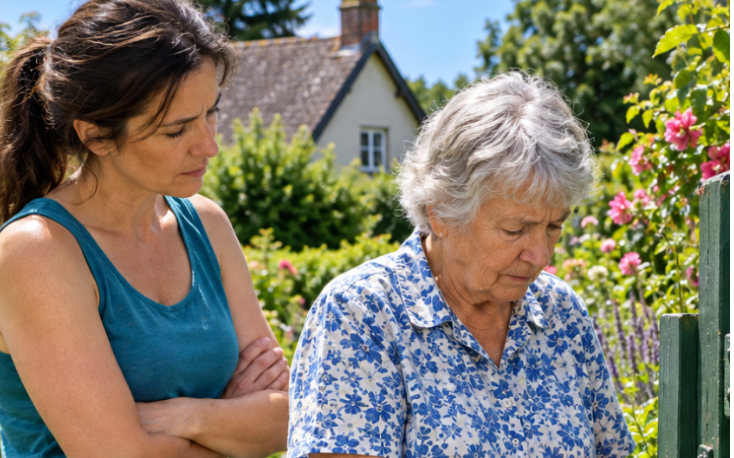
“Lena, we’ve been standing at the gate for fifteen minutes in this heat and the key just won’t turn! Did you change the lock cylinder while we were away? Come on, tell us where you hid the spare, it’s not under the porch. The kids are losing their minds in the car.”
Zinaida Pavlovna’s voice boomed from the phone speaker, so loud and demanding that Lena didn’t even need to put it on speaker mode. Sitting in her city apartment kitchen, hands wrapped around a cooling mug of morning coffee, Lena stared out the window. Saturday morning promised peace and quiet, but that illusion shattered with a single phone call.
Heavy footsteps echoed in the hallway. Her husband Viktor shuffled by in his slippers and peeked into the kitchen. He was still half-asleep, hair sticking out in every direction, looking thoroughly disgruntled that his weekend was kicking off with such noise.
“What’s going on?” he rasped, pouring himself some water from the carafe. “Is that my mom calling? Why did they show up there so early?”
Lena didn’t answer her husband right away. She took a deep breath, steeling herself. The moment she had been mentally preparing for all week had finally come.
“Zinaida Pavlovna,” Lena said into the phone, her tone flat and emotionless. “There’s a very simple reason you can’t open the gate. I really did install a new door on the veranda and changed all the gate locks. And there’s no longer a spare key under the bucket behind the bathhouse.”
A heavy, almost tangible silence fell on the other end of the line. In the background, Lena could hear her sister-in-law’s youngest son fussing, demanding to be let out of his car seat. Viktor choked on his water and stared at his wife with wide eyes.
“What do you mean, you changed them?” her mother-in-law’s voice trembled, that bossy confidence gone—but quickly she snapped back, rising a whole octave in outrage. “Are you out of your mind, Elena? We drove for two hours through traffic! Marina bought a ton of meat for barbecue, our bags are full. Come on, give us the code to the smart lock or tell us where the keys are. Stop messing around, we’re exhausted.”
My husband’s family showed up at my dacha, only to find the locks had been changed
“The keys are in my purse, in the hallway,” Lena replied just as calmly. “And I didn’t invite you to the dacha today. Or next weekend either. In fact, Zinaida Pavlovna, I don’t plan to offer my house for your family outings anymore at all.”
“What on earth are you saying?! Vitya! Bring Vitya to the phone, now!”
Without a word, Lena handed the smartphone to her husband. He wiped his mouth with the back of his hand and took the phone hesitantly, as if it was a grenade with the pin already pulled. He had always been terrified of open conflict between his wife and his family, preferring to stay out of it and hope the women would sort things out themselves.
But Lena wasn’t going to make peace anymore. Watching the bewildered Viktor mumble awkward attempts to calm his mother on the phone, she found herself mentally drifting back to last weekend. That was when her patience—strained over many long years—had finally reached its limit.
Lena inherited her dacha from her parents—not just a plot with a flimsy shed, but a solid, insulated log house with a sturdy stove, a well-tended garden, and a spacious veranda. Her father had built it with care, putting every spare penny into it. After her parents passed, Lena took care of all the paperwork so the dacha was solely hers by law—there was no question of splitting it with anyone. Viktor, her husband, had no legal or financial ties to the place. Lena paid all the taxes, garden community fees, roof repairs, and electrical upgrades from her own salary. Viktor only occasionally helped carry heavy bags from the hardware store, and even then complained that weekends were meant for relaxing on the couch, not hammering nails.
But Viktor’s relatives fell in love with the dacha. At first, they only visited occasionally during the May holidays. Then his mother, Zinaida Pavlovna, began asking for the keys so she could enjoy the fresh air there with her friends. In the last two years, Viktor’s sister Marina started treating the house as her own personal, free vacation spot. She would bring her two noisy sons, her husband, and whole groups of friends along.
Lena put up with it for a long time. She wanted to be a good daughter-in-law and a wise wife, not someone who made a fuss over little things. She overlooked the dirty dishes left in the sink, the trampled flower beds filled with fancy peonies she’d ordered from a special nursery. She quietly washed their bedding, cleared empty bottles from the veranda, and listened to her mother-in-law’s lectures about how the garden beds were arranged all wrong.
But last Sunday, Lena went to her dacha alone to prepare her roses for winter. Viktor stayed in the city. What she found when she stepped through the door made her freeze in her tracks.
A suffocating smell of sour milk and unwashed bodies filled the house. On the expensive handwoven rug—made by Lena’s grandmother—there was a huge sticky stain from spilled cherry juice. A kitchen cabinet door hung from just one hinge. In the fridge, which had been left slightly open, a puddle had formed from thawed, spoiled food; the power had gone out, but no one bothered to check the fuse box.
Stepping outside, Lena found that the well pump was broken. It looked like one of Marina’s guests had tried to fix it themselves, but ended up stripping the threads and just tossed the parts in the grass. The greenhouse had been left wide open, letting the wind ruin what was left of the harvest, and the safety net on the kids’ swing set—something Lena had bought especially for her nephews—had been torn.
In that moment, it was like an invisible switch flipped inside her. All her pity, her desire to please, and her fear of seeming inhospitable disappeared completely. All that remained was a cold, crystal-clear anger. She called in a specialist, paid for an urgent well repair, hired workers who, in just two days, installed a strong new door and replaced all the padlocks on the gates. It cost her quite a sum—the savings she’d set aside for vacation—but her peace of mind was worth far more. She didn’t say a word to Viktor, knowing he would immediately report everything to his mother.
And now, her husband’s relatives had shown up at her country house, only to find the lock had been changed, Lena thought vindictively as she snapped back to reality and looked at her husband, who was starting to look pale.
“Mom, wait, don’t yell,” Viktor muttered, pressing the phone to his ear with his shoulder. “I honestly didn’t know anything. Lena, what are you doing? Why did you change the locks? Let me give them the keys now, otherwise it’s just awkward. They’ve already arrived and brought groceries.”
He reached for the hooks in the entryway where the key rings usually hung, but Lena intercepted his hand. Her glare was so intense that Viktor instinctively stepped back.
“Put the phone on the table. And turn on the speaker,” she ordered.
Her husband followed the instructions without protest. Instantly, Marina’s outraged voice burst from the speaker—it sounded like she’d snatched the phone from her mother.
“Lenka, have you lost all sense of shame? We’re out here sweating in the sun with the kids! Open up, we have every right to be here! My brother is your husband, so the house is shared. Are you putting on a show or what?”
“Marina, listen to me very carefully,” Lena said, leaning her hands on the countertop and enunciating each word. “The house is not shared. It’s mine. Legally, factually, and morally. My father built this house, I invest my own money into it. There’s not a single nail from your family here.”
“How dare you throw that in our faces!” Viktor’s mother jumped in, her voice shaking with outrage. “We’re family! We’re relatives! Vitia’s salary is shared with you, so the money going into the house is shared too.”
“That’s not correct, Zinaida Pavlovna. For the last three months, Viktor’s salary has gone toward paying off the loan for Marina’s car. You all personally begged him to help his sister. And the pump at the house, which your daughter’s husband broke last weekend—I paid to have that fixed myself. Twenty-five thousand rubles.”
There was a brief silence on the line. Apparently, Marina hadn’t told her mother about the broken equipment.
“What pump?” Viktor asked in confusion, glancing from the phone to his wife. “You never told me about that.”
“And why would I tell you? Would you have fixed it? No. You would have said it was just an accident and asked me not to fight with your sister,” Lena said with a bitter smile. “I went there last Sunday. The house was a mess—cupboard door ripped off, grandma’s carpet soaked in juice, rotten food in the fridge, and the well was broken. You didn’t even take the trash out—all the bags were left on the veranda, and stray dogs dragged them everywhere.”
“So what if we left some trash behind?” Marina snapped as she quickly pulled herself together. “The kids were tired, we were in a rush to get back to the city. You could have just cleaned up after your nephews—your crown wouldn’t have fallen from your head. And the pump broke on its own, it was old. My Kolya just wanted to check why the water wasn’t running.”
“That’s exactly why I’m done cleaning up after you, fixing things, and taking out your trash. There’s a new lock on the gate now. You might as well turn around and head back to the city. Or maybe check into a paid tourist site, since you bought meat anyway. My property is off-limits to you now. For good.”
Lena reached to hang up, but Viktor suddenly covered the phone with his hand. His face flushed a deep red—the situation was spiraling out of control, and the familiar world where his wife’s patience smoothed over every conflict was crashing down before his eyes.
“Lena, you’re out of line,” he hissed through clenched teeth. “That’s my mother. My sister. You’re humiliating me in front of them. Give me the keys right now, I’ll go and open the house for them myself. Then we’ll talk about this. You can’t just kick my family out onto the street.”
“They’re not out on the street, Vitia. They’re in their own car, and they have their own apartments in the city.”
“That’s not the point—it’s about principle!” her husband shouted. From the phone’s speaker came Zinaida Pavlovna’s approving hum. “I am the man of the house, and I decide who gets to come here!”
Lena slowly straightened up. All the exhaustion of the past years, every unspoken grievance, every time she’d kept quiet just to preserve a false sense of peace—all of that boiled up in her at once. She looked at the man she’d lived with for ten years and suddenly realized she didn’t respect him at all. He was willing to sacrifice her nerves, her money, and her personal space, all just to avoid hearing complaints from his brazen relatives.
“Master of the house?” she repeated quietly, but with such force that Viktor flinched. “A true master is someone who takes care of things. Someone who hammers in a nail, fixes the fence, and stands up for his wife when her home is disrespected. But you, Vitia, you’re just a guest. Same as they are. Someone who just shows up when everything’s already done.”
“Don’t you dare talk to me like that!” Viktor slammed his fist on the table. “If you don’t hand over the keys right now, I’m packing my things and moving in with my mother! We’ll see how you sing when you’re all alone!”
Threatening to leave was always his favorite move. In the past, Lena would get scared, start crying, beg for forgiveness, and try to find a compromise. The thought of being alone at forty-five used to terrify her—divorce seemed like the end of everything. But now, seeing his angry, flushed face and hearing his mother on the phone agreeing: “That’s right, son, let her sit alone and think about her behavior,” Lena felt nothing but an incredible sense of relief. It was as if a fresh breeze had burst into a stuffy room.
She turned around, walked out of the kitchen, and headed for the bedroom. Viktor looked proudly at the phone, sure his wife was going to fetch her purse with the keys.
“Mom, everything’s fine. I’ll be there soon,” he said into the phone. “Wait a little longer in the car, turn on the air conditioning. She’s just stressed from work, you know how women can be.”
There was the sound of the closet door opening, then the unmistakable zip of a suitcase. A couple of minutes later, Lena appeared in the hallway again. She didn’t have the keys in her hands. Instead, she was dragging Victor’s large plastic suitcase they usually took on vacation. Right after, a sports bag went flying—Lena had swept his t-shirts, jeans, and underwear from the shelves without even looking.
“What are you doing?” Victor’s voice cracked into a falsetto as he rushed into the hallway, forgetting to hang up his phone.
“I’m helping you pack,” Lena calmly unzipped her husband’s jacket hanging on the hook and tossed it on top of the bag. “You wanted to go to your mother’s, right? Go ahead. You’ll make it just in time for the barbecue.”
“Are you… kicking me out? Because of some country house? Over a piece of land?”
“No, Vitya. I’m not kicking you out over the country house. I’m doing it because I don’t exist in this marriage. There’s you, your mother, your sister’s problems, your nephews, the loans—but there’s no room for me, my feelings, my things, or my effort. Take your suitcase.”
Victor’s mother, listening on the phone, finally realized where this was headed, and her anger quickly turned to panic.
“Lenochka, sweetheart, what on earth are you thinking?” Zinaida Pavlovna wailed. “Getting divorced over such a silly thing! So you had an argument—just forget it! Vitya, stop her!”
But Lena had already opened the front door. Cool air from the stairwell swept into the apartment.
“The exit’s that way, Victor. You can come by for the apartment keys tomorrow—by then, I’ll have changed this lock too,” she said, placing the suitcase on the threshold.
Victor stood there, blinking in confusion. All his bravado had vanished. He looked from the suitcase to his wife and back, realizing she wasn’t joking. No tears. No drama. Just a cold, concrete resolve.
“Lena, wait—” he tried to grab her hand, but she pulled away. “Let’s just talk, okay? I didn’t realize this was so important to you. I’ll tell Mom to leave, I swear. Mom? Do you hear me? Go back to the city, we’ll sort this out ourselves.”
“Son, what do you mean? But what about us?” Zinaida Pavlovna squeaked in confusion from the phone.
“I said go!” Victor snapped unexpectedly, then ended the call and threw the phone onto the table.
He let out a heavy sigh, shoulders slumping with guilt, and dragged the suitcase back into the hallway. Without meeting his wife’s eyes, he went out to the balcony, took out a cigarette, and lit up—even though Lena had forbidden smoking inside long ago. But this time, she didn’t say a word.
She closed the front door, leaned against it, and shut her eyes. The tension was still vibrating inside her, but deep down she felt incredibly light and at peace. She had stood up for herself. For the first time in years, she hadn’t let herself be walked over.
An hour later, Victor’s phone buzzed with a lengthy message from his sister, full of outrage and accusations of betraying the family. He read it, deleted it grimly, and headed to the kitchen to do the dishes—a task so rare that, at any other time, Lena would have been surprised.
The family’s weekend getaways to the dacha were now a thing of the past, gone forever. Lena realized she was in for some tough conversations ahead—her mother-in-law’s hurt feelings, her sister-in-law’s attempts at manipulation, and maybe even a long journey of setting new boundaries with her own husband. If their marriage could even survive this change. But one thing she was certain about: next weekend, she’d go to her beloved dacha alone. She’d make herself a cup of coffee, settle onto the veranda behind her new, secure door, and listen only to the birdsong—knowing that the key to her peace was finally in her own hands.