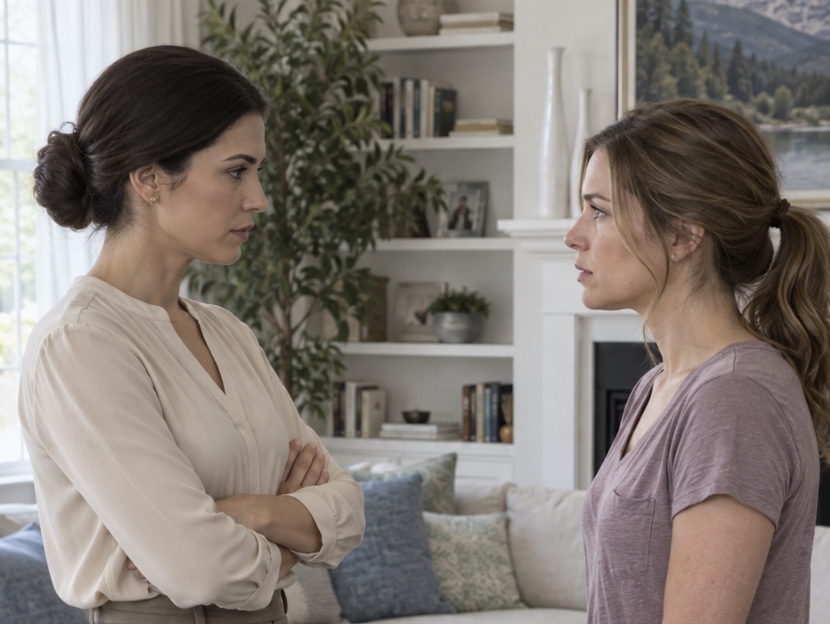
“Sveta, open the gate. We’ve arrived with our things, and we’re not going to stand out here in the sun all day.”
Olga’s voice came through the phone at the same moment someone began pounding insistently on the metal gate.
Svetlana looked up from her desk and checked the time. Almost two hours remained until the end of her shift. Outside the dispatch office window, the August heat shimmered above the asphalt, and the few pedestrians passing by kept to the narrow strips of shade beside the buildings.
“What things?” she asked.
“The usual. Clothes, shoes, some dishes. Artyom’s here with me.”
“I’m at work.”
“Is the key under the awning? You used to leave a spare there.”
Svetlana straightened in her chair.
“There hasn’t been a spare key there for a long time.”
“Then come home and let us in. We’ll wait in the yard.”
The call ended before Svetlana could ask another question.
For several seconds, she stared at the dark screen. Then she called her neighbor Irina, who lived two houses away. Irina answered almost immediately.
“Sveta, there’s a car outside your gate. A woman’s unloading suitcases, and a young man’s carrying boxes.”
 
“That’s my sister.”
“Should I go over?”
“No. Just let me know if they try climbing over the fence.”
“They’ve already opened the gate.”
Svetlana frowned sharply.
“How?”
“The young man reached between the bars and lifted the latch. You only secure it with that bolt on the inside.”
Svetlana closed her eyes and slowly exhaled through her nose. Even she had not expected Olga to go this far. Their conversation a few days earlier had been unpleasant, but perfectly clear: she had offered her sister help with renting an apartment, not permission to move into her house.
“They won’t get inside. The door’s locked.”
“They’re already walking around the property. There’s one box by the porch and two more near the shed.”
“All right. Thank you.”
Svetlana arranged for a colleague to cover the rest of her shift, gathered her belongings, and went outside.
On the drive home, she did not rehearse an argument or think up hurtful things to say. Instead, she carefully recalled what she had told Olga over the phone, the apartment she had found, and why her sister had apparently decided that her refusal meant nothing.
Svetlana had inherited the house after their parents died.
She and Olga received their inheritance after the required six-month waiting period. Their parents had left no will, so the property was divided between the daughters in shares of equal value.
 
Svetlana received the old family house and its land. Olga received a smaller apartment in town, some of their parents’ savings, and their father’s car. To ensure the two shares were comparable in value, the sisters signed an agreement before a notary. Neither felt she had been treated unfairly.
By then, the house needed considerable work. The roof leaked in two places, the boards on the enclosed porch had dried out and split, the wiring dated back to Soviet times, and the bathroom was cold in winter. Their parents had kept everything functional, but in their final years they no longer had the strength to make improvements.
Olga said immediately that she did not want the house.
“I’m used to living in town. A yard, snow to clear, grass to cut—that’s not for me. Take the house. Just don’t complain later about how much it costs to maintain.”
Svetlana never complained.
During the first two years after the inheritance was settled, she concentrated on essential repairs. She replaced the wiring, fixed the roof, reinforced the front steps, and repaired the heating system. Later, she gradually renovated the bathroom, insulated the floors, installed new windows, and redid the kitchen.
She hired tradespeople for some jobs, but did much of the work herself. She sanded wooden surfaces, assembled cabinets, laid the path from the gate to the porch, repaired hinges, and replaced broken handles.
She spent her savings carefully. First, she made a list of the work needed, compared prices, and postponed anything unnecessary. The house improved slowly, but she avoided debt and unfinished renovations.
Olga handled her inheritance differently.
 
First, she sold their father’s car and bought a more expensive one. A few months later, she went on an extended vacation, returning with photographs of hotels, restaurants, and boat trips.
Svetlana made no comment. The money belonged to her sister, and Olga had every right to decide how to spend it.
Then Olga opened a small home goods shop. She rented premises in a shopping center on the outskirts of town, bought far too much stock, and did very little planning. Customers were scarce, the rent kept coming due, and the merchandise sat on the shelves.
Once, Svetlana offered to go through the contracts and expenses with her, but Olga brushed her off.
“I’ll figure it out myself. You don’t know anything about retail.”
The shop closed eight months later. Olga sold some of the stock at discounted prices and stored the rest in an acquaintance’s garage. For a long time afterward, she insisted that she had simply been unlucky with the location.
The sisters did not argue about their inheritance. For several years, they barely discussed money at all. They met on birthdays, sometimes called each other on weekends, and exchanged news and holiday greetings.
Olga lived in her apartment with her adult son, Artyom. He had recently turned twenty-five. He had changed jobs several times, never stayed anywhere long, and believed the right opportunity would eventually come along on its own.
 
Svetlana rarely offered her nephew advice. Artyom was an adult, responsible for his own decisions.
The first troubling conversation happened in early August.
Olga called one evening and asked whether her sister was home.
“I am. What’s happened?”
“I’ll have to sell the apartment.”
Svetlana put down her screwdriver. She had been replacing the handle on the pantry door.
“Why?”
“I’ve built up some debts.”
“What kind of debts?”
At first, Olga gave evasive answers. Gradually, however, it emerged that she had failed to settle several financial obligations after closing the shop. Then she had taken out new loans to cover old payments. When that stopped being enough, she began falling behind on everything.
“Have you listed the apartment already?”
“There’s a buyer. The sale should go through soon.”
“Where will you live?”
“That’s why I’m calling.”
Svetlana immediately grew wary, but let her sister finish.
“Artyom and I need somewhere to stay for a while. Not long. Just until things get better.”
“I’ll help you find an apartment to rent.”
“Why pay strangers when you have an entire house?”
“Because this house is my home.”
“I’m not saying we’d stay forever.”
 
“How long, exactly?”
Olga fell silent.
“Until I find a job.”
“That could take several months.”
“Or a couple of weeks.”
Svetlana stood and walked across the kitchen.
“I’ll find you an affordable apartment and pay the first month’s rent. That will give you time to find work, and Artyom can contribute to the expenses too.”
“Are you seriously suggesting I rent some cramped apartment when you have two empty rooms?”
“I have a guest room and a home office. They aren’t unused.”
“Sveta, we’re family.”
“That’s exactly why I’m offering practical help.”
“That isn’t help. You’re just trying to pay me off.”
Svetlana tightened her fingers around the back of a chair, but answered calmly.
“I’m offering to pay for a month of housing and help you find it. That’s a reasonable way to support you.”
 
“I don’t need anything from you.”
Olga hung up.
The next day, Svetlana called an acquaintance who handled apartment rentals anyway. The woman found a small two-bedroom apartment in an older building near a bus stop. It was clean and had the necessary furniture and appliances. The owner was willing to sign a lease that weekend.
Svetlana sent her sister the photographs and phone number.
A reply arrived a few minutes later:
“We’re not going there.”
Svetlana did not try to persuade her.
She assumed Olga would find another option or return to the conversation later. Instead, her sister chose an entirely different approach.
When Svetlana arrived home, the gate stood wide open. Suitcases, boxes, and two large bags were piled beside the porch. Artyom was taking a sports bag out of the car, while Olga spoke on the phone beneath the apple tree.
“Put the boxes in the living room,” she told her son. “We’ll sort everything out afterward.”
Artyom spotted his aunt’s car and stopped.
Svetlana switched off the engine, got out, and closed the gates behind her.
“Where did you get a key to the house?”
Olga put her phone into her handbag.
“We don’t have a key. The door wasn’t locked.”
“It was locked.”
“Then Artyom opened it.”
Svetlana looked at her nephew.
He avoided her eyes and rubbed the back of his neck.
“The porch window was partly open. I reached in and turned the handle.”
 
“So you entered my house through a window?”
“Aunt Sveta, don’t say it so loudly. We’re family.”
Without a word, Svetlana walked toward the porch. Two boxes were already inside, and the door leading into the house stood open.
Unfamiliar shoes lay in the hallway. In the guest room, Olga had already opened her suitcase, put clothes in the wardrobe, and arranged her cosmetics on the dresser. Her handbag lay on the bed.
In the home office, Artyom had stacked boxes beside the desk and removed the throw from the armchair, apparently deciding that he would sleep there.
Svetlana inspected everything without comment. Then she returned to the hallway.
“Come into the living room.”
“We’ll bring the rest of our things in first,” Olga replied. “It’s hot outside.”
“Leave them where they are.”
The homeowner’s tone left no room for negotiation.
Olga lifted her chin indignantly, but went into the living room. Artyom sat on the edge of an armchair, stretching his legs out. Svetlana remained standing beside the table.
“Who gave you permission to enter the house?”
“Stop making a scene,” Olga said. “We have nowhere to live.”
“I asked you a specific question.”
“I’m your sister. Artyom is your nephew. What other permission do we need?”
“Mine. Because this house belongs to me.”
Olga gave a mocking smile.
“This house belonged to our parents.”
“It did. After they died, we divided the inheritance. I received the house. You received the apartment and the other assets.”
“Don’t start counting who got what.”
 
“That’s exactly what we need to discuss right now.”
Artyom stood.
“I’ll probably take the things back to the car.”
“Sit down,” Olga said. “Your aunt will calm down in a minute.”
Svetlana turned to her sister.
“You spent your share of the inheritance long ago. Now you’ve decided to live at my expense?”
Olga immediately stiffened. Red blotches appeared on her cheeks.
“Are you deliberately humiliating me in front of my son?”
“Artyom came with you and intended to move in without my consent too. He needs to understand what’s happening.”
“What’s happening is that I’m going through a difficult time.”
“A difficult time doesn’t give you the right to enter someone else’s house through a window.”
“I’m not just someone else!”
“As far as the ownership documents are concerned, this house belongs solely to me. As far as our relationship is concerned, you should have asked and accepted my answer.”
Olga slapped the armrest.
“Our parents always wanted us to support each other.”
“They supported both of us. The inheritance was divided equally.”
“This house is worth much more than that apartment.”
“Now, perhaps. Because I’ve spent years putting money and work into restoring it. When we divided the estate, the property was valued, and you signed the agreement willingly.”
Olga turned toward the window.
“Of course. You always remember everything.”
“When it concerns my home and my expenses, yes.”
Artyom looked anxiously at his mother.
 
“Mom, maybe we really should rent an apartment.”
“Stay out of this.”
“I’m already in it. My things are here.”
“You were happy enough to live with your aunt.”
Svetlana looked at her nephew.
“Are you working at the moment?”
Artyom scratched his eyebrow.
“I’m looking.”
“When did you leave your last job?”
“In June.”
“Have you found any temporary work in those two months?”
“I’ve looked at some options.”
“Looking and working are two different things.”
Olga turned sharply.
“Don’t you dare lecture him.”
“Then don’t bring your grown son into my house expecting me to support him.”
“Nobody’s asking you to support us.”
“You arrived without a rental agreement, without a departure date, and without a plan for what comes next. You didn’t even bring groceries for yourselves. What exactly am I supposed to make of that?”
 
Olga opened her mouth, but had no immediate answer.
Svetlana walked to the window and closed the sash Artyom had used to enter the porch. Then she checked the handle.
“A few days ago, I offered to find you somewhere to live and pay the first month’s rent. You refused.”
“That apartment is unlivable.”
“You haven’t even seen it.”
“The photographs were enough.”
“It has two bedrooms, a kitchen, a bathroom, furniture, and appliances. The bus stop is five minutes away. What exactly makes it unlivable?”
“The neighborhood’s bad.”
“It’s an ordinary neighborhood.”
“The building’s old.”
“Your apartment wasn’t new either.”
“Why are you clinging to this house so desperately? There’s enough room for everyone.”
Svetlana turned to her sister.
“Because wanting to live somewhere for free doesn’t make the rooms available. If you move in, you bring extra expenses, cleaning, groceries, different routines, and endless arguments about when you’ll leave. Even now, you can’t tell me when you’d move out.”
“Until I sort out my debts.”
“You’re selling the apartment. Some of the debts will be paid after the sale.”
“Not all of them.”
“Then you both need jobs and a rental you can afford all the more.”
Olga clasped her hands in her lap.
“You could at least let us stay for a few months.”
“No.”
The answer was so calm that Olga was momentarily at a loss.
“Just like that?”
 
“Yes.”
“So you’re throwing your sister onto the street?”
“No. The apartment I found is still available. I can take you there today, pay the first month, and help you arrange the lease.”
“And after that?”
“After that, you pay for it yourselves.”
“With what?”
“You get a job. So does Artyom.”
Her nephew frowned.
“I’m willing to work.”
“Then start tomorrow.”
“Easy for you to say.”
“Supporting two adults indefinitely would be much harder.”
Olga stood and paced around the room. She adjusted her hair, wiped her forehead, and stopped in front of her sister.
“I thought you’d understand my situation.”
“I do. That’s why I found an apartment and offered to pay for the first month.”
“You turn everything into a calculation.”
“Because appeals for support often conceal a very convenient arrangement: one person deals with their problems while someone else takes on the costs and inconvenience.”
Olga glanced at the open suitcase in the next room.
“I wasn’t planning to stay here for years.”
“How long were you planning to stay?”
“Until I found a decent job.”
“A week? A month? Six months?”
“I don’t know.”
 
“That’s why you won’t be living here.”
Artyom quietly rose from the armchair.
“Mom, Aunt Sveta is right about one thing, at least. We came without warning.”
Olga snapped her head around.
“Now you’re against me too?”
“I’m not against you. But we really did climb in through a window. That isn’t normal.”
“You’re the one who opened it.”
“Because you said Aunt Sveta would let us stay.”
Svetlana studied her sister.
“So you convinced Artyom in advance that I would agree?”
Olga said nothing.
“And when were you planning to tell me you were staying? After you’d put all your clothes away?”
“I knew you’d start refusing again over the phone.”
“So you decided to present me with a done deal.”
“Because there’s no other way to deal with you.”
Svetlana went into the guest room, closed the suitcase, and set it on the floor.
“Put your clothes back. The apartment is about forty minutes away.”
Olga did not move.
“I’m not going anywhere.”
“Then I’ll call the police and report that people entered my home without permission.”
Her sister laughed in disbelief.
“You’d call the police on your own sister?”
“If you refuse to leave my house, yes.”
Artyom immediately headed toward the office.
“I’ll carry the boxes out.”
“Stop!” Olga raised her voice.
He turned.
“Mom, enough. I don’t want the police coming here because we can’t leave like reasonable people.”
“You were perfectly happy ten minutes ago.”
“I thought you’d agreed on this.”
“Now you know we hadn’t,” Svetlana said. “You can either help your mother move into the rental or keep this argument going.”
Artyom picked up the first box.
Olga stood in the middle of the living room, holding her handbag tightly against her side. Her nostrils flared, and her gaze darted between her son and her sister. She had clearly expected Svetlana to make excuses, give in to keep the peace, or back down for fear of a family argument.
But Svetlana had already opened the door and carried one of the suitcases onto the porch.
“Don’t touch my things!” Olga shouted.
 
“Then carry them out yourself.”
“I said I’m staying.”
Svetlana took out her phone and dialed.
“Who are you calling?”
“The apartment owner, for now. I want to check whether she can meet us today. If you don’t leave voluntarily, my next call will be to the police.”
Olga clenched her teeth.
“You wouldn’t do it.”
Svetlana looked straight at her and said nothing.
A few seconds later, a woman answered.
“Good afternoon, Natalya Sergeyevna. Is the apartment still available? Yes, my relatives can come and see it today. We’ll be there in about an hour.”
She ended the call.
“Pack your things.”
Olga grabbed the suitcase and began putting her clothes inside. She moved hurriedly, crumpling blouses and throwing them on top of her shoes.
“Believe me, I’ll remember this day.”
“Remember that housing arrangements should be made before you arrive with suitcases.”
“Our parents wouldn’t recognize you.”
Svetlana stopped in the doorway.
“Our parents taught us to take responsibility for our decisions. They gave us equal starting points. I kept my share of the inheritance and invested in the house. You spent yours as you saw fit. I didn’t demand your car, ask you to pay for my repairs, or claim a right to your apartment.”
“You always do everything right.”
“No. I make mistakes too. But I don’t make you responsible for them.”
Twenty minutes later, the belongings were back beside the car.
Svetlana checked the rooms to make sure nothing had been left behind. Then she closed the porch window, locked the front door, and inspected the gate.
“Why are we using your car?” Olga asked.
“Because everything won’t fit in yours. Artyom will ride with you, and I’ll take some of the boxes.”
“You could have hired a delivery service.”
“I could have. But I promised to help.”
Olga gave her sister a hard look, but made no further objections.
 
The apartment was on the fourth floor of a five-story building. The stairwell was clean, and the windows overlooked a courtyard with large trees. Inside were two small bedrooms, a kitchen with basic cabinets, a refrigerator, a washing machine, and a sofa.
The owner, Natalya Sergeyevna, met them outside the entrance and immediately explained her conditions.
“I rent everything formally. Both tenants will be named in the lease. Utilities are paid separately. No smoking inside.”
“We don’t smoke,” Artyom said.
Olga walked through the rooms, opened a wardrobe, checked the bathroom tap, and looked out the window.
“It’s stuffy in here.”
“It’s August,” Svetlana said calmly. “Open a window.”
“And the kitchen’s small.”
“There’s enough space for two people.”
Natalya Sergeyevna looked questioningly at Svetlana.
“Will you be taking it?”
Olga was about to speak, but Artyom answered first.
“Yes.”
The owner took out the prepared lease.
Svetlana read every clause carefully. The document specified the rental period, the rent, how utilities would be paid, and the condition of the furniture and appliances.
As promised, Svetlana paid for the first month. Natalya Sergeyevna provided a receipt confirming payment.
“Starting next month, you pay yourselves,” Svetlana told her sister and nephew. “The due date is in the lease.”
“I see it,” Artyom replied.
Olga said nothing.
They carried the boxes and suitcases upstairs. Svetlana helped bring everything into the rooms, but left the unpacking to them.
Before leaving, she placed a list of organizations hiring staff on the kitchen table. Her acquaintance had sent her the openings that morning.
“There are options here for you and several for Artyom. The phone numbers and addresses are listed.”
Olga picked up the sheet with two fingers.
“So you’ve chosen our jobs for us too?”
“No. I found some possibilities. You’ll choose and make the arrangements yourselves.”
 
“As if we couldn’t manage without you.”
“Then that’s good.”
Svetlana headed for the door.
Artyom caught up with her in the hallway.
“Aunt Sveta, thank you for the apartment.”
“Show your thanks through your actions. Don’t make the owner wait for her rent.”
“I’ll call two of these numbers tomorrow.”
“Call today. The working day isn’t over yet.”
He nodded and took out his phone.
Olga remained in the kitchen. She did not say goodbye.
Svetlana did not go back to have the last word. She had provided help, the lease was signed, and the belongings were in the apartment. The rest was no longer up to her.
Her house greeted her with silence.
She walked through the rooms, aired out the guest bedroom, wiped the wardrobe shelf, and returned the throw to her office. Then she took out a screwdriver and checked the fittings on the porch window.
The following day, Svetlana installed a new handle with an interior locking mechanism. The window could no longer be opened from outside. She also fitted the gate with a proper lock that could not be reached through the bars.
She did not call Olga.
Three days later, Artyom sent a message. He had found a job as a warehouse assistant and was due to start on Monday. It was not the work he had dreamed of, but it would allow him to contribute to the rent.
Svetlana replied briefly:
“Good. Don’t be late on your first day.”
Olga called a week later.
“You could at least have asked how we were settling in.”
“If there had been a serious problem, you would have called.”
“So you don’t care.”
“I care whether you’ve started looking for work.”
There was a pause.
“I had an interview.”
“How did it go?”
“They invited me back for a second round.”
“Good.”
“Artyom’s working now.”
“He told me.”
Olga sighed heavily.
“Are you satisfied?”
“With what?”
“With making us live separately.”
“I’m glad you have somewhere to live and have started dealing with your situation.”
“You could have been gentler.”
“Then you’d still be in my guest room, explaining why you couldn’t move out yet.”
 
Olga said nothing and ended the call.
In September, she found a job as an administrator at a service center. Her duties included speaking with customers, keeping records, and tracking service requests. The first few weeks felt unfamiliar, but the work itself was straightforward.
Several times, Olga complained to Svetlana about the early mornings, strict manager, and constant phone calls. Her sister listened without offering money or taking responsibility for solving her problems.
Artyom continued working at the warehouse. A month later, he was offered a position with more responsibility. He began paying part of the rent and buying groceries himself.
The apartment sale proved more complicated than Olga had expected. After paying off debts, she had far less money left than she had planned. Previously, she would have looked for someone to blame. Now, however, she dealt with her own financial documents every day and could no longer tell herself the money had disappeared by chance.
Svetlana did not ask how much remained or exactly whom her sister owed. Only once did she remind her:
“Don’t take on new obligations until you’ve settled the old ones.”
“I understand that now.”
By winter, Olga had repaid most of her debts. The remaining payments were clear and manageable. She no longer mentioned moving in with her sister or asked her to keep paying the rent.
In early December, the sisters met at a small café. It was their first relaxed meeting since the move in August.
Olga arrived first and chose a table by the window. She looked tired, but composed. A folder lay in front of her.
“What’s that?” Svetlana asked.
“A schedule for my remaining payments. I write everything down now.”
“A useful habit.”
“Don’t make fun of me.”
“I’m serious.”
 
Olga ran a finger along the edge of the folder.
“Artyom wants to rent a room closer to work.”
“So things are going well for him.”
“Yes. He’s even started saving.”
Svetlana nodded.
For a while, they discussed everyday news. Then Olga put down her spoon and looked at her sister.
“I really was planning to stay with you for a long time.”
Svetlana did not pretend to be surprised.
“I realized that.”
“At first, I thought a month. Then I decided we could stay until spring. I’d work, keep my earnings, and pay off my debts.”
“And the household expenses?”
“I barely thought about them.”
“Cleaning, groceries, heating, water?”
“I didn’t think about them,” Olga repeated. “It seemed to me that you already had everything, so two more people wouldn’t make a difference.”
“They would have.”
“I know that now.”
She fell silent, looking down at the folder.
“I was counting on you not being able to turn us away. I deliberately came during the day, while you were out. I wanted to unpack, take the rooms, and then tell you it was too late for us to move somewhere else.”
“I realized that too.”
“You don’t have to keep repeating it.”
 
“I’m not.”
Olga rubbed the bridge of her nose.
“I hate remembering how we opened that window.”
“I hope you won’t do anything like that again.”
“I won’t.”
“Then let’s leave it back in August.”
Olga looked up.
“You helped us anyway. You could have simply called the police.”
“I promised to pay the first month’s rent, and I kept my promise.”
“At the time, I saw that apartment as a punishment.”
“And now?”
“Now I understand it was the only sensible option.”
Svetlana moved her cup slightly aside.
“Help should give someone a way out of their difficulties, rather than make it easier to settle into them.”
Olga gave a small smile, without her former sharpness.
“You always talk as though you’ve thought everything through beforehand.”
“Not everything. Only the things I’ll end up paying for.”
“That’s fair.”
It was the first time Olga had said those words.
 
After that meeting, the sisters’ relationship became calmer. They did not become inseparable or start calling each other every evening. But the unspoken resentment disappeared, along with the expectation that one of them was obliged to fix the consequences of the other’s decisions.
In spring, Olga moved into a smaller, cheaper apartment. By then, Artyom was living separately. Each paid for their own housing and planned their own expenses.
One day, Olga came to visit Svetlana. She called ahead, agreed on a time, and waited outside the closed gate.
Svetlana came out to meet her.
“Can’t open it?” Olga asked, looking at the new lock.
“You can’t reach it from outside anymore.”
“Sensible.”
They walked into the yard. The house looked solid and well maintained. Svetlana had recently replaced a porch step, and the first plants were beginning to emerge beside the path.
Olga stopped and looked around carefully.
“I used to think you’d simply been lucky to get the house.”
“It was old and needed repairs.”
“I know. But I never noticed how much you put into it. I only saw the finished result.”
“That happens.”
“And I treated my share of the inheritance like an endless supply. As though the money could never run out.”
“It always runs out if all you do is spend it.”
Olga nodded.
“It’s a good thing you didn’t let us stay.”
Svetlana opened the front door.
 
“It’s a good thing you understand that now.”
From that day on, the inheritance stopped being a source of conflict. Both sisters had received equal opportunities and used them differently. Svetlana preserved the house and spent years investing time and effort in it. Olga went through mistakes, debt, and a forced move, but eventually learned to rely on herself.
Svetlana had not refused to help her sister. She found housing, paid the first month’s rent, transported the boxes, and provided contacts for potential employers. But she did not allow that support to become an indefinite obligation to maintain two other adults.
An inheritance comes only once. Living at someone else’s expense, however, can continue for years when there is always someone nearby who is afraid to give a firm “no.”