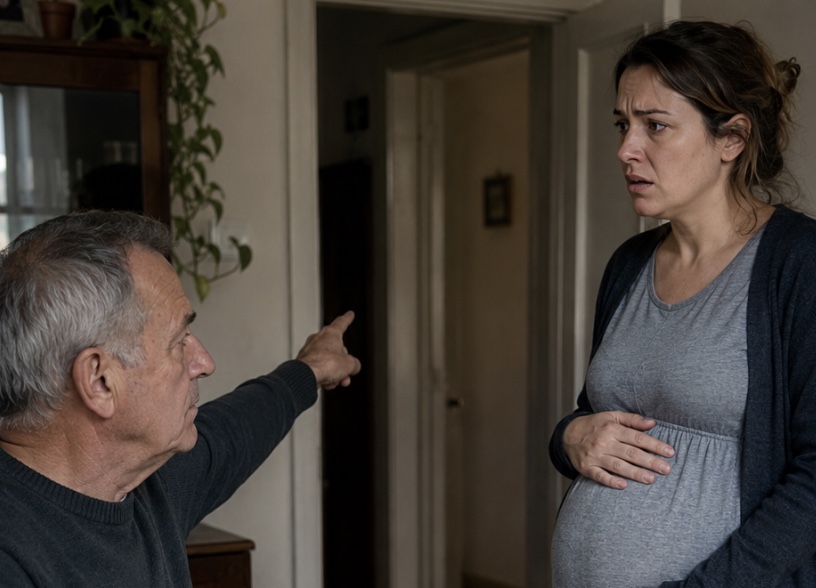
Alina froze in the middle of the kitchen. Her hands moved instinctively toward her stomach, one palm settling over the already visible curve as though she could shield her baby from the words she had just heard. Her pulse pounded in her ears.
Not long ago, this very man had driven over to pick her up himself. He had silently loaded her suitcases into the car, then told her mother-in-law exactly what he thought of her behavior. He had repeated again and again that her parents’ home would always be open to her. That no matter what happened, his daughter could count on him.
And now he was sitting across from her with a stone-cold expression, giving her an ultimatum.
Nadezhda Mikhailovna stood by the window with her back turned. Her shoulders were tense.
Alina opened her mouth, but not a single word came out.
 
Alina had grown up in a home where people knew how to talk to one another. Not shout. Not bury problems in silence. Actually talk.
In the evenings, her parents would often sit in the kitchen for hours, and when Alina was little, she sometimes fell asleep listening to the soft murmur of their voices. Viktor Sergeyevich and Nadezhda Mikhailovna had overcome plenty of obstacles themselves before finally building a life together, and those struggles had taught them to appreciate what they had.
“Family isn’t a celebration,” her father used to say when Alina was old enough to understand. “It takes work. But a husband has to stand beside his wife, no matter what happens.”
Her mother always added:
“And don’t ever lose yourself. Know your worth.”
Alina remembered both lessons.
After graduating from medical college, she found a job as a nurse at the city hospital. The work was exhausting, but she loved it. She loved feeling useful, the constant movement of her shifts, and the people she worked with.
That was where Ilya first appeared in her life.
He was a driver for a transportation company and regularly delivered medical supplies to the hospital. Every time he came through the staff entrance, his greeting seemed to last just a little longer than necessary.
Eventually, he began waiting for her after night shifts.
There was never any grand explanation. He would simply be standing beside his car with two cups of coffee and a smile.
“How did you know I was working nights today?” she asked him once.
 
“I asked the security guard,” he replied calmly.
One winter night, around half past one in the morning, Alina got a flat tire on an empty road. She called Ilya almost as an afterthought.
He arrived twenty minutes later without a single complaint.
A year later, he proposed.
Alina said yes.
Her parents liked him immediately.
One evening after dinner, once the plates had been cleared away and tea had been poured, Viktor Sergeyevich looked at his future son-in-law and spoke quietly.
“Take care of my daughter. Everything else will work itself out.”
Ilya nodded seriously without saying anything unnecessary.
Her father liked that.
After the wedding, the newlyweds decided to move temporarily into Ilya’s parents’ house. It was a large home on the edge of the city, quiet and spacious, with the entire second floor available to them.
Ilya’s mother, Larisa Pavlovna, had insisted on the arrangement herself.
“Why waste money renting a place?” she had said. “The house is big. Kolya and I will stay downstairs, you two can have the second floor. We’ll hardly even get in each other’s way.”
 
It seemed sensible.
Temporary.
Everyone believed that in a year or eighteen months, Alina and Ilya would have enough money for a down payment and move into a home of their own.
No one imagined how long that word “temporary” would stretch.
The first cracks appeared slowly.
At first, Alina blamed everything on personality. Larisa Pavlovna was simply used to being in charge of the house. That was all.
But over time, it became obvious that, in her mind, the second floor had never really belonged to Alina and Ilya.
She entered without knocking.
Always.
At any hour of the day, sometimes early in the morning.
“Larisa Pavlovna, could you please knock first?” Alina asked one day, trying to sound as gentle as possible.
“Oh, come on,” her mother-in-law dismissed her, already walking toward a cupboard. “We’re family.”
Things kept being moved.
Freshly ironed laundry somehow ended up back in the washing basin because Larisa Pavlovna had decided it had not been washed properly.
Food disappeared from the refrigerator.
“You young people don’t know how to manage a household at all,” she would say with complete confidence while throwing away perfectly good cottage cheese that had not even reached its expiration date.
One evening, Alina returned home after a twelve-hour shift and discovered that all the documents in her desk drawer had been taken out, sorted through, and rearranged.
 
Her mother-in-law calmly explained that she had been searching for the warranty papers for the vacuum cleaner.
“Ilya, please talk to her,” Alina asked him that night.
He did.
Things became worse afterward.
“As long as you live under my roof, you’ll live by my rules,” Larisa Pavlovna announced over dinner without looking at either of them.
Ilya remained silent.
Then he changed the subject.
The question of children became especially painful.
Almost every week, Alina heard the same thing.
“So when are you finally going to make us happy? What exactly are you waiting for?”
As the months went by without any pregnancy announcement, Larisa Pavlovna began making increasingly obvious hints.
They were always directed at Alina.
Alina quietly went to doctors and had test after test done.
Ilya kept postponing his own appointment. First there was a work trip, then his schedule was too busy, then something else came up.
When he finally went for the examination, it turned out that he was the one who needed treatment.
Larisa Pavlovna behaved as though the conversation had never taken place.
Several months later, Alina stared at two lines on a pregnancy test and knew she was supposed to feel joy.
But joy was not the first thing she felt.
Fear was.
They talked for a long time that night, speaking quietly so no one downstairs could hear them.
Alina admitted that she was afraid to have a baby while living in that house.
 
Ilya listened, nodded, and agreed.
In the end, they made the decision together. Alina would stay with her parents during the pregnancy.
It would be calmer there.
Safer.
Her father came to collect her belongings on Saturday morning. He walked upstairs without saying much and picked up one of her suitcases.
Larisa Pavlovna appeared in the hallway and blocked the doorway.
“What exactly is going on here?” she demanded, her tone sharp.
“My daughter needs peace,” Viktor Sergeyevich replied evenly, stepping around her with the suitcase.
Larisa Pavlovna continued saying something behind him, but he never turned around.
Once Alina moved back into her parents’ home, she felt as though an invisible weight had been lifted from her shoulders.
She started sleeping normally again.
She no longer lay awake waiting for the bedroom door to open without warning.
She stopped flinching at footsteps in the hallway.
She ate whatever she wanted.
At her next checkup, the doctor noticed the difference.
“Has something changed in your life?” she asked. “Your results are noticeably better. Whatever you’re doing, keep doing it.”
Alina only nodded.
Several weeks passed.
One evening, after her mother had already gone to bed, her father asked Alina to stay in the kitchen.
He closed the door and remained silent for a long time, staring at the table.
Then he finally spoke, slowly, like a man who had spent days carefully thinking through every word.
“I’ve been watching the two of you for a long time,” he said. “Watching Ilya. He isn’t a bad man. That’s not what I mean. But he isn’t someone who protects you. Every time he had to stand beside you, he found a way to avoid conflict instead. Those aren’t the same thing.”
Alina said nothing.
“Once the baby is born, his mother will try to control everything. And he’ll stay silent again. I’m sure of it.”
He raised his eyes to meet hers.
“That’s why I’m asking you to divorce him. I’ll make sure you and the baby have everything you need. But if you go back there, you’ll lose yourself again.”
Alina stepped onto the balcony afterward and stood there for a long time, looking at the dark street below.
Her phone was in her pocket.
Ilya had not called.
Perhaps he was waiting.
The truth was, Alina did not even know what she herself was waiting for.
They agreed to meet at a small café near the hospital.
It was the same place where Ilya had once waited for her after a shift with two cups of coffee.
Alina arrived first, chose a table by the window, and spent a long time watching people pass outside while she tried to gather her thoughts.
When Ilya walked in, she did not smile.
She simply nodded.
“How are you?” he asked as he sat down across from her.
 
“I don’t know,” she answered truthfully.
Then suddenly, everything came pouring out.
She spoke without stopping, without trying to control her voice the way she usually did.
She told him how she had endured his mother’s constant invasions of privacy for years.
How terrified she had been at the thought of bringing their baby into that house.
How her father had stood in the kitchen and given her an ultimatum.
Her voice broke several times.
She did not try to hide it.
“But the worst part isn’t even that,” she said at last, looking directly at him. “The worst part is that everyone around me keeps deciding how I’m supposed to live. Your mother. My father. And I’m stuck in the middle, wondering where my own life is in all of this.”
Ilya was silent for a long time.
He stared at her hands resting on the table.
“I didn’t understand how miserable you were,” he finally said quietly. “I thought that if I didn’t make the situation bigger, it would eventually calm down on its own. I was wrong. I’m sorry.”
That evening, he called his mother and told her they were moving out.
Larisa Pavlovna shouted for a long time.
She accused him of betrayal and ingratitude. She reminded him of everything she had ever done for him.
Ilya listened.
Then he said calmly:
“Mom, my family is Alina and our child. Everyone else is family too, but they’re relatives. I love you, but this is my decision.”
Then he ended the call.
They found an apartment quickly.
It was a small one-bedroom place on the third floor, only a ten-minute walk from the hospital.
The landlord had been renting it out for years, and it showed.
The sofa sagged in the middle.
The kitchen cabinets were worn around the edges.
The balcony door had to be pushed hard before it would close properly.
“It doesn’t matter,” Alina said as she walked around the room. “The important thing is that it’s ours.”
They moved their belongings in several trips.
Boxes. Bags. A baby crib.
Alina’s mother brought them an old chest of drawers. It was heavy, its drawers were difficult to open, but it was solid.
“This thing will probably outlive all of us,” Nadezhda Mikhailovna joked, patting its side.
 
Life became noticeably more modest.
Alina tracked every expense on her phone.
Ilya took extra driving shifts.
They did not talk about renovating.
New furniture would have to wait too.
But in the evenings, when Ilya came home from work and the two of them ate dinner together in their tiny kitchen, Alina noticed something.
She had not experienced this kind of silence in a very long time.
It was not empty silence.
It was peaceful.
Alive.
No one entered without knocking.
No one rearranged their belongings.
No one explained the correct way to make soup.
One evening, Alina’s father arrived without warning.
He stood in the doorway for a moment, looking around the apartment.
 
Then he fell silent.
“I overreacted,” he finally admitted. “I had no right to speak to you that way. You’re an adult. This is your life.”
“Dad, I know you were trying to protect me,” Alina replied. “But I’m going to build my family myself. Not you. And not Larisa Pavlovna.”
Viktor Sergeyevich nodded.
They never returned to that conversation.
A year passed.
Alina and Ilya’s son was strong, loud, and already sitting confidently on his own, fascinated by everything he could reach.
The old chest of drawers with the stubborn drawers now stood in the nursery.
Two chairs had appeared on the balcony, along with a pot of geraniums.
Larisa Pavlovna now called before visiting.
She spoke more carefully too.
Alina did not hold a grudge against her.
She had simply created a boundary, and that boundary had turned out to be stronger than any argument.
Viktor Sergeyevich visited often and could spend hours playing with his grandson.
One day, as Ilya helped him put on his jacket in the hallway, his father-in-law said quietly:
“I was wrong about you. I thought you were too soft. But being gentle and being weak are two different things.”
Ilya only shrugged.
“It just took me a long time to figure things out.”
Alina heard their conversation from the kitchen.
 
She did not come out.
She simply smiled and poured more hot water into the teapot.
Eventually, she understood something that was probably more important than anything else.
A real family does not begin with a wedding.
It does not even begin with the birth of a child.
It begins at the moment when two people decide that they will live their own life together, without allowing other people to write the script for them.