Alla Viktorovna’s home welcomed guests with the delicious aroma of vanilla and roasted meat—she’d been cooking for three days and loved to make that obvious. Anastasia was making her way up to the third floor, holding Marina’s hand and clutching a box with their gift—a large, handcrafted ceramic vase they’d selected with Alexander after an entire evening of discussion. Marina, dressed up in a pretty blue dress with a white collar, walked quickly alongside, gazing up at her mom.
“Mom, do you think Grandma will be happy?” Marina asked.
“Of course, she will,” Anastasia replied, though she didn’t quite believe her own words.
Alexander walked ahead, holding a bouquet of fifteen tea roses—his mother’s favorite. He rang the doorbell, and almost immediately the door opened. Alla Viktorovna stood on the threshold—in a new burgundy dress, her hair perfectly styled, wearing that familiar expression Anastasia could now read after five years. Her lips stretched into a smile for her son, looked past her granddaughter with no warmth at all, then froze when her gaze landed on her daughter-in-law. Coldness. Calm, habitual, like a draft that always slipped through the cracks.
“Sasha, my dear!” Alla Viktorovna embraced her son, took the roses, pressing them to her chest. “Thank you, sweetheart. Please, come in.”
“Happy anniversary, Mom.”
“Happy anniversary, Alla Viktorovna,” Anastasia said, handing her the box. “This is from all of us. It’s a handmade vase.”
“Well, we’ll find somewhere to put it,” her mother-in-law replied, barely glancing at the gift, and turned away.
It was always like this. After five years of marriage, Anastasia had grown used to every word she said, every gift, every attempt to please her mother-in-law hitting a cold, solid wall. At first, she agonized over it, searching for what she had said or done wrong, trying to find where she’d misstepped. Later, she realized—it wasn’t about her actions at all. It was who she was. She was an outsider. Not the right family, not the right blood, not the sort of woman Alla Viktorovna had dreamed of for her only son.
But the cold truly turned to ice after Marina was born.
Anastasia couldn’t understand what a little girl could have possibly done to make her own grandmother resent her so much. Marina was born healthy, calm, and beautiful. But Alla Viktorovna had expected something else. She was waiting for an heir—a boy to carry on the family name, someone to keep it going. In her mind, it was clear: a real child meant a son, while a girl was nothing more than a disappointment, a mistake that could hopefully be corrected with the next pregnancy.
“Well, it’s alright,” she’d said at the hospital, looking down at her swaddled granddaughter without a smile. “A girl—you can try again next time for a boy.”
Anastasia never forgot that “next time.” From her first day, it hung over Marina like a label.
Year after year, my mother-in-law never missed a chance to make a comment about how her son had made the wrong choice, how in their family boys were always born first, and that girls only bring extra trouble and will eventually become someone else’s family. Marina hardly ever got gifts. On her granddaughter’s birthdays, Alla Viktorovna would bring a token present—cheap socks, a coloring book—and would find a reason to leave early. She never hugged Marina, never sat her on her lap, never read her bedtime stories. Little Marina, so sensitive, reached out to her grandma with all her heart—kids don’t hold grudges, they forgive before they even need to—but each time she just ran into indifference.
And then Kirill was born.
Elena, Anastasia’s sister-in-law and Alexander’s younger sister, gave birth to a son—and Alla Viktorovna’s house turned into a place of celebration like Marina had never known. There he was—the awaited, wished-for, one and only. The heir. From his very first day, Kirill became the main child in the family, the center around which everything revolved.
Alla Viktorovna didn’t even try to hide the difference. At family gatherings, Kirill got expensive toys, new clothes, all the oohs and aahs, grandma’s lap, and bedtime stories. Marina sat nearby and watched. She tried—she made grandma cards, learned poems for the holidays, always ran up first to give a hug. And every time, she saw those cards set aside without a glance, grandma turn to Kirill halfway through her poem, and the affection she so longed for slip right past her.
Anastasia saw all of this and kept silent. For Alexander’s sake. For the sake of peace, to avoid fights and drama. She swallowed her feelings, clenched her teeth, and took Marina home early, always with the excuse that she was tired. But deep inside, the hurt built up—slowly, year after year, like water behind a dam.
Alexander noticed everything. He wasn’t blind or stupid. He saw how his mother doted on his nephew and ignored his daughter, how Marina’s light dimmed in that house. Sometimes he tried to step in—gently, carefully:
“Mom, why don’t you pay any attention to Marina? She’s your granddaughter too.”
“I give everyone the same attention,” Alla Viktorovna would snap, with a tone that left no room for argument. And Alexander would back down.
That was his weakness. He loved his wife and daughter, but his mother was someone he’d been taught to obey since childhood. He couldn’t raise his voice, set her straight, or choose his wife over his mother. Instead, he came up with thousands of excuses: she’s getting old, she’s lonely, she doesn’t mean harm, she’s just like that. Anastasia listened to his excuses and felt a thin, but growing, crack forming between them. She wasn’t bitter for herself, but for Marina. Their daughter was growing up, understanding everything, and it broke her heart to see her little girl get hurt by her own grandmother over and over.
And then—the big day. Alla Viktorovna’s 60th birthday. A big table, lots of guests, and family from all over the city gathered for the party.
The table was set up in the big room—a long stretch made from a few tables pushed together, covered with a white tablecloth and loaded with snacks. At the head sat the birthday guest of honor. People settled in, chatting, some already pouring drinks. Anastasia and Marina, unsure where to go, ended up near the center—right next to Elena and her three-year-old son Kirill, at the end where the hostess was supposed to sit.
Alla Viktorovna entered the room and looked over the table with a host’s sharp eye—but her expression changed instantly when she saw where everyone was sitting. Her brows furrowed. Her lips pressed together tightly.
“What is this?” she said, stopping in place. “Who told you to sit there?”
The conversations at the table fell quiet. Guests began turning around.
“We just took the available seats,” Anastasia answered quietly. “If needed, we can move.”
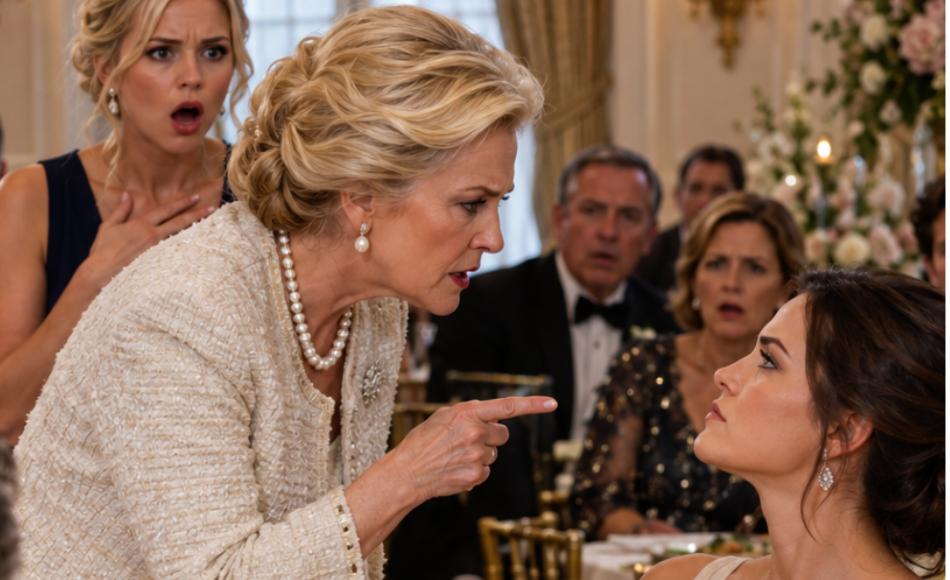
“You need to,” the mother-in-law cut her off. “Over there, to the end. Lena and Kirill will sit here. These seats are for family.”
Her words landed in the sudden silence, heavy and clear. Some guests dropped their eyes to their plates, some felt awkward, while others looked up with interest, sensing a scene brewing. Anastasia was at a loss. She had expected many things from her mother-in-law, but not this—not a public, demonstrative slap in front of all the relatives. Her cheeks burned. Marina glanced between her mom and grandmother, not understanding.
“Mom, why do we have to go there?” the little girl whispered. “I wanted to sit next to Grandma…”
And that whisper, that confused little voice, did what five years of patience hadn’t. Something in Anastasia that had built up for five years edged right up to breaking.
“Alla Viktorovna,” she said as she stood up, and her voice sounded strange even to herself, “Marina is your granddaughter, just like Kirill. Why can’t she sit next to you?”
“Because I said so,” Alla Viktorovna lifted her chin. “In my house, I decide who sits where. And furthermore…”
She looked her daughter-in-law up and down, slowly, with contempt, as if only just now really noticing her, and let out words that clearly had built up in her for years:
“You are not worthy to sit at the same table as my daughter!”
And at that moment, Anastasia erupted from hurt.
Everything that she had swallowed for five years, everything she kept quiet for the sake of peace, for Alexander, for the family’s sake—all of it poured out at once.
“Not worthy?!” Her voice rang out through the entire room, and the guests froze with their forks midair. “I’m not worthy? And you—you’re worthy? You ignore your own granddaughter for years! What did Marina ever do to you? Is it just because she was born a girl? What did the child ever do to deserve this?”
“Don’t you dare raise your voice at me!” Alla Viktorovna’s face turned red. “In my house!”
“I stayed silent for five years!” Anastasia couldn’t stop herself now. “I watched how Kirill got everything and Marina got nothing! How she draws you cards and you just put them away! How she learns poems and you turn your back! Did you even once pick her up? Did you once read her a story? Did you ever hug her?”
“Why should I have to care for her?” the mother-in-law exploded, completely dropping her pretense. “You promised me an heir, and what did you give me… I was dreaming of a grandson who would carry on the family name, but instead I got… disappointment! You’ve failed me! Ever since you joined our family, you’ve ruined everything!”
The guests sat frozen, neither alive nor dead with tension. Then Elena spoke up—she stood beside her mother and wrapped an arm around her shoulders.
“Nastya, how can you act like this with Mom? It’s her birthday! You’ve ruined the whole celebration for her. Mom is getting old, and here you are yelling at her.”
“You!” Anastasia turned to her sister-in-law, and the movement made Elena instinctively step back. “You’ve sat and watched for five years. You saw how your Kirill treated my daughter like she’s not even a person, and did you ever say a word? Did you ever stick up for her? No—you found it convenient, because your boy was the winner. You kept quiet just to please your mom.”
Elena opened her mouth but couldn’t find any words, just pressed closer to her mother.
“Why is everyone attacking me!” Alla Viktorovna cast a pained look around the room, searching for support. “On my own day! That’s the gratitude I get! I fed and cared for that girl,”—she nodded toward Marina—“and what do I get? Nothing but trouble from her, same as her mother. I don’t need a granddaughter like that, or her mother either!”
It was in that moment that Marina, who until then had just been blinking in confusion and looking from one shouting adult to the next, finally understood. With a child’s tender heart, she realized the most important thing—her grandmother didn’t love her. Didn’t want her. Thought she was just a burden. The girl’s little face crumpled, her lips trembled, and she began to cry bitterly, sobbing into her mother’s side.
“I’m not wanted…” she sobbed. “Grandma doesn’t love me…”
And that crying changed everything.
Alexander, who until that moment had been standing by the wall as pale as a sheet, not interfering, almost stunned, suddenly stepped forward. He looked at his daughter—at her shaking shoulders, at her tears, at the deep pain written on her small face—and it was as if he finally understood the price of his silence. Everything he had tried to sweep under the rug for years, all the excuses and postponing, was now right in front of him—crying, wearing a pretty blue dress.
“Mom,” he said, his voice quiet, but his words silenced the room. “What did you just say? That my daughter doesn’t matter to you?”
“Sasha, I didn’t mean… not in that sense…”
“You did mean it.” Alexander walked over to Marina, knelt down, and picked her up in his arms. She clung to him, burying her tear-stained face in his shoulder. “I heard everything. And you know what, Mom? I’ve seen it all for a long time. I just didn’t want to admit it. I thought it would pass, that you would soften. But you didn’t. You made your own grandchild cry. On your birthday. With everyone watching.”
“I am your mother!” Alla Viktorovna gasped. “I raised you, I lost sleep for you! And now you’re against me… because of her… because of them?! I’m everything to you, and still you—!”
“You’ve done a lot for me, yes,” Alexander nodded, his voice calm. That calmness made Alla Viktorovna feel even more uneasy than any shouting could have. “And I’m grateful to you for that. But for five years, you’ve taken advantage of how soft I am. That I can’t stand up to you. And for all those years, you slowly tore my family apart. You humiliated my wife. You never loved my daughter. And I stayed silent — and by doing so, I betrayed them. Every single time, I betrayed them.”
“She’s the one who turned you against me!” his mother snapped, pointing at Anastasia. “She drove you away from your mother! Mark my words, she’ll leave you, and you’ll realize you only have one mother!”
“No one turned me against anyone,” Alexander said as he stood up with Marina in his arms, holding her close. “I’ve finally opened my own eyes. And let me tell you this: until you accept that Marina is just as much your family as Kirill, we won’t set foot in this house again.”
“Well, fine by me!” Alla Viktorovna shot back. “Good riddance! Someday you’ll remember your mother and come begging for forgiveness, but it’ll be too late!”
“I won’t come back,” Alexander said.
He turned to his wife.
“Nastya, let’s go. Let’s take Marina and head home.”
Anastasia nodded silently. With the subdued stares of the guests upon them, they gathered their daughter’s things. Anastasia paused for a moment at the table — at the box with the vase that was never even unwrapped.
“Take your gift with you,” Alla Viktorovna threw in as they walked away. “I don’t want anything from you.”
“Leave it,” Anastasia replied calmly. “A keepsake. Maybe one day you’ll look at it and remember that you had a granddaughter you drove away.”
And then they left. The door closed behind them, shutting out the festive table, the gasping guests, and the birthday woman who burned with rage.
The car was silent. After crying her heart out, Marina sat quietly in the back seat, clutching her beloved stuffed bunny. Anastasia turned around and gently stroked her daughter’s head.
“Marisha, don’t ever think there’s anything wrong with you,” she said quietly. “You’re our wonderful girl. The very best. It’s just that grandma… grandma couldn’t see that. That’s her loss, not yours.”
Marina sniffled.
“Are we never going to her place again?”
Without taking his eyes off the road, Alexander answered firmly:
“We’re not going, sweetheart. We’ll go to places where you’re welcomed. And there are plenty of those, believe me.”
After that birthday, Alexander cut off all contact with his mother. No calls, no visits, he didn’t even answer her messages. At first, Alla Viktorovna was absolutely sure it was just temporary — he’d be upset, calm down, and come back, just like always. That’s how it always was. She was sure this time would be no different.
But the weeks turned into months, and her son still didn’t return.
That’s when she brought out the big guns. First, Elena called — her voice trembling with tears as she told Alexander how their mother wasn’t herself, how worried she was, how her blood pressure was up, how wrong it was to abandon an elderly woman like that. Alexander listened to his sister and replied simply:
“Lena, you kept quiet for five years while my daughter was being hurt. So stay quiet now, too.”
After that, Alla Viktorovna began telling mutual acquaintances how miserable she was, how her son had abandoned her in her old age, and how her daughter-in-law—”that snake”—had taken him away from the family. These echoes sometimes reached Anastasia, but they barely touched her anymore. She looked at Marina—how her daughter had blossomed over the past months, how she had stopped being so tense and now laughed more often—and realized her mother-in-law had lost what mattered most. With her own hands, she had pushed away a child who, not so long ago, reached out to her with all her young heart. She could no longer be a grandmother—not the one that was needed. That ship had sailed.
At home, things were slowly getting better. Marina was opening up. But between Anastasia and Alexander, for a while there was still something left unsaid—the same tension that had built up over the years of his silence. One evening, after their daughter had gone to bed, they sat in the kitchen, and Anastasia finally said what she had been holding inside:
“Sasha, I’m not just upset with your mother. I was angry at you, too. For a long time. You saw everything—and said nothing. I was there alone, do you understand? Completely alone, with Marina, fighting everyone. And you just stood on the sidelines.”
Alexander was silent for a long time, turning a cup of cold tea in his hands.
“I know,” he said at last. “And I have no excuse. I was a coward. I thought if I didn’t argue with my mother, everything would somehow work itself out. But in the end, I let you both down. And Marina, too. I’m sorry. I don’t know how to fix this, but I promise I’ll try my hardest.”
Anastasia looked at her husband. The hurt hadn’t disappeared—you can’t heal wounds like this in one conversation; those take time. But for the first time in five years, she saw someone standing fully by her side, for real, without looking back at his mother. And that changed something.
“You know,” she said after a pause, “let’s not pretend everything’s healed right away. It hasn’t. But at least now we’re in this together. The three of us. I’m not alone anymore.”
“Together,” Alexander nodded and placed his hand over hers.
That night, they didn’t try to sort out every issue or lay out all their past grievances. Instead, they simply sat in the kitchen, sipping cold tea, while behind the wall their daughter slept soundly—the very same little girl whom someone had once labeled unworthy, unnecessary, wrong. But here, inside these walls, she was more loved than anyone in the world. And for now, both parents knew, that was enough. The rest they would rebuild together—slowly, brick by brick, but this time, as a family.