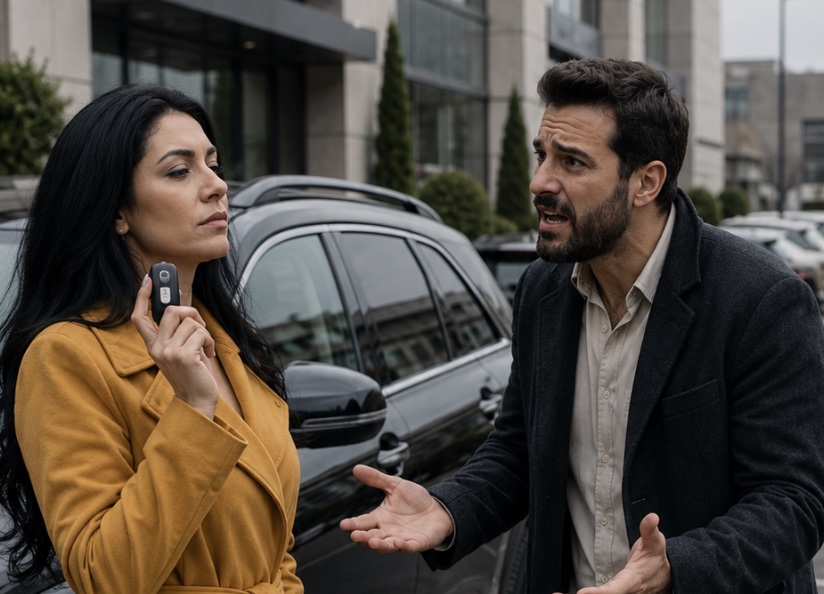
“Are you taking the bus today?” Anna asked calmly, holding out a transit card to her husband.
Igor looked at her in surprise and instinctively reached for the car keys that usually lay on the shelf beside the hallway mirror.
“No, darling.”
Anna gently but firmly picked up the keys before he could reach them.
“Starting today, I’ll be driving your car. You can take the bus, the train, a minibus—whatever works. You decided to give our family savings to your brother without asking me. Now you can experience firsthand what that decision actually cost us.”
Igor opened his mouth, then closed it again.
He stood in the hallway wearing his coat, briefcase in hand, staring at his wife like a man who still hadn’t decided whether he should be offended or laugh.
Anna calmly slipped on her shoes, picked up her handbag, and walked out first.
 
Anna and Igor had married seven years earlier, in September, at a small café by the river. There had been no extravagant celebration and no huge guest list.
Back then, they both joked that their real wealth was still somewhere ahead of them.
Igor had arrived at the wedding in his own car—an old but reliable Toyota he had bought while he was still a student. Anna had sat beside him in her wedding dress and said that one day she would have a car of her own too.
“One day” stretched into seven years.
They worked in completely different parts of the city.
Igor handled equipment supplies, which meant constant driving between warehouses, client meetings, and businesses outside the city.
Anna managed advertising work for several agencies on an outsourcing basis. Her schedule was just as demanding: presentations, negotiations, photo shoots, meetings, and client visits.
Whenever Igor needed the car for the entire day, Anna had to rely on taxis or public transportation.
It was slow, inconvenient, and increasingly expensive.
“We need a second car,” she had told him many times. “This isn’t a luxury anymore.”
“I know,” Igor always agreed. “We’re saving for one.”
And they really did save.
For almost a year, both of them lived under strict financial discipline. They gave up their summer vacation, stopped going to restaurants on weekends, and carefully watched every unnecessary expense.
Anna accepted several extra projects she normally would have refused because she was already exhausted.
Every month Igor told her the same thing.
“We’re almost there.”
By spring, they had finally saved enough.
In the evenings they sat together scrolling through car listings, comparing mileage, model years, condition, and prices.
Anna preferred a dark-blue hatchback.
Igor argued that silver would be more practical in the city.
They had even arranged to visit a seller that weekend.
A few days before the appointment, Anna asked Igor to transfer the deposit.
That was when he became strangely nervous.
He changed the subject. He said they should check everything one more time. He claimed they shouldn’t rush into anything.
Anna watched him and felt something cold slowly forming inside her.
“Igor,” she finally said quietly. “Where is the money?”
He remained silent for a long time.
Then he confessed.
 
At first, Anna didn’t even understand what he was telling her.
“Wait,” she said slowly. “You transferred all of it? Every last cent?”
“Artyom asked for help. Debt collectors were calling him every day. He wasn’t sleeping anymore,” Igor explained quietly, staring down at the table. “I thought he’d pay it back within a month.”
“You thought,” Anna repeated. “But you didn’t think you should ask me first?”
Igor said nothing.
Anna stood up, walked over to the window, and stared outside for a long time.
She tried to find anger inside herself, but what she felt was worse.
It was the sensation that she simply hadn’t existed when Igor made that decision.
A year of saving.
All those extra projects.
The vacation she had given up.
The weekends they had spent cutting expenses.
Everything had disappeared in a single moment, without her knowledge.
“You knew for weeks that the money was gone,” she finally said without turning around. “And you kept pretending everything was going according to plan. We looked at cars together. You discussed colors with me. All that time, you knew we didn’t have the money anymore.”
“I didn’t know how to tell you.”
“That’s not an answer, Igor.”
A few days later, Igor met with Artyom.
He came home late and took off his shoes as quietly as possible, almost as though he hoped Anna had already gone to sleep.
But she was sitting in the kitchen with a cup of tea that had long since gone cold.
“Well?” she asked.
Igor sat across from her and spread his hands.
“He still hasn’t found work. He has nothing to pay us with. He says maybe in six months.”
“Maybe,” Anna repeated.
“Maybe later.”
 
She nodded, put her cup in the sink, and went to bed without another word.
Igor remained alone at the kitchen table.
That vague promise—“maybe later”—now hung over all their plans like a debt with no repayment date.
The following morning Igor got dressed as usual, picked up his briefcase, and walked toward the shelf where the car keys always lay.
“Igor,” Anna called from the hallway.
He turned.
His wife was standing beside the mirror, already wearing her coat, holding his keys in her hand.
“Starting today, I’m using the car,” she said evenly. “You’re taking the bus.”
“Anna, come on.” He gave her a weak smile, assuming this was just an emotional gesture that would be forgotten by breakfast. “You know I need to be at the warehouse outside the city by nine.”
“There’s a train at eight fifteen. You’ll make it.”
Igor stared at her and gradually realized she was completely serious.
Anna had already added herself to the insurance as an authorized driver.
The seat had been adjusted for her height.
The mirrors were positioned exactly the way she needed them.
She had planned everything without drama or unnecessary discussion.
“Anna, this is ridiculous,” he said, no longer smiling.
 
“It’s very serious.”
She dropped the keys into her handbag.
“You made a major decision on your own. Now I’m making one on my own. Seems fair.”
Then she left.
Igor remained in the hallway, staring at the empty place where the keys had always been.
After a moment, he pulled out his phone, opened the public transportation app, and began studying routes and transfers.
That day, he was twenty minutes late for a client meeting.
He stood at a bus stop in the cold April rain and discovered too late that he had forgotten his umbrella.
On the way home, he spent a long time waiting beside the road, watching cars pass him one after another.
Three weeks went by.
Igor now woke up an hour earlier every morning.
He had to calculate routes, check schedules, allow extra time for connections, and make sure he wouldn’t miss the train.
April turned out to be unusually cold and rainy.
Bus stops were exposed to cutting wind, while the minibuses were packed during rush hour.
One evening Igor finally arrived home close to nine.
He had spent the entire day outside the city and needed two separate connections just to get back.
Anna was sitting in the living room with her laptop.
Igor took off his shoes, hung up his wet coat, and stood silently in the doorway for a while, unsure of what to say.
“Tired?” Anna asked without looking up.
“Very,” he admitted, lowering himself onto the sofa.
 
Then he hesitated.
“Anna, I was thinking about something the whole way home. This used to be your everyday reality, didn’t it? Transfers, crowded buses, carrying bags, wasting time waiting for transportation. This was how you would have kept getting around.”
Anna closed her laptop and looked at him.
“You’re only thinking about that now?”
“I think I only understand it now,” he said quietly. “And it wasn’t really about the car, was it? I took our shared money and treated it as if it belonged only to me. As if you weren’t part of the decision at all.”
Anna was silent for a moment.
“That’s exactly why you’re the one dealing with the inconvenience now instead of me.”
Igor nodded.
He had expected the words to sound like punishment, but Anna said them calmly, without triumph and without accusation.
That made them hit harder than any argument could have.
No shouting could have explained so clearly what he had done wrong.
The following day, Igor called Artyom himself.
“We need to meet,” he said. “Not just to talk. We need something in writing.”
His brother hesitated and began explaining his situation again, but Igor interrupted him gently and firmly.
“Artyom, I helped you. Now help me. Let’s officially record the debt and agree on monthly payments. Pay whatever you can afford, but there needs to be a payment every month.”
The meeting passed without an argument.
They wrote a simple agreement stating the amount owed, the monthly payment, and a repayment schedule.
Artyom signed it without protest.
Igor realized that his brother had probably been uncomfortable with the uncertainty too.
 
That evening, Igor told Anna everything.
He placed the agreement on the kitchen table and pushed it toward her.
“Here,” he said. “And there’s something else. I found some additional work. Evenings and weekends. Remote consulting on equipment. Every cent from it is going toward your car.”
Anna picked up the paper and read it carefully.
“That’s good,” she finally said.
“Until we save enough, the car is yours. I’m not asking for it back.”
“You wouldn’t be getting it back anyway,” Anna replied.
There was no sarcasm in her voice.
She was simply stating a fact.
They agreed to open a separate savings account.
Every month, Igor’s income from his extra work went into it, along with part of whatever Artyom managed to repay.
Anna also started contributing money from her projects again.
This time, both of them knew exactly how much was in the account.
Both could see every deposit.
For the first time, it truly felt like shared money—not merely in name, but in practice.
Igor continued taking buses and trains.
 
He never complained.
Four months later, Artyom finally found steady work.
After that, his repayments became regular—small, but dependable.
Whenever a transfer arrived, Igor quietly showed Anna the notification on his phone.
She would simply nod.
Eventually, the savings account reached the amount they needed.
Anna called the seller herself.
They went to see the car together.
 
They took Igor’s car—or, by that point, Anna’s car—because that arrangement already felt completely natural.
The dark-blue hatchback was exactly what Anna had imagined all those months earlier.
When the seller finally handed her the keys, Igor was the first to speak.
“Congratulations.”
Anna looked at him, allowed herself a small smile, and slipped the keys into her pocket.
From that day on, one simple rule became permanent in their marriage:
No large transfers to relatives without a conversation and the agreement of both partners.
Igor would later say more than once that those months of standing at bus stops in the rain had been the most expensive lesson of his married life.
Not because the journey had been difficult.
But because the lesson had been fair.