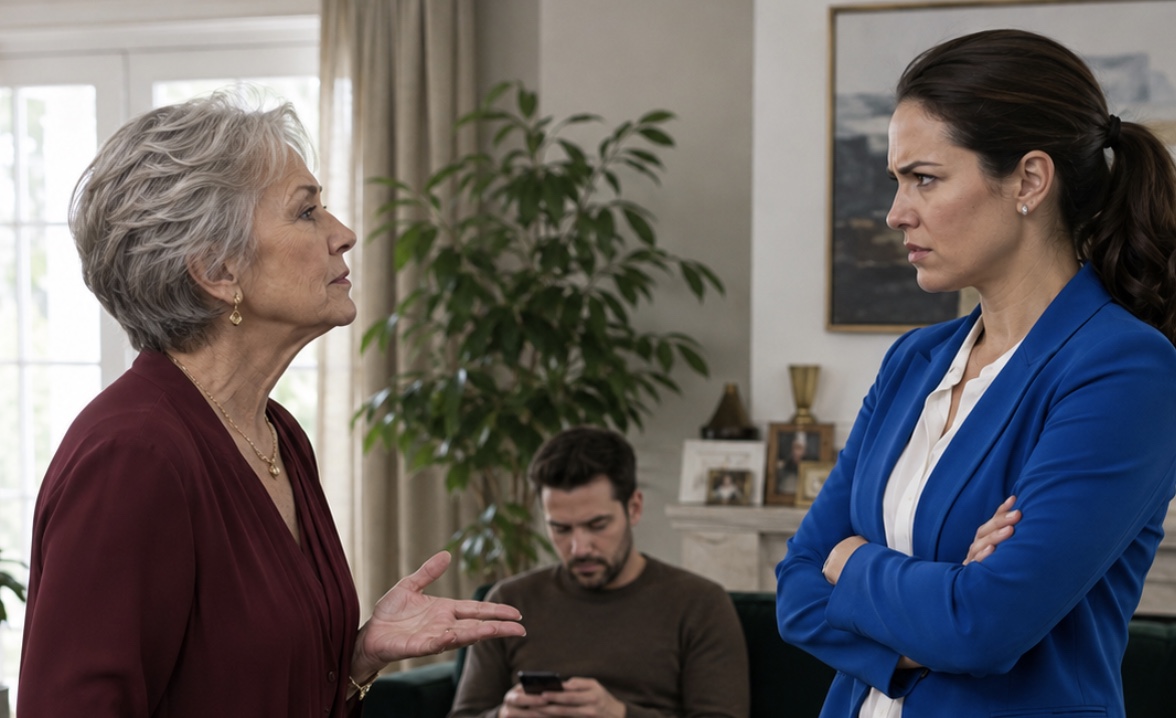
“Why did you buy this refrigerator?” Galina Stepanovna’s voice came from the kitchen doorway, cutting through the room like a knife scraping across glass. It was not a question asked out of curiosity. It carried the unmistakable tone of an inspector already looking for something to criticize, making it clear that whatever answer Alina gave would eventually be used against her.
“The old one broke down, Galina Stepanovna,” Alina replied without turning around, continuing to wipe the gleaming chrome door. “The repairman said the compressor was finished. Fixing it would have cost more than buying a new one.”
“More than a new one?” Her mother-in-law stepped farther into the kitchen and shamelessly opened the freezer compartment. “So what, you bought this one for three thousand rubles? Some clearance sale at the market?”
“Seventy-eight thousand,” Alina answered calmly, feeling the familiar string of tension tightening inside her. She already knew what was coming. She always knew, yet she still answered honestly, as though some small part of her hoped the reaction might be different this time.
“Seventy-eight thousand?!” Galina Stepanovna threw up her hands, her voice rising to that particular pitch Evgeny always described as, “Mom is just worried.” “Who spends that kind of money on a metal box? Zhenya earns less than that in a month, and you throw money around like it means nothing!”
“It’s my income, Galina Stepanovna. I didn’t take a single ruble from Zhenya’s salary. And this isn’t just a ‘metal box.’ It’s a side-by-side refrigerator with a freshness zone and an ice maker. Excuse me, I need to finish what I’m doing.”
Her mother-in-law pursed her lips so tightly that pale lines appeared around her mouth. Without another word, she left the kitchen.
But Alina knew that silence was only the opening act.
The real conversation would happen that evening, and her husband would once again ask her not to “provoke people.”
At thirty-three, Alina Sorokina was the kind of woman people liked to describe as self-made. In her case, however, it was not a fashionable label but a simple summary of her life.
At seventeen, she left her small hometown with a single suitcase, earned a state-funded place at a university in the capital, and from her third year onward worked night shifts in a call center to pay for a rented bed in a shared apartment.
By twenty-five, she had qualified as a medical logistics specialist. By thirty, she had opened her own dispatch company specializing in the transportation of pharmaceutical products that required strict temperature control.
At first, she worked alone from a tiny rented apartment, balancing a laptop on her knees. Now her company employed fourteen people, owned two refrigerated trucks, and had contracts with three pharmacy chains.
The apartment on the seventeenth floor of a new residential complex belonged to her. She had bought it with a mortgage and paid the loan off five years ahead of schedule.
She had designed the renovation herself, choosing everything from the bathroom tiles to the electrical sockets in the living room.
Her home office, connected to the bedroom, was practical rather than luxurious: a height-adjustable desk, an orthopedic chair, shelves filled with documents, and a few living plants.
There were no awards or certificates hanging on the walls.
Only one photograph.
It showed Alina standing beside her mother, taken a month before her mother died from COVID.
She had met Evgeny five years earlier at a mutual friend’s birthday party.
Zhenya was calm, dependable, comfortable to be around. He worked as a foreman at an automobile plant, had skilled hands and a quiet voice. He did not try to change Alina, interfere in her business, or resent her success.
That calmness was exactly what she had fallen in love with.
After fourteen-hour workdays, she could sit beside him in silence without having to explain herself. When she came home exhausted, he made her tea with thyme and never asked how much money she had earned that month.
His mother, Galina Stepanovna, and his older sister Margarita entered Alina’s life as part of the package.
They lived on the other side of the city in an old Soviet-era apartment that Galina Stepanovna had inherited after her husband’s death.
Margarita was forty, permanently dissatisfied with life, and educated as a librarian. She worked in the archives of a research institute for a salary that barely covered transportation and cigarettes.
Her husband had left her six years earlier, and since then her entire world had shrunk to the two-bedroom apartment she shared with her mother and an endless list of complaints about how unfair life had been to her.
Alina never flaunted her success.
If anything, she deliberately made herself seem less financially secure than she really was.
When she bought a new car, she claimed she had taken out an expensive loan. When she installed air conditioning throughout the apartment, she said she had received a bonus from an old employer.
She believed modesty would preserve peace.
She believed hiding her success would protect her from resentment.
She was wrong.
Alina began helping her husband’s relatives during the first year of their marriage.
At first, the requests were small.
She covered Galina Stepanovna’s utility bills when her monthly budget “unexpectedly didn’t work out.” She bought Margarita a winter coat because the old one was supposedly falling apart and “you can’t afford anything decent on an archivist’s salary.”
When Margarita broke her leg, Alina regularly ordered groceries to be delivered to their apartment.
Gradually, those small gestures became an established system.
Every three months, Alina transferred Galina Stepanovna an amount equal to roughly half the average regional salary.
For birthdays, she bought household appliances: a microwave oven, a multicooker, even a robot vacuum cleaner. Galina Stepanovna called the vacuum “that buzzing idiot” and pushed it into a storage closet.
Twice a year, Alina paid for her to spend time at a health resort in Kislovodsk “for her joints.”
She never expected gratitude.
That turned out to be wise.
The usual response to money transfers was something along the lines of, “Well, you have more money than you know what to do with. You could have sent more.”
Whenever Margarita received the same five-thousand-ruble birthday gift, she would open the envelope in front of everyone, look inside, purse her lips, and remark that Alina “could show a little more respect to her husband’s older sister.”
“Why do they never say thank you?” Alina once asked Evgeny as they lay in bed in the darkness.
“Mom is just from a different generation,” he said, turning onto his side. “She thinks saying thank you makes a person look weak. You know how some older people are. If something is natural, they don’t think it requires gratitude.”
“Giving people money is natural?”
“In a family, yes. You’re part of the family.”
Alina said nothing.
But a thought settled inside her like a tiny splinter.
Apparently, she became “family” whenever someone needed her wallet.
The rest of the time, she was still “that girl who thinks she’s some big businesswoman.”
The turning point came before Alina’s business trip to Novosibirsk.
She was leaving for four days to sign a contract with a new client.
As usual, before traveling she prepared enough food for Evgeny for the entire week, paid the household bills, and transferred Galina Stepanovna her usual financial support.
The evening before her flight, her mother-in-law called.
“Alinochka, we have a little situation. Rita wants to go on vacation to Adler. There’s a last-minute package available, but she needs thirty thousand rubles by tomorrow. Bring the money over, would you?”
“Galina Stepanovna, my flight to Novosibirsk leaves at six tomorrow morning. I have difficult negotiations ahead of me. I’ve spent a month preparing for them.”
“What does that have to do with anything? Just transfer the money now. Why delay it?”
“I’m not going to transfer thirty thousand rubles for Margarita’s last-minute vacation. First, my budget for this month is already planned. Second, I don’t understand why her vacation is my financial responsibility.”
Silence filled the line.
It was thick, almost threatening.
Alina could practically feel resentment boiling on the other end.
“What do you mean, you’re not going to?” Galina Stepanovna’s voice became lower and sharper. “You can find nearly a hundred thousand rubles for refrigerators, but you can’t pay for your husband’s own sister to have a vacation? You’ve become spoiled by money, girl. Have some shame!”
“Galina Stepanovna, this is my money. I earned it. I decide how I spend it.”
“Oh, so that’s how you’re speaking now? Fine. Tell your husband exactly what you just told me. We’ll see how he reacts.”
She hung up.
Alina remained standing in the middle of the living room, phone in hand, feeling anger and despair rising inside her at the same time.
She already knew what would happen.
Evgeny would not defend her.
And he didn’t.
That evening, he entered the bedroom looking as though someone in the family had died.
“Mom called. She’s really upset. She says you humiliated her.”
“I said I wasn’t paying for Margarita’s vacation. How is that humiliating?”
“You could have said it more gently. She’s an older woman. Her blood pressure…”
“Zhenya,” Alina said, sitting on the edge of the bed, exhaustion spreading through her body like lead, “your mother’s blood pressure rises every time I refuse to do something she wants. That is manipulation. Pure manipulation.”
“You’ve become very cold lately,” he said, shaking his head as he walked out of the bedroom. “You used to understand what family meant.”
Alina was left alone.
Her flight was eight hours away.
She never managed to fall asleep.
The trip to Novosibirsk was a professional success.
The contract was signed, the client was pleased, and the possibility of expanding her business farther into Siberia suddenly seemed real.
Alina returned home feeling triumphant.
That feeling disappeared the moment she entered the apartment.
Galina Stepanovna was sitting in the kitchen.
“Oh, look who finally decided to come home,” she said instead of greeting her, pouring tea into Evgeny’s mug. “We’ve been managing the household without you. Zhenya practically starved while you were relaxing in hotels.”
“I was working, Galina Stepanovna.”
“I know what your kind of ‘work’ looks like. Sitting in restaurants and signing pieces of paper. Very difficult.”
Alina walked into the bedroom, closed the door, and rested her forehead against the cool wall.
She promised herself she would not react.
Not today.
Not after four exhausting days of negotiations, two flights, and almost no sleep.
“Alinochka!”
The door opened without a knock.
Galina Stepanovna stood in the doorway with her hands on her hips. She was short and solidly built, but carried herself with the authority of someone twice her size.
“Don’t try to avoid this conversation. Rita and I discussed everything, and we decided that you will pay for her vacation. It’s a matter of showing respect to the family.”
“You discussed it?” Alina turned around slowly, and there was a hard edge in her voice that even she had never heard before. “The two of you made a decision about my money without including me?”
“It isn’t your money. It’s family money. You’re married, which means everything you earn belongs to the family.”
“Family money is the money that goes into our shared household budget. And, just so we’re clear, around eighty percent of that budget comes from me. You’re talking about my personal income. Money neither you nor Margarita earned.”
“Oh, so that’s how it is!”
Her mother-in-law’s voice rose sharply.
Heavy footsteps immediately sounded from the living room as Evgeny came toward them, drawn by the argument.
“What happened now?” he asked from the doorway, looking from his mother to his wife.
“Your wife just announced that her money isn’t family money!” Galina Stepanovna exclaimed, dramatically pressing a hand to her chest. “Did you hear that, Zhenya? Now you know exactly how she sees you! Now everyone knows who is really in charge in this house!”
“Alina, why do you have to say things like that?” Evgeny asked with the exhausted expression of someone being inconvenienced by a conflict he wanted to disappear. “Mom is only asking for help. You can afford it, so why not help? We’re family.”
“Zhenya, your sister is a grown woman with a university degree. Why am I responsible for paying for her vacations?”
“Because you can afford it!” Galina Stepanovna snapped. “And she can’t! Besides, you entered this family when everything was already provided for you, so the least you can do is contribute!”
Alina actually laughed.
It was not a happy laugh.
It sounded dry and brittle.
“Everything was provided for me? I came into this family without receiving a single ruble from any of you. The apartment is mine. The car is mine. The business is mine. What exactly did you provide for me besides constant criticism?”
“We gave you a husband!” Galina Stepanovna shouted. “And you’re too ungrateful to appreciate it!”
Silence fell.
Heavy, ringing silence.
Evgeny stared at the floor.
Alina looked at him and waited.
Just one sentence.
One gesture.
One sign that he was willing to defend his wife.
“Zhenya?” she said quietly.
“Well… Mom isn’t completely wrong,” he finally muttered without lifting his eyes. “You can be too harsh sometimes. You could have handled it more gently.”
Something inside Alina finally broke.
Not exploded.
Broke.
Like a cable that had carried too much weight for too long.
“Thank you,” she said in a flat, icy voice, looking directly at her husband. “Thank you for finally helping me understand.”
“Understand what?” Evgeny frowned, clearly expecting a different reaction.
“That I am completely alone in this marriage.”
She turned around, took her car keys from the shelf, and walked out of the apartment, quietly closing the door behind her.
She did not shout.
She did not slam the door.
Any loud sound, she felt, might destroy what little control she still had.
She spent the night in a hotel on the outskirts of the city.
Her room overlooked a parking lot.
She ordered tea and a sandwich and remained awake until three in the morning, staring at the wall.
She thought.
She remembered.
Five years of marriage.
Five years of trying to prove that she was not a threat, not arrogant, not some “conceited businesswoman.”
She never bragged about what she bought, yet every purchase caused resentment.
She never discussed her income, but the simple fact that she worked for herself seemed to offend her husband’s relatives.
Galina Stepanovna, who had spent forty years working as a cashier in a grocery store, genuinely could not understand how someone could earn serious money “sitting at home and talking on the phone.”
Margarita believed Alina had simply gotten lucky.
It was easier for both women to devalue her work than to admit that their own circumstances were at least partly connected to their own choices.
But the worst realization had nothing to do with her mother-in-law.
The worst part was Evgeny.
Quiet, agreeable, endlessly afraid of confrontation.
In five years, he had never once firmly told his mother no.
His strategy was always the same: hide from the conflict and leave Alina standing in front of the bullets.
Every time Galina Stepanovna crossed another boundary, Evgeny said, “Ignore her. That’s just how she is.”
Every time Margarita said something insulting, he shrugged and said, “Rita is unhappy. You have to understand her.”
As if unhappiness gave someone permission to mistreat others.
As if Alina’s success automatically made her guilty.
As if having more meant she was required to give endlessly.
“He has never defended me,” Alina said aloud into the empty hotel room. “Not once.”
And somehow, admitting that made her feel better.
Painfully, strangely better.
Like an infected wound that had finally opened and begun to drain.
The next morning, she returned home, showered, changed into a formal trouser suit, and made herself coffee.
Evgeny had slept on the couch.
He entered the kitchen with red eyes and a guilty expression.
“Alina, I’ve been thinking,” he began. “I talked to Mom. She says she’s willing to accept your apology.”
“What apology?” Alina asked, taking a sip of coffee without looking at him.
“You need to apologize for what you said yesterday. About the money and everything else. She said she’s ready to forget the whole thing if you pay for Rita’s vacation and say you’re sorry.”
Alina slowly placed her cup on the table.
Then she looked at her husband.
There was so much exhaustion and pain in her eyes that Evgeny stopped speaking.
“Zhenya,” she said quietly, almost gently. “I spent last night alone in a hotel. I thought about our life. Do you know what I realized?”
“What?”
“Your mother and your sister are not the main problem.”
He stiffened.
“You are.”
“Me?”
“You. The man who has never once told them they were wrong. The man who keeps asking me to apologize when I have done nothing wrong. And now you’re standing here delivering your mother’s surrender terms as though I’m a schoolgirl who misbehaved in front of the principal.”
“I’m just trying to keep the peace!” he cried. “They’re my family. You have to understand that!”
“And what am I?” Alina stood up. “Who am I to you, Zhenya? I have been your wife for five years. For five years, I have supported your mother, your sister, and most of our household. And for five years, I haven’t heard one word of support from you. What am I to you? A wallet that also cleans the apartment? Or a human being?”
“You don’t understand…”
“I understand enough,” she interrupted. “You are an adult man, Evgeny. You made your choice. Your mother and sister are allowed to say and demand whatever they want, while I am expected to stay quiet and pay for it. I don’t want to live like that anymore.”
“What are you saying?” His face went pale.
“I’m saying I want a divorce.”
The word left her mouth sharply and cleanly.
To her own surprise, she felt calm.
“You’ve lost your mind! Over some vacation package?”
“Not because of a vacation, Zhenya. Because of five years of silence and betrayal.”
The divorce unfolded the way these divorces usually do.
There were awkward silences in court.
There were boxes filled with Evgeny’s belongings.
There was the quiet moment when he moved back into his mother’s apartment, where Galina Stepanovna and Margarita were waiting for him.
Alina kept her apartment because she had bought it before the marriage, making it her separate property.
She kept the car as well.
There was surprisingly little shared property to divide. Evgeny had never been interested in saving money or building assets. He preferred living in the present.
Galina Stepanovna began sending furious messages.
They were long, emotional, filled with exclamation marks and accusations about “destroying a family” and “selfishness.”
Alina read them without anger.
More like a linguist studying an unusual dialect.
Margarita, meanwhile, told mutual acquaintances that “Alina probably found herself some rich lover in Novosibirsk.”
The first week after the divorce was the hardest.
The apartment, once filled with familiar sounds—Evgeny’s footsteps, the television murmuring in the background, water running in the bathroom—now seemed painfully silent.
Alina sometimes caught herself speaking aloud just to hear a voice.
She cried twice.
The first time was when she found one of Evgeny’s forgotten T-shirts in the wardrobe.
The second was when she realized she was not crying for him.
She was mourning the family she had imagined she had.
Support came from unexpected places.
Svetlana, a former colleague from Alina’s first job, called one evening and said exactly what she needed to hear:
“You did something many people spend their entire lives being afraid to do.”
A distant cousin Alina had not seen in seven years drove in from the countryside with homemade pastries and a bottle of wine.
They sat in the kitchen until two in the morning.
For perhaps the first time in years, Alina spoke openly about her feelings without worrying about how someone might react.
A month after the divorce, Evgeny called.
His voice sounded tired and faded.
“Alina, maybe you could reconsider? I talked to Mom. She said she’s willing to forgive you even without an apology. Just come back, and everything can go back to normal.”
“No, Zhenya,” Alina said, shaking her head even though he could not see her. “Normal is exactly what I don’t want anymore. I want something different.”
She paused.
“And you know what?”
“What?”
“I’m sorry you still don’t understand. I truly am.”
She ended the call and blocked his number.
Three months later, her phone rang.
An unknown number appeared on the screen.
Normally Alina ignored such calls, but this time she answered.
“Hello?”
“Alinochka, it’s me.”
Galina Stepanovna’s voice sounded different.
Deflated somehow, like a balloon that had lost all its air.
“Please don’t hang up, all right?”
“I’m listening.”
“I just… I wanted to say something.”
She hesitated.
For several seconds, all Alina could hear was static.
“I think you were probably right.”
“About what?”
“Everything. Rita… well, she’s exactly the same as she always was. She doesn’t want to do anything. Zhenya moved back in with us, and now I cook for him, wash his clothes, iron everything, and Rita is still living off me too.”
Her voice weakened.
“And you… you really were supporting all of us, weren’t you? We didn’t appreciate it. Not at all.”
Alina remained silent for a moment, absorbing what she had just heard.
For the first time since they had met, Galina Stepanovna was speaking without accusations.
Without manipulation.
Without hidden demands.
She was simply stating the truth.
“I’m not angry with you, Galina Stepanovna,” Alina finally said. “I really don’t hold a grudge. But there is no going back.”
“I understand,” her former mother-in-law replied, her voice trembling slightly. “Just… be happy, all right? You deserve that.”
After the call ended, Alina remained seated for a long time, staring at the dark screen of her phone.
She felt no satisfaction in the woman’s difficulties.
No triumph.
Only a calm, slightly sad sense that everything had finally fallen into its proper place.
It was Friday evening.
Alina sat in her office, the bright room overlooking the southern side of the city, finishing a commercial proposal for a new client.
Soup simmered quietly on the stove.
Jazz played softly through the speakers.
Outside, the city lights were beginning to appear one by one.
On the second monitor, a schedule of next week’s transport routes filled the screen.
The business was growing.
Novosibirsk had turned out to be only the beginning.
Alina typed the final sentence, saved the document, and leaned back in her chair.
Her thoughts moved calmly now, without pain or urgency, like a deep river that already knew where it was going.
She remembered the day she refused to buy Margarita a vacation in Adler.
Many people believed that was what destroyed her marriage.
Galina Stepanovna told relatives that her daughter-in-law had “been too greedy to spend thirty thousand rubles, so the whole family fell apart.”
Evgeny probably believed the same thing.
But Alina knew the truth.
The refrigerator had not ended the marriage.
The vacation had not ended it.
Even her mother-in-law’s insults had not ended it.
The marriage ended because for five years, the man beside Alina had remained silent whenever she needed him to stand beside her.
For five years, he had never made her feel that she was his closest family.
The vacation had merely illuminated a truth Alina had spent far too long refusing to see.
And once she finally saw that truth and accepted it, her life stopped belonging to everyone else.
At last, it belonged to her.