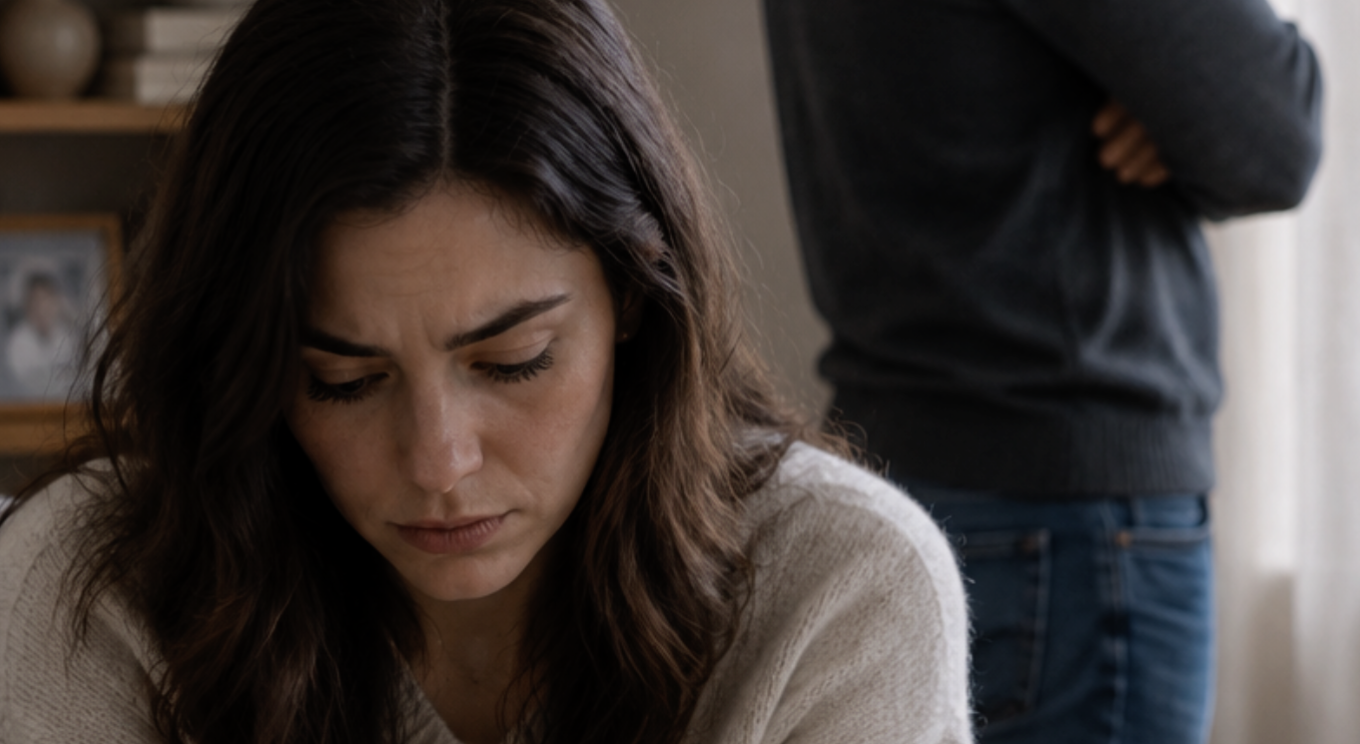
The key slipped in easily, but turned without catching—someone had already unlocked the door today, maybe even more than once. Yana pushed the door with her shoulder and stepped into the hallway, only to find everything out of place from how she’d left it that morning. The coat rack had slid up against the wall, and her box of mock-up supplies was now lying on the floor by the door, tied up with twine like a package ready to be thrown away.
From the other room, Gleb’s steady voice drifted out, calm and familiar, as if nothing unusual was happening. Yana set down her bag, took off her jacket, and slowly made her way down the hallway. The storage room door was wide open, and a draft of dust wafted out from the disturbed shelves.
“Gleb,” she called softly. “Who’s been here?”
“I’ll explain everything, just don’t get upset right away,” he replied without looking back.
“I’m not getting upset. I’m asking.”
He walked into the hallway, wiping his hands on the hem of his t-shirt, and looked past her—at the box by the door. His expression was just guilty enough to not actually be guilty.
“Rimma Anatolyevna stopped by,” he said. “So what? She has a key.”
“How did she get one?” Yana asked.
“I gave it to her.”
“When?”
“A long time ago,” he shrugged. “You never know what could happen. If we’re away, someone has to water the plants.”
Yana looked over at the windowsill, where her one and only succulent sat—the kind you water maybe once a month, if you feel like it. She tried to smile, but it came out crooked and brief.
“Gleb, we agreed that we wouldn’t give the key to anyone. It’s not a whim. It’s a simple agreement between two adults.”
“You’re blowing this out of proportion,” he said. “She just cleaned up a little.”
“She cleaned out my storage room and left my box by the door,” Yana nodded at the twine. “That’s my work in there. Six months worth.”
“It’s just cardboard and little sticks, Yana. She didn’t know.”
“She could have asked,” Yana replied, still in that gentle voice. “I have a phone. It’s been on since seven this morning.”
Gleb looked away and leaned against the door frame. He always did that when things got uncomfortable: ready to step away at any moment.
“She meant well,” he said. “It’s just hard for her to see the house messy.”
“Our house,” Yana clarified. “My house, to be exact.”
“Here we go,” he winced. “Back to the discussion about square meters.”
“I haven’t brought it up once all this time,” she said. “You’re the one who mentioned it.”
He said nothing. She picked up the box, set it on the table, and untied the twine—inside, of course, everything was a mess, corners bent out of shape as if it had been shoveled in. Yana carefully straightened one sheet, then another, and her voice stayed even.
“Gleb, let’s be reasonable. Give the key back. And let’s agree that from now on, we get a heads up in advance. I don’t want to fight with anyone.”
“I’ll talk to her,” he said quickly. “I promise.”
“Today?”
“Yeah, today, today.”
“Thank you,” Yana said, and she even found herself believing it.
In the evening, he didn’t call Rimma Anatolyevna. He was watching some video about assembling wheels, laughing at the screen, and there was such carefree joy in his laughter that Yana decided not to bother him until morning. She still thought it was something trivial, and that a small problem could be dissolved with patience, like salt in water.
***
On Saturday, the doorbell rang at half past nine. Yana opened the door – on the threshold stood Rimma Anatolyevna, holding a shopping bag in one hand and a measuring tape in the other, and behind her, shifting from foot to foot, was an unfamiliar man in a neat jacket.
“Good morning,” Yana said. “We weren’t expecting you.”
“Why wait for me?” Rimma Anatolyevna replied, stepping inside. “I’m not a guest. Valentin Igorevich, come in, the hallway is narrow but it’s not a problem, we’ll be tearing it down anyway.”
“Excuse me, tearing down what?” Yana asked.
“The partition wall,” Rimma Anatolyevna said, pointing with her finger. “This one right here. We’re making a passageway. Gleb, where are you? Come help the man.”
Gleb came out of the room, and from his face, Yana understood everything before he even spoke. He wasn’t surprised by the tape measure, or the jacket, or the word ‘tearing down.’ He already knew.
“Yana, just stay calm,” he said.
“I’m completely calm,” she replied. “I just want to understand who is planning to tear down what in my apartment.”
“In ours,” Rimma Anatolyevna corrected her.
“In mine,” Yana repeated. “I inherited it from my grandmother. Long before all this.”
“Oh, let’s not get into the paperwork,” the woman waved her hand dismissively. “Paperwork is just a formality. We live by human rules, not by papers.”
Valentin Igorevich coughed politely and pulled out his phone, pretending to look for something important. Yana turned her whole body to face him.
“So, if I understand correctly, you’re here to do an assessment?”
“I was told everyone involved was aware,” he replied cautiously.
“You were told wrong,” Yana said. “Goodbye.”
“Well, really!” Rimma Anatolyevna lifted her chin. “Gleb, do you see how she speaks to me in my son’s house?”
“Yana, why are you acting like this?” Gleb muttered. “This man came all the way across the city.”
“Then he can go all the way back,” she said. “I’ll pay for his ride if needed.”
Valentin Igorevich quickly gathered himself and left, muttering something about ‘being in touch.’ The door closed behind him. Rimma Anatolyevna walked into the room, sat confidently in an armchair, and placed her shopping bag on the floor as if the chair had been brought there just for her.
“Sit down,” she said to Yana. “Since you’re such a businesswoman, let’s talk business.”
“I’ll stand.”
“As you wish. Gleb and I have a plan, and it’s a good one. We sell your apartment, we sell mine, and buy one big place. There’ll be enough space for everyone. I get a room, you get a room, and we all live together.”
“Who will be listed as the owner?” Yana asked.
“Me,” Rimma Anatolyevna replied simply. “How else? I’m the eldest, and I feel better when everything’s in my name.”
“So I invest my grandmother’s apartment, and end up with nothing.”
“You end up with your husband,” the woman looked at her almost fondly. “Is your husband not enough?”
Yana glanced at Gleb. He stood there, arms crossed—not on his chest, but awkwardly, holding his elbow with one hand—and stared at the floor with great interest.
“Gleb,” she called. “Are you aware of this plan?”
“We talked about it in general terms,” he said.
“Who do you mean by ‘we’?”
“Well… her and I.”
“And what about me?”
“I was just about to,” he replied.
“When, exactly?” Yana asked. “After they’ve already torn down the partition?”
“Don’t twist my words,” he muttered.
“I’m not twisting anything,” she replied, her voice turning noticeably cooler. “I’m just asking straightforward questions and getting nothing but grimaces back.”
Rimma Anatolyevna smacked her palms on the armrests.
“Just look at her! I spent my whole life working hard, going without, and now I’m being asked who the head of the family is! Gleb, say something to her.”
“Yana,” he began, “it’s really hard for her to manage all by herself.”
“Is she seventy-two?” Yana asked.
“Fifty-nine,” the woman snapped back.
“And you’re in perfectly good health,” Yana nodded. “I’m glad to hear it. So let’s be honest: this isn’t really about caring for someone. It’s about square meters.”
“It’s about respect,” Rimma Anatolyevna shot back. “Respect means a young woman doesn’t wave her documents in an elder’s face.”
“Respect is also not going into someone else’s storage room without asking,” Yana replied.
A heavy, sticky silence filled the room. Rimma Anatolyevna stood up, brushed off her skirt as if something had fallen on it, and walked to the door in small, indignant steps.
“Gleb, walk me out,” she ordered. “And really think carefully about who you’re living with.”
He rushed after her, like a schoolboy chasing after a teacher. Yana was left alone in the middle of the room, staring at the dent left in the chair, quietly counting to twenty to stop herself from saying something she’d regret.
***
That evening, Yana opened her banking app to set aside more savings for her studio, only to discover that 600,000 had been withdrawn from their joint account. Not in parts. In a single move, four days ago.
She held her phone steady, kept her breathing even, and called out to her husband in her regular voice.
“Gleb, could you come here, please?”
He walked in, saw the screen, and immediately started talking quickly—too quickly, like someone who had been rehearsing.
“It’s not what you think. I’ll put it back later.”
“Where did the money go?”
“For a deposit. She needed to put it down, it was a good option and would’ve gone to someone else.”
“A deposit for which apartment?”
“That one… the bigger one. I told you about it in general terms.”
“You didn’t actually tell me anything,” Yana said. “You said ‘in general terms’—that’s not telling. That’s just a whisper.”
“Fine, I didn’t have time!” he raised his voice. “Do I have to ask permission now?”
“Yes,” she replied calmly. “That’s exactly what it’s called—asking the other person before taking six hundred thousand out of a joint account.”
“She’s my mother!” he yelled.
“This is our money,” Yana replied. “We saved for two and a half years. You were the one who drew the progress bar on the fridge.”
“The progress bar can wait.”
“The progress bar can wait,” she repeated slowly. “But she can’t, apparently.”
Gleb paced around the room, then stopped and looked at Yana with the expression of someone pushed to the edge.
“Do you know what your problem is? You measure everything.”
“And do you know yours?” she asked. “You never measure anything, and then you’re shocked when it doesn’t add up.”
“You want me to choose.”
“I don’t want you to choose,” Yana said. “I want you to stop stealing from your own home. Those are two very different things.”
“Don’t you dare say that!”
“Then give the money back, and I’ll never use the word again.”
He let out a loud sigh, the kind you hear right before someone drops the most important words. And then, he did just that.
“My mother means more to me, and that’s final,” he said, firm as ever.
The room fell silent—not the solemn kind of quiet, just an ordinary hush: a neighbor slid a chair somewhere, someone flicked a switch in the hallway. Yana nodded, quick and businesslike, as if confirming newly received information.
“Alright,” she said. “I understand.”
“What do you understand?” he asked, suddenly cautious.
“Exactly what you said. You spoke it out loud, and I heard it. There’s nothing left to explain.”
“Yana, are you about to start with your…”
“I’m not about to start anything,” she replied. “I’ll do everything tomorrow. First thing in the morning.”
He grunted and waved his hand like he was swatting away a mosquito. Then he went to his room, turned on his favorite video about wheels, and even bumped up the volume. Yana sat at the table, pulled out her notebook, and wrote down four short lines—as brief as a shopping list.
She stared at those four lines for a long time, with no tears and no trembling. The anger inside her wasn’t hot, but cold—cold as metal on a winter day. Then she tore out the page, folded it in half, and went to bed. She actually fell asleep quickly.
***
At 7:20 in the morning, Yana made her first call.
“Artyom, good morning. I need a lock replaced today. Not tomorrow, not ‘this week.’ Today.”
“I can make it before noon,” a man answered. “Just changing the cylinder, or the whole lock unit?”
“We’re changing everything. Two sets of keys, that’s all I need.”
“Understood. I’ll be there at eleven.”
Her second call was to the bank. She transferred the rest of their savings to her own account—the one she’d opened before she got married—and disabled Gleb’s access to the card linked to her wallet. It took eleven minutes in total.
For her third call, she dialed Valentin Igorevich—she’d found the number in Gleb’s call history, and he’d left his phone charging in the hallway.
“Valentin Igorevich, hello. This is Yana, we met yesterday.”
“Yes—yes!” he replied cheerfully. “I was just about to ask about the timing.”
“Let me clarify it myself,” she said. “My apartment isn’t for sale. Not today, not a year from now. No showings, no assessments, no ‘just talking in general.'”
“But I was told it was a linked transaction…”
“It used to be linked,” Yana replied. “Now it’s not. And please tell the sellers to return the deposit. That money was put down without my consent.”
“I can’t guarantee…”
“You can pass on the message. I’ll be the one guaranteeing.”
She hung up and wrote a message to Rimma Anatolyevna—polite, formal, and not a single unnecessary word. “Hello. The deal is canceled, my apartment is not for sale. Six hundred thousand needs to be refunded to Gleb’s account by eight tonight. The key to my door no longer fits.”
A reply came in a minute later—long, filled with exclamation marks. Yana read it once and put the phone away.
At eleven, Artyom arrived. By twelve ten, a new lock was on the door and two keys lay on the nightstand. At half past twelve, Yana started packing her husband’s things.
She did everything so carefully—maybe even too carefully. T-shirts stacked perfectly, shoes neatly bagged, tools placed in her own toolbox, the box set gently on the floor by the door. She didn’t toss, crumple, or wrinkle a single thing. It struck her as odd, how smoothly his shirts lay one on top of another.
At two o’clock, Dasha showed up with the car.
“Are you sure you’ve made up your mind?” Dasha asked, glancing around the hallway.
“Absolutely sure,” Yana replied. “Help me carry this out.”
“And where is he?”
“With her. Left this morning to ‘talk things over.’ So let him finish his conversation.”
“Aren’t you scared?” Dasha said, picking up the box.
“I was scared yesterday,” Yana answered. “When I imagined staying silent and living in an apartment where I’m measured up with a tape measure.”
They got everything downstairs in three trips. By four, the car pulled up in front of Rimma Anatolyevna’s building. Yana climbed up to the fifth floor and lined the bags up perfectly by the door—side by side, as if she were putting merchandise on display.
Then she rang the bell. It was Gleb’s sister, Alisa, who answered, her eyebrows shooting up in surprise.
“Hello,” Yana said. “Here are Gleb’s things. Everything that belongs to him—I haven’t forgotten anything or kept anything for myself.”
“What are you doing?” Alisa gasped.
“I’m returning your son and brother,” Yana replied. “Everything’s in good shape, nothing missing.”
From deeper inside the apartment, Rimma Anatolyevna’s voice carried out, then hurried footsteps, and suddenly Gleb himself appeared in the doorway. He looked at the bags, at Yana, at Dasha who was standing by the elevator—and his expression went blank, like a screen that had just turned off.
“Are you serious?” he asked.
“Absolutely,” Yana said. “You made your choice, out loud. I’m not going to argue. I just stopped getting in the way.”
“Open the apartment.”
“New lock. There are two keys, both with me.”
“That’s low!”
“It’s consistent,” she replied. “Low was four days ago, in the banking app.”
Rimma Anatolyevna moved forward, planting her fists on her hips.
“You had no moral right!” she began.
“Maybe I didn’t have the moral right,” Yana agreed. “But legally—I have every right. And as for the money, please return it by eight.”
“There isn’t any! It’s already been put down!”
“Then you’re going to have an unpleasant conversation with the sellers,” Yana said. “I’m not taking part.”
She turned and walked toward the elevator. Behind her, voices shouted—two at first, then three—blending together into a thick, jam-like mess of noise, but she pressed the button and rode down.
***
By eight in the evening, the money still hadn’t been returned. At 9:40, Yana’s phone rang, and her husband’s name lit up on the screen.
“I’m listening.”
“We’re getting the deposit back,” Gleb said dully. “Not all of it—they’re keeping a hundred thousand as a penalty for backing out.”
“So a hundred thousand is the price of your independence,” she replied. “That’s a bit steep, but you set the price yourself.”
“Yana, let me come over and we’ll talk things through like adults.”
“We’ll talk tomorrow. In the daytime. Outside the entrance.”
“Why outside?”
“Because the apartment isn’t for negotiations anymore,” she said. “It’s where I live now.”
He showed up at one o’clock. He stood downstairs, hands in pockets, looking like he hadn’t slept or eaten—though truthfully, he probably had, just picked the right expression to wear.
“I was wrong,” he began.
“Wrong about what, exactly?” Yana asked.
“Well… in general.”
“General doesn’t count. Say it specifically.”
“You’re trying to humiliate me.”
“I want to hear if you actually understand what you’ve done,” she said. “Because saying ‘in general’ is just a way to avoid understanding.”
He swallowed hard and dropped his gaze.
“I took the money without asking. Gave the key away without asking. Invited someone over without asking.”
“What else?”
“And… I said my mother was more important.”
“That’s really the main thing,” Yana nodded. “The rest are just consequences.”
“But I didn’t mean that you mean nothing to me!”
“You meant exactly what you said,” she replied. “People almost always say what they really think, and then spend half their lives explaining it’s just ‘a figure of speech.'”
Gleb shifted awkwardly from foot to foot.
“She’s agreed to another option. She’s ready to sign over a share to you.”
“Please thank her,” said Yana. “But I don’t need a share of a flat that was bought with my own apartment. That’s like having my coat taken and generously being given back a sleeve.”
“You’re so harsh.”
“I’m free,” she said. “It just looks the same from the outside.”
He was silent for a moment, then finally said what he seemed to have come for.
“You won’t be able to handle it alone. The studio, the bills, all of it.”
“I will,” Yana replied. “Now all my savings are together, and no one can just move them around ‘generally.’ I’ll even get everything done faster than I planned.”
“And that’s it? All these years down the drain?”
“Not down the drain,” she said. “They’re mine. I lived them, I remember them, I’m not throwing them away. I’m just moving on, without someone who sees me as just another item in someone else’s plan.”
Two days later, Alisa called—her tone gentle, almost friendly.
“Yana, hello. I wanted to apologize for what happened at the door.”
“Accepted.”
“But I do need to say—you were pretty harsh. Her blood pressure shot up.”
“Alisa,” Yana gently cut her off, “mine did too. I just didn’t report it to anyone.”
“She didn’t mean any harm. She’s just used to making all the decisions.”
“Exactly,” Yana said. “She’s used to making decisions in someone else’s apartment. It’s hard to unlearn that, I get it. It’s painful.”
“So what now? You won’t forgive him?”
“I don’t blame him,” Yana answered. “I just don’t live with him anymore. It’s not a punishment. It’s just geography.”
A week later, Rimma Anatolyevna sent a long message—two pages about ingratitude, about how today’s youth are so cold, how her son is gold and will find himself a decent woman. Yana read halfway and replied with just one line: “All the best. Please throw away the key, it doesn’t fit anything.”
They filed the paperwork a month later. With no kids or shared property to divide, it took less time than remodeling the bathroom. On the way out, Gleb tried one more time.
“What if I fix everything? Move out from her place, start over, just us together.”
“You won’t leave,” Yana said. “And it’s not about the apartment. You won’t leave on the inside.”
“You don’t respect me at all.”
“I respect your choice,” she answered. “So much so that I haven’t argued with it for two months now.”
In the fall, Yana rented a small space for her studio and moved in her boxes—the same ones that had once been set out on the doorstep like trash. The materials survived, she straightened the corners, and had to redo two sheets—and honestly, the new ones turned out even better.
Sometimes news would reach her: Rimma Anatolievna’s deal never happened, she never got her hundred thousand back, Gleb still lives in his room, and his things are all still in the same bags because the closet is taken. Yana listened to these updates with neither gloating nor sympathy—just like you’d listen to a weather forecast in a city that’s no longer yours.
One time, Dasha asked her if she regretted that everything happened so quickly.
“Fast is the only thing that saved me,” Yana replied. “If I’d dragged it out, I would have started explaining, persuading, hoping. And then one day I’d have signed the papers and been left with nothing but the sleeve of my coat.”
“He probably expected you to fight for him, didn’t he?”
“He expected me to endure it,” Yana answered. “That’s not the same. He confused patience with love, because it was easier for him that way.”
“Were you scared, leaving your bags at someone else’s door?”
“No,” Yana said. “It would be much scarier to open my own door one day and see everything measured out with a tape measure.”
She turned the key in the new lock, walked in, and flicked on the light. The coat rack stood exactly where it should, the succulent was still alive, nothing in the hallway was tied up with string, and for the whole evening, there was exactly one owner in the apartment.
Yana put the kettle on, laid her notebook on the table, and drew a line beneath four lines. All four had been crossed out in a single day.