“Why do you always have to interfere with your advice? Mom has made her decision, so that’s how it’s going to be. Do you even understand who you’re talking to?”
Ilya delivered the words as though he were reciting a speech he had memorized. Even the intonation was not his own—it belonged to his mother. Vika had heard that tone so many times that she could predict which word would come next.
She stood beside the window, looking down into the courtyard. It was August, and the heat was relentless. Their children, Artyom and Sonya, were playing in the sandbox below. Vika watched them from the corner of her eye while Ilya shifted awkwardly in the middle of the room, looking like a man who disliked himself but had no intention of backing down.
“I didn’t offer anyone advice,” she said calmly. “I asked why we weren’t invited.”
“The children would be out of place there. It’s an expensive restaurant, an adult gathering. You understand, don’t you?” He lowered his voice slightly, as though that would make his explanation more convincing. “Mom asked me to send her regards to you and the children.”
Her regards.
So that was all they deserved—a greeting passed through someone else.
Vika turned back toward the window. Sonya was shaping something out of damp sand, concentrating so hard that the tip of her tongue stuck out. Artyom sat nearby, staring at his phone. He was eleven now and no longer interested in sandcastles. He had grown up without her noticing.
“All right,” Vika said.
Ilya had clearly been expecting an argument. When none came, he seemed even more unsettled. He shuffled his feet, muttered something about the shirt that needed ironing for tomorrow evening, and disappeared into the bedroom.
In Ilya’s family, people spoke about Faina Sergeyevna with something close to reverence.
A woman of character.
A strong personality.
She had raised her son without a husband and achieved everything on her own.
During seven years of marriage, Vika had never quite understood what Faina Sergeyevna had actually achieved on her own, apart from creating that reputation.
The apartment where she lived had been purchased with money from the sale of Vika’s inheritance—a plot of land near Tver that had belonged to her grandmother. Everything had been arranged quietly while Vika was pregnant with Sonya and barely able to think through the constant nausea.
“Mom will find a good property,” Ilya had told her. “She understands these things.”
Vika had trusted him. She had signed the documents without reading them.
A year later, when her mind was clear again, she found the paperwork and stared for a long time at her own name in the line marked “Owner.”
The apartment had been registered in her name.
Apparently, Faina Sergeyevna had either forgotten about that detail or assumed Vika would never inspect the documents.
But Vika had inspected them.
And she had remembered.
Four years had passed since then.
Her mother-in-law lived in a three-bedroom apartment in a newly built complex, drank coffee on the enclosed balcony, and told relatives how fortunate she had been to find such a wonderful home. Whenever she had the opportunity, she also added that her daughter-in-law was a simple woman with no ambition who stayed home with the children.
In reality, Vika had been working remotely for years, managing the accounts of several small businesses. Faina Sergeyevna did not need to know that.
As always, Ilya remained silent.
Whenever he had to choose between his mother and his wife, he adopted the position of an ostrich: head in the sand, hoping the problem would somehow disappear on its own.
The day before the anniversary celebration, Vika visited a stationery shop. Not the small one near their building, but a larger store on the avenue with a better selection. She bought a thick, elegant envelope decorated with embossed patterns.
At home, she printed several pages, folded them carefully, placed them inside, and sealed the envelope.
She left it on the cabinet in the hallway where Ilya would notice it immediately before leaving.
“What’s this?” he asked the next morning while buttoning his jacket.
“A gift for your mother. Give it to her from all of us.”
Ilya picked up the envelope and turned it over in his hands. It was unusually heavy for a greeting card, but Vika looked so calm that he did not ask any further questions. He placed it in the inside pocket of his jacket.
He kissed her cheek mechanically, with about as much affection as a person touching a door handle on the way out.
“I’ll probably be home late,” he said. “Mom likes her guests to stay for a long time.”
“That’s fine. The children and I will find something to do.”
He left.
Vika remained in the hallway for a moment, listening as his footsteps faded down the stairwell. Then she returned to the kitchen, switched on the kettle, and called the children inside for lunch.
The banquet was scheduled for seven o’clock.
Faina Sergeyevna had chosen an expensive, pretentious restaurant with high ceilings, white tablecloths, and live music on Friday evenings.
Twenty-three people had been invited, all relatives from Ilya’s side of the family. Vika recognized most of them by sight but often confused their names. Cousins, distant cousins, old friends and their husbands.
The birthday woman arrived in a fuchsia-colored dress with a brooch pinned to the lapel and a hairstyle that had clearly taken most of the morning to create.
She moved between the tables like the hostess of a grand reception, holding her head slightly back so that the string of pearls around her neck lay perfectly.
The guests showered her with compliments.
Faina Sergeyevna accepted them with the dignity of someone who understood exactly how valuable she was.
Ilya sat beside his mother like an obedient schoolboy at a parent-teacher meeting. He had already drunk a glass of champagne and was beginning to relax.
He had almost forgotten about the envelope.
One toast followed another.
Faina Sergeyevna laughed, placed a hand dramatically over her heart, and thanked everyone. She knew how to be charming in public—Vika would have admitted that much.
In front of an audience, she became a completely different person.
Warm.
Lively.
Almost human.
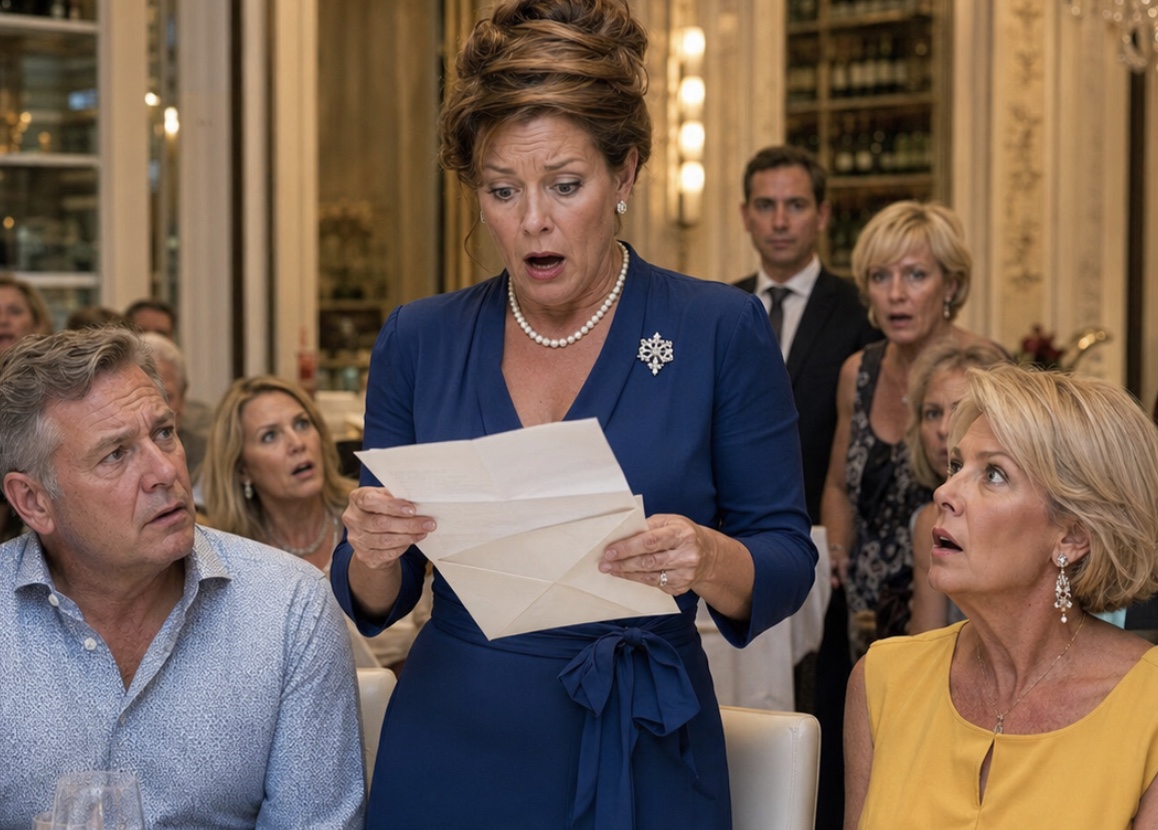
When Ilya’s turn came, he stood, cleared his throat, and reached into the inside pocket of his jacket.
“Mom, this is from all of us. From me, Vika, and the children.”
He held out the envelope.
Faina Sergeyevna took it between two fingers, the way people handled something they would rather not touch but had to accept out of politeness. She turned it over.
She seemed pleased by the embossed decoration.
“Oh, I wonder what they’ve sent me,” she said with gentle mockery, as though she already knew the answer. “Perhaps I should read it aloud. Everyone can hear my daughter-in-law’s congratulations.”
Someone laughed.
Several guests encouraged her.
“Read it! Go on!”
A microphone was passed to her.
Faina Sergeyevna opened the envelope carefully, running one fingernail along the seam so she would not damage it. She pulled out the folded pages.
She unfolded the first sheet and raised it to her eyes before she had time to say anything aloud.
Music continued playing throughout the room.
The guests chatted among themselves.
A waiter standing near the wall adjusted a stack of napkins.
Faina Sergeyevna stood holding the microphone and said nothing.
The silence stretched on.
People began exchanging puzzled looks.
“Faina, what does it say?” someone called from a distant table. “Read it already! Don’t keep us waiting!”
Slowly, Faina Sergeyevna raised her eyes.
Then she looked back down at the pages.
Her face, which moments ago had been flushed from champagne and compliments, suddenly looked pale and flat. Her brooch caught the chandelier light and flashed brightly, but the woman wearing it appeared not to notice.
She stood there reading in silence.
Her lips moved slightly.
Ilya remained seated, unable to understand what was happening.
“Mom?” he called quietly.
She did not answer.
He stood, walked over, and gently took the pages from her hands. She offered no resistance. Her fingers simply opened.
Ilya looked down.
The first page contained a screenshot from the residents’ group chat. It showed messages between the building manager and the tenants.
Apartment number forty-seven.
Outstanding utility payments.
The total was so large that Ilya’s vision seemed to blur for a moment.
Below it was a copy of a bank statement.
His wife’s bank statement.
It showed a substantial payment made two weeks earlier.
The second page was neatly typed without unnecessary emotion. A few short paragraphs, clear and direct.
Ilya continued reading and felt a chill spread across the back of his neck.
At that moment, Vika was sitting at home with the children.
Artyom had already gone to his room to watch something through his headphones. Sonya was sitting beside her mother on the sofa, leaning against her shoulder and turning the pages of a picture book.
Every so often, she pointed at something excitedly.
“Mom, look at this funny horse!”
Vika looked.
She smiled and stroked her daughter’s hair.
Outside, darkness was slowly settling over the city.
August seemed reluctant to leave. The heat remained until late in the evening, and even after sunset the air was warm and heavy.
Vika opened the balcony door.
The smell of poplar trees warmed by the sun drifted into the room, mixed with the distant aroma of meat cooking over charcoal.
She did not touch her phone.
Was she waiting?
No.
She was simply living inside that evening—with the book, the warm air, and her daughter’s shoulder pressed against her own.
She knew that what she had done was right.
Not because it had created a dramatic scene, but because there had been no other choice.
For two years, she had watched the unpaid bills accumulate. The property management company sent every notice in her name because she was the legal owner.
For two years, Faina Sergeyevna had pretended there was no problem.
Apparently, she simply threw the bills away without reading them, with the same indifference she showed toward anything that did not immediately inconvenience her.
Vika had not rushed to pay them.
She watched.
She collected every document.
Then she paid the full amount, cleared the debt, and obtained all the necessary records.
Only after that did she write the letter.
One month was not an act of cruelty.
It was reasonable notice.
A decent amount of time.
Back at the restaurant, the atmosphere had changed.
The guests were no longer talking.
The musicians had sensed the discomfort and gradually fallen silent. Only the double-bass player continued to touch the strings softly, as though he could not quite bring himself to stop completely.
Ilya stood beside his mother, holding the papers and staring at the floor.
Faina Sergeyevna still had not spoken.
“What happened?” asked Ilya’s cousin Olya, making her way closer. “Faina Sergeyevna, are you feeling unwell?”
“Everything is fine,” she finally replied.
Her voice was controlled.
Too controlled—the voice of someone using every ounce of strength to keep herself together.
“It was simply… an unexpected greeting.”
“Then read it!” someone called again from the far end of the room.
Those guests still did not understand what was happening.
They were still enjoying themselves.
Faina Sergeyevna took the pages from Ilya.
She stared at them for a long moment, folded them, and placed them inside her small evening handbag with its gold clasp.
“It’s personal,” she said briefly.
Then she produced a practiced society smile.
“Let’s have another drink instead.”
The guests raised their glasses.
The musicians resumed playing.
A waiter brought out the main course.
Nevertheless, something remained suspended in the air—the unmistakable sense that the celebration had cracked.
The damage was not yet visible, but the crack was there.
At the neighboring table, Olya whispered to her husband. Elderly Aunt Raya kept glancing at Faina Sergeyevna with concern. Ilya spent the rest of the evening looking like a man suffering from a sudden toothache but too embarrassed to admit it.
He returned home at half past midnight.
Vika was still awake. She lay in bed holding a book, though she was not reading it.
Ilya entered the bedroom, removed his jacket, and hung it over a chair. Then he stood for a long time beside the window.
“You knew,” he said at last.
It was not a question.
“Yes.”
“Why didn’t you tell me?”
Vika lowered the book and looked at him calmly.
There was no anger in her expression.
Perhaps she had grown tired of being angry.
Or perhaps she had made the decision so long ago that the anger was no longer necessary.
“You would have gone to your mother. She would have cried. Then you would have come home and asked me to forget about everything. I didn’t want to have that conversation.”
Ilya sat on the edge of the bed and rubbed his face with both hands.
“The debt was… serious.”
“I know. I paid it.”
“Why?”
“Because it is my apartment, Ilya. My money paid for it. I am simply taking back what belongs to me.”
He said nothing.
Outside, the August night was hot and airless. Somewhere below, a car door slammed and an engine started.
“She didn’t know the apartment was registered in your name,” he said quietly. “She thought…”
“She knew,” Vika interrupted. “She signed the same documents. She simply assumed I would never read them.”
Silence.
“Why the envelope?” he asked. “Why did you do it there, in front of everyone?”
Vika considered the question for a moment.
Then she answered without satisfaction or triumph in her voice.
“She sent her regards to us through you. I sent my reply through you. That seems fair.”
Ilya could think of nothing to say.
He lay down and turned toward the wall.
Vika picked up her book again. She was still on the same pages she had been holding an hour earlier.
She had not read a single new line.
In the next room, the children slept peacefully.
Meanwhile, in an expensive apartment on the other side of the city, Faina Sergeyevna sat at her kitchen table in her elegant fuchsia dress, reading the printed pages again and again.
It was as though she hoped that on the third or fourth reading, the words would somehow be different.
But the final line remained unchanged.
Faina Sergeyevna called at eight the next morning.
Vika saw her name on the screen, allowed the phone to ring three times, and then answered.
“Yes?”
“We need to talk.” Her mother-in-law’s voice was dry, stripped of its usual social elegance. “Come here.”
“I’m not coming, Faina Sergeyevna. Say whatever you need to say now.”
A pause followed.
Clearly, that was not the response she had expected.
“Do you understand what you did yesterday?” Her voice finally trembled, not with tears but with anger. “In front of the entire family, at my anniversary celebration—”
“I was at home,” Vika said calmly. “With the children. The same children to whom you sent your regards.”
Silence.
When Faina Sergeyevna spoke again, her tone had changed. It was almost conciliatory.
“Listen, let’s discuss this like adults. The apartment situation is simply a misunderstanding. Surely you understand. Ilyusha was in a hurry at the time, and the documents got mixed up…”
Vika leaned against the wall and closed her eyes briefly.
So this was the approach she had chosen.
Seven years had passed, and the woman was still trying to explain things away.
She still believed Vika might accept the excuse that the documents had somehow been “mixed up.”
“Nothing was mixed up,” Vika said evenly. “You know that, and I know it. One month is a reasonable amount of time. Real estate agents work perfectly well in August, so you should have no trouble finding somewhere else.”
“Where am I supposed to go at my age?” Faina Sergeyevna’s voice finally broke. “You’re throwing me out onto the street! Your husband’s own mother!”
“I’m not throwing you into the street. I am reclaiming an apartment that legally belongs to me.”
Vika paused.
“That is all, Faina Sergeyevna. Have a pleasant day.”
She ended the call and placed the phone on the table.
Her hands were perfectly steady.
Ilya had left for work earlier than usual without eating breakfast or saying much.
Vika had not tried to stop him.
She needed time alone to think—not about her mother-in-law, because that decision was final, but about something else.
She made herself a cup of coffee and stepped onto the balcony.
Even in the morning, the August heat was already intense. The sky was pale and bleached by the sun. Even the pigeons on the neighboring rooftop sat with their feathers puffed out, as though they too were suffering.
Below, the caretaker pushed a rubbish cart across the courtyard. One of its wheels squeaked with every second turn.
Vika thought about Ilya.
Not angrily.
Her anger had burned itself out long ago, leaving behind something colder and more rational.
She looked back at their seven years together and suddenly saw them clearly, the way a room appears in daylight after someone has spent years living under a weak bulb.
Ilya was not a bad man.
He was simply weak.
His weakness ran so deeply and had existed for so long that he probably no longer recognized it.
His mother gave an order, and Ilya delivered it.
His mother was offended, and Ilya remained guiltily silent.
His mother made a decision, and Ilya did not argue.
Vika carried everything.
She carried the children, the household, and the emotional weight of all those years. She did it silently because she did not know how to create scenes and had no desire to learn.
She might have continued carrying it indefinitely if not for the apartment.
If not for the unpaid bills accumulating silently like water behind a dam.
She took a sip of coffee.
Somewhere beyond the buildings, the city hummed.
She did not know what would happen next.
For the first time in years, that uncertainty did not frighten her.
Ilya returned around lunchtime.
It was unexpected. He rarely came home before seven.
Vika was feeding Sonya while Artyom sat beside them talking about the summer camp he was supposed to attend the following week.
Ilya entered, greeted the children, and kissed Sonya on the top of her head.
Then he looked at Vika.
“Can we talk?”
“Yes.” She nodded toward the bedroom. “Give me five minutes.”
She finished feeding Sonya, sent the children to watch cartoons, and entered the bedroom.
Ilya stood by the window, almost exactly as he had the previous night.
Vika realized that this was the position he adopted whenever a conversation became difficult.
“I went to see Mom,” he said.
“I know. She called me this morning.”
“She…” He grimaced. “She wants you to give her the apartment. To transfer it into her name. She says she’ll pay you.”
Vika remained silent.
“I understand how that sounds…” He stopped.
Then he looked at her, and she saw something in his eyes that had been absent for a long time.
It was not a request.
It was something more confused and vulnerable.
“Vik, this is my fault. Back then, I didn’t understand what was happening. I simply trusted Mom when she said she would handle everything properly. I never thought things would turn out like this.”
“I know you didn’t think.”
“But that apartment is her home. She has lived there for seven years.”
“With my money.”
“Yes,” he said without arguing. “With your money.”
Vika sat on the edge of the bed.
“Ilya, I’m not putting her out on the street. A month is enough time. She’ll find another place. She has her pension, and she also has the money I’m asking for the apartment. I’m offering it below market value, and you know that. But she will not continue living there. I have made my decision.”
He remained silent for a long time.
Then he nodded slowly, like a man accepting something painful because he finally understood there was no alternative.
“And what about us?” he asked quietly. “What happens to us?”
Vika looked at him properly.
Not past him.
Not through him.
Directly at his face.
“I don’t know,” she answered honestly. “That doesn’t depend on the apartment.”
Three weeks later, Faina Sergeyevna moved out.
She did not go far. She found a two-bedroom apartment in a neighboring district, on the second floor, with a sensible layout.
She found it quickly.
When necessary, Faina Sergeyevna knew how to take action.
Ilya and a distant cousin helped her move.
Vika did not go.
There was no reason for her to be there.
That same day, Vika called an agency and rented a country house for September.
It was not expensive—just a simple house with a veranda, pine trees surrounding it, and a river within a ten-minute walk.
At first, Artyom refused to go because he had made plans with his friends. But when Vika mentioned the river and a boat, those plans suddenly became flexible.
When Sonya heard about the boat, she spent the next several days telling everyone they met that the family was going to the seaside.
Vika did not correct her.
As for Ilya, he went with them.
It was his own suggestion.
He took time off work, something he had not done in three years.
During the first two days, he wandered around looking slightly lost. He had no job to occupy him, no constant calls from his mother, and none of his usual routine.
On the third day, Artyom persuaded him to go fishing.
They returned that evening silent, content, and smelling of river water and mosquito repellent.
Vika watched them from the veranda and wondered whether perhaps nothing had been decided yet.
Perhaps something could still be saved.
Or perhaps it could not.
She did not know.
Sonya sat beside her, swinging her legs and eating an apple with loud, enthusiastic crunches.
“Mom, will we come here again?”
“We’ll see.”
“Oh, Mooom.”
“We’ll come back,” Vika said. “We will.”
She looked up at the pine trees, the sky, and the first stars appearing above the roof.
August was ending.
September lay ahead.
Faina Sergeyevna called again in October.
Vika saw her name on the screen and answered without anxiety.
She simply answered.
“How are the children?” her mother-in-law asked.
Her voice was different.
It was neither conciliatory nor artificial.
It was simply tired—the voice of an aging woman who had run out of arguments.
“They’re well. Artyom is at school, and Sonya is at kindergarten.”
“I see.”
A pause.
“I only wanted to ask.”
“Now you know.”
Silence followed.
Then Faina Sergeyevna said, “You’re never going to forgive me.”
Vika thought for a moment.
“I don’t hold a grudge against you, Faina Sergeyevna. But I’m not going to pretend nothing happened, either. That is more honest.”
Her mother-in-law did not respond.
She simply said goodbye and ended the call.
When Ilya learned about the conversation, he sat silently for a long time.
Then he said, “Thank you for answering.”
Vika shrugged.
Ignoring the call would have been petty.
And Vika had never been a petty woman.
She and Ilya continued living together, cautiously, like two people learning all over again how to move through the same room.
Something between them had shifted.
It was not repaired—not yet—but it had moved.
He called his mother less frequently.
He spent more time at home.
One afternoon, he picked Sonya up from kindergarten without being asked and bought her an ice cream on the way home, even though she had not requested one.
Vika noticed.
She did not comment.
She simply noticed.
In the end, she decided not to sell the apartment.
She rented it out.
The money arrived in her account every month, quietly and reliably, without unnecessary discussion.
Artyom would eventually attend university.
Sonya was growing.
Life was long, and additional money would never hurt.
Sometimes Vika remembered that evening at the restaurant.
She pictured Faina Sergeyevna standing with the microphone in one hand and the pages she had not dared read aloud in the other.
Vika remembered it without satisfaction.
She simply saw it as the moment after which everything finally returned to its proper place.
And putting things in their proper place was something Vika had always known how to do.