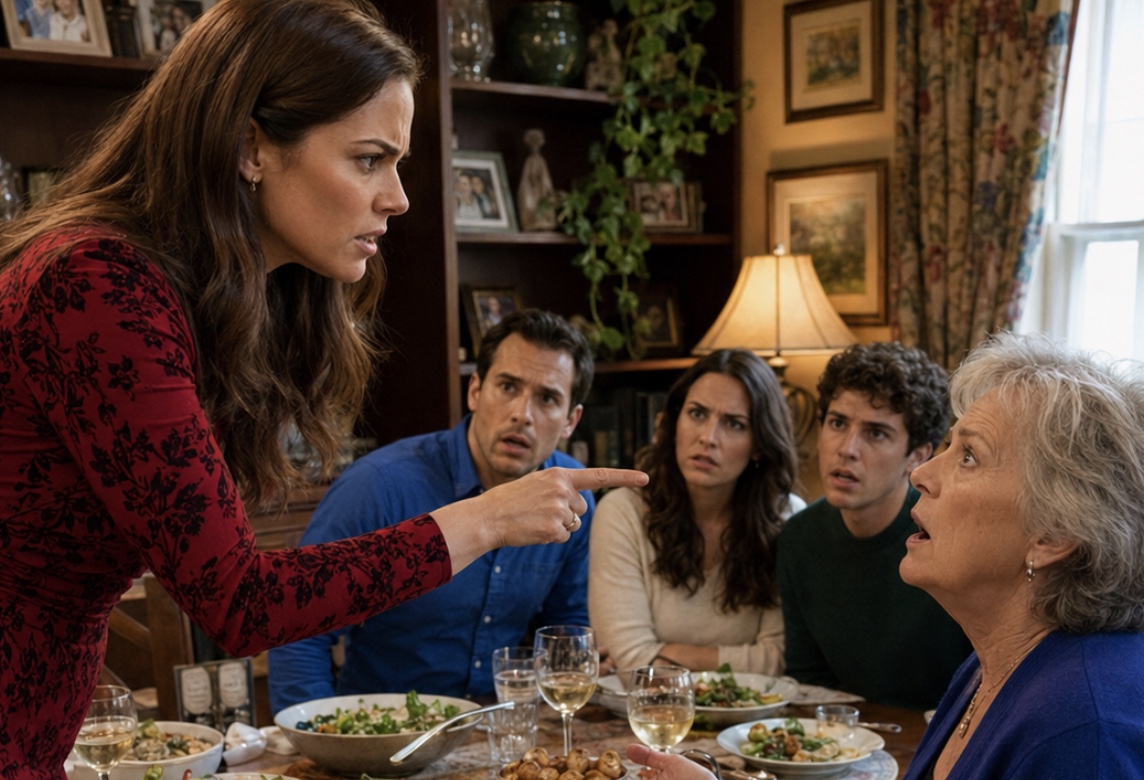
“Why would one woman need so many apartments? Transfer one to Kolya and the other to Lena. There’s no sense letting good property go to waste.”
Galina Pavlovna said it as casually as though she were asking someone to pass the bread. Her plump hands continued spooning Olivier salad onto everyone’s plates, and her voice remained ordinary, almost affectionate.
Silence fell over the table.
Victoria froze with her fork halfway to her mouth. She blinked, wondering whether she had misheard. But her mother-in-law had already moved on—placing a napkin beside her son and pouring more fruit compote for her daughter—as though she had said nothing unusual.
Kolya was the first to react. Dmitry’s younger brother leaned back in his chair and broke into a wide grin.
“So, when can I come and see my new place? I’d like to start renovating before summer.”
Victoria turned toward Dmitry. He sat perfectly still, his jaw clenched. His sister Lena was already whispering excitedly into her mother’s ear.
Victoria alone remained silent. Her throat had suddenly gone dry, and a long-forgotten feeling began rising inside her—the feeling that came whenever someone tried to take away everything she had built brick by brick.
Three years before that dinner, Victoria had stood outside a rented room with two suitcases and a shattered phone.
Her former husband, Sergei, had not even bothered to say goodbye. While Victoria was visiting her mother in another city, he changed the locks and moved his new girlfriend into their home.
“What do you mean, ‘don’t come back’?” Victoria had asked over the phone, still unable to believe what she was hearing. “Sergei, that’s our apartment.”
“My apartment,” he replied indifferently. “Pick up your things. I’ll leave them in the hallway.”
And that was exactly what she did.
She stood on the landing beside several plastic bags containing everything she had accumulated during seven years of marriage. She had no job, no savings and nowhere to live.
Her friend Marina made her a cup of tea that evening and spoke without trying to soften the truth.
“Vika, you’re intelligent. You’ll get through this. But never allow yourself to become that dependent on someone again.”
Victoria listened—not so much to her friend as to the fear inside her.
She found two jobs. During the day, she worked in the accounting department of a construction company. In the evenings, she handled bookkeeping projects remotely. She cut every unnecessary expense. She brought homemade lunches in plastic containers, walked instead of taking taxis and refused to buy anything that was not absolutely essential.
Every spare ruble went into savings.
A year later, her grandmother died. Zinaida Timofeyevna passed peacefully in her sleep, leaving her only granddaughter a three-bedroom apartment in a residential district.
Victoria spent a long time sitting alone in the empty rooms, surrounded by the lingering scent of her grandmother’s pies and valerian drops.
Then she made a decision.
She sold the large apartment and used the money to purchase a comfortable two-bedroom home for herself and a small studio to rent out. Later, she took out a mortgage on a one-bedroom apartment and paid it off within eighteen months. By then, disciplined living and careful budgeting had become second nature.
Two of the apartments produced a steady rental income. In the bright two-bedroom apartment with its spacious kitchen and warm enclosed balcony, Victoria finally felt that she had a real home.
That was when Dmitry entered her life.
He was calm, cheerful and never tried to pressure or rush her. After they married, he moved into her apartment. On their first evening together, Victoria spoke to him honestly.
“Dima, those apartments are my safety net. I paid for them with more than money. They cost me my nerves and my health. I need to know there will always be solid ground beneath my feet.”
He wrapped his arms around her, kissed the top of her head and answered quietly:
“I admire you. You’re stronger than anyone I’ve ever met.”
For the first time in years, Victoria allowed herself to breathe freely.
At first, her relationship with Dmitry’s family was easy.
Galina Pavlovna welcomed her warmly, served homemade pies and asked about her work. She proudly told the neighbors:
“My daughter-in-law is a real businesswoman. She achieved everything by herself.”
Victoria smiled and even helped her mother-in-law renovate the bathroom. She recommended affordable tile shops and found a reliable contractor. It seemed they had developed a genuine understanding.
Gradually, however, the conversations began to change.
One afternoon over tea, Galina Pavlovna casually asked:
“Vika, how much do your tenants pay for the studio? Twenty thousand? Twenty-five?”
“That isn’t particularly important,” Victoria replied gently, avoiding the question.
“Oh, come on. I’m not a stranger. I’m only curious,” her mother-in-law said with a smile.
Then, during another family visit, Kolya suddenly asked:
“Vika, is your one-bedroom apartment empty at the moment, or are you renting it out? I’ve been thinking about moving away from Mom. I’m tired of living with her.”
Soon Lena joined in as well. During a family lunch, she laughed and called across the table:
“It’s convenient having our own little real-estate agent in the family! Maybe you could give relatives a discount?”
Everyone laughed. Victoria smiled along with them, but something tightened inside her.
A week later, a chill ran down her spine.
Victoria had gone into her mother-in-law’s kitchen to get some water when she heard Galina Pavlovna speaking through a door that had not been fully closed.
“What would be so terrible about it, Lena? She has more apartments than she needs. We’re family. Things like this should be handled within the family.”
“Then suggest it to her, Mom,” Lena replied. “Just be careful. She might become stubborn.”
Victoria quietly stepped back into the corridor.
Her hands had gone cold. She recognized the sticky, familiar anxiety immediately. Her first marriage had begun the same way. At first everything had supposedly belonged to both of them. Later, she discovered that none of it had ever truly been hers.
That night she lay awake for hours, staring at the ceiling. Dmitry slept beside her, breathing evenly, but for some reason the sound brought her no comfort.
Several weeks later, Galina Pavlovna called and invited them over.
“Come for dinner on Saturday. We’ll have a quiet family evening. I’ll fry some cutlets.”
Victoria agreed, although an uneasy premonition tightened in her chest. She still hoped she had misunderstood everything.
On Saturday, her mother-in-law’s apartment smelled of fried meat and fresh dill. A mountain of cutlets stood in the center of the table beside a large bowl of Olivier salad and a pitcher of homemade fruit compote.
Galina Pavlovna bustled around the room, assigning seats and insisting that everyone take second helpings.
At first, the conversation was perfectly ordinary. They discussed Kolya’s job, the difficulties Lena’s son was having at school and the recent weather.
Then Galina Pavlovna placed her spoon on the table, looked around at everyone and spoke in the same everyday tone that made Victoria’s breath catch in her throat.
“I’ve been thinking, Vika. Why does one woman need three apartments? Let’s do the decent thing. Transfer one to Kolya and the other to Lena. There’s no point letting valuable property sit unused.”
Lena immediately brightened.
“Mom, I’ve already looked at the area. It’s excellent. The school is only a ten-minute walk away. It would be perfect for me.”
Kolya sprawled comfortably in his chair and spoke dreamily:
“I’d start renovating immediately. I’ve already found a construction team. I’d tear down the kitchen wall and turn it into an open-plan studio…”
Victoria sat completely motionless, her face drained of color. Her fingers tightened around the edge of the tablecloth.
The words would not come—not because she was frightened, but because the sheer arrogance of the situation had stunned her into silence.
They had already divided everything between themselves.
Without asking her.
As though the apartments belonged to no one.
Before Victoria could speak, Dmitry calmly put down his fork, looked at his mother and said in an even, almost icy voice:
“Excellent idea, Mom. In that case, let’s divide your country house among everyone as well. Six hundred square meters of land and a house—it makes no sense for it to stand empty half the year.”
Galina Pavlovna stopped abruptly. The smile slowly disappeared from her face.
“That’s completely different,” she began. “The country house belongs to your father and me…”
“And the apartments belong to Vika,” Dmitry cut in.
His voice hardened.
“She doesn’t owe any of you anything. She earned those apartments herself. She worked two jobs while living alone in a rented room after her divorce. Anyone here who needs a home can go out and work for one, exactly as she did.”
The kitchen fell silent.
Kolya stared down at his plate. Lena turned red and began twisting her napkin between her fingers. Galina Pavlovna opened her mouth, but no words came.
Victoria slowly turned toward her husband.
He was staring straight ahead, the muscles in his jaw visibly tense. Beneath the table, however, his hand found hers and held it firmly.
Galina Pavlovna’s face turned crimson. Her eyes narrowed, and she pointed an accusing finger at Victoria.
“She turned you against your own family! You got married and forgot where you came from!”
Lena immediately sniffled, dabbed her eyes with a napkin and began lamenting:
“We’re your family! Relatives are supposed to help one another! I’m raising a child by myself, and she can’t even spare one apartment…”
“Henpecked,” Kolya muttered, folding his arms across his chest. “Your wife gives an order, and you jump.”
Dmitry did not raise his voice.
He looked directly at his brother and spoke slowly.
“Vika didn’t win those apartments in a lottery. She lived in a rented room after her divorce. She worked two jobs. She paid off the mortgage herself. Meanwhile, you’re sitting here deciding who should receive what belongs to her.”
“But we’re a family!” Galina Pavlovna insisted. “Greed has never brought anyone anything good…”
“That’s strange, Mom,” Dmitry interrupted, his voice now completely cold. “In our family, ‘helping each other’ always seems to involve taking something that belongs to someone else. This time, it happens to be Vika’s property.”
No one answered.
Victoria silently rose from the table, gathered several plates and carried them into the kitchen. She placed them in the sink and gripped the edge of the countertop. Her hands were trembling.
She could hear her mother-in-law muttering in the other room, but the words had become indistinct.
Victoria closed her eyes.
For the first time in many years, anxiety was not suffocating her. On the other side of the wall stood a man who had chosen to defend her.
After that dinner, Dmitry’s family seemed to split apart.
Galina Pavlovna called her son every few days, and every conversation began in the same way.
“Dima, just think about it. Kolya is still living with me. Lena and her child are stuck in a rented apartment. Meanwhile, your wife has apartments standing empty…”
“They aren’t empty, Mom. They’re rented out. And it’s none of our business,” Dmitry replied evenly.
“I’m your mother, and I can see this family is falling apart because—”
“The family is falling apart because you believe you have a right to someone else’s property,” he cut her off. “Do not bring this subject up again.”
One day Kolya sent Victoria a message:
“At least rent one to me at a family rate. Don’t be so stingy.”
Victoria showed the message to her husband.
Dmitry called his brother and said only one thing:
“If you contact my wife about her apartments again, you and I are going to have a very different conversation.”
Kolya never wrote to her again.
Whenever Lena saw Victoria, she avoided eye contact and pursed her lips, but she also kept quiet.
Victoria looked at her husband and felt warmth slowly spreading through the place inside her where fear had lived for years.
She had been right to keep her property legally separate.
More importantly, she had been right to trust Dmitry.
A year later, they stood together on a plot of land forty minutes outside the city.
The foundation had already been poured, and Dmitry was spreading the plans for their future house across the hood of the car.
“The terrace will be here,” he explained, pointing to the drawing. “And the veranda will face the forest. Can you imagine what the mornings will be like?”
Victoria smiled and rested her head against his shoulder.
“I can. It will be our home.”
Our home.
That was exactly what it was, because they were building it together, as equal partners, using money they had earned together.
Victoria continued renting out her apartments. The income helped finance the construction and strengthened the emergency fund she now protected calmly, without the old, constant fear.
She and Galina Pavlovna saw each other only on holidays. Her mother-in-law still considered Victoria “far too calculating” and occasionally complained about her to the neighbors, but she never again attempted to decide what should happen to someone else’s property.
From time to time, Victoria remembered the rainy evening when she had stood outside a locked door with two suitcases.
She understood now that although she had lost an apartment that night, she had gained something much more important: the knowledge that financial independence protects not only your money, but your dignity as well.