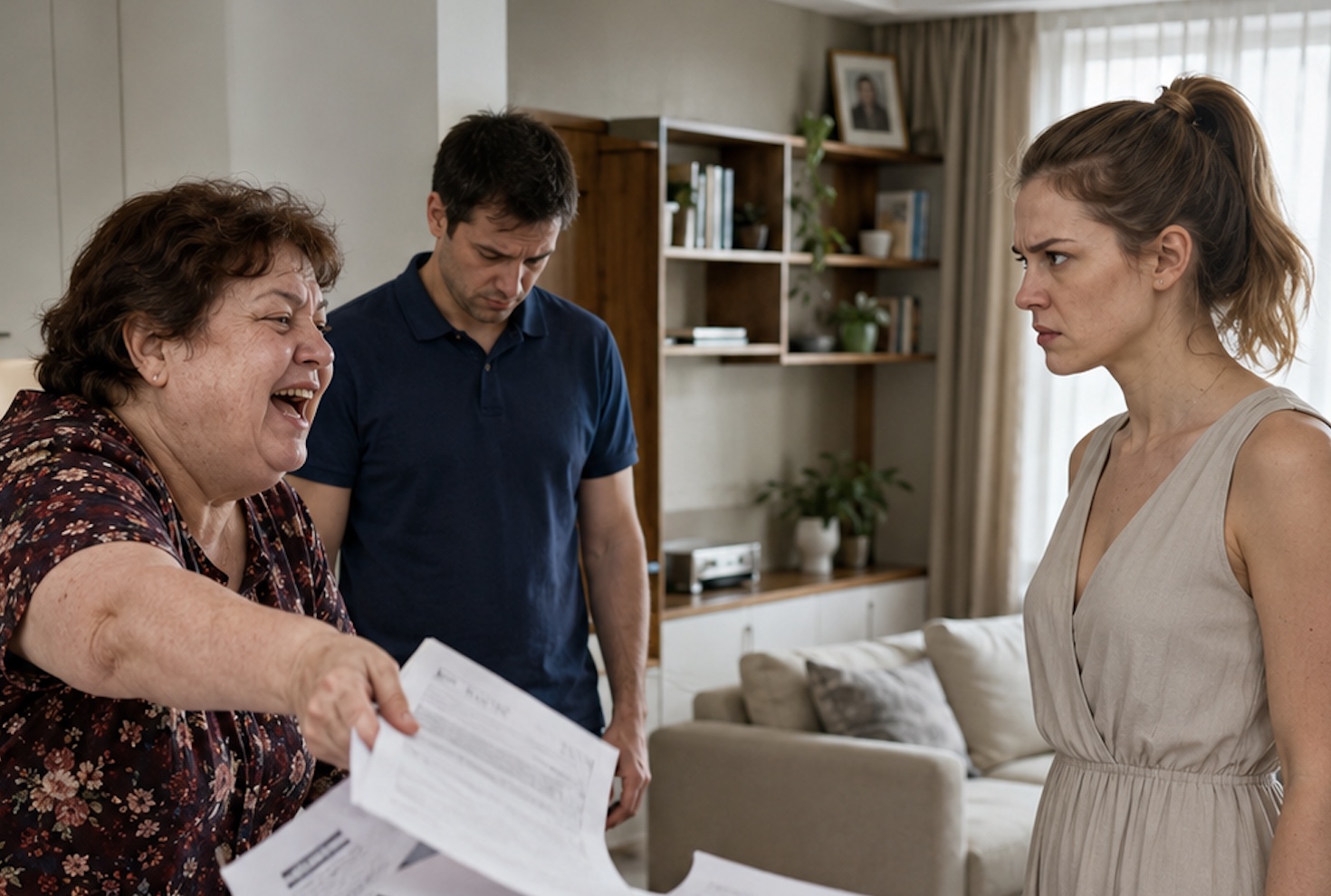
“Take a good look at this!” Tamara Viktorovna flung a thick stack of papers onto the table, sending the pages sliding across the plastic tablecloth like a fan. “We’ve done you a favor, and this is how you repay us—by turning your back on the family!”
Vera stood by the window, staring down into the courtyard. Children were kicking a ball around. Someone on the balcony opposite was watering flowers. Pigeons crowded around a bench.
It was an ordinary summer morning.
The only thing that wasn’t ordinary was what was happening inside her apartment.
“We’ve registered the entire family at your address,” her mother-in-law continued, sounding almost festive, as though she were announcing wonderful news. “Now we all have equal rights to the apartment. So don’t start making a scene.”
Vera slowly turned around.
Tamara Viktorovna stood in the middle of the kitchen, broad and smug, wearing the same flower-patterned flannel robe she seemed to have had on since the previous Thursday. Her hair had been carelessly tied back, and cookie crumbs clung to her chin.
Beside her, standing slightly behind, was Stas—Vera’s husband.
He stared at the floor.
At thirty-two, Stas had mastered the art of looking down so intensely that it seemed he might disappear through it at any moment.
“What family?” Vera asked quietly.
“Me, Stas, his aunt Lyuda and her husband, and our nephew Artyom. Five people.” Tamara Viktorovna folded her arms across her chest. “Everything was handled by a notary. Completely legal.”
Vera felt the blood drain from her hands.
The apartment belonged to her. She had inherited it from her grandmother three years earlier, before she married Stas. Vera had renovated it herself, selected every bathroom tile herself, and carried boxes containing flat-packed cabinets up the stairs herself.
This place was her world.
Hers.
“Stas.” She looked at her husband. “Stas, lift your head.”
He did.
His eyes were guilty, but apparently not guilty enough to make him do anything.
“Mom said it was the right thing to do,” he muttered. “A family should live together. You said yourself that you wanted us all to be closer.”
“I was talking about taking a vacation together,” Vera replied.
Tamara Viktorovna snorted.
“The seaside can wait. Now we have proper living space. By the way, Artyom is arriving next week. He’ll stay in the small room for the time being.”
“The nursery?” Vera asked.
“You don’t have children yet,” her mother-in-law said with a shrug. “The room is standing empty.”
Vera did not shout.
She had never liked shouting. It wasn’t in her nature.
Instead, she picked up her handbag and keys and walked out of the apartment.
On the landing, she leaned against the cold wall and remained there for a full minute. Then she took out her phone and dialed a number.
“Lena, where are you?”
Lena was a doctor at the municipal hospital and Vera’s closest friend since university. She worked exhausting twenty-four-hour shifts and answered in a sleepy voice.
“At home. I just finished a shift. What happened?”
“A lot. May I come over?”
“Of course. I’ll make coffee.”
Vera went downstairs, crossed the courtyard past the pigeons, and stepped onto the street.
The summer heat pressed down on the city. Warm air rose from the asphalt, and the trees stood perfectly still. Vera walked to the bus stop, boarded the next bus, and stared out the window for the entire journey without truly seeing anything.
Her thoughts came calmly, one after another.
That was how her mind worked. She did not panic immediately. First, she placed every fact into its proper compartment.
Five people had been registered in her apartment without her knowledge or permission.
How was that even possible?
She was the sole owner. No one could be registered there without the owner’s consent.
Then she remembered something.
Three months earlier, Stas had asked her to sign several documents. He had told her they were related to their car insurance and required a spouse’s signature.
She had signed without reading them.
He was her husband.
She had trusted him.
The bus swayed as it turned a corner.
Vera closed her eyes.
Lena’s apartment smelled of coffee and homemade food. Despite being exhausted after her shift, Lena had prepared sandwiches.
They sat in the kitchen while Vera told her everything. Lena listened silently, nodding from time to time.
“Show me the documents you signed,” she said when Vera finished.
“I don’t have copies. Stas handled everything.”
“Then the first thing you need is an official property and residence-registration extract. You need to see exactly what has been recorded. Vera, registration and ownership are not the same thing. Even if those people are registered at your address, that does not automatically give them ownership rights.”
“Tamara said we all have equal rights now.”
“Tamara says a lot of things.” Lena poured more coffee. “I have a former patient who is a housing lawyer. He’s extremely competent. I’ll give you his number.”
Vera nodded.
She was no longer listening distractedly. She absorbed every word.
Something inside her had changed, like a switch being flipped.
While Vera was at her friend’s apartment, Tamara Viktorovna was making herself comfortable.
Stas had left for work. He was a driver for a transportation company, and his shift would not end until eight in the evening.
Left alone, Tamara Viktorovna began inspecting the apartment as though she already owned it.
She walked through the rooms, opening cupboards and examining their contents. She ran her hand over the velvet sofa in the living room.
Then she entered the small room that had once been Vera’s study. It contained a desk, several shelves filled with books, and an old floor lamp.
“We’ll need a bed in here,” she said aloud, though no one was listening. “And Artyom will need a television.”
She returned to the kitchen, opened the refrigerator, and stared inside for a long time. Then she removed a container of borscht Vera had cooked the day before, put it on the stove, and poured herself a large bowl.
As she ate, she considered the situation.
The apartment was excellent. Three rooms, a fifth-floor location, and a view of the park.
Tamara Viktorovna lived in a cramped, dark one-room apartment on the opposite side of the city, with a kitchen faucet that never stopped leaking.
She had no intention of returning there.
Her plan was simple.
First, she would establish herself here.
After that, she would see what happened.
The one thing she had failed to take into account was Vera.
Vera returned home at half past six.
She was calm, her back straight. Inside her handbag was the housing lawyer’s phone number and a list of questions she had written during the bus ride home.
The kitchen smelled of burned onions. Tamara Viktorovna was frying something and singing loudly to herself.
Vera’s favorite cup stood on the table. Its handle had been broken off. Her mother-in-law had apparently dropped it and then casually placed it back as though nothing had happened.
Vera looked at the cup.
Then she looked at Tamara Viktorovna.
Finally, she looked out the window, where the summer sun was sinking behind the rooftops.
“Tamara Viktorovna,” she said evenly, “tomorrow morning I’m going to see a lawyer.”
Her mother-in-law turned around, surprised.
She had clearly expected tears, screaming, and doors being slammed.
“Go wherever you like,” she said, stirring the onions. “You’ll only waste your money. Everything was done legally.”
“We’ll see,” Vera replied.
Then she went into the bedroom to gather her documents.
The lawyer saw Vera the following morning at ten thirty.
His office was located inside a modern business center near the metro station. There were glass doors, air-conditioning, and a young receptionist in a white shirt.
It did not resemble the sort of place where people usually brought painful family problems.
Pavel Ignatyevich was a short, meticulous man with observant eyes behind thin-framed glasses.
He listened without interrupting and then asked to see her documents.
Vera placed everything she had found on his desk: the certificate confirming her ownership, a copy of her grandmother’s will, and an official property extract she had ordered online during the night.
He studied the papers for a long time, rearranging the pages and making notes in pencil.
“So you signed documents three months ago?” he asked at last.
“Yes. I believed they were for car insurance.”
“Do you have a copy of what you signed?”
“No. Stas said the copy would be kept at his workplace.”
Pavel Ignatyevich removed his glasses and rubbed the bridge of his nose.
“Here is the situation. People cannot legally be registered in your property without your written consent as the owner. Either you signed something without reading it, or your husband used a forged signature. Those are two different possibilities, but both are serious.”
Vera stared at him.
“What happens if the signature was forged?”
“Then we are dealing with a criminal offense.”
The words fell into the silence of the office like a stone dropping into deep water.
Vera took a different route home.
She got off the bus early and walked through a small park because she needed time to think. Trees cast cool shadows over the pavement. Music leaked from someone’s headphones. A cyclist rolled past.
Life continued as usual, while Vera’s entire world had been turned upside down.
A forged signature.
She did not want to believe Stas was capable of it.
He was weak and easily controlled, like a puppet whose strings had always been held by his mother.
But forging his wife’s signature required a different kind of audacity.
Or someone else’s hands.
His mother’s, Vera thought.
And suddenly everything became clear.
Her phone rang as she approached her building.
The number was unfamiliar.
She stopped beside the courtyard fountain and answered.
“Vera Sergeyevna?” said a restrained male voice. “My name is Artyom. I’m Tamara Viktorovna’s nephew.”
For a moment, Vera did not know what to say.
“I’m listening.”
“I know I’m supposed to arrive next week.” There was a brief pause. “I’m not coming. And I want you to know that I never agreed to being registered in your apartment. Aunt Tamara did everything herself. I was simply informed after the fact. She told me it was temporary and that you knew about it.”
Vera slowly sat down on the edge of a bench.
“Go on.”
“I have something that may help you,” Artyom continued cautiously, like someone afraid of saying too much. “Three months ago, Aunt Tamara asked me to help her with some documents. I didn’t understand what they were for. I assumed it had something to do with her own apartment. But she showed me a sample of a signature. Someone else’s signature.”
“Whose?”
“A woman’s. I didn’t know whose it was at the time. Now I think I do.”
The fountain murmured nearby. Sparrows bathed in a puddle beside the curb.
Everything looked perfectly ordinary.
Yet at the same time, every piece of the puzzle slid into place.
“Artyom,” Vera said, “are you prepared to confirm this officially?”
There was a long silence.
“Yes,” he finally replied. “She isn’t my mother. And what she’s doing is wrong. I can’t be part of it.”
That evening, Stas returned from work exhausted and smelling of gasoline.
He sat down in the kitchen and asked for tea. Tamara Viktorovna fussed around him, reheating meat patties and talking about Artyom’s arrival and the new curtains they needed to buy for the small room.
Vera poured tea for her husband, placed the mug in front of him, and sat across the table.
“Stas,” she said, “I spoke with a lawyer.”
Tamara Viktorovna froze beside the stove.
“And?” Stas asked without lifting his eyes.
“He explained that registering people in my apartment without my signature is illegal. If my signature appears on those documents but I didn’t put it there, then a criminal offense has been committed.”
“You signed them!” Tamara Viktorovna snapped. “You signed everything yourself and now you’ve forgotten.”
“I signed car-insurance documents.”
“You never remember anything. You’re always distracted.” Her mother-in-law turned to her son. “Stas, tell her.”
Stas said nothing.
He rolled a teaspoon nervously between his fingers and stared at the table.
“Stas,” his mother repeated, louder this time. “Tell her she signed those papers herself!”
“Mom…” he began.
“What do you mean, ‘Mom’? Tell her!”
Then something happened that Vera had never expected.
Stas raised his head.
He did it slowly, like a man for whom even that small movement required enormous effort.
“I didn’t know her signature was on those documents,” he said quietly. “You gave them to me and said Vera had already signed them.”
Tamara Viktorovna’s mouth fell open.
“What?”
“I took them to the office because you asked me to. I thought Vera knew about it. You told me the two of you had agreed.”
“Be quiet,” his mother hissed.
“No,” Stas said.
His voice was still quiet, but this time it was firm.
“No, Mom. Enough.”
The kitchen became so silent that they could hear water dripping from the faucet.
Tamara Viktorovna stared at her son.
Something changed in her face. Her self-satisfaction slipped away, revealing confusion and fury underneath.
Vera looked at her husband.
During their three years of marriage, he had never once told his mother no.
He had never looked directly at her like this.
Vera did not know what it meant.
Was it too late?
Was it too little?
Or was it the beginning of something different?
There was no answer yet.
The night passed strangely.
Tamara Viktorovna locked herself in the living room and lay on the sofa, sighing loudly and theatrically.
Stas smoked on the balcony for a long time. Eventually, he entered the bedroom, lay down on his side of the bed, and said nothing.
Vera remained beside him with her eyes open, listening to the city outside: occasional cars, someone laughing in the courtyard, and the distant hum of traffic.
She was not angry.
That surprised her.
There was no anger left—only a calm, icy clarity.
She got up before everyone else the following morning.
Pavel Ignatyevich agreed to see her without an appointment. Vera called him at eight, briefly explained what had happened, and he told her to come at ten.
This time, she brought additional evidence: printed copies of her messages with Stas from the days when the papers had been signed and a voice message he had sent her at the time.
“Vera, sign right here. Mom says it’s urgent. It’s for the insurance.”
The lawyer listened to the recording, read the messages, and nodded.
“This is useful. Extremely useful. Combined with Artyom’s testimony—provided he is willing to appear personally and confirm that Tamara Viktorovna showed him a sample of someone else’s signature—we have a very clear picture. We should file a formal complaint.”
“With whom?”
“The police, first. At the same time, we’ll file a civil claim challenging the registrations.” He looked at her over the top of his glasses. “Vera Sergeyevna, you understand this may take time?”
“I understand,” Vera said. “I’m not in a hurry.”
Artyom arrived two days later—not the following week, as his aunt had planned.
He called Vera in advance, and they met at a café near the lawyer’s office.
He was young, around twenty-five, thin, soft-spoken, with a habit of looking slightly to the side whenever he spoke.
He worked as a restaurant cook and shared a rented apartment with a friend. He had been afraid of Tamara Viktorovna since childhood. She was the oldest member of the family and was accustomed to everyone obeying her.
“She called me in April,” he explained, holding his mug with both hands. “She said she had found an opportunity to register herself in a good apartment, and she wanted to register me too, so I would have an official address. I had just left my previous job and had other problems, so I didn’t pay much attention. She gave me some papers and asked me to look at the signature. She said she wanted to know whether it had been filled in correctly. I looked at it and didn’t think anything of it. But after everything was completed…”
He fell silent.
“I started to feel uncomfortable.”
“Why did you decide to call me now?”
“Because she called and ordered me to come to the apartment and ‘stick to the same story.’” Artyom raised his eyes. “I’m not going to stick to any story. None of this belongs to me.”
Vera studied him.
He was a strange young man—quiet and slightly lost.
But honest.
She could see that.
“Are you prepared to give an official statement?”
“Yes. I’ve already spoken to a lawyer of my own,” he added. “I want to handle everything properly.”
They filed the police report on Friday.
Tamara Viktorovna learned about it from Stas on Saturday morning.
He told her himself.
He entered the living room, where she was watching television, and said plainly that Vera had filed a complaint, Artyom was giving evidence, and the authorities had opened a case.
Her reaction was loud.
Very loud.
The neighbors almost certainly heard her through the closed doors and over the television.
Tamara Viktorovna screamed about betrayal. She shouted that she had sacrificed her entire life for her son. She accused Vera of destroying the family and called Artyom a Judas.
Stas stood there and listened.
He did not argue.
He did not agree.
He simply waited.
When she finally ran out of breath, he spoke.
“Mom, you need to leave. Today.”
“What?”
“You need to go back to your apartment. This is Vera’s home. You should never have done this.”
“You’re throwing your own mother out?”
“I’m asking you to leave,” Stas replied. “Those are not the same thing.”
Tamara Viktorovna stared at him as if she were seeing a stranger.
Perhaps she was.
She left before lunchtime.
She packed a bag in silence and called a taxi. On her way out, she slammed the door so hard that the sound echoed throughout the building.
But she left.
That evening, Vera sat alone in the kitchen, drinking coffee and looking out the window.
The sunset was bright orange and pink, almost unreal, like a picture on a postcard.
Stas came in and sat across from her.
For a long time, he said nothing.
“There’s something I need to tell you,” he finally began.
“Go ahead.”
“I know I behaved badly. Not only now. Always.” He stared down at his hands. “I never knew how to refuse her. I never learned. That is my problem, not yours. I’m not asking you to forgive me. I only want you to know that I understand.”
Vera listened without interrupting.
“I made an appointment with a therapist,” he added quietly. “My first session is next week.”
That was the last thing she had expected.
“Good,” she said after a pause.
They said nothing else that evening.
But something had shifted—not suddenly or dramatically, but in the way the air changes before rain. The change was almost invisible, yet impossible not to feel.
Three weeks later, the court issued its decision.
The registrations were declared invalid because they had been completed unlawfully and without the property owner’s consent.
All five people were removed from the apartment’s official registration records.
The criminal case concerning the forged signature continued.
It was a long and exhausting process, filled with hearings, postponements, and paperwork. But Vera attended every session personally, always on time, carrying a folder containing all her documents.
Tamara Viktorovna arrived at the first hearing wearing a wide-brimmed hat and pretended not to recognize her daughter-in-law.
Her lawyer was a modest local attorney. She had apparently expected the entire matter to disappear on its own.
It did not.
Artyom spoke quietly but clearly during the hearing.
He did not look at his aunt.
Afterward, he gave Vera a brief, businesslike nod in the courthouse corridor.
She nodded back.
In September, Vera finally transformed the small room into the space she had dreamed about for years.
She removed the old floor lamp, installed proper lighting, and bought an easel.
She had once been talented at drawing, but she had stopped during university. Later, the confusion and constant compromises of married life had made her forget about it entirely.
Now she remembered.
Her first drawing was simple: the view from the window, several rooftops, and a piece of sky.
It turned out well.
After Lena saw a photograph of it, she sent a message.
“You should sell this. I’m serious.”
Vera laughed.
She had not laughed like that in a long time—freely and without effort.
Stas looked into the room and studied the easel.
“It’s beautiful,” he said simply.
Vera nodded.
They still did not know what would happen next.
They did not know whether they would stay together.
It was an honest and uncomfortable question, and neither of them was ready to ask it aloud.
But for the first time in a long while, Vera understood that the question belonged to her.
Only to her.
And she would be the one to answer it.
The apartment belonged to her.
So did her life.
The divorce was finalized in November.
There were no arguments and no dramatic scenes.
Stas came to the registry office wearing his usual jacket. He signed the papers and stepped outside.
He stood near the entrance and lit a cigarette.
Vera came out a moment later, and for a while they stood beside each other in silence—two people who had spent three years together and were now preparing to walk in different directions.
“How are you?” he asked.
“I’m all right,” she replied. “You?”
“Me too.” He extinguished the cigarette. “I’m sorry. For everything.”
Vera looked at him.
He seemed different—not necessarily better or worse, simply different.
Perhaps therapy was helping.
“Have a good life, Stas,” she said.
Then she walked toward her car.
There were no tears.
No drama.
A chapter had simply ended.
The court gave Tamara Viktorovna a fine and a suspended sentence, taking her age and lack of previous convictions into consideration.
Her lawyer succeeded in securing the minimum punishment.
She left the courtroom with a stony expression and did not say a word to anyone.
People later said she had been ill for a long time afterward—high blood pressure and problems with her nerves.
Stas visited her once a week and brought groceries.
That was his business.
It was no longer Vera’s.
After the final hearing, Artyom sent Vera a short message.
“I’m glad everything ended the way it should have. Good luck.”
Vera replied, “Good luck to you too.”
They never spoke again.
But she occasionally remembered him: the quiet, honest young man who had unexpectedly found himself on the right side of the conflict.
Winter passed quickly.
In spring, Vera finally made several changes to the apartment that she had been considering for years.
It was not a major renovation. She repainted the walls, replaced the curtains, and bought a new kitchen table.
She threw away the velvet sofa in the living room—the one Tamara Viktorovna had once stroked possessively—and replaced it with another one.
It was light, comfortable, and entirely hers.
The apartment became different.
Or rather, it finally became itself.
Lena came to celebrate the transformation, bringing a bottle of wine and a cake from a pastry shop.
“Well,” she said, looking around. “This is completely different. You can actually breathe in here now.”
“Yes,” Vera agreed. “You can.”
They sat together until midnight, talking, laughing, and remembering their university years.
Outside, the city murmured. Lights glowed in the windows of the buildings opposite, and music played somewhere in the distance.
Vera listened and thought, This is it.
This is how it is supposed to feel.
Her painting developed into something unexpectedly serious.
At first, she painted only for herself in the evenings.
Then Lena posted a photograph of one of Vera’s works in a group chat, and someone asked for her contact information.
Then another person did the same.
By spring, Vera already had several commissions. They were small, but they were real.
She continued working as an accountant for a construction company.
That part of her life remained unchanged.
But now there was something else beside it—something alive and entirely her own.
In May, she enrolled in a watercolor course.
The instructor was an older artist with a respected name in certain circles. He studied her work and said without unnecessary compliments, “Come to the classes. There is something here worth developing.”
So she came.
And she stayed.
In July, exactly one year after the morning Tamara Viktorovna had thrown that stack of papers across the kitchen table, Vera opened the window in the small room, which had now become a proper art studio.
She looked down into the courtyard.
Children were kicking a ball around.
Someone was watering flowers on a balcony.
Pigeons crowded around the bench.
Everything was exactly the same.
And everything was completely different.
Vera picked up a brush, looked at the clean sheet of paper in front of her, and smiled.
Not because life had suddenly become easy.
It hadn’t.
She smiled because, for the first time in years, every morning belonged to her.
There were no foreign voices dictating her choices.
No one else’s rules.
No one claiming rights to her space.
There was only Vera.
Only the light coming through the window.
And only the blank white page waiting ahead.