The words were spoken quietly, almost affectionately.
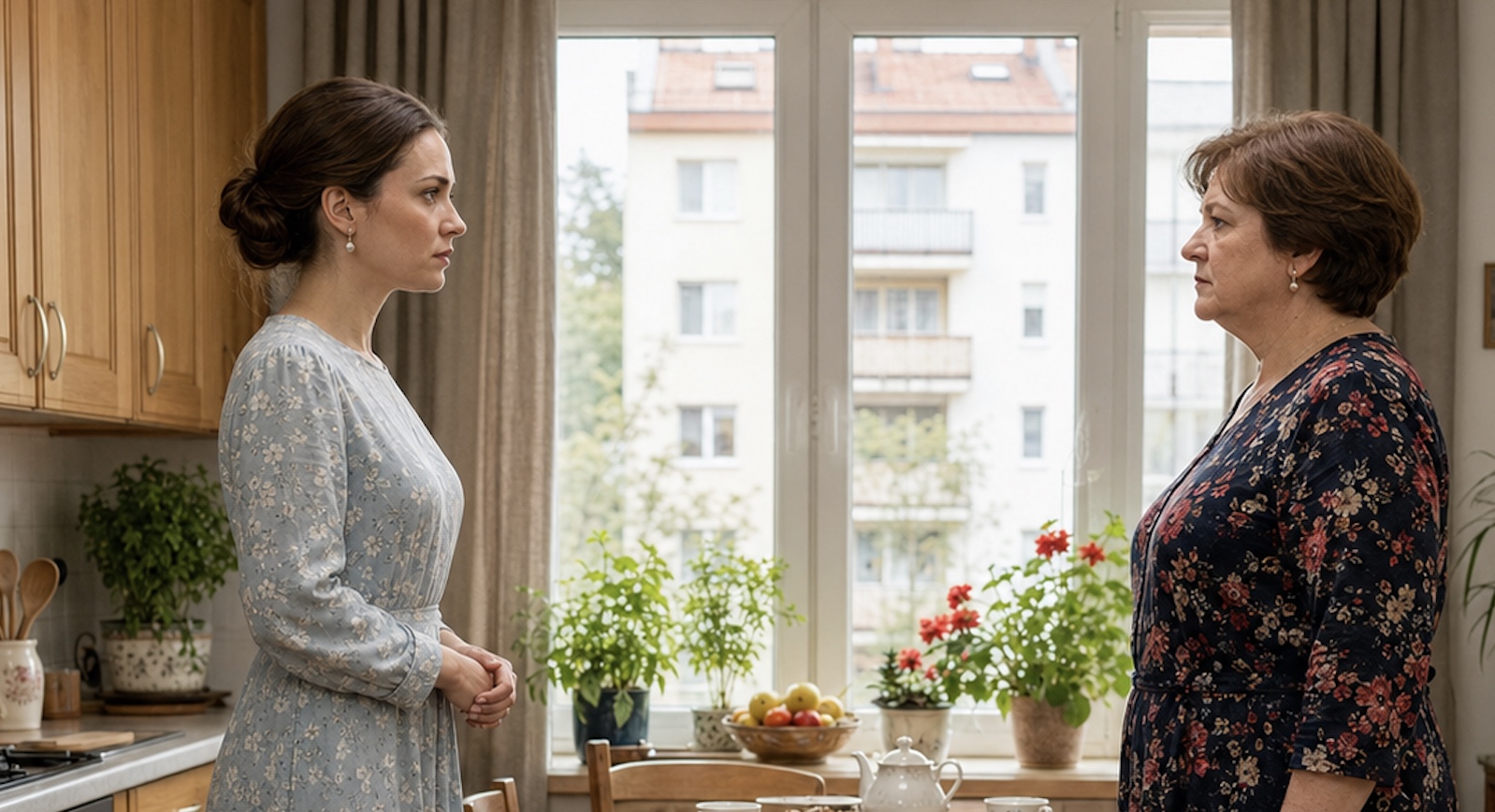
Her mother-in-law said them with a smile while smoothing the tablecloth on the dining table, as though she were merely stating something obvious. As though there had not been five years of living under the same roof, endless compromises, and all the resentment Valentina had been forcing herself to swallow since the first month of her marriage.
Valentina stood in the middle of the kitchen, holding a plate, and felt something inside her slowly but irreversibly give way.
There was no crash. No explosion. No scandal.
Something simply clicked inside her, softly and finally.
They had moved into Nina Pavlovna’s apartment immediately after the wedding. It had been Igor’s decision—her husband, and Nina Pavlovna’s only son. He had made it confidently and calmly, the way he always made decisions involving his mother.
“Val, what’s the point of renting a place? Mom has a three-bedroom apartment. There’s plenty of room. We’ll stay there for a while and save for our own home.”
That “for a while” stretched into five years.
Valentina still remembered the first time she entered the apartment. She had been a twenty-six-year-old newlywed with a shy smile and a sincere desire to make a good impression.
Nina Pavlovna had welcomed her warmly. She made tea, showed her the bedroom, and said, “Make yourself at home.”
But a person cannot feel at home when the owner of the house reminds them every day that they are not.
At first, it was only small things.
Nina Pavlovna rearranged the belongings Valentina placed on the shelves in the room she shared with Igor. She never explained why. She simply moved them.
She changed the order of the bottles in the bathroom. Once, she threw away the curtains Valentina had hung in the kitchen.
“They don’t match the walls,” she said.
Valentina stayed silent.
Igor would say, “Mom, why did you do that?”
And that was where the matter ended.
Then there was the cooking.
Nina Pavlovna insisted on preparing every meal herself and rarely allowed Valentina near the stove.
“You make things differently, Valechka.”
‘
It sounded harmless, almost complimentary, but the real meaning was clear.
This is my kitchen. These are my rules. These are my pots and pans.
“Igor, I feel uncomfortable,” Valentina told him one evening when they were alone. “I want to cook too. This is my family as well.”
“Mom is simply used to controlling everything. Don’t pay attention to it.”
Don’t pay attention.
That was her husband’s favorite phrase.
Five years of not paying attention had brought her to this moment—standing in the kitchen with a plate in her hands while her mother-in-law calmly explained who the real mistress of the house was.
Valentina placed the plate on the table.
Slowly. Carefully.
As though she were afraid that if she put it down too hard, something would shatter.
Not the plate.
Her.
“Nina Pavlovna,” she said, “I know this apartment belongs to you.”
“Well, I’m glad you understand that.”
“I have always understood. That is why I have spent five years trying to make myself convenient. I tried not to make noise, not to interfere, and not to argue.”
Her mother-in-law looked at her with slight suspicion, though the smile had not yet left her face.
“Valechka, no one is saying you have been a nuisance.”
“That is exactly what you say. Every time you move my belongings. Every time you keep me away from the kitchen. Every time you remind me that you are the mistress here and I am only a guest.”
Nina Pavlovna straightened her back. Her smile became thinner.
“I don’t understand what you are unhappy about. You live here without paying rent. I cook. I clean.”
“I clean too. I contribute money to the household. And for five years, all I have wanted is to feel at home instead of feeling like a visitor.”
The conversation was interrupted by the sound of the front door closing.
Igor had come home.
He sensed the tension immediately and stopped in the hallway.
“What happened?”
“Nothing,” Nina Pavlovna replied. “We are simply talking.”
Valentina looked at her husband.
He was tall and tired, with his tie hanging crookedly after a long day at work. He was a good man. Truly, he was. He loved his wife, and he loved his mother.
But for five years, he had been unable to choose between those two loves. He simply stood in the middle and pretended everything was fine.
“Igor, I need to speak to you,” Valentina said. “Tonight. Seriously.”
Their conversation lasted a long time.
Valentina spoke calmly because she had been preparing for it for months.
She told him everything—about the kitchen, the curtains, and the constant feeling that she was a temporary resident in her own family.
She told him that in his mother’s home, the daughter-in-law would always come second.
She told him she wanted a home of her own. A real home. A place where she could be the mistress.
Igor listened with a frown. Then he said something she had not expected.
“Val, Mom doesn’t behave this way for no reason. She is afraid.”
“Afraid of what?”
“That we’ll leave. That she’ll be alone. Dad died three years ago—you remember. She holds on to us because she has no one else.”
Valentina fell silent.
Of course she knew about Igor’s father. She knew how difficult his death had been for Nina Pavlovna. She had watched the older woman spend almost an entire year barely leaving her room.
But knowing about someone’s grief was one thing.
Suddenly recognizing the connection between that grief and the rearranged bathroom bottles was something else entirely.
“That explains it,” Valentina said at last, “but it does not excuse it. Do you understand?”
“I do.”
“I sympathize with your mother. I truly do. But I cannot spend five years living as a guest because she is afraid. That is not fair to me.”
Igor remained silent for a long time.
“Do you want to leave?”
“I want us to have our own home. We have saved enough. You said so yourself. It is time.”
“And Mom?”
“Your mother will be all right. We will visit her. Often. But we need to live separately.”
It was not an ultimatum.
There were no threats and no shouting.
They were simply words supported by five years of accumulated understanding.
They could not continue living this way.
Igor did not answer immediately. He stood, walked to the window, and stared down into the courtyard for a long time.
Then he turned around.
“All right. Let’s start looking for an apartment.”
Nina Pavlovna found out the following day.
Her reaction was predictable.
There were tears, accusations, and the inevitable sentence:
“I knew she would take you away from me.”
She said it to Igor rather than to Valentina, as though her daughter-in-law were not even in the room. As though she were a piece of furniture being moved rather than a person capable of making her own decisions.
Valentina did not argue.
She understood that Nina Pavlovna was not cruel by nature. She simply did not know how to behave differently.
She had spent her entire life being the mistress of a home—first in her parents’ house, then in her own. Later, controlling her son had become another part of that role.
Control was the only language of love she knew.
But Valentina was not obligated to accept that kind of love without boundaries.
They found an apartment a month later.
It was a small two-bedroom home on the other side of the city, bright and recently renovated, with windows overlooking a courtyard full of birch trees.
The first time Valentina walked through the rooms, she felt something she had not felt in five years.
The space belonged to her.
Moving out was difficult—not physically, but emotionally.
On the day of the move, Nina Pavlovna locked herself in her bedroom and refused to come out to say goodbye.
Igor knocked several times.
There was no response.
They left in silence.
Igor looked miserable in the car. Valentina reached over and took his hand.
“She will be angry for a while, and then she will forgive us,” she said.
“How do you know?”
“Because she loves you. Her anger is only fear. It will pass.”
He looked at her.
“You are too kind to her after everything she has done.”
“I see her as a person who is hurting. That does not mean I will agree to live by her rules. But I do not want to hate her either.”
The first weeks in the new apartment felt strange.
Wonderful, but strange.
Every morning, Valentina woke up and went straight to the kitchen.
Her kitchen.
She opened the refrigerator and looked at the food she had bought herself. She made coffee in a small pot exactly the way she liked it, not the way Nina Pavlovna believed it should be made.
Then she sat beside the window and watched the birch trees.
It was such a simple happiness that at first she could hardly believe it was real.
A cup of coffee.
Her own kitchen.
A morning without someone else’s rules.
Igor gradually relaxed as well.
During the first week, he was consumed with guilt. He called his mother three times a day and visited her every other evening.
At first, Nina Pavlovna spoke to him coldly and gave short answers. But by the second week, she began asking questions.
Had they settled in properly?
Was the apartment warm?
Did the stove work well?
“That is a good sign,” Valentina told him.
“You think so?”
“She has started showing interest. That means the anger is fading. Only the love is left.”
During the third week, Nina Pavlovna called Valentina directly.
It was the first time she had ever done so without a particular reason.
Her voice was tense, but she had called.
“Valechka. How are you two doing?”
“We are doing well, Nina Pavlovna. We are still getting settled.”
“Is it warm there?”
“Yes, it is.”
There was a pause.
“I wanted to say something. Well… You should not think I don’t understand. I may have gone too far sometimes.”
It was not exactly an apology. Nina Pavlovna was still far from being able to offer a real one.
But it was something.
It was the first step beyond her own pride.
“I know you love Igor,” Valentina answered. “And I love him too. We will visit you. I promise.”
Both women fell silent.
But this silence was different.
It was not heavy or hostile.
It was simply the pause between two people trying to discover a new way of speaking to each other.
Three months passed.
Valentina and Igor visited Nina Pavlovna every Sunday.
His mother set the table and cooked Igor’s favorite meat patties. Valentina brought cake or fruit.
They sat together and talked.
Nina Pavlovna still occasionally said something unnecessary. She might remark that something had been better in the old apartment or that she would have done things differently.
Old habits do not disappear in three months.
But now the situation was different.
Valentina no longer remained silent.
Without anger or drama, she calmly said, “Nina Pavlovna, we do things the way that works for us.”
And, surprisingly, her mother-in-law stopped arguing.
The first time, she looked offended.
The next time, she looked surprised.
Eventually, there was something close to respect in her expression.
Nina Pavlovna had spent her whole life surrounded by people who agreed with her. First her husband, then her son, and later her daughter-in-law.
Everyone preferred giving in rather than arguing.
She had never learned that it was possible to behave differently.
That someone could calmly say no, without hatred, and the world would not collapse.
A boundary was not a declaration of war.
One evening, while Igor stepped onto the balcony for a cigarette, Nina Pavlovna spoke quietly to Valentina without looking at her.
She was staring out the window.
“I must have been unbearable when you lived here.”
Valentina paused.
“You were afraid of losing your son,” she said. “I understand that. But knowing the reason did not make it easier for me.”
“I know.”
“I did not do everything right either. I stayed silent for too long. I should have spoken earlier.”
Nina Pavlovna turned toward her.
For the first time, she looked at Valentina without the familiar assessing expression of a woman inspecting her territory.
She simply looked at her.
“You are a good woman, Valya. It took me too long to see it.”
It was the kindest thing she had said to her daughter-in-law in five years.
That spring, Nina Pavlovna caught a cold.
It was nothing serious, but her fever remained high for several days.
Valentina heard about it from Igor and went to visit her without making a fuss.
She brought homemade broth, honey, and herbal tea.
Nina Pavlovna opened the door wearing a dressing gown. Her nose was red, and her hair was messy.
“Why did you come? I can manage.”
“I know you can,” Valentina replied. “But things are easier when there are two people.”
She walked into the kitchen, heated the broth, poured it into a bowl, and carried it into the bedroom.
Nina Pavlovna ate in silence, looking strangely embarrassed, as though she did not know how to accept care from another person.
“You did not need to waste your time,” she said.
“It is not a waste. I came because I wanted to.”
Her mother-in-law put down the spoon.
“Valya,” she said, “I want to ask you something. Please do not refuse immediately.”
“I’m listening.”
“When you left… when I pushed you away, I thought that was the end. I thought I would lose Igor. I thought there would never be grandchildren and that I would grow old alone.”
She paused before continuing quietly.
“But now I see that I was wrong. You still visit me. Even you come, although you have every reason not to.”
“I do,” Valentina agreed.
“Why?”
Valentina thought carefully before answering because the question was sincere.
“Because you are Igor’s mother. Because I do not need a war—I need a family. And because carrying anger for five years costs too much.”
Nina Pavlovna remained silent for a long time.
“You are wise,” she finally said. “Wiser than your age.”
“It is not wisdom. I am simply tired of unnecessary pain.”
That same spring, Valentina discovered she was pregnant.
She and Igor sat together in their kitchen, staring at the test, and she felt that everything was finally as it should be.
This was the right place.
Their own home.
Their own space.
A place where she was the mistress—not because her name appeared on a document, but because it truly felt like home.
They told Nina Pavlovna on a Sunday.
For one moment, she said nothing.
Then she burst into tears.
Not from sadness, but from joy.
It was the first time Valentina had ever seen her cry openly in front of her.
“My God,” she kept saying, wiping her eyes. “I never thought I would live to see this.”
“You’ll live long enough to attend your grandson’s wedding,” Igor joked.
“Don’t say such things,” Nina Pavlovna replied, waving him away, though she was laughing too.
Then she reached for Valentina’s hand.
The gesture was awkward and unfamiliar, like something she had forgotten how to do.
“Forgive me, Valechka,” she said. “For all those years. You deserved better.”
Valentina covered the older woman’s hand with her own.
“It is behind us now,” she said. “Everything important is still ahead.”
I often think about this story when women come to me with the same pain.
Daughters-in-law who remain silent for years.
Mothers-in-law who control everything for years.
Husbands who stand in the middle, hoping the problem will somehow disappear on its own.
It never does.
Things begin to change only when someone finds the courage to speak honestly—without war, hatred, or cruelty.
Simply to say:
“I need to feel at home, not like a guest. I need my boundaries to be respected.”
That is not selfishness.
It is not a betrayal of the family.
It is one of the conditions without which a family cannot truly function.
Valentina stayed silent for five years.
Nina Pavlovna refused to listen for five years.
Igor avoided the conversation for five years.
And all three of them were unhappy, each in a different way, each trapped in private resentment.
One honest conversation changed everything.
Not instantly. Not in a single day.
But it changed the direction of their lives.
A mother-in-law and daughter-in-law may never become best friends, and that is perfectly normal.
But they can become two people who respect one another.
They can sit at the same table without tension.
They can learn to say, “I am sorry,” even if the words come late and awkwardly.
And that is why it is worth finding the courage to say one day:
“No. This cannot continue. I need things to be different.”
Not to win.
But to save the family.