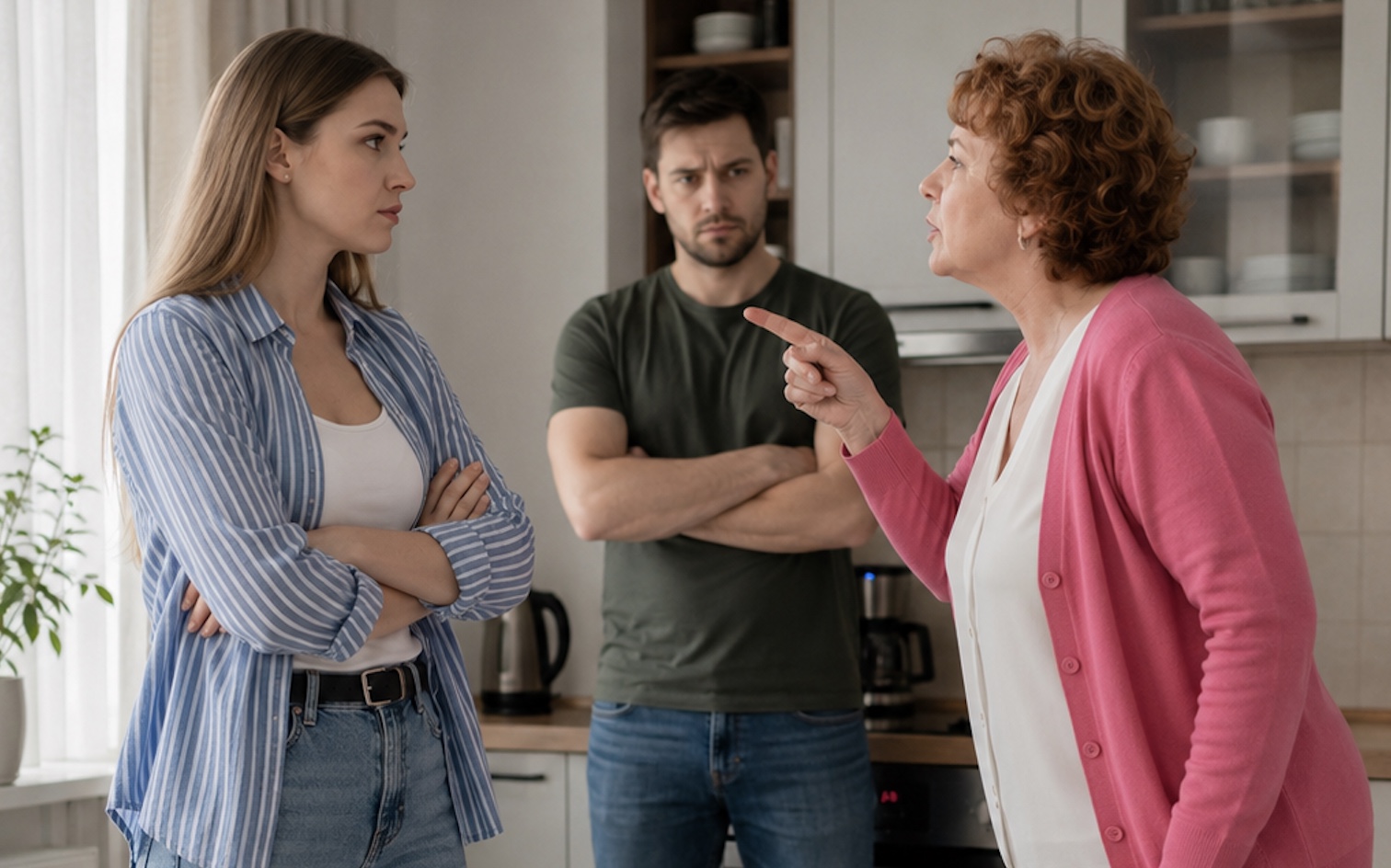
“Vera, where did you leave the car keys? I checked the little table in the hall, but they’re not there,” Olya called from the kitchen.
My husband’s sister sounded so casual and self-assured, as though she were asking me to pass the salt.
I froze beside the sink without turning off the faucet. Water hammered against the stainless-steel basin, spraying cold droplets over my hands.
After a twelve-hour shift, all I wanted was to finish my lukewarm tea, take off my aching shoes, and sit in silence for ten minutes.
But silence had become a rare luxury in that apartment.
I dried my hands on a towel, shut off the water, and slowly turned around.
My twenty-year-old sister-in-law was sitting at my kitchen table, scrolling through her phone with one leg crossed lazily over the other. A brand-new bright-yellow delivery jacket hung over the back of my favorite wooden chair, still stiff and crisp from the packaging. An enormous insulated courier bag had been dumped on the floor beside her.
“Why do you need my keys?” I asked evenly, although that familiar, sticky chill was already spreading through my chest.
“I got a job as a courier,” Olya replied, finally looking up from her screen with mild irritation. “I’m not running around on foot carrying pizzas. I’ll destroy my feet. The pay is better if you use your own car. Anton has a company van, and he won’t let me take it. Your white car sits in the courtyard all day anyway while you’re sitting around in some office. I’ll take it in the morning and bring it back in the evening. It’s no big deal. Just change the insurance tomorrow and add my name.”
I placed my cup on the edge of the counter.
I had worked for seven years as a transportation logistics coordinator for a large nationwide freight company. I planned routes for twenty-ton trucks, calculated depreciation down to the last ruble, monitored fuel cards, tire wear, and exact travel times.
I knew perfectly well that a car was not merely a piece of metal with a nice steering wheel.
It was an expensive, complicated machine that required careful handling, regular maintenance, and constant investment. I could estimate the true cost of every kilometer faster than an electric kettle could boil.
My white Hyundai Creta had been purchased entirely by me.
Three years before I got married.
I had paid for it with my own savings, money I had accumulated by giving up vacations, new clothes, and countless small pleasures.
Anton, my husband, was what you might call a convenient man.
He was a convenient son to his domineering mother and a convenient older brother to his spoiled younger sister. At work, he could spend hours searching for the smallest error in an invoice or arguing with a supplier over a hundred rubles.
At home, however, his response to every injustice was always the same.
“Why are you making such a big deal out of this? They’re family. We have to help each other. We’re not strangers.”
He always said it with the solemn expression of a martyr who genuinely believed that the word “family” automatically erased personal boundaries, ownership rights, and common sense.
It had started three years earlier, when we moved into the spacious three-bedroom apartment.
The apartment belonged to my mother-in-law, Tamara Nikolaevna. She offered it to us after our son, Yegor, turned three and our rented one-bedroom place became unbearably cramped.
“Live there, children. Save money for a home of your own. I won’t take a single ruble in rent,” she had declared with a broad, queenly gesture during a family dinner.
Anton had glowed with pride and gratitude toward his mother.
I had looked at Tamara Nikolaevna’s triumphant smile and understood even then that free housing did not exist.
Sooner or later, payment would be demanded.
During the first few months, we managed to maintain ordinary family politeness. We paid for cosmetic repairs ourselves, replaced the old wallpaper with washable material, bought new furniture for Yegor’s room, and purchased a huge sofa for the living room.
My mother-in-law visited on weekends, drank tea with my homemade pies, and brought Yegor inexpensive plastic cars.
Normal grandmother. Normal visits.
Then the “free” apartment began sending invoices.
Not in money, but in my labor, my time, and my property.
At first, the requests were small and occasional.
“Verochka, could you drive Mom to the country house? She has seedlings, and they’re too heavy to carry on the train.”
I agreed.
I drove her.
The trunk of my spotless car was packed with cardboard boxes full of damp soil. The plastic interior was scratched by old wooden rakes that my mother-in-law absolutely had to transport that very day.
I said nothing.
I smiled.
Then the requests multiplied.
By the fifth month, it was no longer an occasional favor. It had become a full-service subscription.
“Verochka, pick Olya up from the train station. Her bags are heavy.”
“Verochka, drive to the building-supply store outside the city. Mom urgently needs wallpaper for the hallway.”
“Verochka, take Aunt Galya and me to the shopping center. We need to choose a present for her.”
Without noticing when it happened, I became their unpaid personal driver.
My car was no longer treated as mine. To Anton’s relatives, it had become part of the family vehicle fleet—always fueled, always available, and ready to depart at the first phone call.
Olya could call me at two in the morning on a Friday.
“Vera, come pick me up from the club downtown. The taxi drivers are charging insane prices. I’d rather give that money to you. You’re awake anyway.”
I would get out of bed, dress, and drive through pouring rain into the city center.
Olya would climb into the passenger seat smelling of cheap alcohol and heavy perfume, then smear mud all over the floor mats.
Naturally, she never gave me money for fuel.
Not once in three years.
One time, Anton persuaded me to let Olya practice driving on the highway because she had just received her license.
She backed into a concrete post and dented the rear bumper.
“She’s still learning,” my husband said dismissively. “These things happen.”
I tolerated all of it.
I understood how manipulation worked, and at first I even felt sorry for Anton. That was why I endured the situation far longer than I should have.
We were living in his mother’s apartment.
My supposed debt to Tamara Nikolaevna hung over me like a thick cloud. It was not a precise financial obligation. It could not be measured or repaid.
It was the kind of sticky, invisible debt that suffocated you and made it nearly impossible to say a firm and completely lawful no.
But the logistics specialist in me never stopped working.
I was trained to count everything.
So I counted every kilometer.
Every interior cleaning after transporting seedlings and dusty bags of fertilizer.
Every full tank of fuel before a trip outside the city.
Every traffic-camera fine that arrived in my name after Olya borrowed the car for a weekend with friends.
Every scratch on the bumper.
Every oil change that came twice as quickly because other people were constantly using my vehicle.
Three hundred and forty-two thousand rubles.
That was how much servicing my husband’s family had cost me over three years.
And that total did not include my time.
It did not account for the fact that I worked five days a week and spent my legal days off behind the wheel, quietly satisfying someone else’s demands while Anton slept until noon.
That Saturday, as Olya sat in my bright kitchen, swinging her foot and shamelessly demanding the keys so she could destroy my car on potholes, narrow courtyards, and icy winter roads while delivering pizzas, something inside me finally snapped.
There were no tears.
No shouting.
No dramatic outburst.
My brain simply examined the family arrangement as if it were a business project.
The conclusion was obvious.
The project was catastrophically and hopelessly unprofitable.
They wanted to use the car I had purchased with my own money as a full-time delivery vehicle.
It would be driven over broken roads, deep potholes, muddy courtyards, and snowdrifts.
I would pay for the damaged suspension, worn brake pads, frequent oil changes, and burned fuel.
Only me.
Because we lived in Tamara Nikolaevna’s apartment and were supposedly required to remain eternally grateful.
So much for “a small favor.”
So much for “a close family.”
I did not start an argument.
People like them fed on shouting, tears, and explanations. A scandal would only entertain them.
There was no point debating someone who believed she had a natural right to take your belongings. It would have been like trying to explain to a self-checkout machine that you were in a hurry.
The only thing that could defeat such an audacious scheme was another scheme—colder, cleaner, and better prepared.
I did not answer Olya.
I simply put the keys inside my handbag, closed the zipper, and went into the bedroom.
Anton followed me around all evening, complaining that I was selfish. He said Olya was only trying to earn money and become independent, while I was behaving like an evil stepmother determined to ruin the girl’s future.
I remained silent.
For the next six days, I prepared.
I was a logistics specialist.
Plans, charts, calculations, and schedules were my language.
On Monday, during my lunch break, I called Rita.
Rita was an old friend from school who had become a successful real-estate agent. She had the kind of instinct that detected manipulation as quickly as an experienced bomb technician detected explosives.
A spacious one-bedroom apartment had just become available in a newly built residential district, close to my workplace and Yegor’s kindergarten.
I viewed it that same evening.
I signed a one-year lease and transferred the first month’s rent along with the security deposit.
On Tuesday, through professional contacts, I obtained a full property record for my mother-in-law’s apartment.
I merely wanted to confirm my suspicions.
I did.
The apartment had been used as collateral for a large personal loan that Tamara Nikolaevna had taken out to finance some questionable business venture belonging to her younger brother.
Anton had never bothered to mention the loan, even though we had been planning to spend my vacation savings renovating the bathroom.
On Wednesday, Thursday, and Friday, I packed our belongings methodically.
Quietly.
Without creating a scene.
One box per day.
First, I packed our winter clothes and shoes.
Then Yegor’s expensive educational toys and books.
After that came my cosmetics, documents, electronics, and photograph albums.
Every morning before work, while Anton was still asleep, I drove the boxes to the new apartment.
Visually, almost nothing changed in the old home.
In reality, the closets contained only a thin layer of essential items sufficient for another few days.
On Friday evening, I created a spreadsheet.
I printed it at work.
It was neat, formal, and divided by dates and categories, with a bold final figure at the bottom.
I used the exact format Anton reviewed every day at the warehouse: invoices, estimates, depreciation, and total cost.
On Saturday evening, both of them arrived.
Tamara Nikolaevna and Olya.
It was supposed to be a regular family dinner, but they clearly expected it to conclude with a ceremonial and unconditional transfer of my car keys to the young courier.
I set the table.
There was oven-roasted chicken with crisp golden skin, fluffy mashed potatoes, fresh salad, and sliced appetizers.
Everything was prepared exactly the way they liked it.
I arranged the plates and laid out the cutlery.
“Well, Verochka,” my mother-in-law said after eating a substantial dinner.
She placed her fork beside the plate and delicately dabbed her lips with a paper napkin.
“Olechka starts her first shift tomorrow. Her schedule is very busy, so give her the car keys. Bring out the registration papers as well. I assume you changed the insurance? We don’t want any fines, as I’m sure you understand.”
I slowly rose from the table.
I walked into the hallway and took a thick plastic folder from my bag.
Inside were three sheets of paper.
Signatures, official details, printed clauses—everything looked authentic and had been prepared from a standard contract template I found online.
I returned to the kitchen and placed the folder directly in front of Tamara Nikolaevna, pushing the empty salad bowl aside.
“What is this?” she asked, frowning at the documents with visible disgust.
“An official vehicle rental agreement for a comfort-class car,” I replied calmly, looking directly into her eyes.
“The daily rental fee for using my car for commercial deliveries is three thousand rubles. A refundable deposit of fifty thousand rubles is also required in case of an accident or damage. Fuel, cleaning, and routine maintenance will be entirely your responsibility. Read it and sign.”
The table fell silent.
The silence became so dense and sharp that I could hear the cooling kettle making soft, rhythmic noises on the stove.
Anton choked on his tea.
He began coughing and wiped his mouth with his hand.
“Vera, what kind of nonsense is this?” he snapped. “What rental agreement? Have you lost your mind at that job?”
“It is an ordinary commercial rental,” I answered, turning my cold gaze toward him. “The car has real monetary value. Daily wear costs money. The risk of an accident costs money. I am not a charity, and I am not responsible for financing your family’s comfort. If she needs a car to work, she can pay for the equipment she uses.”
“You’re planning to charge your own family?” Tamara Nikolaevna shouted.
Her face immediately became covered in uneven red blotches.
“Are you insane? We are FAMILY! We allowed you to live in our private apartment for free! If it weren’t for my generosity, you would be crawling from one disgusting rental dump to another. And now you’re prepared to strangle yourself over a piece of metal, you petty little creature!”
“Three hundred and forty-two thousand rubles,” I said clearly, pronouncing each word as if I were reading out a sentence in court.
“What?” Olya asked, blinking beneath her artificial eyelashes.
“Three hundred and forty-two thousand rubles,” I repeated more loudly.
I turned to the second sheet in the folder.
“Cleaning the interior after your nightclub trips: five thousand. Repainting the rear bumper: fifteen thousand. Traffic fines from the M4 highway: twelve thousand. Replacing the suspension struts after transporting cement to the country house: forty thousand. And fuel. Endless amounts of fuel.”
I tapped the paper.
“That is exactly how much I have spent from my own salary during the past three years. It is the documented cost of working as your unpaid personal driver. You can check the receipts. They are attached at the back.”
“How dare you count every tiny expense?” my mother-in-law shrieked.
She slammed her palm against the table so hard that the porcelain cups rattled.
“We gave you a home! We did everything for you! What decent daughter-in-law refuses to sacrifice for her family? You are sick! Greedy, calculating, paranoid! It is impossible to speak to you like a normal person!”
She jumped to her feet.
“Get out of my apartment!” she screamed, her voice rising into a shrill wail as anger turned into open threats.
“I want you gone by tomorrow! Get out of my house with your precious calculator! As far as I’m concerned, I no longer have a daughter-in-law!”
Emboldened by her mother’s fury, Olya also sprang from her chair.
She reached toward my open handbag, which was resting on a stool beside me, and tried to snatch the car keys from inside.
“My car was purchased before the marriage. You are not getting the keys,” I hissed, knocking her hand away.
I closed my fingers around her narrow wrist—not hard enough to bruise her, but firmly enough to make her cry out and immediately step back.
Anton jumped up so suddenly that his chair toppled over.
“Vera, you’re going too far!” he yelled, waving his arms. “You’ve completely lost perspective! Apologize to my mother right now! You’re acting irrationally! Give Olya the keys and let her work. She needs the money. Then pack your things and stay with your own mother for a week until you calm down and remember how you’re supposed to speak to family!”
I looked at him.
Carefully.
For a long time.
That was the moment of truth.
The moment when he had to choose.
And he chose.
Once and for all, he sided with the free, convenient lifestyle his relatives enjoyed.
He betrayed me to protect their comfort.
Without saying a word, I turned and walked to the wardrobe in the hallway.
I removed my beige coat from the hanger.
“I already packed my things,” I said in a calm voice that sounded almost unfamiliar, slipping my arms into the sleeves. “I started on Wednesday.”
Anton froze as though he had walked into an invisible wall.
“What do you mean, packed? Packed where?”
“I mean exactly what I said, Anton. The closets are empty. Yegor’s toys have already been moved. So have my winter clothes, documents, and electronics.”
They sat around the table in silence, trying to process what they had heard.
My mother-in-law opened her mouth to unleash another stream of insults, but no words came out. It was as though she had suddenly run out of air.
Olya stared at me with wide, frightened eyes.
“I am filing for divorce on Monday morning,” I said, lifting my handbag and placing the strap over my shoulder. “My car is leaving with me. Your apartment stays with you. Your unpaid driver and sponsor has resigned effective immediately.”
None of them tried to stop me.
Anton stood in the middle of the kitchen, blinking in confusion as he slowly realized that the arrangement had collapsed.
“Vera, wait. Let’s discuss this properly. Mom was just angry. She didn’t mean it,” he finally stammered as I opened the front door.
“Anton,” I said, turning to look into his eyes one last time. “The family’s free vehicle service is permanently closed. One day, the logistics coordinator got tired and issued the final invoice.”
I stepped into the stairwell.
The heavy metal door slammed behind me with a deep, final sound.
The divorce was completed a month later.
The process was loud, ugly, and humiliating.
Anton tried to claim part of my car. He shouted in the courtroom and produced suspicious fuel receipts, arguing that shared marital funds had been spent on gasoline.
The judge, an exhausted older woman, looked at him over the top of her glasses with open contempt and rejected his claim.
The car had belonged to me before the marriage.
Legally, it was entirely mine.
My mother-in-law’s apartment remained with them, along with its debts, liens, and unpaid utility bills—expenses Anton had previously covered using money that effectively came from me.
I used my experience and professional contacts.
Six months later, I left my salaried position and opened a small logistics and courier service for local online stores.
My knowledge of routing, cost calculations, and operational planning paid off.
The business began to grow.
Today, I employ five drivers who use their own vehicles.
Yesterday evening, seven-year-old Yegor and I were sitting in the spacious, bright kitchen of our new rented apartment.
“Mom, are we going to Dad’s this weekend?” he asked, swinging his legs while carefully finishing a pancake covered in condensed milk.
“No, sweetheart. This weekend we’re going to the amusement park, just like we’ve been planning,” I said, gently stroking his hair. “Dad lives with Grandma and Aunt Olya now. They have their own things to deal with.”
“So you and I are staying together?” he asked, looking at me with serious eyes.
“You and I are staying together,” I said with a nod.
“Mom, are we happy now?” he asked quietly.
“Yes, my sunshine. We are very happy.”
An immaculate glass vase stood on the kitchen table.
There were no unwanted bouquets inside it.
No falling petals.
No dried stems.
Only clean glass on a clean table.
Outside the window, the courtyard slowly darkened as warm yellow streetlights flickered on.
The apartment was astonishingly, healingly quiet.
The keys to my white car rested on the little table in the hallway.
Cold.
Heavy.
Shining beneath the lamp.
My keys.
My home.
My life.
From that moment on, I would never again reroute my future to accommodate someone else’s demands.