“Oh Lord, how I’ve missed my own bed,” Svetlana whispered as she climbed the stairs to the third floor.
A month at her parents’ house after the surgery had drained her completely. She had lost weight, her face had grown pale and drawn, and dark circles had settled beneath her eyes. The only thought that had kept her going through those exhausting weeks was the idea of coming home — back to her cozy apartment, where everything was familiar, safe, and hers.
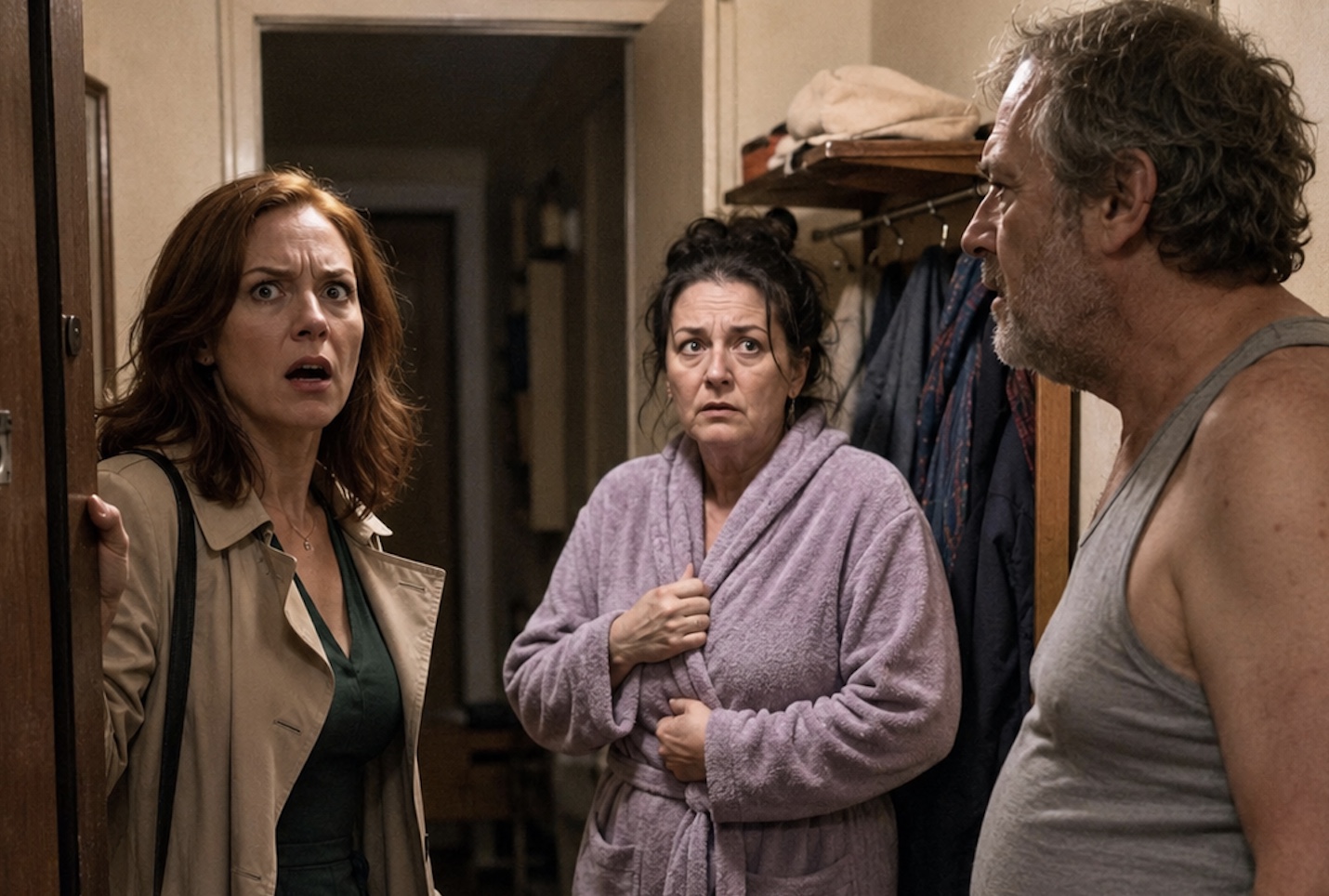
The key turned easily in the lock. Svetlana pushed the door open, stepped into the hallway — and froze.
From the kitchen came an unfamiliar smell of dill and garlic. A heavyset woman in a bright floral apron was arranging three-liter jars of pickled vegetables on the shelves. From the living room came the sound of the television. And there, sprawled in Svetlana’s favorite armchair, sat an elderly man wearing her terrycloth robe.
Her bag slipped from her hand and hit the floor with a dull thud.
“Who are you?” Svetlana managed to force out.
The woman turned around, wiped her hands on her apron, and looked at her with genuine confusion.
“And who exactly are you looking for? We’ve been living here for more than a month.”
Everything went dark before Svetlana’s eyes.
Svetlana grabbed the doorframe to keep herself from falling. Only one thought hammered inside her head: this had to be a mistake. A monstrous, absurd mistake.
“What do you mean, living here?” Her voice broke into a hoarse whisper. “This is my apartment. Mine!”
The woman threw up her hands and called toward the living room.
“Gennady, come here! Some young woman is saying this apartment belongs to her.”
The elderly man reluctantly got up from the armchair, wrapped the robe — her robe — tighter around himself, and stepped into the hallway.
“We did everything properly,” he said. “There’s a rental agreement. The money’s been paid. You must have the wrong address.”
But Svetlana did not have the wrong address. She knew this apartment by heart — every crack in the ceiling, every tile in the bathroom. Her grandmother, Zinaida Pavlovna, had signed it over to her six years earlier, long before Svetlana married Andrey. Back then, Svetlana had just started her first serious job and could barely believe her luck.
“Grandma, this is too much,” she had said, hugging the old woman tightly.
“Take it, Svetochka. I’m happy in the village, and you need a place to live in the city.”
Svetlana had poured her entire soul into the apartment. She had filled the cracks in the walls herself, chosen the wallpaper herself, and saved for three months to buy a washing machine. When Andrey appeared in her life — handsome, charming, always full of grand plans — she let him into her home with joy.
“Why should you struggle alone?” he used to say. “I’m here with you.”
But in reality, “here with you” meant living in her space, under her roof, at her expense. In four years of marriage, Andrey had never changed a single lightbulb without being reminded. But he changed jobs every three months and constantly borrowed money he never returned.
Then, six months ago, his mother started calling. Galina Petrovna had never been shy about giving advice.
“Svetochka, Andryusha needs support. You’re a family. Property should work for the family.”
When the doctors told Svetlana the operation could not be avoided, she left for Kaluga to stay with her parents. Andrey promised to look after the apartment, call every day, and wait for her.
At first, he called less often.
Then he stopped calling at all.
Now, standing in her own hallway in front of strangers, Svetlana was beginning to understand why.
Svetlana slowly walked through the apartment, and with every step, something tightened deeper inside her chest.
In the kitchen, there were someone else’s pots, a cast-iron pan she had never bought, and jars of seedlings on the windowsill where her violets used to stand. In the bathroom hung gray towels that smelled of unfamiliar soap. And in the bedroom, someone had moved the wardrobe to the window, taken down her curtains, and packed all her personal belongings into three cardboard boxes pushed into the corner.
She crouched down and opened one of the boxes. On top lay a photograph — Svetlana and her grandmother standing on the balcony of this very apartment. The glass in the frame was cracked.
“We didn’t throw anything away,” the woman’s voice came from behind her. “We packed everything carefully. That’s what we were told to do.”
“Who told you?” Svetlana asked quietly.
“Well, the owner. Andrey. He gave us the keys and said his wife knew everything.”
Svetlana clenched her teeth.
Andrey arrived only around eight in the evening. He walked in, saw her — and did not even turn pale. He merely twitched his shoulder, the way he always did when he did not want to explain himself.
“Svet, don’t start. We wanted to do what was best. There was no money at all, and Mom suggested this option. Everyone does it. It’s not a big deal.”
“You rented out my apartment to strangers,” she said slowly, as if speaking to a child. “Without telling me. While I was recovering from surgery.”
“Well, what was it supposed to do, sit empty?” Andrey snapped, throwing his jacket onto the cabinet. “I’m registered here too, by the way.”
He did not apologize. He did not even try.
And in that moment, Svetlana understood with frightening clarity: in his mind, she had long since stopped being the owner. He truly believed he had the right to manage everything that belonged to her simply because they were married.
She silently closed the box.
Her hands were no longer shaking.
Svetlana wiped her face, straightened her back, and walked over to the tenants.
“I’m asking you to leave the apartment,” she said. “This is my property, and I never signed any rental agreement with you.”
Gennady frowned and went to the dresser. He pulled out a folder of papers.
“Here it is,” he said. “The rental agreement. Your husband’s signature. And here are the receipts. We paid on time — three months in advance.”
Svetlana looked at the documents. Andrey’s handwriting. His signature. The amount: twenty thousand a month. Money she had never seen.
Less than an hour later, her mother-in-law burst into the apartment. Clearly, Andrey had already called her. Galina Petrovna swept in as if the place belonged to her.
“What have you done, Svetlana?!” she cried. “You’re throwing people out onto the street? They paid money, by the way! Tamara has high blood pressure. She can’t be upset!”
“Neither can I,” Svetlana replied. “But that didn’t stop you.”
Andrey stood beside his mother, arms crossed over his chest.
“Enough with the hysteria. Am I your husband or not? I have the right to make decisions about family matters.”
Svetlana looked at him for a long time without saying a word. Then she opened her bag and took out a plastic folder. Inside were the documents: the deed of gift and the ownership certificate. Everything was in her name. The date was two years before the wedding.
“You have nothing to do with this apartment,” she said calmly. “Not legally. Not morally.”
Galina Petrovna turned crimson. Andrey opened his mouth — then closed it again.
Svetlana took out her phone and called the local police officer right in front of them.
Her voice did not tremble.
The officer arrived quickly — young, fit, carrying a folder under his arm. He carefully examined Svetlana’s documents, then the rental agreement Tamara handed him with shaking hands.
“I’m afraid I have to disappoint you,” he said, returning the papers. “This agreement has no legal force. Andrey Valeryevich Klimov is not the owner of this property and had no right to rent it out without the written consent of the owner. In effect, you were deceived.”
Tamara gasped and lowered herself onto a stool. Gennady removed his glasses and rubbed the bridge of his nose.
“How could this happen? Galina Petrovna told us everything was fine. She said her son was the owner, that his wife had no objection…”
“His wife objects very much,” Svetlana said quietly.
Suddenly, she truly felt sorry for the old couple. They were not fraudsters or squatters. They were simply trusting people who had been used without knowing the full truth.
“I won’t throw you out tonight,” she said. “I’ll give you three days to move out. Will that be enough?”
“That will be enough, dear, enough,” Tamara nodded, wiping her eyes with the corner of her apron. “Thank you.”
But after the officer left, Svetlana could no longer bear to look at Andrey or his mother. Galina Petrovna tried to raise her voice again, but Svetlana silently pointed to the door. Muttering something about ingratitude, her mother-in-law left.
That evening, Svetlana took two large suitcases down from the upper shelves. Calmly, without tears or shouting, she packed Andrey’s shirts, socks, razor, and laptop. Then she placed the suitcases by the entrance.
When her husband came back and started mumbling about a “mistake” and “let’s talk,” she cut him off with a single sentence.
“While I was lying under IV drips, you and your mother turned my home into a hotel. After that, there is no family left.”
And she closed the door behind him.
Three days later, Tamara and Gennady moved out. Svetlana did more than simply let them leave — she called her colleague Marina, whose mother-in-law rented out a room in Butovo at a low price, and arranged for them to move in there.
“Thank you, Svetochka,” Tamara said as she hugged her goodbye right in the stairwell. “We truly didn’t know. If we had known, we never would have agreed.”
“I know,” Svetlana replied. “Take care of yourselves.”
Gennady silently nodded and carried out the last bag.
The door closed — and for the first time in three days, the apartment was empty.
Truly hers again.
At first, Andrey moved in with his mother. Then the phone calls began — first once a day, then ten times an hour.
“Svet, stop sulking. I understand everything now. I was an idiot. Let’s meet and talk like adults.”
“We will meet,” she answered evenly. “In court. I’ve filed for divorce.”
“Are you serious? Over some nonsense?”
“Because of that ‘nonsense,’ I couldn’t sleep in my own bed. Goodbye, Andrey.”
She changed the locks the very next day. At the same time, she installed a second latch and a newer peephole.
Galina Petrovna launched a full information campaign among the relatives. She called aunts, cousins, even Svetlana’s former classmates.
“Can you imagine how greedy she is? She kicked her husband out over an apartment! Heartless, selfish — exactly like her grandmother!”
At first, some people listened. Some even sympathized. But sooner or later, every conversation reached the same uncomfortable question:
“Galya, why was Andrey secretly renting out his wife’s apartment in the first place? Was he her husband or her real estate agent?”
Galina Petrovna had no answer to that.
So, over time, she fell silent. And Svetlana finally stopped flinching every time her phone rang.
Several months passed. The divorce was finalized without scandal — there was nothing to divide.
One morning, Svetlana woke up in her own bed, under her own blanket, and realized that nothing hurt anymore — not inside, not outside. The kitchen smelled once again of her favorite coffee and vanilla candles. Her violets had returned to the windowsill, and the photograph of her and her grandmother stood on the shelf in a new frame.
Sometimes, while washing the dishes, she would suddenly remember that heavyset woman in the floral apron and the jars of pickles — and she still could not fully believe it had all really happened. That people close to her had so easily decided that her life, her home, her walls were nothing more than a resource to be used without asking.
Once, while they were drinking tea, her friend Marina asked:
“Aren’t you afraid to live alone?”
“You know,” Svetlana said with a smile, “I was afraid when I opened the door and saw strangers inside. But being alone feels peaceful.”
The keys to the apartment now belonged only to her.
And that was enough for her to feel like the owner of her own life again.