The card was declined. Try again, please,” the cashier said without even looking up.
Alina pressed the card to the terminal again. Another short beep. Another red message on the screen. Behind her, someone let out an exaggerated sigh. Someone else dropped their shopping basket with a loud clatter.
“Miss, maybe you have cash? People are waiting.”
Alina felt her cheeks burn. There was nothing luxurious in her basket: buckwheat, milk, eggs, sausages with a yellow discount sticker, a small piece of cheap cheese, and a bag of mandarins.
“Please take off the cheese. And the mandarins,” she said quietly.
At last, the terminal beeped green. At that exact moment, her phone screen lit up with a bank notification: “Charge: 4,870 rubles. Farm food delivery.”
Alina read the address beneath the message twice.
Chekhov Street, building seven, apartment twelve.
She knew that address by heart.
Her mother-in-law lived there.
Alina walked home to save money on the bus. The grocery bag pulled heavily at her hand, while one number kept spinning in her mind: almost five thousand rubles for one delivery.
She and Igor had been married for six years. At first, they rented a tiny one-room apartment. Then they took out a mortgage on a small two-room flat in a new building that still smelled of fresh paint and other people’s renovations. A year later came the loan for a used car. Igor had convinced her that they “couldn’t manage without it, especially in winter.”
Since then, a normal life had always been postponed.
First until the loan was paid off. Then until he got a raise. Then until they had “at least some stability.”
“Al, you understand, don’t you? It’s a difficult period right now,” her husband repeated almost every month. “We’ll be patient for a bit, and then things will take off.”
So Alina was patient.
She went to the store with a list. She hunted for discounts. She photographed price tags so she could compare them later. Sometimes she even paid in installments for a coat or a large holiday grocery order. If she ordered a second coffee when meeting friends at a café, she felt guilty for the rest of the evening.
“You ordered delivery again?” Igor would frown whenever he saw a pizza box on her rare day off. “That’s basically robbery. There’s borscht at home.”
But when it came to his mother, he spoke differently.
Tamara Pavlovna lived alone in a three-room apartment and loved calling in the evenings to complain about her back, her blood pressure, and “all the chemicals in supermarket food.”
“Son, yesterday I bought cottage cheese from Pyaterochka and threw it straight out. Impossible to eat. At our age, you can’t put that kind of thing into your body.”
And Igor would silently open the app and place an order.
Farm-raised meat. Goat cheese. Trout. Winter berries. All the things that never appeared in their own refrigerator.
“It’s nothing, Al. Stop making things up,” he brushed her off when she once asked about it carefully. “Mom is alone. Life is hard for her. She doesn’t need much.”
Alina had believed him.
Until today.
That evening, as usual, Igor went into the shower and left his phone charging on the nightstand. Alina had never looked through his screen before.
Today, she picked it up.
She knew the password: their wedding date.
The banking app opened immediately.
She scrolled slowly, as if reading someone else’s diary.
Transfers to his mother every month. Regular amounts. Twenty-five thousand each time.
Delivery payments: Luzhki Farm, Homemade Shop, a fish store on Chekhov Street.
Receipts for eight thousand. Six thousand. Eleven thousand.
Then another transfer: “For Mom’s medicine, urgent.”
In the past month alone, it added up to about sixty thousand.
Almost as much as the two of them spent together on food, gas, and utilities.
Alina sat down on the edge of the bed.
In the hallway stood her autumn boots with a cracked sole. Yesterday she had shown Igor a link to winter boots on sale for four thousand rubles.
“Al, are you serious?” he had grimaced. “Now is not the time to waste money on nonsense. You’ll manage until spring. Nothing terrible will happen.”
You’ll manage.
She repeated those words silently several times.
From the bathroom came the sound of running water and quiet humming. Igor was singing something under the shower, calm and content.
And suddenly Alina understood something very simple.
It wasn’t about loans.
It wasn’t about a difficult period.
It wasn’t because there wasn’t enough money.
There was enough money.
It was just that she, Alina, had been placed at the very end of the line in this family.
After the mortgage.
After the car.
After his mother’s trout and goat cheese.
Somewhere near the bottom of the list, between “later” and “she’ll manage.”
She remembered how she had blushed at the checkout that day. How she had counted mandarins one by one. How she had apologized to the people in line for her poverty — a poverty that apparently did not even exist.
Something inside her clicked.
Quietly.
Finally.
On Saturday, Tamara Pavlovna arrived without calling first, carrying two large bags with greens and a loaf of country bread sticking out of them.
“I brought you a few things,” she announced from the doorway. “I know what your food situation is like here.”
At lunch, she looked over the table — pasta, cutlets, cabbage salad — and pressed her lips together.
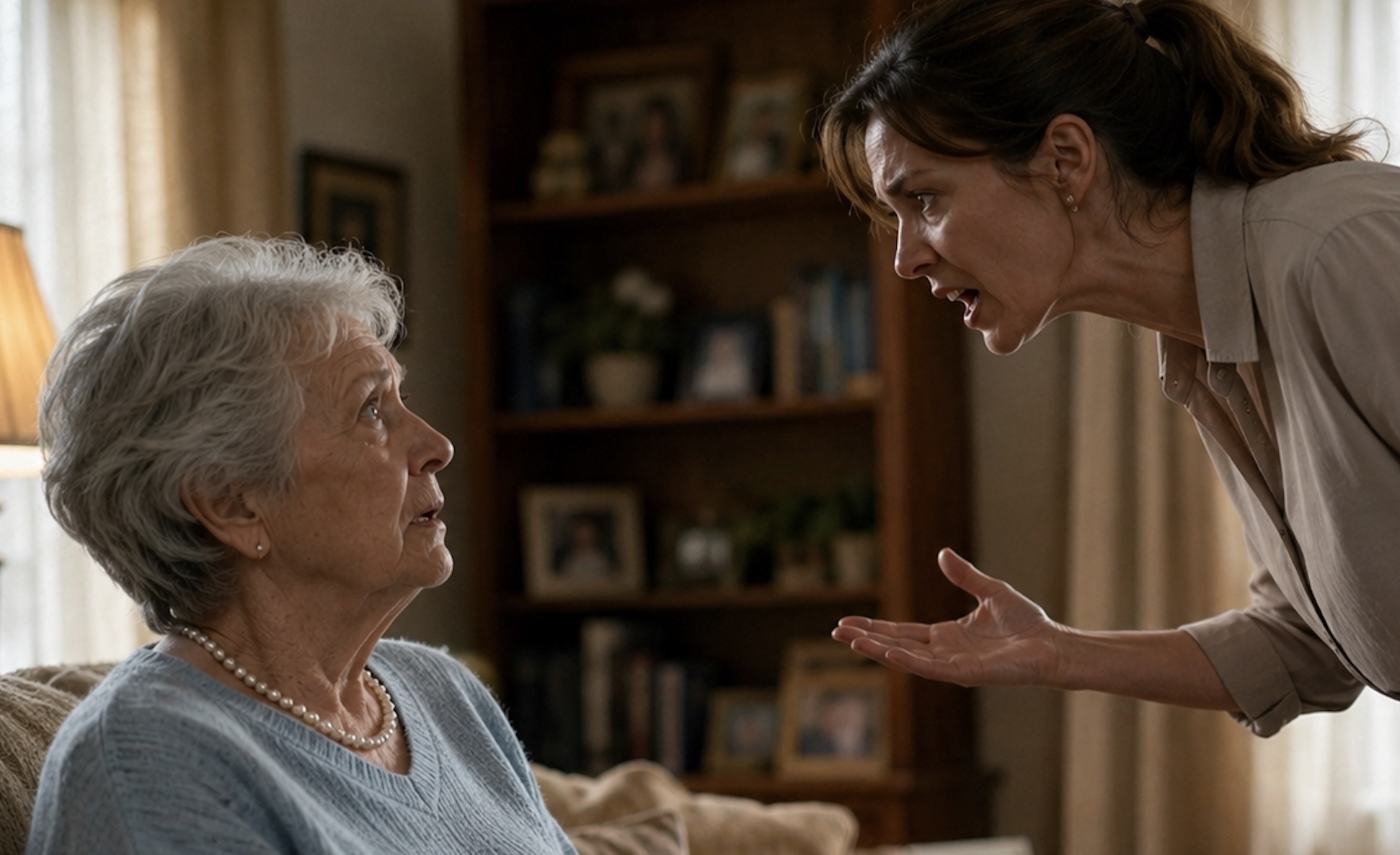
“Igoryok, you’ve lost weight. What, don’t they feed you here?” she laughed, but her eyes were on Alina. “In our day, a woman thought about her husband first. But now it’s all careers, phones, manicures. I opened your refrigerator, by the way. Completely empty. No proper cheese. No real meat.”
Igor focused on cutting his cutlet and said nothing.
Alina put down her fork.
Calmly, without her hands trembling, she picked up her phone and opened the banking messages. She had taken screenshots the day before on purpose.
“Tamara Pavlovna,” she said evenly, “our refrigerator is empty for one simple reason. Our family is feeding another family. Yours.”
She placed the phone on the tablecloth, screen facing up.
“Here are the transfers for the last three months. Here are the deliveries to your address. Marbled beef, trout, farm cheeses. Meanwhile, we sometimes use a credit card just to buy ordinary buckwheat. Yesterday my husband refused to let me buy winter boots for four thousand rubles. My sole is cracked, Tamara Pavlovna.”
The silence in the room thickened like water.
Tamara Pavlovna was the first to recover. She pressed a hand to her chest.
“But my son does it himself! I never asked for anything! He offers. What am I supposed to do — refuse?”
“What the hell do you think you’re doing?” Igor snapped, pushing his plate away. “Who gave you permission to go through my phone? It’s my money, my expenses. I decide where it goes!”
Alina looked at him.
And for the first time in six years, she did not look away.
“It is our money, Igor. And I am no longer afraid to say that out loud.”
Tamara Pavlovna left, slamming the door loudly behind her.
Igor locked himself in the room and turned on the television so loudly that it could be heard throughout the entire apartment.
Alina remained alone in the kitchen.
Automatically, she gathered the plates, rinsed them, and wiped the table. Then, without even knowing why, she walked over to the refrigerator and opened it.
The light inside came on evenly, almost mockingly.
On the top shelf was half a pack of butter in a crumpled wrapper.
Below it, four eggs in a cardboard tray.
An opened packet of cheap pasta that someone had, for some reason, put in the fridge.
A jar of discounted tomato sauce, opened the week before.
That was all.
“For this,” she said quietly.
For this empty, glowing box, she had been getting up at six in the morning. Crossing the city to get to the office. Taking overtime. Counting yogurts in her basket and shamefully putting one back on the shelf whenever the total at the register went over a thousand.
Meanwhile, on the other side of the city, another refrigerator was full of marbled beef and farm cottage cheese.
From the room came the laughter of a TV host.
Igor did not come out.
He did not knock.
He did not ask how she was.
Alina slowly closed the refrigerator door.
And she realized that something inside her had just closed as well.
Forever.
The next morning, she got up earlier than usual.
She made herself coffee, sat at the kitchen table with her laptop, and in forty minutes did what she had been putting off for years.
She opened a separate account at another bank.
She transferred her latest salary there — all of it, without sending part of it, as before, into the “shared pot.”
She changed the passwords to her email and personal accounts.
She turned off the automatic transfer to her husband.
By lunchtime, she had her own separate financial world on her phone.
Small, but hers.
That evening, Igor came home from work and immediately opened the refrigerator.
“Al, is there going to be dinner? And listen, I tried to pay for the insurance with the card, but for some reason it wouldn’t go through.”
“It didn’t go through because I cut off your access,” she answered calmly, not looking away from her cup. “Starting today, we have separate budgets. I’ll pay my half of the utilities and the mortgage. Everything else is yours.”
He laughed as if she had told a joke.
“Are you serious right now? Because of yesterday’s circus?”
“Because of six years, Igor.”
He looked at her and waited for her to change her mind.
For her to sigh, lower her eyes, and say, “Fine, let’s talk calmly.”
That was how it had always been.
But Alina did not look away.
“I am no longer going to live worse than your mother just so you can feel like a good son. If you want to feed her, feed her. With your own money.”
“You’re selfish,” he breathed.
“Maybe,” she agreed. “Finally.”
And for the first time in all the years of their marriage, she saw confusion on his face.
Real confusion.
Because the person he had silently leaned on all these years had stopped holding him up.
Several months passed.
Alina no longer flinched at the checkout.
She stopped taking pictures of price tags.
Simple but decent things appeared in her refrigerator: good cheese, fruit, a jar of her favorite coffee.
Not every day.
But without guilt.
At first, Igor was angry. Then he was offended. Then he tried to pressure her.
“You’re destroying the family because of money. Mom is hurt. I don’t even know how to talk to her now.”
“That is your relationship with your mother,” Alina replied. “I am no longer part of it.”
Gradually, he grew quieter.
The farm food deliveries to Chekhov Street became fewer, then almost disappeared.
One day, looking at the floor, he said quietly:
“I think I really did go too far. I just… got used to it.”
Alina nodded.
She did not forgive him right away.
But she heard him.
Whether they would stay together, she still did not know.
But for the first time in a long while, that uncertainty did not frighten her.
Because inside her was something she had never had before — peace.
Quiet and steady, like the light in her own kitchen late in the evening.
The light in her home, where her dignity was finally no longer last on the list.