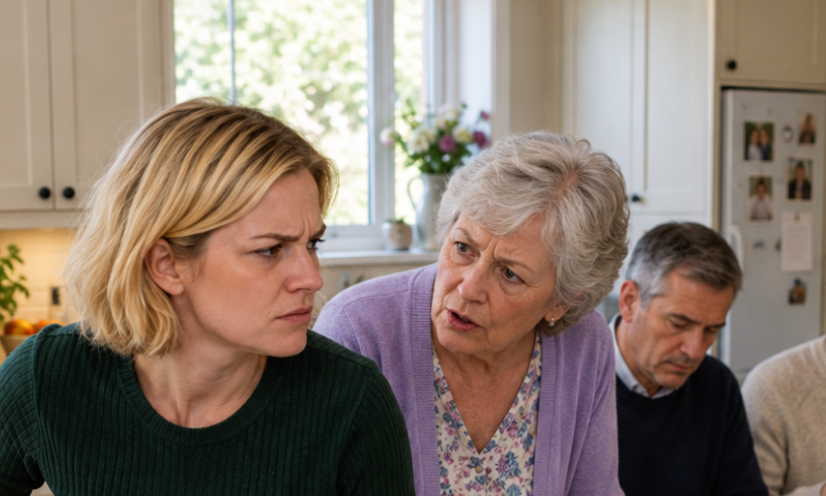
Last night, Sonyka messaged me. For the first time ever, she did it herself, not because her mom asked her to.
“Aunt Vera, is it true that Dad is living in the workshop because of you?”
I sat with that message on the balcony until three in the morning. I don’t smoke; I just sat there in my jacket over my nightgown, staring at the neighboring house, where someone’s string lights blinked all night—even though New Year’s was still a month and a half away.
I pulled the IOU out of the box with the warranty papers. A piece of grid-ruled notebook paper, folded in quarters. “I, Vadim Sergeyevich, borrowed three hundred and eighty thousand rubles from Vera Nikolaevna, promise to return it by November first.” Signature, complete with a flourish.
If I just tore it up, that would be the end. The oven could wait; I’d lived twenty years without it. Sonyka would start messaging me again: “Aunt Vera, how do you keep braces from rubbing?” Oleg would stop tiptoeing around the apartment like it’s a minefield. Maybe I really did start all this because of the money? Maybe my mother-in-law is right, and family is about staying silent, not keeping tabs?
I folded up the paper again. Didn’t tear it. But I didn’t make any decisions, either. I just went to bed.
In the morning, Lyuda called—Oleg’s cousin. They had kicked me out of the group chat, but not her. She sent me a screenshot.
My mother-in-law posted a long message there, paragraph after paragraph, like a school report. She wrote that Vera destroyed Inna’s family because of money. That Vera gave the money to Vadim in secret, and that she should explain to the relatives herself why she kept it secret. Twenty-seven people read it. An aunt from Saratov reacted with a crying emoji.
That same day, I sat in a lawyer’s office. The office was in a business center above a shoe store, and it smelled like tangerines, even though I didn’t see any. There was a stack of school textbooks on the windowsill, with ‘Algebra’ on top. The lawyer, young and very calm, read through the IOU twice.
“The document is fine,” she said. “The amount is written out, the deadline is there, and there’s a signature. First step is to send a written claim—we give them ten days. If he doesn’t return the money, we go to a magistrate for a court order. Debt, late fees, court costs. It’s quick if the debtor doesn’t object.”
“What if he does object?”
“Then it’s a regular lawsuit. It takes longer but the outcome is the same. An IOU is an IOU.”
I sent the claim that very evening, by registered mail with confirmation. At the post office, the woman ahead of me was mailing a package with jars of jam, and she was told three times to repackage it.
Four days later, the delivery confirmation came back, with his signature—the same flourish.
Then ten days passed. Vadim never called me, not even once.
On the eleventh day, I went to the magistrate.
An envelope with a blue stripe
The court order was issued eight days later. A copy was sent to Vadim, and he had ten days to contest it. The lawyer told me: if he contests, no problem, we’d just file a regular lawsuit.
He didn’t contest.
And on Saturday, around nine in the morning, the doorbell rang. Oleg was still sleeping. I answered in my bathrobe, my hair still wet from the shower.
Rimma Arkadyevna was standing on the landing. Wearing the same cocoa-colored coat, made up like she was headed to a parent-teacher meeting. In her hand was a bank envelope, white with a blue stripe.
“I’m not coming inside,” she said. “Here.”
I stepped out and closed the door quietly behind me. The hallway smelled of the neighbors’ fried cutlets and cold lime from the whitewashed walls. On the windowsill between the floors was an empty coffee jar, where our fifth-floor neighbor annoyingly drops his cigarette butts, even though he’s been asked not to so many times.
“It’s three hundred and eighty,” my mother-in-law said. “Plus interest and fees, I checked the paperwork. Count it over.”
I looked at the blue-striped envelope. Banks hand those out when you withdraw a large amount of cash. I knew exactly what this money was for. And she knew that I knew.
“I told you not to take that loan,” I said.
“You tried to talk me out of it so you could get it yourself.” She handed me the envelope. “Take it. I don’t need your debt collectors. And Sonya doesn’t either.”
I took it.
I counted the money right there on the windowsill, next to the makeshift ashtray jar. The bills were crisp and stuck together; I had to lick my finger to separate them. My mother-in-law stood there watching my every move, never looking away. One bill was torn at the edge, so I set it aside, but then changed my mind and put it back.
Exactly right. Down to the last ruble.
I wrote the receipt right there, balancing it on my knee and using her pen. Received from Rimma Arkadyevna against Vadim’s debt, full amount repaid, no claims, no further enforcement. Date, signature. Then I handed her Vadim’s ruled notebook sheet with the curly flourish, just as the lawyer had told me to do.
She folded both papers in half and put them away without even reading. Then she said:
“Don’t come to us anymore. Oleg can visit, he’s my son. But you—don’t come.”
“I won’t.”
She walked down the stairs instead of taking the elevator, even though it was working. On the third-floor landing, she stopped for a moment, and I thought she might turn around. She didn’t. She adjusted her hat and kept going.
***
Oleg found out that same evening. But not from me. His mother called, and they talked out on the balcony for about forty minutes. Then he came to the kitchen and sat across from me.
“You took mom’s credit money,” he said. It wasn’t a question. It was a statement.
“She brought it herself.”
“Ver, she’s sixty-eight. She’ll be paying for Vadik’s debt for five years.”
“She would’ve paid it anyway. She made up her mind long before I got involved.”
He nodded, that kind of nod when you don’t agree but are too tired to argue about it. He got up, walked to the hallway, and without looking back said:
“You could’ve at least not counted it in front of her.”
Three months have passed since then. No, Oleg and I didn’t have a fight, if you’re wondering. He just goes to visit his mother alone on Sundays now. He comes home in the evening, brings back jellied meat in a container, and puts it in the fridge. I don’t eat it. Maybe out of spite—the best jellied meat in the family has always been hers, I’ll admit that even now.
I bought a furnace in January. It sits in the small room that used to be Ilyushka’s. In the evenings, I use it to craft dental crowns on commission, and now I have my own clients, not just lab work.
Oleg walks past that room now without looking in.
Ilya called on New Year’s from Kazan. We talked about his exams, about how they shut off the hot water in the dorm again. Then he paused for a moment and asked:
“Mom, grandma was crying. Did you really take her money?”
“Yes, I did.”
“I see,” he said. And changed the subject to the weather.
I still keep replaying that “I see” in my head. What exactly does he understand? I never asked.
Inna never wrote to me again. I have no idea if she and Vadim got divorced or made up. His workshop is still open though—I saw the sign from the bus. Sonya never replied when I said, “Sonya, this isn’t your fault, it’s just grown-up stuff.” She read the message, but never answered.
And my scarf is still hanging on my mother-in-law’s coat rack. Blue, with a tiny checkered pattern. I don’t ask for it, and they don’t give it back.
Sometimes I wonder if I should have just torn up that receipt on the balcony. Or given the envelope back and waited for the bailiffs to get the money from Vadim himself, no matter how long it took. But instead, I borrowed the money on credit from a woman who is almost seventy, and even counted out each ruble right in front of her.